

Life Lessons with Noah Rasheta
Episode 99 of the Secular Buddhism Podcast
Welcome to another episode of the Secular Buddhism Podcast. This is episode number 99. I'm your host, Noah Rasheta. And today I'm doing something a little bit different. I was recently interviewed on another podcast called Presence Podcast that was recently started by my friend Ken Sullivan. In an effort to help promote Ken's new podcast, he's allowed me to share the audio of our recent interview here as an episode of the Secular Buddhism Podcast. So if you enjoy this episode, please check out Ken's new podcast and subscribe. It's called Presence Podcast, and you can find it on iTunes and all the other main podcasting platforms.
And now I give you the audio of episode number four—Life Lessons with Noah Rasheta—on Presence Podcast.
Presence Podcast, Episode 4
Ken Sullivan: You are listening to the Presence Podcast, episode number four, and I'm your host Ken Sullivan. And today I have a very special guest with me, Noah Rasheta. Noah hosts the amazing Secular Buddhism Podcast. I love and appreciate his perspective and his uncanny ability to teach with analogies and metaphors. I really thought it would be an awesome opportunity to have him here. I also appreciate very much, Noah, the positive impact that I can see you're having on the world. How is the podcast doing so far?
Noah Rasheta: It's doing really well. It continues to grow month over month and year over year, so I'm pretty excited about it.
Ken Sullivan: Awesome. So why don't you take a minute just to tell any of our listeners about the series of workshops or anything else that you've been working on recently?
Noah Rasheta: Yeah, so the thing I've been working on most recently is just the content for the podcast. I am trying to develop an online workshop series, mostly kind of explaining the fundamentals of what mindfulness is and kind of like a Buddhism 101 type course. That's still in the works, but for the most part, people can go to the podcast and listen to the beginning. The first five episodes are intended to be kind of a summary of basic Buddhist philosophy and concepts. But that's what I've been working on.
Ken Sullivan: Online workshop?
Noah Rasheta: No, my goal is to do an online workshop that people can subscribe to and just take it on their own time. I don't know if it'll be like a series of videos. I think it'll be a combination of videos and content to read through, but all web-based.
Ken Sullivan: Awesome. I know you were talking about your trip to Nepal. Do you want us to mention anything about that right now? Or because you already have such a big waiting list, should we not talk about that?
Noah Rasheta: We could mention it, mostly for next year because I will do it again. But yeah, this one is totally booked and has a long wait list.
Ken Sullivan: So is that the only thing that you're doing when it comes to having people do any mindfulness or meditation type sessions that you're doing in person?
Noah Rasheta: It is right now. I'm considering doing a retreat while I'm down in Mexico. But it's just an idea at this point. I do think it's very likely that while I'm down there, I'll host some kind of mindfulness retreat in person.
Ken Sullivan: Nice. You know, I hadn't even thought about this, but now that we're talking about it, I should invite you to come and help out with like one of our upcoming Surrender Lab sessions or retreats. We can talk more about that later.
But when we were having lunch down at the Vertical Diner in Salt Lake—about a month ago or whatever it was—I just thought it was really powerful when you were describing your experiences volunteering in Africa. And how you started seeing that you were having potentially more of a negative impact than a positive one while you were building schools and stuff. Do you want to briefly touch on that?
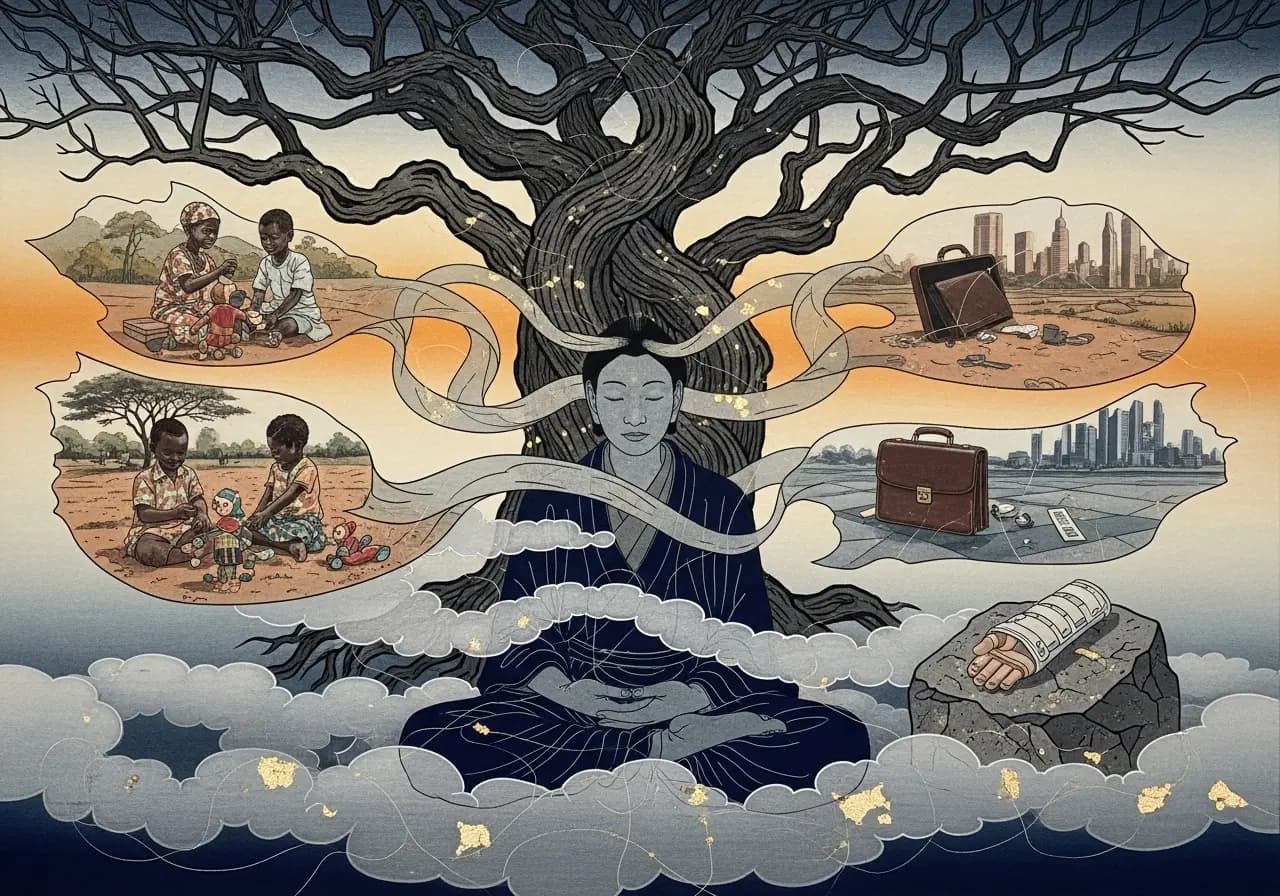
Noah Rasheta: Sure. Yeah, I think sometimes we get in our mind the idea that we have so much to offer to other cultures or to other countries. And Africa is one of those places where the general mindset is, "I'm gonna go to Africa because they need my help or they need our help." And you get there and it's a pleasant surprise to discover that, for the most part, it's like, "No, you get to go there and learn from their culture and spend time with them and see how happy most of them are living out in conditions that we would consider extreme poverty." We would think, "Oh wow, these poor people who live this way," and yet they're out there and it works and they're happy. And oftentimes when we come over there and we're trying to instill our way of thinking and our set of standards—well, this is a good way of living and you need this from us—it can actually be detrimental because it's like, "Well, who's to say that our way of living is the right way or any better than their way?" And that was a fun experience to go out there with a group of volunteers, kind of with the initial mindset of, "Well, what do we have to offer?" Only to have the roles reversed and realize how much African culture and Africa in general has to offer us Westerners in perspective on ways of living and what truly matters in life.
Ken Sullivan: Yeah, I remember you talking about how they would make like a little soccer ball out of wrapped up plastic bags or something?
Noah Rasheta: Yeah, like plastic bags like you'd get at the store. Just wad it up and then wrap one over another over another until it's big enough to be a soccer ball.
Ken Sullivan: That's so awesome. But like, over and over you just saw they were just so happy. And then talk about how you started to perceive that you started to have this potentially actual negative impact. Wasn't there an experience with one of the kids that started like, what was your first aha on that?
Noah Rasheta: We were briefed that we should be careful to bring toys. For example, you have all these kids who are playing with sticks and bottles or whatever they have available there, and they're using their imagination. And then you bring a toy or something out of your backpack and hand it to one kid, and it kind of creates this moment of instability because it's like, "Well wait a second, why does one kid get a toy? Now what do you have for all the other kids?" You know, it's like by trying to introduce something that wasn't there before, you're actually creating more problems. Now the kids might be fighting over the one toy that they didn't have before or things like that. I don't recall seeing that scenario exactly, but they had briefed us when we got there to be cautious of that. Don't just give people stuff. Those are the kind of situations that can present problems that we wouldn't have thought of because we're just thinking everybody would want what I have, and that's not necessarily true, you know?
Ken Sullivan: We like to project ourselves onto the world, don't we?
Noah Rasheta: Yeah, we do.
Ken Sullivan: Okay, so if I was to ask you then—we've lived, you and I have some pretty similar backgrounds—if I was to ask you what you would say as of this point in time, what your very biggest life lesson has been so far. What would you say is the top of the list?
Noah Rasheta: That's a really good question. I would have to say my biggest life lesson so far is the realization that the stories that I have about life, about myself, about others are just that. They're stories. And they seem so real, and they may not be. I think the biggest aha moment I've had in my life so far was the realization that the story I have about myself—specifically myself—is also just a story. And not realizing how bound I was by that story. In this case for me specifically, it was around losing my company. I've always been an entrepreneur, and it was instilled in me this idea of being an entrepreneur. I didn't realize how I had fused my sense of identity with this label, this way of living, right? Being an entrepreneur is something that you do, it's not who you are. And yet here I was thinking, "This is who I am."
Years after having built up a big, successful company, when the company started having problems and was failing, it was a really painful experience. I was able to sit with the experience as it was unfolding to really explore why it hurt so much. I wasn't losing my life over this, but why does it hurt so much? And I realized how my sense of identity was totally wrapped up in that label, and the label was getting ready to go away. That was a big aha moment for me. It kind of dominoed into other aspects of my life where I realized I've been so attached to these stories—"This is who I am" or "This is who you are" or "This is how life is." And every now and then something comes along and it crushes that story. It makes you realize it was just a story all along. That was a big aha moment for me.
Ken Sullivan: Oh yeah, I mean I have story after story after story that I could tell about how those are the same kind of aha that I'm constantly having.
[...]
Ken Sullivan: I think that's just a really useful story for us to hear, especially here in the West.
Noah Rasheta: As we go through life playing this game of assigning meaning to everything—some things are good and some things are bad—sometimes just taking a break and like, like you always talk about, just be in the moment. Just be with what's happening and stop thinking of this as "This is a good or bad thing that's happening to me" and just say, "This is what's happening. What does it feel like to be going through this? Where do these emotions come from? Why does it feel this way?" And just becoming more aware of the relationship that we have with our experiences as they're unfolding.
Ken Sullivan: I think that's, you know, that's what I would end this on as an invitation.
Noah Rasheta: The whole premise of your podcast—with presence—is that you are that story. You're listening to this, and you're going through something in your life. This just happened or this other thing's about to happen. Like, we're all playing that game. We're all waiting to see, "Well, is this thing a good thing or a bad thing?" And what if we could just pause for a moment and think, "I'm not gonna assign meaning. I'm just gonna really experience this as it unfolds and see what happens."
Ken Sullivan: So hard. It's so, so hard.
Noah Rasheta: Yeah.
Ken Sullivan: To not assign meaning, because we have all this experience that we immediately start pulling from. It's like this pressure—like, I have to. I have to call it something. I have to call it something.
Noah Rasheta: Yeah.
Ken Sullivan: And when you let go of that need to feel like you have to be right about it and just say, "Hey, what does this feel like? What did it take for this moment to arise? What can I gain from this?" You know, you talked about when we first started talking about how you're in a back brace because you just sprained your back.
Noah Rasheta: I'm in a wrist brace.
Ken Sullivan: I just wiped out on my mountain bike. I got a concussion. I hurt both of my hands. I just recently went through shoulder surgery. I mean, just all these things. You know, how are they actually playing parts? And if I didn't have those, who would I have not connected with? Who would I have not, you know, what experiences wouldn't I have had? I think it's a beautiful way to wrap it up.
You're awesome, Noah. You're beautiful. I love you, brother. Love you so much.
Noah Rasheta: Thank you very much. I appreciate that. Love you too.
Ken Sullivan: This has been my absolute pleasure.
Noah Rasheta: Cool. Well, I'm excited for your podcast, and I'm excited just for everything that you're doing. Fun stuff.
Ken Sullivan: Thank you. Thank you. We're just a couple of hermanos trying to do our part, huh?
Noah Rasheta: Yeah.
Ken Sullivan: When somebody asks you to define love, or if anybody ever does ask you to define love, how, what do you say? Because words are so limiting.
Noah Rasheta: Yeah, it really is. I don't know that I've been asked that before, but I think if I were, it would be something like, "I know what it is, but I can't explain it. But I can feel it." And I think of it in the context of my family, right? Like, how would I explain that to my kids, what it is to love them? To me, that's the perfect example of, "Well, I can't, but one day you might get to know what that feels like, and then you'll know how I felt, you know, being your dad."
It's kind of like with time. We all kind of know what it is. We've invented ways to measure it. But at the same time, I'd love to hear someone really explain what it is because I think if we try, most of us realize, actually I don't know what it is. All we know how to do is measure it in the context of the sun comes up or the sun goes down. We divide that form of measurement into hours or minutes. And I think with love, sometimes it's similar. Like, we try to define it, but by defining it, we limit it. And it's so much more than just doing something for someone or saying something nice. It's so much more than that. It can't be defined. It's just an experience.
Ken Sullivan: Yep. Experience. You're awesome, Noah. Thank you so much. This has been just beautiful. I love it.
Noah Rasheta: Thank you so much. I'm very grateful that you were willing to sit down and have a conversation with me.
Ken Sullivan: Awesome. Well, thank you. I really appreciate it.
For more about the Secular Buddhism Podcast and Noah Rasheta's work, visit SecularBuddhism.com
For more about the Presence Podcast and Ken Sullivan's work, find Presence Podcast on iTunes and other major podcasting platforms.