

The War Within: Finding Peace in a World of Violence
Episode 212 of the Secular Buddhism Podcast
Hello. You are listening to the Secular Buddhism Podcast, and this is episode number 212. I'm your host, Noah Rasheta, and today I'm talking about finding peace in a world of violence. So let's get started.
Welcome to the Secular Buddhism Podcast, where we explore Buddhist teachings and ideas in a way that's practical, down-to-earth, and relevant for everyday life.
As always, I'd like to start with a piece of advice from Tenzin Gyatso, the 14th Dalai Lama. He says: "Do not try to use what you learn from Buddhism to be a Buddhist. Use it to be a better whatever you already are." Please keep this in mind as you listen and learn about the topics and concepts discussed in this episode.
The Weight of the World
This week, I found myself sitting with the news, feeling this familiar heaviness in my chest. Again. Another school shooting. Ongoing war. More hatred manifesting as violence in our world. This morning, I came across a news article about a recent arrest of an adult attempting to sexually assault a thirteen-year-old child. And I realized the perpetrator is the sibling of one of my closest friends. My heart just sank.
I sat there reading the news, thinking of my own kids—the same ages as the kids killed in the school shooting. My daughter the same age as the girl in the sexual assault case. I thought about the pain of the parents who lost their children this week. Then, thinking of all the heartache and suffering we see in the world, I was feeling something between anger and despair. I found myself asking the same question I've asked so many times before: "What will it ever take for the world to know peace?"
Maybe you've felt this too—this sense of helplessness when you see the violence, the hatred, the seemingly endless cycle of harm we inflict on each other. You ask yourself, "What can we do? What can possibly be done when it feels like the world is drowning in its own poisons?"
I saw this same question unfolding in the comments on social media. And I noticed the complete inability to agree on what can be done, and the additional anger and frustration that arises when it seems no one can answer the question. This made me think: maybe we're asking the wrong question.
Instead of asking "What can we do?"—this abstract, overwhelming question that no one is ever going to agree on—it might be wiser to ask something more specific, more personal. Something like, "What can I do?"
And even more importantly: "What's happening inside me that contributes to the lack of peace in the world?"
Because here's what I've come to understand: that hatred we see manifested in acts of violence and war, that greed that drives people to take what isn't theirs, that ignorance that allows someone to believe that destroying life will somehow solve their problems—these don't come from somewhere "out there." They come from the same roots that exist within each of us.
The Ripple Reality
We all want world peace. We want to wake up to news of cooperation instead of conflict, healing instead of harm. But peace is generally not a top-down phenomenon that can be legislated or decreed into existence.
Peace is a grassroots movement that starts in individual hearts. It moves outward in ripples: a peaceful heart creates a peaceful home. A peaceful home influences a peaceful family. Peaceful families build peaceful neighborhoods. Peaceful neighborhoods form peaceful communities. And peaceful communities, eventually, create a peaceful world.
But we keep trying to work backwards. We demand world peace while waging war in our own hearts. We call for others to lay down their weapons while we stay armed with our own resentments, our own hatred, our own violence—even if it only manifests in our thoughts and words, or social media comments, rather than in our actions.
The person who walked into that school with a gun was someone's neighbor. Someone's child. Someone who sat in classrooms and ate lunch in cafeterias just like we all have. They weren't born violent. They weren't inherently evil. Somewhere along the way, the poisons that exist in all of us—the seeds of ignorance, greed, and hatred—were watered and nurtured until they grew into something monstrous.
And here's the uncomfortable truth we need to face: the same seeds exist within each of us. The difference is not in the presence or absence of these seeds, but in how we tend to them. The hatred that pulls a trigger comes from the same root as the hatred I feel in traffic when someone cuts me off. The scale is different—drastically different—but the poison is the same.
When I feel that flash of rage at the driver who cut me off, when I fantasize for even a moment about them getting what they deserve, I'm watering the same seed that, under different conditions, with different nurturing, could grow into something terrifying.
The Three Poisons: Our Inner War
In Buddhism, we talk about the three poisons that contaminate our minds and hearts: ignorance, greed, and hatred. They're real forces that shape our thoughts, emotions, and actions every single day.
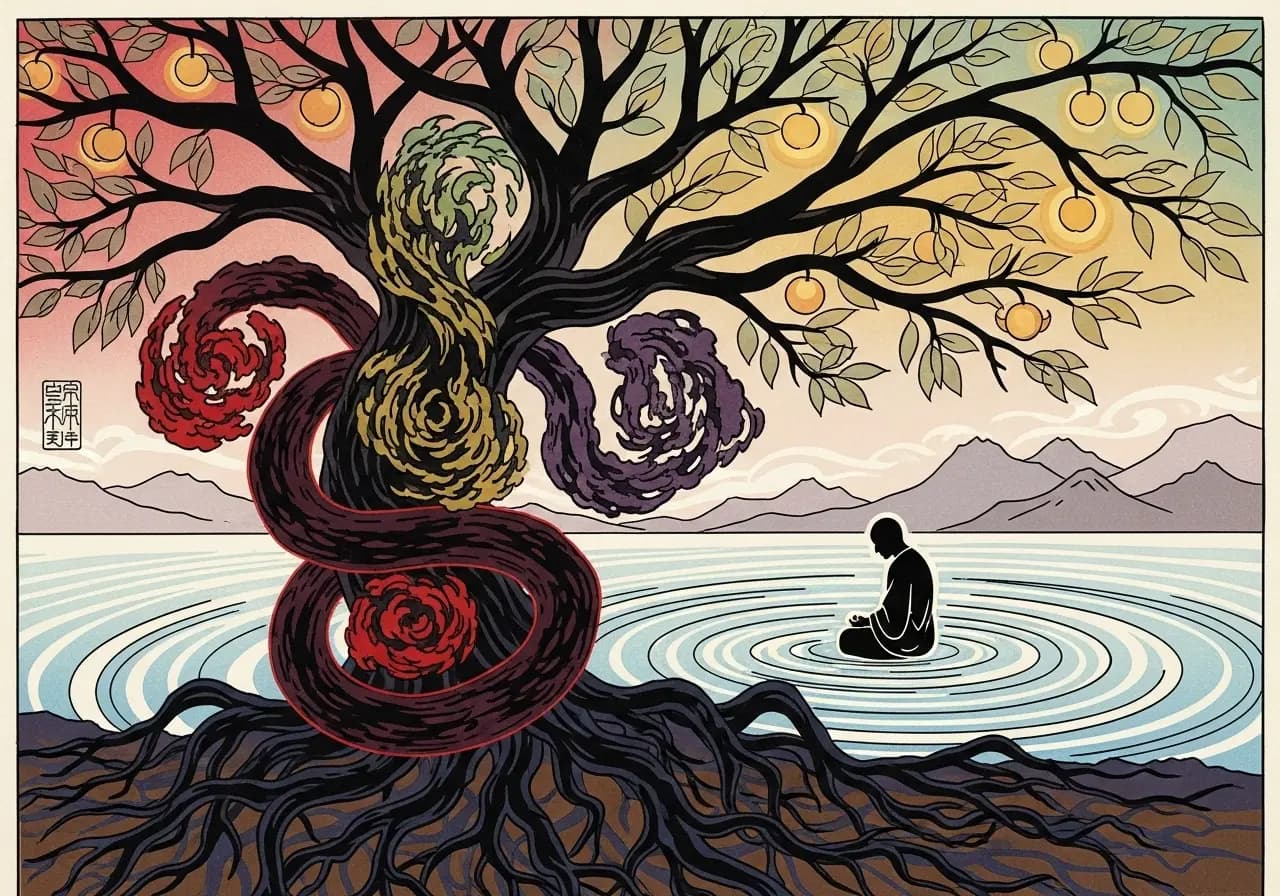
I want you to imagine yourself as a tree. Your roots, deep in the ground, represent your core beliefs about yourself and the world. The trunk represents your thoughts—growing up from those beliefs, shaped by them. The branches and leaves that reach out from the trunk are your emotions and feelings. They are your response to the winds and the weather of daily life, shaped by your thoughts and beliefs. And finally, the fruit that the tree bears represents your actions—what you actually say and do in the world. That fruit is the tangible outcome of the entire system. The visible results of everything happening inside you.
When poison enters the roots of a tree, it affects everything that grows from them. The trunk becomes weak or twisted. The branches wither or grow wild. And the fruit? The fruit becomes poisonous, too, capable of poisoning others who consume it.
This is what happens when the three poisons infiltrate our being. They contaminate our beliefs, distort our thoughts, inflame our emotions, and ultimately, poison our actions. And our poisoned actions can poison others, creating a cycle of toxicity that spreads through families, communities, and yes, even the entire world.
Ignorance: The First Poison
Let's start with ignorance. This isn't just "not knowing" something. It's actively misunderstanding the nature of reality. It's seeing the world through a distorted lens and believing that distortion is truth.
The person who commits an act of violence operates from profound ignorance. They believe, somehow, that violence will solve their pain. That destroying others will build them up. That causing suffering will ease their own suffering. This is what we mean by "hurt people, hurt people." This is ignorance at its most tragic—the complete misunderstanding of how cause and effect actually work.
But we all operate from ignorance in smaller ways every day. We say things like "You made me angry" instead of "I experienced anger when you did that." See the difference? The first assumes that others have control over our internal states. The second recognizes that our emotions arise from within us, based on our interpretation of events.
We believe our happiness depends entirely on external circumstances. If I just had more money, if my partner would just change, if my boss would just appreciate me, then I'd be happy. This is ignorance. We're misunderstanding where happiness actually comes from.
Perhaps the deepest ignorance is the illusion of separateness. We see ourselves as isolated individuals, separate from others, separate from nature, separate from the world. The shooter sees their victims not as fellow human beings with families, dreams, and fears just like their own, but as "others," as "enemies," as "problems to be eliminated."
But even in our daily lives, we operate from this ignorance of separation. We think we can hate someone without that hatred affecting us. We think we can wish ill on others without poisoning our own hearts. We think we can damage the world around us without damaging ourselves. This is the fundamental ignorance that underlies all violence, whether it's a harsh word or a horrible act.
Greed: The Second Poison
The second poison is greed, or attachment—but not just in the sense of wanting money or possessions. It's the desperate grasping energy that says, "I MUST have this. I NEED this. I'll do anything to get this."
For someone who commits violence, this greed might manifest as a desperate need for control in a life that feels out of control. A desperate need for significance in a world where they feel invisible. A desperate need for revenge against perceived wrongs. It's the grasping that becomes so tight, so desperate, that they're willing to destroy everything to get what they think they need.
But we all experience this poison. It shows up as our need to be right in arguments—that desperate grasping for validation. Our need for approval—that constant checking of social media for likes and comments. Our need for things to go according to our plans—that tight grip on how we think life should unfold.
Notice how the tighter we grasp, the more violent we become when things slip through our fingers. When someone challenges our need to be right, we might lash out with cruel words. When we don't get the approval we're seeking, we might become bitter and resentful. When life doesn't go according to our plans, we might rage against reality itself.
This is the poison of greed—this desperate, violent grasping for things we think we need to be happy.
Hatred: The Third Poison
And the third poison is hatred—the pushing away, the resisting, the fundamental rejection of what is. For someone who commits an act of violence, this shows up as the inability to tolerate anything that feels like a slight, a rejection, a hurt. The tiniest wound becomes an unbearable offense that demands violent retaliation.
But hatred shows up in all of us. It's in our dismissal of people we disagree with politically. It's in our judgment of people who think differently, who look differently, who live differently. It's in our resistance to our own uncomfortable feelings and experiences. It's in the way we can't sit with sadness without trying to distract from it, can't feel loneliness without numbing it, can't acknowledge fear without pushing it away violently.
Hatred is this fundamental movement of pushing away, rejecting, resisting. It creates internal warfare—this constant battle between what we want the world to be and what it actually is. And that internal warfare eventually manifests outward.
The Antidotes: From Poison to Medicine
So what do we do? Are we stuck with these poisons? Is there a way to transform them?
In Buddhist teachings, for every poison, there's an antidote. And here's what's important: these antidotes aren't some external force we have to find. They're capacities that exist within us, waiting to be cultivated.
For ignorance, the antidote is wisdom. For greed, the antidote is gratitude. For hatred, the antidote is loving-kindness.
When ignorance arises—when we catch ourselves operating from a distorted understanding of reality—we can pause and ask for wisdom. We can ask ourselves, "What am I missing? What perspective am I not seeing? How could I understand this more clearly?"
This shift from ignorance to wisdom doesn't require us to know everything. It just requires us to be open to the possibility that what we think we know might not be the whole truth.
When greed arises—that desperate grasping—we can shift into gratitude. Instead of focusing on what we don't have, we can notice what we do have. Instead of the question "What else can I get?" we can ask "What am I already blessed with?" Gratitude has this remarkable power to loosen our grip. It softens the desperate energy of grasping into the peaceful energy of appreciation.
And when hatred arises—that push to reject and resist—we can cultivate loving-kindness. Now, this doesn't mean we become doormats or accept harmful behavior. It means we begin to recognize that behind every action—even the most harmful actions—there's a person who's suffering. There's pain driving the behavior, even though that doesn't excuse the behavior.
We can't love our way out of injustice. We still need justice systems, consequences, protection. But we can approach even those with a fundamental stance of loving-kindness rather than hatred. We can wish for the harm to stop without wishing for the person to suffer—at least not forever.
Actually, there's something crucial here that I want to say about loving-kindness. It's not passive. It's not about accepting violence or harm. Loving-kindness often manifests as the firm boundary that says, "I care about you, but I won't let you harm me or others." A parent setting a loving boundary with an addicted child—that's loving-kindness. A person leaving an abusive relationship—that's loving-kindness. Protecting yourself and others from harm—that's loving-kindness.
And this inner work—this cultivation of wisdom, gratitude, and loving-kindness—it starts with ourselves. We can't give what we don't have. If we're at war with ourselves, we'll be at war with the world. If we can't offer kindness to our own hearts, our kindness to others will be hollow and unsustainable.
Loving-kindness doesn't mean liking everyone or approving of all actions. It means recognizing the basic humanity in everyone, including those who have caused harm. It means wishing for the end of the suffering that drives people to cause suffering.
When someone commits an act of violence, loving-kindness doesn't excuse their action. But it recognizes that this person was once a baby, innocent and full of potential. Something went wrong. Many things went wrong. And while we must protect society from harmful actions, we can still wish for the healing of the pain that created the perpetrator.
Call to Action: Two Practices
So what do we do with all of this? How do we begin to transform these poisons within ourselves and contribute to peace in the world? I want to offer you two practical practices that you can begin today.
Practice 1: The Daily Poison Check-In
Each evening, take a few minutes to review your day. Sit quietly and ask yourself three questions.
First: "Where did ignorance show up today?" Maybe you assumed you knew someone's intentions without asking. Maybe you believed your happiness depended on something external. Maybe you forgot your interdependence with others.
Second: "Where did greed arise?" Perhaps you grasped too tightly to being right in a conversation. Maybe you desperately needed approval or recognition. Maybe you tried to control something that wasn't yours to control.
Third: "Where did hatred manifest?" Did you push away an uncomfortable feeling? Did you wish harm on someone, even briefly? Did you reject some part of yourself or your experience?
Don't judge yourself when you notice these poisons. We're not trying to shame ourselves into change. We're building awareness. We're becoming gardeners who can recognize weeds in our mental garden.
Then ask yourself: "What antidote could I have applied?" How could wisdom have helped you see more clearly? How could gratitude have relaxed your grasping? How could loving-kindness have softened your resistance?
This simple practice builds the awareness that is the first step to transformation.
Practice 2: The Ripple Practice
When you feel overwhelmed by world events, when the violence and hatred seem too much to bear, try this practice.
Place your hand on your heart and say: "May I be free from ignorance, greed, and hatred. May I be at peace."
Then expand outward: "May my family be free from ignorance, greed, and hatred. May they be at peace."
Continue expanding: "May my neighborhood be free from these poisons. May my community be at peace. May my country be at peace. May all beings everywhere be free from ignorance, greed, and hatred."
Start where you are, with what you can actually influence—your own heart, your own mind. You can't end all war, but you can end the war within yourself. You can't eliminate all hatred, but you can transform the hatred in your own heart. You can't cure the world's ignorance, but you can seek wisdom in your own understanding.
This isn't a passive practice. When you genuinely cultivate peace within yourself, it changes how you interact with everyone around you. It changes the energy you bring to every situation. It changes the seeds you water in others.
The Choice Point
We continually have a choice. Not just once, but every day, multiple times a day. When ignorance arises, we can choose wisdom. When greed arises, we can choose gratitude. When hatred arises, we can choose loving-kindness.
The person who committed this recent act of violence made their choice. We can't undo that. The damage is done, the lives are lost, the trauma ripples outward. But we can make different choices. And every time we choose the antidote over the poison, we add a drop of peace to the world.
It might seem insignificant—choosing patience over anger in traffic, choosing gratitude over complaint at dinner, choosing understanding over judgment with our families. But remember the ripple effect. Remember that every act of violence started as a seed, watered over time. And every act of peace also starts as a seed.
The question isn't "What will it take for the world to know peace?" That's too big, too abstract, too far from our direct influence. The question is "Will I choose peace in this moment?" Because world peace isn't some far-off goal that will be achieved through treaties and agreements. World peace is the accumulation of billions of individual moments of choosing peace over violence, wisdom over ignorance, gratitude over greed, love over hatred.
Your peace matters. Your choice matters. The poisons you transform in your own heart create ripples that extend far beyond what you can see.
The tree that you are—with your roots of belief, your trunk of thought, your branches of emotion, and your fruit of action—that tree is in your care. You are the gardener. You choose which seeds to water. You choose whether to nurture poison or medicine.
And in a world that sometimes feels overwhelmingly poisoned, your choice to cultivate healing, to grow different fruit, to offer shade and sustenance rather than toxicity—that choice is an act of revolution. It's an act of hope. It's an act of peace.
The war within you is the only war you can truly end. But when you end that war, when you make peace with yourself, when you transform your poisons, you become a force for peace in the world. Not through grand gestures or dramatic actions, but through the quiet, consistent choice to meet each moment with as much wisdom, gratitude, and loving-kindness as you can muster.
That's what you can do. That's what I can do. That's what we all can do.
One moment at a time. One choice at a time. One heart at a time.
Until the ripples meet and merge, and the world we long for—the world of peace—emerges not from above, and not from outside, but from within.
Thank you for sharing this moment with me, and for your own commitment to this path of greater inner peace. May we all be free from ignorance, greed, and hatred.
Thank you for listening, and I look forward to talking with you again next time.
For more about the Secular Buddhism Podcast and Noah Rasheta's work, visit SecularBuddhism.com