

Zen Koans
Episode 213 of the Secular Buddhism Podcast
Hello, and welcome to another episode of the Secular Buddhism Podcast. I am your host, Noah Rasheta. And as I always say, you don't need to use what you learn from Buddhism to become a Buddhist. You can use what you learn to simply be a better whatever you already are.
Today, I want to talk about something that at times feels strange, could feel frustrating, and even a little absurd. And that is the topic of Zen koans.
I'm thinking about this topic because recently I added a new channel or space in our online community where members can discuss Zen koans together. As I was preparing for that, I realized this would probably make a good podcast episode because koans are something I haven't talked about in a long time, or at least not in depth. Some of you longtime listeners will probably recall that you have encountered koans through the podcast over the years. At one point, I used to share a koan in each episode and allow you to sit with it and then share my thoughts on it in the next episode.
But for others, this might be a completely new topic. Either way, I want to approach this topic as if we were all beginners, because honestly, that's the only way to approach Zen koans anyway. Here's what's important to understand from the start: Koans aren't riddles to solve. They're not puzzles where someone has the right answer and someone else has the wrong answer. They're something else entirely. And understanding what they actually are and what they're for changes everything about how we work with them.
Our Addiction to Certainty
Let's dive in. One thing I've noticed about being human is that we seem to be absolutely addicted to certainty. We want answers. We want resolution. We want things to be solved. We want things to make sense. We want to know that we got it right.
Think about how uncomfortable it feels when you don't know something. When someone asks you a question and you don't have an answer, or when life throws you a curveball and you can't figure out what to do, that feeling of not knowing—that feeling in your chest, perhaps a slight panic, that reaching for something solid to hold on to—we all feel that. It's part of the human experience, and I think that's what fuels this addiction to having certainty.
So what do we do when we feel this? We race toward answers. Any answer. Even a bad answer feels better than no answer. We'd rather be wrong with a sense of certainty than be right with a sense of doubt.
Think about it. You're driving down the highway and someone cuts you off. I use this analogy a lot because I think it's really relevant. But that uncertainty of "Did they see me? Are they going to hit me? Why are they doing this?"—the truth is we don't know. But it's so uncomfortable to not know that our brain will just immediately create a story. It'll say, "What a jerk. They did that on purpose. They did that because they aren't paying attention."
We'd rather be angry with a false sense of certainty about their intentions than to sit with the uncertainty of not knowing why they did what they did. But life doesn't work that way. Life is full of ambiguity, full of moments of uncertainty, full of situations where there isn't a clear answer, there isn't a clear right or wrong. It's full of moments where we simply don't know.
And yet we've never actually been trained for that. We've never been trained to sit with the discomfort of not knowing. In fact, I would argue that we've been trained since childhood to seek the correct answer, to solve the problem, to figure it out. That's what we do in our education. That's what school is all about—how do we learn about the things that we don't know? The whole mindset is always around answers.
Well, what if I told you there's an entire practice designed specifically to train you to be comfortable with not knowing, to actually embrace confusion, to sit in the middle of uncertainty and discover that you don't need to escape it? That is what Zen koans are for.
The Stakes of Not Knowing
And here's what's at stake. When we can't tolerate not knowing, we end up making premature decisions. We grasp at incomplete understanding and mistake that for wisdom. We reduce the rich mystery of life into tidy little boxes that make us feel safe, but it also keeps us small.
But when we learn to sit with confusion, when we develop what Zen calls "don't-know mind" or the beginner's mind, something incredible happens. We become available to insights that don't come through logical thinking. We open ourselves to understanding that emerges not from solving, but from surrendering.
In Zen, there's a well-known saying: "Great doubt, great awakening. Little doubt, little awakening. No doubt, no awakening."
This phrase emphasizes the importance of bringing a deep questioning spirit—sometimes described as an existential or great doubt—to our practice, to Zen practice, in order to open the way to true insight or awakening. The greater the intensity of one's inquiry and doubt, the deeper the potential for transformation and realization. And the flip side is true: without such profound questioning, awakening just isn't possible.
What Is a Koan?
So what exactly is a koan and how does it play into all of this?
The word "koan" literally means "public case" in Chinese, like a legal precedent. Koans emerged in the Tang Dynasty in China and were further developed in Japanese Zen traditions. They're stories, questions, or statements from interactions between Zen masters and students that have been compiled over centuries.
But here's what they are not: They're not riddles with clever answers. They're not intellectual puzzles. They're not meant to be figured out with your intellectual or thinking mind.
Koans are designed to break your thinking mind, to jam up the gears of your usual way of processing information. Think of them like a computer program that is designed to crash the operating system so that you can see the code that's running underneath.
Think of it this way. Your rational mind is an incredible tool. It does so much for us. It's great for planning, for analyzing, for solving problems. But it's actually terrible at accessing certain kinds of wisdom. It's like trying to use a hammer to paint a picture. The tool isn't broken. It's just the wrong tool for the job.
Koans create what we might call cognitive dissonance. They present something that just doesn't compute. And they're designed to confuse you. And in that moment of not computing, something else becomes possible—a different way of seeing, a shift in perspective that can't be thought. It can only be experienced.
So the purpose isn't to find the answer. The purpose is to let the question work on you, to carry it with you, to wrestle with it, to let it confuse you so thoroughly that eventually something in you lets go of needing to understand. And here's the beautiful paradox: It's often when you stop trying to solve the koan that something shifts—not because you gave up, but because you finally stopped getting in your own way.
From Answers to Questions
This reminds me of my own introduction to Buddhism. And I've shared this story before, but when I first encountered Buddhism, what drew me in wasn't the answers it provided. It was the questions that it asked.
I had grown up in a religious tradition that gave me answers, and for a long time, that felt comforting. But eventually, I started having my own questions, and when the questions didn't match the provided answers, I felt that deep sense of uncertainty and confusion. I felt lost.
Buddhism was the first spiritual tradition I encountered that seemed much more interested in helping me to ask better questions instead of giving me definitive answers. And that shift from seeking answers to sitting with questions—that changed everything for me. That was an entirely new approach.
So the practice of Buddhism in general and Zen koans specifically is to make that transition from thinking it's all about the answers to maybe it's all about the questions.
The Koan of Chiyono
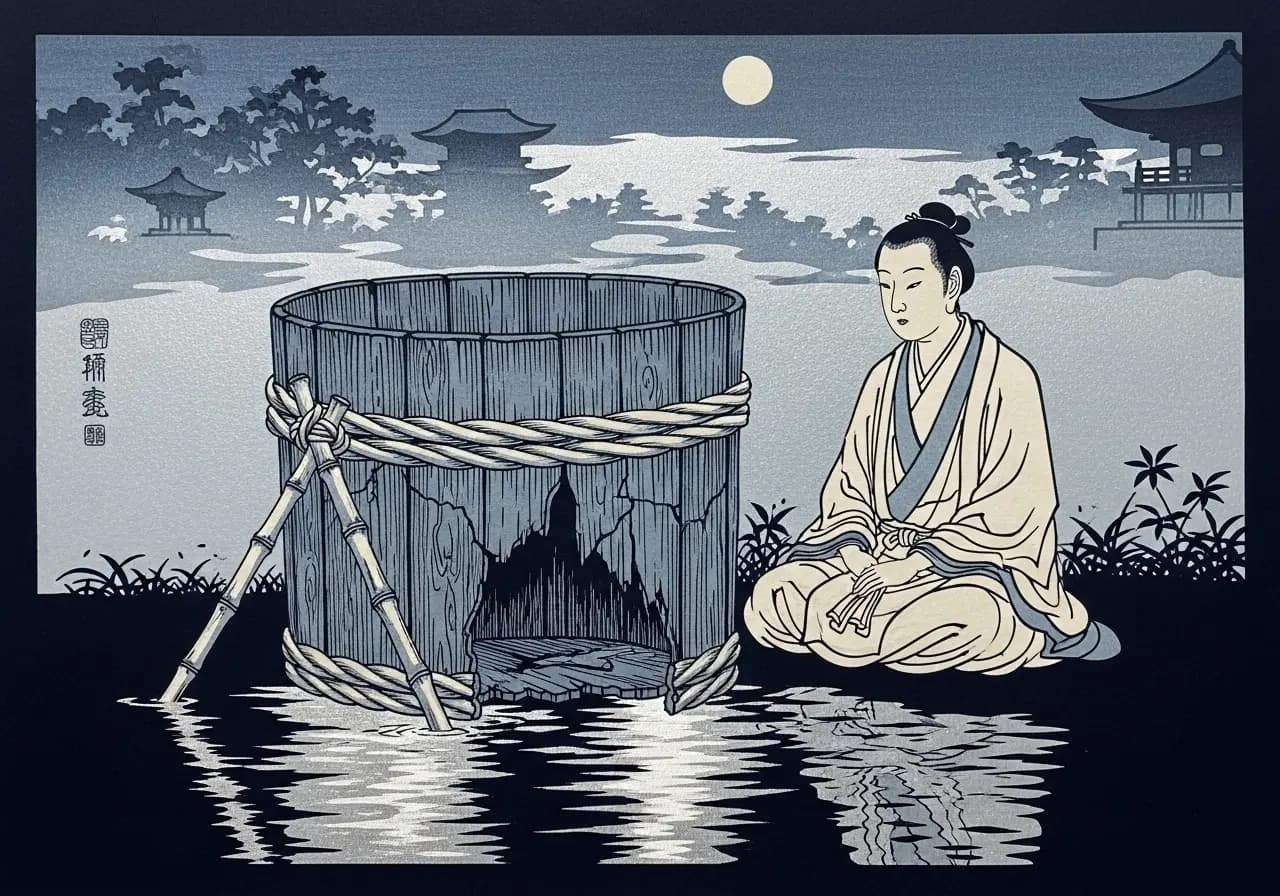
Let me share one of my favorite koans with you. It's about a nun named Chiyono who studied for many years under Zen master Bukō at a temple in Japan. She practiced diligently. She meditated faithfully. She studied earnestly. But still, she could not attain what's called the fruits of meditation—that breakthrough, that awakening, that enlightenment that people refer to that she was seeking.
So one moonlit night, she was carrying water in an old wooden pail that was bound together with bamboo strips, and she was being so careful, walking so mindfully, trying not to spill a drop of water. And as she was walking, the bamboo broke. The bottom fell out of the pail, the water rushed out, and with it, the reflection of the moon disappeared.
At that moment, she was set free, and she said, "No more water in the pail, no more moon in the water."
And that's the Zen koan—that expression: "No more water in the pail, no more moon in the water."
Understanding Chiyono's Breakthrough
Now, this is the moment where we might be tempted to analyze and say, "Okay, let me figure out what this means. What does the water represent? What is it about the moon? What's the symbolism of the breaking pail?" But watch what happens when you try to solve it. You're doing exactly what Chiyono was doing before the pail broke. You're carefully trying to hold it all together, trying not to spill, trying to get it right.
The old pail is Chiyono. It's also you, and it's also me. The greatest attachment we have is attachment to our idea of ourselves—this carefully constructed identity that we're trying to preserve, trying to protect, and trying to perfect.
The harder Chiyono tried to attain enlightenment, the more self-conscious she became, the more careful she was to not break the pail. Does that sound familiar? How much energy do we spend trying to keep our sense of self intact, trying to make sure we do not fail, trying to not look foolish, trying to maintain control?
For me, here's what the koan reveals: Nothing real happens until something breaks. Until the ego self—that constructed identity—cracks open. Until the bottom falls out and we realize we were trying to hold on to something that was already empty.
And notice, I just gave you an explanation of a koan. And now watch what your mind wants to do. It wants to say either, "Ah, I get it now. I understand," or it might be thinking, "I don't get it. I don't know what he's talking about." But it's in that moment of thinking that you do or that you don't understand that you've missed it entirely.
Because understanding a koan intellectually is like looking at a picture or depiction of the moon reflected in the water. The real moon is still there. It's above, unreflected. The real insight is still waiting for your own bottom to fall out.
Sitting With Koans, Not Solving Them
And this is why we sit with koans rather than try to solve them. We carry them with us. We let them work on us in ways we can't predict or control.
Here's something important to understand about working with koans. When you hear someone sharing their reflection on a koan, like I just did, they're not giving you an answer. They're sharing what got shaken loose in them, what broke open, what confused them, or what wouldn't leave them alone until they wrestled with some form of an interpretation.
And when you hear someone else's reflection, you don't need to compare who got it right, because that's not the point. It's not about answering it. It's not about right or wrong. What you're doing is you're looking through a different window into the same mystery.
So imagine if you had ten people looking at the same mountain, but all from different sides. One person might see the part of the mountain that's covered in snow. Another one might see the part that has green trees, and another the steep cliffs. Another sees a gentle slope, and you get the idea. Are any of them wrong? No, they're all describing the same mountain, but from their unique vantage point.
This is how we should work with koans: not comparing answers, but sharing perspectives; not debating interpretations, but instead exploring what each person sees from where they stand.
Many Perspectives, One Mountain
Now, someone might share how "no water, no moon" spoke to them about letting go of a relationship that just ended. Or someone else might connect with it in an entirely different way, saying, "This is about releasing expectations about my career and the changes that I'm going through in my career." And then yet someone else might find that this speaks to their meditation practice or their parenting tactics, their fear of death, their loss of a loved one—whatever it is.
And here's what's crazy: everyone is right and everyone is wrong. Or maybe more accurately, right and wrong just don't apply here. They do not apply to koans. The koan isn't meant to have a correct answer or a correct interpretation. It's meant to crack something open in whoever it is that encounters the koan.
So if you decide to work with koans, you should approach them without the pressure to make sense of it or understand it. If you encounter a koan and have absolutely no idea what it means, that's great. That's perfect. Sit with it. Sit with that uncertainty. Carry it with you. Let it confuse you. Let it frustrate you, and let it work on you in ways that you can't control.
And if you share your reflections—whether that's in a community space like our podcast community, or with a friend of yours, or putting it in your journal, or posting something on social media—share what's moving in you, not what you think the right answer is. Share your confusion. Share your questions. Share what it is about the koan that won't leave you alone. That's far more valuable than any interpretation of the koan.
And be light about it. Koans are absurd by design. They're supposed to be. Don't take it so seriously that you lose the playfulness of wrestling with something that refuses to be pinned down. There's something delightfully frustrating about koans, and that frustration is part of the practice.
From Practice Koans to Real Life
And I love thinking about that with real life, because that's where this gets really practical and really relevant to our daily life. The koans we study—these old stories from Zen masters—these are practice grounds for the real koans, the ones that life throws at you when you least expect it.
You know those moments I'm talking about: when it feels like the bottom falls out from your pail, when the ground disappears beneath your feet, when the proverbial rug has been pulled out from under you, when you suddenly don't know what to do or who you are or how to handle whatever comes next.
Maybe it's getting laid off from a job that you were certain was going to be secure. Maybe it's the diagnosis that changes everything. Maybe it's your relationship that feels like it's ending. Maybe it's your teenager that's making choices that you just can't understand and can't control. Maybe it's your own mind that's just doing things you can't predict—like anxiety is showing up or depression is settling in or these thoughts that just simply won't stop racing.
Whatever it is, these are the real koans. These are the moments that feel like groundlessness. The times when all your usual strategies for keeping that pail intact and making sure you don't spill any water suddenly don't work.
That's the moment when the whole thing breaks.
Our Usual Response to Breakdown
And what do we typically do in those moments? We panic. We scramble. We try desperately to find some solid ground again. We reach for answers, for solutions, for fixes, for meaning. We try to make meaning of it. We need to know what to do. We need to know that it will be okay. We need to know something, anything, because not knowing and uncertainty—that's what we're really afraid of. And that's what we have not practiced.
But what if those moments of not knowing, those experiences of groundlessness, what if those are exactly what the formal koans are trying to prepare us for? What if the practice of sitting with a confusing koan, carrying it with you, letting it work on you—what if that's training you to sit with the confusion and the discomfort of uncertainty in real life without needing to escape it?
Because here's the truth: Some of life's biggest questions don't have answers. Some situations don't have solutions. Some of the pain we experience doesn't have a fix. Some uncertainty doesn't ever get resolved. That's the nature of reality. And if we've never practiced being with that, if we've never developed the capacity to sit in the middle of not knowing without falling apart, then every time life gets uncertain—which is often—we're going to suffer unnecessarily.
This koan practice isn't separate from your life. It's preparation for your life.
Building Your Tolerance for Ambiguity
It's building your tolerance for ambiguity, your capacity to hold space for not knowing, for the mystery of whatever life is going to throw your way without collapsing it into some premature understanding where you try to make sense of it all. Your ability to keep walking when you can't see the path that's in front of you—that's what this is all about. That's what the practice will do.
That moment when Chiyono's bamboo pail broke—that's not just her moment. That's your moment too. It's every moment when you were holding on to something and whatever you were holding on to falls away. When the reflection of the moon disappears and when the bottom of the pail drops out and all the water spills.
And the question isn't, "How do I prevent those moments? How do I prevent the pail from breaking in the first place?" That's not the question. The question is, "Can I be fully present and aware when it does break? Can I stay with the moment? Can I stay with what's revealed when the water spills out and the reflection's gone?"
That, for me, is the essence of this particular koan.
The Existential Crisis
And again, for me, this was the pivotal moment in my journey of studying Buddhism: this moment of realization that the big existential questions that I was desperately hoping to find answers to—Who am I? Why am I here? What happens when I die?—those types of questions, there are no answers to them.
I'll never forget the experience of listening to a lecture series called "The Meaning of Life" presented by the major world traditions. And you had the perspective of Christianity, Judaism, Islam, Hinduism, and Buddhism. When the topic of Buddhism came up, up until that moment, it was all about, "Okay, here's how this tradition answers these big, meaningful questions."
And this whole time, mind you, this is an eighteen-hour lecture series. It wasn't until the very end that you had the topic of Buddhism. I've been taking notes. I had a little notepad, and I was desperately trying to write everything down that felt relevant so that I could find the answer.
And then the presenter for Buddhism just turned it all on its head because it started out with this perspective: "In the Buddhist tradition, we don't have the answers to these big existential questions. Instead, we're going to focus on the question itself. Where does that question come from? Who is it that wants to know? Why do you think that the answer matters?"
It was all about questioning the questions. And I remember putting my pen down on the notepad and closing the notepad because that was a light bulb moment for me. I had never thought that life's questions might be more relevant than the answers to life's questions. And that was the start of what I would describe as a major Zen koan—sitting with the discomfort of not knowing and eventually realizing, "I don't think I need to know. And then not even caring to know anymore because it's not about the answer."
The Paradox of Answers and Peace
You know, for so long you think: if you have this big burning question, the only way to feel at peace is to have an answer to the big question. And when you do have the answer and you think it's the answer, it does give you a sense of peace. It feels comforting to think, "I know the answer to that."
But the comfort doesn't come from the answer. The comfort comes from the certainty you feel that that answer is correct. So the moment you start to wonder, "Maybe it's not the correct answer," all that peace goes away. And suddenly you have discomfort, confusion, and anxiety. At least that's how I felt going through this existential crisis in my own life.
But then there's another way. What if the question doesn't matter and you no longer even carry the question? You get that same sense of peace that somebody with the answer has. The difference is, nobody can rob you of the peace because it's not about the answer.
So if another answer that seems better comes along, then you're all confused. Like, "Well, crap, I thought I had the answer, but maybe that's not the answer. Maybe it's this other answer." And there you go back into the confusion.
Whereas the Buddhist approach—with Zen koans as the example—you learn to sit with the discomfort. And when you realize, "You know what, I don't need to know the answer. It doesn't matter to me," that peace can't be taken from you because it doesn't matter what the answer is, or if there is or there isn't an answer. None of that would matter if you've sat with the discomfort of the question long enough and you're completely comfortable with not knowing.
That is the essence of Zen koans for me.
An Invitation to Sit With Uncertainty
So here's what I'm inviting you into today. Not necessarily to join our community space, unless you do want to join us there and have discussions around these Zen koans, but I want to invite you into the practice of sitting with uncertainty.
The next time you encounter something in life that just doesn't make sense to you, that you can't quite figure out, that refuses to resolve, try this for a moment. Instead of immediately reaching for an answer, just sit with the question. Sit with the problem, the dilemma, whatever it is. Sit with that. Carry it with you. Let it work on you. And see what happens when you become more and more comfortable with the uncertainty of not knowing.
When you feel that uncomfortable feeling of not knowing, that panic of uncertainty, just notice it and name it. Say, "Ah, there's that feeling again. That's the feeling of wanting to have an answer. That's the feeling of needing resolution. But what is it? Who is the one that needs to know? Like, where does that come from?"
Sit with that and explore it going the other direction, right? Instead of exploring it in the direction of the answer, turn it and explore it in the direction of the question. And then see if you can just be with that for a moment—not to fix it, not to solve it, not to understand it, just to learn to be with it, to be with the moment of not knowing.
Training for Real Life
And remember, this isn't just about these old Zen stories and koans. This is about training for real life, for the moments when your pail breaks, for the times when the ground beneath you disappears, for the experiences that will come where you will not know what is happening or why it's happening or what's going to happen next. These are the inevitable moments of the human experience.
And that's what I think the koan is really asking: Can you be with what is without needing to fix it, solve it, or understand it? Sometimes that's exactly when the real insight comes—not when you figured it out, but when you stopped trying to figure it out. The bottom falls out, no more water in the pail, no more moon in the water. And then maybe something real begins.
In Closing
So thank you for taking the time to listen to this episode with me. I hope that these concepts and ideas, and specifically the practice of Zen koans or the practice of sitting with uncertainty, will move you in the direction of exploring the questions rather than moving you in the direction of always needing the answers. That's what I want to leave with you today.
And don't just take what you've heard as intellectual information. Take this into your life. Test it. See what happens when you learn to sit with uncertainty instead of running away from uncertainty, running towards the answer. See what breaks open when you stop trying so hard to hold it all together and refuse to spill any water.
All right. Thank you for listening. Until next time.