

Right Livelihood
Episode 211 of the Secular Buddhism Podcast
Hello, welcome back to another episode of the Secular Buddhism Podcast. This is episode number 211. I'm your host, Noah Rasheta.
Today I'm going to share the audio of a Dharma talk I gave several weeks ago on the topic of right livelihood. I hope you enjoy this episode.
Remember, as always: you don't need to use what you learn from Buddhism to be a Buddhist. You can use what you learn to simply be a better whatever you already are. Thank you for listening.
So before I left, we were slowly going through the various parts of the Eightfold Path. That's kind of where I left off in my notes—just jumping into the very next one, which is right livelihood.
You know, let me start right there. I think for me, right livelihood is one of those teachings that seems pretty straightforward on paper. The more you sit with it, though, the more it invites you to have some deep reflection about it.
I know most of the times that I've encountered it in my initial studies, it just felt like maybe the least relevant part of the Eightfold Path for me. It felt like just a checklist, right? It's like, okay, well, I'm not selling weapons, I'm not dealing in poisons, I'm not trafficking humans. Okay, we're all good to go. Check, let's move on to the next one.
I wouldn't spend too much time thinking about it. And I think for most of us that's probably how it feels, right? It's like, okay, we've got that one covered because we're not really dealing in any of those things.
But I do think that we may be missing something if we only look at it as a box to check, because the question of how we make a living and what that does to us or for us might actually be one of the more significant questions that we can ask in terms of being on a spiritual path.
The Story of Mark
So, a few years ago, I had a friend. We'll call him Mark. He worked in a corporate setting, and he was really good at what he did. He had all the markers that you would look at as success markers. You know, nice house, a good salary, a fancy title, all those things.
But I noticed every time we would talk, it felt like something was just kind of off. He was doing well, but it was clear he didn't like what he did. In fact, I would say he hated what he did. But he would always say, "But it pays the bills, right?"
Now, I'm not here to bash the corporate world or anything like that. I actually work in it myself. But I do think it's possible to have a meaningful, ethical, fulfilling life, and the role that we play in our work could push us one way or the other.
What struck me about Mark—and we probably all know someone like this—is that he was kind of living a divided life. There's who he is at work from nine to five, then there's who he is before or after, and he's trying to pick himself back up. He doesn't enjoy what he does. It's like there's the authentic version and then there's the work version, and they're kind of split.
I know I've experienced that myself in jobs that I've had where I just really didn't like what I did. And I'll tell you a little bit more about that in a minute when it falls into a more relevant part of this talk.
But it just gets me thinking: What does right livelihood really mean, especially in our modern world? And what does it mean to bring our values into the way that we make a living without turning this into some kind of spiritual guilt trip?
Beyond the Checklist
Traditionally, right livelihood is defined as refraining from jobs that cause harm. Things like dealing weapons, intoxicants, poisons, or exploiting others. But as always with Buddhist teachings, this isn't about just the morality or the black-and-white rule book kind of way. It's about skillfully reducing suffering for ourselves and others.
I don't think that the Buddha was approaching this by saying, "Hey, here's this list of five bad jobs. Don't do these." I think he was saying, "Consider the consequences of how you make a living."
That, to me, is the essence of it. Does the work that you do cause harm? Does it increase greed, hatred, or delusion—whether that's in yourself or others? Does it support compassion, clarity, and well-being?
I think those are still really important questions that we should explore today, that we should always explore about our jobs.
I like to reframe this using the word "skillful." That's especially relevant here. Instead of asking, "Is this the right job for me?" we could ask: Is this a skillful way for me to be earning a living? Does this align with the kind of person that I want to be?
What impact does my job have on my heart and mind? Do I tend to be more kind and compassionate because of the work that I do? These might be tough questions, but they're worthwhile ones.
Acknowledging Real Constraints
I want to acknowledge something important in this discussion of careers: most of us don't have complete freedom over our livelihood. We've got rent to pay, families to feed, student loans to pay, medical bills, and things like that. It's not realistic to wake up and say, "You know what? Today I'm going to be a poet because that feels much more aligned with my sense of purpose."
That's not exactly how it works, and I don't think that the teachings ignore that reality. I don't think right livelihood is about quitting your job tomorrow and moving into a cave to meditate. I mean, of course, if you really wanted to, I guess you could.
But I like to think of it more as finding a more conscious, compassionate way to relate to the work that you're doing, or seeking ways to move toward something that's just more skillful over time.
Sometimes right livelihood isn't even about what you do. It's about how you show up while doing it. I've met janitors, for example, at the school who bring mindfulness and compassion to the work that they're doing while mopping the floors. I've also met therapists who have gotten so burned out of their work that while their work is noble and good, they've actually become a source of harm. They're so burned out and unskillful now at what they do because they resent it.
So maybe the question isn't "What do I do for a living?" or "What should I do for a living?" Maybe it's more about exploring: Who am I becoming in the process of what I do? What qualities am I cultivating through my work? Am I becoming more numb and reactive, or am I becoming more present and compassionate?
These are the kinds of questions we can ask, regardless of what we're doing—whether we're sweeping floors, writing code, leading a company, or just raising kids full-time. It doesn't matter.
The Tetris Analogy
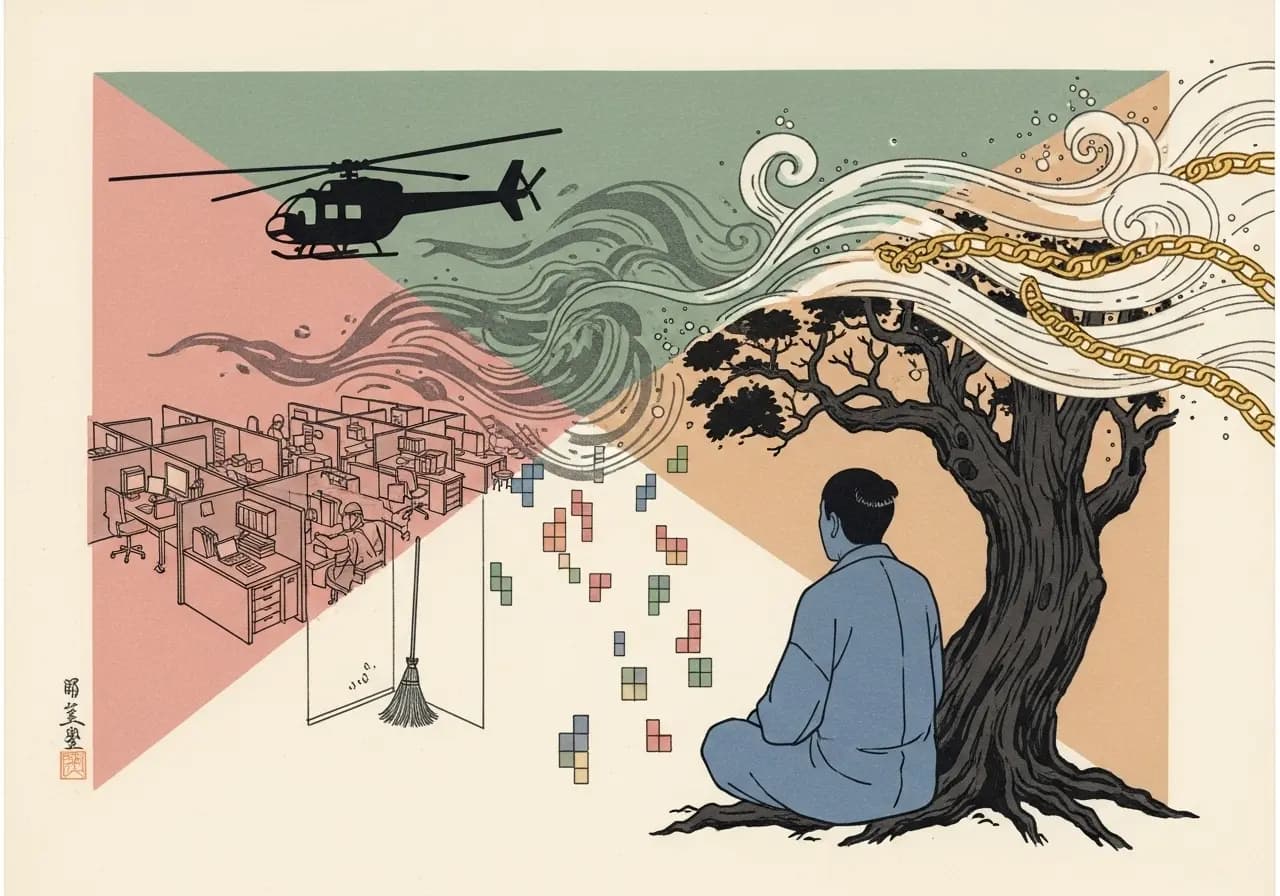
I like to bring in the Tetris analogy here because, as we know, life is like a game of Tetris. We don't control all the pieces that show up. We just do the best with each piece that we have as it shows up in front of us.
I think this applies perfectly to livelihood. Maybe the job that you have right now isn't the ideal piece, but it's the piece that makes the most sense. Maybe it doesn't light your soul on fire, but can you use it skillfully? Can you engage with it in a way that supports being present and having integrity?
If it's workable and it's not harming others, then hey, that might be a perfect piece to be using for now, rather than always thinking about what is the perfect job.
I know life changes, right? My goal for a career when I was a kid has always been to be a helicopter pilot. That was it. As long as I end up there, I did life right.
And I didn't make it there. You know, here I am, and when someone says, "If you had a magic wand and you could do whatever, what would it be?"—I have no doubts. I would be flying helicopters. But it just hasn't worked out. It hasn't worked out for me to do that for one reason or another.
And I don't feel like, "Dang, I missed out on my life's calling." It just didn't work out because of the Tetris pieces that came my way.
Golden Handcuffs
I've had opportunities at other times to do things that seemed like a good fit—jobs that were paying good money. I'm thinking of my first job when I moved back to Utah from Arizona. This is a concept I wanted to talk about that's called "golden handcuffs."
I had a job as the director of marketing doing internet marketing for a company that sold supplements. I thought, "Oh, this would be great, because I'm good at that. I'm good at online marketing and advertising and getting people to buy things."
But over time I realized something troubling: I don't actually enjoy this at all. I'm essentially convincing people to buy a supplement they don't need. And in this case, the company's business model involved kind of tricking you into subscribing, and then making it hard for you to unsubscribe.
Do you remember there was a time period on the internet when that was like a business model? Yeah, there was. And I was stuck doing that with this company, and I hated it. I hated how I felt because it felt like I was using my skills and talents to convince people to click on things that were going to trap them in a subscription to something that they don't need and they don't even know they subscribed to.
And at the same time, I was in one of the darkest stages of my life at that time. I needed the job. I needed to pay the bills. My family felt like everything was on the verge of collapse, and the last thing that was going to be helpful was not having a job.
I remember feeling super torn. It was like I had these golden handcuffs—this job that felt great on the surface—and at the same time I lost all freedom.
Anyway, long story short: I got out of that career and thought, "I'll just do something else." And it felt really good to not be trapped by that anymore.
The Middle Way
Bringing in the Middle Way to this whole discussion—avoiding extremes—I think it applies perfectly to the topic of livelihood.
On one extreme, you have the idea that work is just about making money. The more money you make, the better you are at what you do. That feels like one extreme.
On the other extreme, you have this pressure to find the one true calling, your one true purpose. And that's all that matters.
I think the reality for most of us is that we live somewhere in the middle. Our work does need to support us financially and not completely drain our souls. It needs to feel practical and somewhat meaningful. We need to be able to pay the bills and try to maintain our integrity in the process.
That's the Middle Way applied to livelihood.
My Current Path
I think about my current career—doing marketing for a tech company. Is it saving the world? No. It provides infrastructure for companies to be able to run their online processes. It's pretty mundane stuff.
But I enjoy it, and I feel honest about what I do and how I go about doing it. I feel good about how I engage with the people that I work with. I work with integrity with my colleagues, always looking for ways to make it an enjoyable experience in my interactions with others.
And then meanwhile, on the side, I have the podcast. That's a whole different thing. That gives me a greater sense of meaning and purpose in a different way. By itself, it's not going to pay the bills. But by having a job and doing this, you know, it balances out, and I feel a sense of meaning and connection and purpose.
That's how I'm going about it. That's how it works now. It hasn't always been that way. I don't know if it will always be that way because I recognize that life changes and evolves. But for now, that's right livelihood for me.
I recognize the Tetris pieces keep falling, but for now, this combination works.
The Paragliding Perspective
The last analogy that I want to share here connects to paragliding. Why not?
When we're going to fly, the conditions matter, right? We don't just look at the sky and say, "Well, I want to fly right now, so I'm just gonna take off." You have to read the wind, check the forecast, pay attention to what the conditions are telling you.
I think right livelihood is a bit like that. You're kind of reading the conditions of life, looking at what season you're in, what the opportunities and limitations are around the choices available, and then you choose to act.
It's like saying, "Okay, these are the conditions, so this is the type of flying I'm going to do today." I think our lives are kind of like that: "These are the opportunities, these are the skills that I have, so this is the kind of job I'm going to do."
And I think that's perfectly fine. It's a great way to approach it. Because just like with paragliding, if you understand the conditions well, you have a much greater chance of staying aloft rather than crashing and burning. I think our careers can feel the same way.
Practical Reflection Questions
So making this practical in our day-to-day lives, I think there are a few questions that we can reflect on.
One is: Continually assess whether your work increases or reduces suffering for yourself and for others in the world. I recognize that can be a really tricky one. If we ask ourselves, "Am I participating in systems of harm, even if it's indirectly?" well, we live in a very interdependent world and economy now. It could be that the company where you buy your coffee is sourcing their coffee beans from some problematic place, you know?
There may be interdependencies that we're not even fully aware of. So I understand it can be tricky. But being aware matters. Having a little bit of understanding, trying to do our best—knowing that there's probably no way to completely eliminate harm from the choices that we make because we live in a society that's just too interdependent.
But you can ask yourself: Is my livelihood aligned with my values?
How do I show up for work when I am working? Am I present? Am I kind? Am I open and curious? Or do I leave work feeling depleted? Do I leave feeling fulfilled? Am I bitter or am I grateful?
Over time, that might be what determines whether you say, "You know, I think it might be time to try something else."
I don't think that we need to have perfect answers to these questions. But I think asking the questions—that's part of the path. That's part of right livelihood.
The Heart of the Path
So that's kind of where I wanted to go with this conversation. And I think sometimes right livelihood, like I said, feels like a side note in the Eightfold Path. But in some ways, I wanted to dedicate a whole talk to it because maybe we could recognize that it's the heart of the whole thing.
All of us have to do stuff to afford the way that we live. Our career is a significant part of our lives. What we do every day shapes who we are. The way that we earn a living is not separate from the way we live.
It's not about having the right job, but maybe the right relationship with our work. One that honors humanity, aligns with our values, supports our growth.
So wherever you are on that livelihood journey—whether you love your job or hate your job or maybe somewhere in the middle—just know that your path is valid. You're on that path.
And you're not broken if you don't like your job. You're just playing the Tetris piece that you have the best way that you can, and that's more than enough.
The Weekly Invitation
So that's the invitation for the week as well: try to bring more mindfulness to your work this week, whether it's how you handle emails, the boring spreadsheets, parenting, driving, cleaning, or anything else.
How could I do this with more presence? With more kindness? Or perhaps more skillfully?
And then see if your work feels disconnected from your values. And if it does, be willing to explore that a little bit. See what's going on there or why.
Know that you don't have to fix it all at once. But maybe just take baby steps toward more skillful livelihood.
Thank you for listening to the Secular Buddhism Podcast.