

Skillful Means: When Ancient Wisdom Meets Modern Technology
Episode 214 of the Secular Buddhism Podcast - A Special 10-Year Anniversary Episode
Hello and welcome to another episode of the Secular Buddhism Podcast. This is episode 214, a special 10-year anniversary episode. I am your host, Noah Rasheta, and today I have some exciting news I want to share with you. But before we begin, remember you don't need to use what you learn from Buddhism to be a Buddhist. You can use what you learn to simply be a better whatever you already are.
Two Passions That Shaped My Life
I want to start out by telling you about two passions that have shaped my life. The first is Buddhism, these teachings that have transformed how I understand suffering, the nature of my own mind, how I relate to difficulty, and how I navigate this complex experience of being human. The second is technology.
Now I know those two might seem like strange companions. Buddhism often gets associated with simplicity, with retreating from the modern world, with unplugging and disconnecting. And technology often gets blamed for making us more distracted, more disconnected, more caught up in the very things Buddhist teachings are trying to free us from.
But here's what I've come to understand. These two passions of mine, they're not in opposition. I like to think of them as being in conversation. And today I want to share with you why that conversation matters, where it's leading, and what it means for how we can all engage with these teachings in new and powerful ways.
Earlier this month, we celebrated Bodhi Day, the day that we commemorate the Buddha's awakening under the Bodhi tree. And this month also happens to mark the 10-year anniversary of the Secular Buddhism podcast. So it feels like the perfect time to talk about how ancient wisdom and modern tools can work together.
The Buddha as Teacher
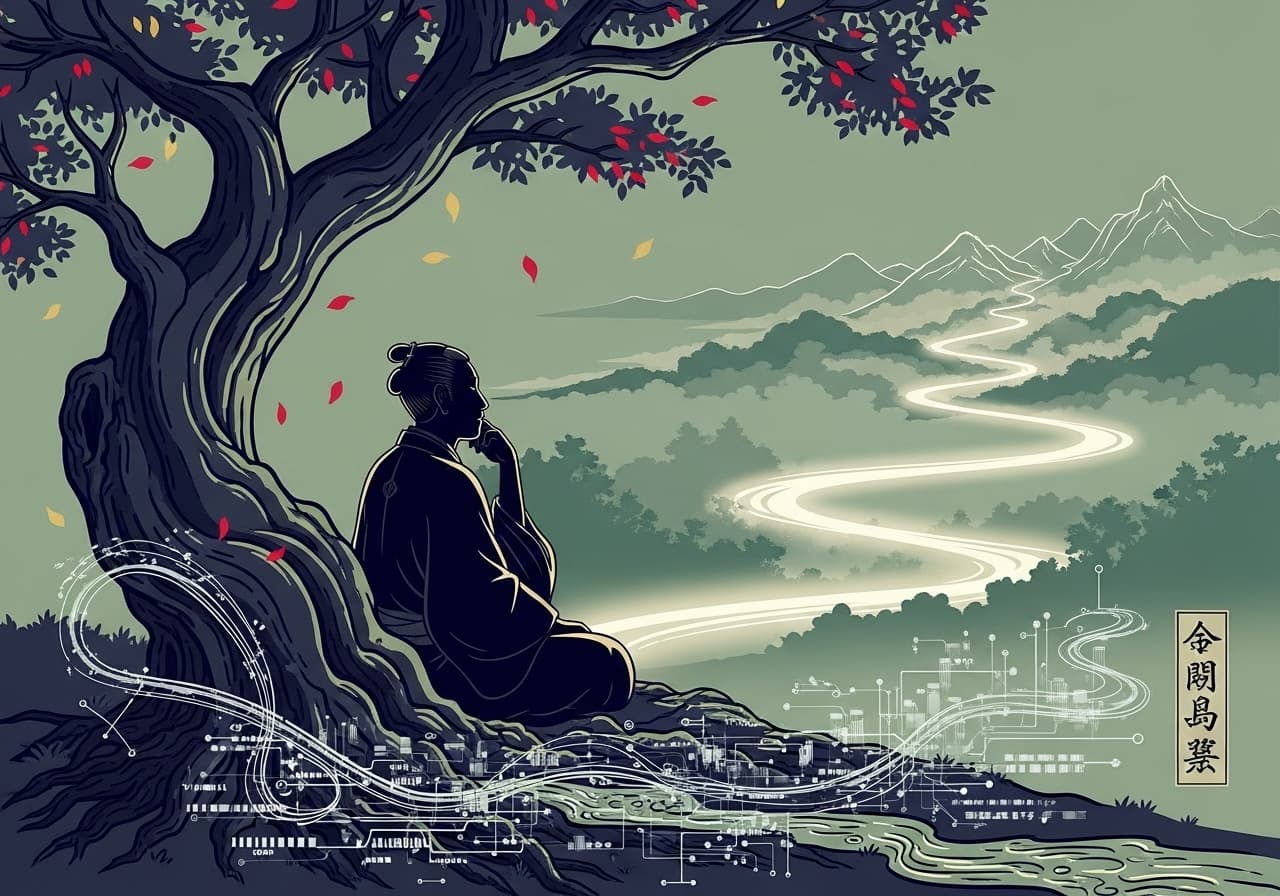
Let me take you back 2,500 years ago. Picture a man sitting under a tree who awakens to a profound understanding of the nature of suffering and the path to its end. He could have kept that understanding to himself. He could have said, "This is too subtle, too nuanced, too difficult to communicate." But he didn't. He spent the next 45 years of his life teaching. Not because he had to, but because he saw that these insights could genuinely help reduce suffering in the world.
And here's the important part. He didn't teach the same way to everyone. He didn't say, "Here's the one true method, take it or leave it." Instead, he taught differently depending on who he was speaking to, what they needed, where they were in their journey. To some he taught meditation, to others ethical conduct. To some he used stories and metaphors, to others rigorous philosophical discourse.
In Buddhism, we call this upaya, or skillful means. The teaching adapts to meet people where they are, using whatever method serves them best. The goal isn't the method itself. The goal is the reduction of suffering, the cultivation of wisdom and compassion.
Technology as Skillful Means Throughout History
Now fast forward through history.
Those original oral teachings, they were precious, but they had a problem. They could only travel as far as a human voice could carry, and they could only be remembered as accurately as human memory allowed. The teachings were shared orally for about 200 years, but then guess what happened? Eventually, society developed a powerful new technology: written words. And with that new technology, the teachings were written down.
Imagine the controversy that must have caused. "You want to write down the sacred teachings? But they were meant to be transmitted directly, person to person, teacher to student. Writing them down will lose something essential. People will misunderstand, they will misuse them."
And you know what? Those concerns weren't entirely wrong. Something does get lost in writing them down: the presence of a teacher, the ability to ask questions, the personal connection. But also something profound is gained. The teachings could now travel across oceans, survive for generations, and reach people who would never have encountered them otherwise.
Fast forward again. Then along comes the printing press, and with it the ability to mass produce books, and the teachings spread further. Then technology produced audio recordings, and video, and then the internet. And each time there were legitimate concerns. Each time something was lost, and each time something extraordinary was also gained. The teachings reached more people in more ways, meeting them exactly where they were.
Which brings us to today, to this moment, to a new technology that's causing the same kinds of concerns, the same kinds of questions, and that's artificial intelligence.
What Is Skillful Means?
So what exactly is skillful means, and what does it have to do with this topic? Let's break it down, because the concept is at the heart of everything I want to share with you today.
Imagine that you're trying to help someone cross a river, and you have several options. You could build a bridge, you could teach them to swim, you could give them a boat, or you could carry them across. Which is the right method? The answer is, well, it depends. Can they swim? How strong is the current? How far do they need to go? Do they need to cross once or are they going to have to cross multiple times? Are they alone or carrying things?
There's no single right answer that works for everyone in every situation. That's the essence of skillful means. It's understanding that the tool needs to match the person, the situation, and the need. It's the recognition that different people need different approaches or different tools. Some people learn best by reading, others learn best by listening, some through community discussion or discussion with a teacher, others through solitary practice. Some need structure and guidance, and others need freedom to explore.
And here's what really matters. The tool is never the point. The tool is simply the vehicle that carries the teaching. As we say in Buddhism, the finger pointing at the moon is not the moon. The technology isn't the teaching. It's the finger pointing toward it.
When the Buddha's teachings were first written down, that writing wasn't the Dharma itself. The Dharma is the truth about the nature of reality, the path to freedom from suffering. The writing was just a skillful way to preserve and transmit that truth.
When I started the Secular Buddhism podcast 10 years ago, the podcast wasn't the teaching either. It was, and still is, simply a vehicle. A way to take these ancient insights about the human condition and make them accessible to people driving to work, people doing the dishes or going for walks, people who might never step into a meditation center or pick up a book about Buddhism, but who also experience suffering just like everyone else and could benefit from these tools.
So the question has never been: what is the right way or the purest form of teaching? The question has always been: what serves people best? What helps reduce suffering? What opens the door to wisdom and compassion?
A Decade of Content
So let me paint a picture for you of where we are and where we're going. Over the past 10 years, I've created hundreds of hours of content: podcast episodes, books, several courses, hundreds of talks. The podcast alone has been downloaded nearly 17 million times. It's reached an estimated 2 million listeners, with about a hundred thousand people engaging with it regularly every month.
And when I wrote "No Nonsense Buddhism for Beginners," I had no idea it would become a number one bestseller in its category on Amazon and that it would stay there for years. It turns out that the format of questions and answers is really appealing because a lot of people learn through asking questions and getting answers through conversation. I think that's why that book has done so well.
Overall, that's just a lot of content. In fact, it would take the equivalent of, I think, 27 marathons for someone to listen to every single podcast episode, assuming it takes you four hours to run a marathon. Do that 27 times. That's just a lot of content.
And here's what I've realized about that. There's incredible value in all that material. There are insights around suffering and its causes, practices for working with difficult emotions, frameworks for understanding impermanence, interdependence, the nature of self, and overall real world applications of ancient wisdom for modern life.
But there's also a problem. Unless you have the time to listen to every single episode, which very few people do, and unless you have perfect memory, which none of us do, so much of that value remains inaccessible. You might remember that I talked about something useful in some episode, but which one? What exactly did I say? How did I explain it? I myself don't remember, not to mention the countless other books and resources that are out there in the world.
It's almost like we have this massive library of content with no card catalog, no index, no way to find what you're looking for except to just read every book cover to cover, or listen to every single podcast episode over and over. And this is where technology again becomes a tool for skillful means.
My Journey into AI
Now, some of you may know about a year and a half ago, I switched careers from teaching paragliding and started working for a data infrastructure company. These are the companies that build and manage the infrastructure that powers the technology that powers the internet, including artificial intelligence.
In addition to my line of work, earlier this year I decided to start a master's program in applied artificial intelligence because that's the space that I am working in. And in the past year, I've been deeply immersed in learning all things related to AI, including prompt engineering, Python programming, coding. I've just gone down the rabbit hole the same way I did with Buddhism, the same way I did with paragliding, the same way I have with a handful of other topics in my life, because when something fascinates me, I dive deep.
And for me, part of the celebration of this new milestone, this 10-year anniversary, is that I'm fusing my love of technology, my studies with AI, and my passion for Buddhism all into one. They're all coming together in this new chapter for the podcast.
The Big Announcement: EightfoldPath.com
Which brings me to the big news.
To celebrate the 10 years of content I've produced on the podcast, I'm excited to announce a brand new tool, a website, a powerful resource that will make it easier than ever to learn Buddhist teachings, stories, practices, and insights. It's a new website called EightfoldPath.com, and it's powered by the latest AI and designed to help people learn Buddhism through listening, reading, or simply asking questions in real time.
The website features a powerful tool that I'm calling Noah AI, and it's trained on all my content. Every single podcast episode, every book, every course, the entire body of teachings that I've shared over the past decade.
Now, let me be very clear about what this is. It's not just a search tool. It's not just a question and answer tool. It's a thinking partner. It's like having access to a Buddhist teacher who happens to have perfect memory of everything I've ever said in any podcast, everything I've ever written in any book, and everything I've taught in any of my courses or talks. You can engage with it conversationally. You can share what you're thinking about, talk about what you're struggling with, and it will help you to explore those ideas from different angles.
What Beta Testers Are Saying
One of the beta testers put it this way. She had been using the tool to ask questions, which is what you'd expect, but then she started sharing her own understanding of one of the teachings, kind of thinking out loud with it, and the AI helped her look at that teaching from a different perspective. And she told me it reminded her of the teaching about the blind men describing the elephant. She said she felt like she was experiencing that teaching in real time, literally being helped to see the elephant from a different angle. And that's when she realized this isn't just a powerful Q&A tool, it's literally expanding perspective. And that's exactly what a good teacher does.
Another community member shared this. He said, "I've been an early adopter and tester of Noah AI, and I can say with experience, it is more than you think it will be. I used it today to work through a challenging work scenario and I got some great advice and insight. I could easily imagine I was talking with Noah about this challenge. The advice was good and grounded. It really helped me as I sorted through this current challenge." And then he says, "Don't go easy on Noah AI. The answers will seem like a friend talking with you and keeping secular Buddhist teachings in mind."
To me, that's the power of this tool. It's not replacing the podcast or the books or the courses or me. It's making them more accessible, more interactive, and more useful for exactly when you need them.
What's Changing and What's Not
So what's changing and what's not? I want to be clear about this because if you listen to the podcast and that's all you do, nothing is changing for you. Wherever you currently listen, that's where you'll continue to listen. The podcast name will remain the same: Secular Buddhism Podcast. The format, none of that is changing.
The only thing that's changing is the website itself. Instead of visiting SecularBuddhism.com, if you wanted to search for transcripts or learn about the community or engage with any of the content, that will now all be hosted on EightfoldPath.com. And the new website has all the same content as the old website, plus a whole bunch more. It's much more than the old one.
Why Change the Name?
So then why change the name? Well, my desire to teach Buddhism has spread beyond the podcast. It's spread to books, courses, retreats, talks. And at times I felt a little constrained by the label "secular Buddhism." If there's one thing I've learned in 10 years of teaching Buddhism, it's that we actually want to move away from our attachment to labels.
Labels are certainly useful and they're great starting points, but they can also become limitations. And I never intended for secular Buddhism to feel like it's something separate or different from any other form of Buddhism, because in my opinion, it's not. All of reality is like the elephant, and we're all blind people just attempting to describe it from our own unique vantage point in space and time.
For me, secular Buddhism was a way of expressing my understanding of Buddhism from a lens that doesn't need to view it as a religious framework. I could view it as a philosophical framework, and that's it. But it was not intended, and still is not intended, to be something that's separate from any other form of Buddhism. I draw my understanding of Buddhism from all the different schools of Buddhism equally. I like them all.
So what I want to emphasize is not the label of the teachings, but the path itself. The path. When you encounter Buddhism, what is the path that you ultimately walk? It's the Eightfold Path. So that's where the name comes from. EightfoldPath.com is going to be the home for everything. The podcast, courses, books, the community, and this new AI tool that's designed to make learning a little bit easier, especially for those who learn best by asking questions and by engaging in conversations.
What You'll Find on the New Website
What you'll find on the new website, even if you never use the AI, is that it's a significant upgrade compared to the old one. On the new website, you can find every single podcast episode transcribed in a clean, easy to read format. That alone is a huge improvement. The old website didn't have clean transcripts, and most episodes didn't have transcripts at all.
But now you can go and search through a decade of content. You can read along while you listen, or just browse the topics that interest you, or interact with it and ask it questions. And all of that is free. The podcast, the transcripts, the introduction to Buddhism course, a 30-day meditation course, access to the Noah AI tool, all of it is free. Anyone can go open a free account to access this new website. And it's free thanks to the support of community members that have contributed to the work I'm doing with the podcast.
As a thank you to supporters, supporters do get additional benefits because supporters are the ones making this possible and accessible to everyone. They get unlimited access to the AI teacher, where free users are just going to be capped at a certain amount of messages per day. Also, supporters will have the ability to save their chat history, and of course access to the community platform and additional courses. I have a pretty thorough seven hours and 20 minutes of in-depth content, and that's a course that's available to supporters as well. So all the core things, everything remains free for anyone who's willing to put in the time to learn.
For Current Supporters
For current supporters, if you're listening to this and you've been supporting the podcast through Patreon or through the Secular Buddhism website, keep an eye on your email. I've already sent out information about the transition to the new one. And if you haven't seen it, check your inbox or your spam folder. That's where you'll find the details. Or you can just visit EightfoldPath.com and create a new account.
If you had an account or you were subscribed to the newsletter before, the system will detect you when you create the new account and it will reconnect you to everything. All you have to do is reenter your payment method and amount when your current support period ends.
And for anyone, remember this new platform is free. It's free for anyone. And I encourage you all to go check it out.
How to Approach This New Tool
I'll say this first. Stay curious as you explore this new tool. Approach it with a beginner's mind. Test it, see what it can do, but also notice how you're relating to it. I think with technology in general, it's always wise to ask yourself: Is it serving you, or are you serving it? Is it helping you engage more deeply with the teachings, or is it becoming another form of distraction?
And then second, don't go easy on it. Ask it real questions. Share what you're actually struggling with. Use it as a thinking partner, not just a search engine. The more you engage with it conversationally, the more useful it becomes.
Keep in mind that it's all a work in progress. It will continue to evolve and improve over time. I have several new and exciting features in the works, and I can't wait to finish building them. And remember, this is also a solo project. This is just me. If you notice any bugs or issues that need to be addressed, just send the message there in the platform. I'll get it and I'll fix it. Because this is a passion project for me, and I'm really excited to just keep improving it and building it. But remember, it is just me. I'm the tech support. I'm also the engineer behind it and the speaker in front of it. I'm all of it.
And third, remember the principle of skillful means. This is just one more tool in the toolbox. Some of you will find this incredibly useful. Others will prefer to stick with listening to the podcast episodes or just reading books. Some of you might use it occasionally when you have a specific question. Any approach, they're all fine. The tool serves you. You don't serve the tool.
Stay Grounded in What Matters
And finally, stay grounded. Stay grounded in what matters most.
Remember, technology is changing. The methods of transmission of teachings are always evolving. The core teachings, those remain the same. Understanding suffering, cultivating compassion, developing wisdom, learning to be present with what is. These truths don't change whether they're transmitted orally, written on palm leaves, recorded in a podcast, or synthesized by an AI.
The Buddha's first teaching after his awakening was essentially this: I have found a path to the reduction of suffering. Let me share it with you in a way you can understand and apply it. That's it. That's still the mission. That's always been the mission. Technology is just the latest iteration of skillful means, finding new ways to meet people where they are, to make these transformative insights more accessible, and to reduce suffering however we can.
Looking Back and Looking Forward
10 years ago, I started a podcast because I saw that technology could help bring these teachings to people in a new way. People who were suffering, who were searching, who might benefit from a secular approach to Buddhist wisdom, but didn't know where or how to start. I had no idea it would reach millions of downloads, that it would create a global community, that it would lead to books and courses and a beautiful sangha that I get to engage with on a weekly basis.
And now we're at another threshold, another evolution in how we can engage with the teachings. And I am as excited about this as I was when I first recorded that very first episode a decade ago. Not because the technology is impressive, even though it is, but because of what it makes possible. More people having access to tools that can genuinely help them suffer less and live with more wisdom, compassion, and freedom.
That is the goal. That's always been the goal. The technology is just the finger pointing at the moon.
Closing Thoughts
So keep your eyes on the moon. And let's see what becomes possible when ancient wisdom meets modern tools, when skillful means evolves to meet the needs of this moment, when we approach innovation with the same intention the Buddha had 2,500 years ago. May this reduce suffering. May this serve the awakening of all beings.
And to each of you, thank you for being part of this journey. Thank you for your openness to evolution and change. And thank you for your commitment to the teachings, however they arrive, in whatever form serves you best.
Visit EightfoldPath.com to explore, create your free account, ask some questions, and see what unfolds for you. The path continues. Let's walk it together.
Thank you for listening. Until next time.
For more about the Secular Buddhism podcast and Noah Rasheta's work, visit EightfoldPath.com