

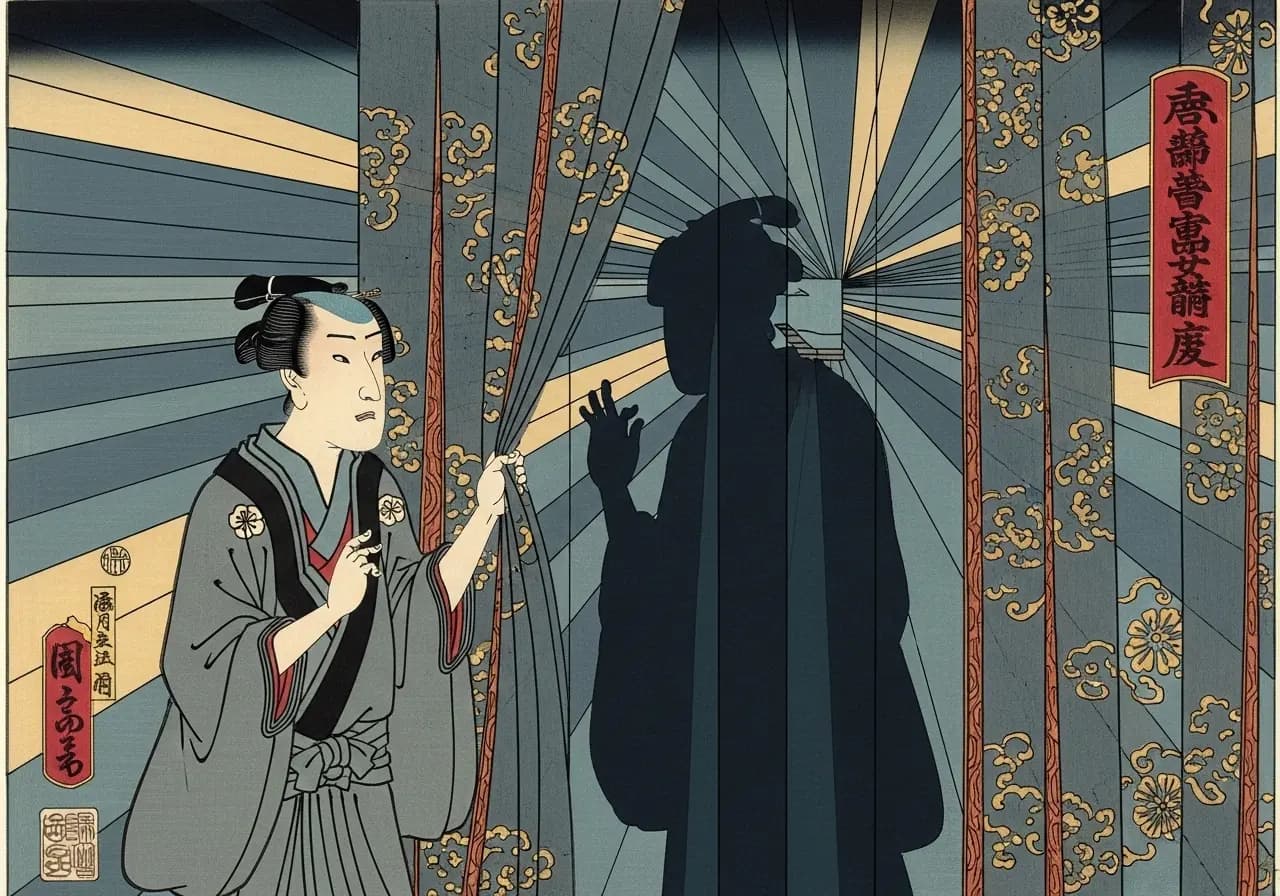
The Rascal Behind the Curtain
Episode 98 of the Secular Buddhism Podcast
Welcome to another episode of the Secular Buddhism Podcast. This is episode number 98. I'm your host, Noah Rasheta, and today I'm talking about the rascal behind the curtain.
The Curious Mind
So what is the rascal behind the curtain? Well, some people are curious by nature. Some people want to peek behind the curtain and see what's going on back there, and others don't. My whole life, I've been a very curious person by nature. I always like knowing the source of where things come from. I find this sense of curiosity is what leads me to want to research or watch documentaries that peek behind the curtains. We have a lot of those these days.
If you're interested in learning about food, you can watch Food Inc. or similar documentaries that show what's going on behind the curtain. How does food get to our table? What all does that process entail? Some people don't want to know that. Some people do.
I had to deal with this same sense of curiosity years ago when I was studying my religious views. I wanted to know who wrote the Bible or where the Bible came from. I'd always been told to read it over and over, but without any pressure of trying to understand other aspects—like where did this come from? Who wrote it? I started studying Bart Ehrman's work on New Testament historicity, and that kind of started to change my worldview.
I like to do this with anything. The Buddha said this—well, who says that the Buddha said this? Where do these writings come from? I like to peek behind the curtain, and that sense of curiosity is natural for me. And there's no area where you're safe from what you might find behind the curtain, right?
Where does our oil and gasoline come from? What all does it take for us to consume the oil that we use? When you peek behind the curtain, you might not like what you're going to see. You can do this with plastics, our clothing. Where does our clothing come from? I remember watching a documentary about diamonds and the process for obtaining them, and I was like, I don't think I'll ever buy a diamond again. Or watching The Cove about SeaWorld and dolphins, and suddenly realizing, oh, I don't know if that's a place that I want to go to or support anymore.
And it can have this effect. I don't want to bring this up all in a negative sense, like every time you peek behind the curtains, life gets more doom and gloom. But that does tend to happen sometimes. We peek behind the curtain, we don't like what we see.
Peeking Behind the Curtain of the Mind
I bring this up because the process of introspective awareness—the process of spiritual awakening—is essentially the process of peeking behind the curtain. But we're doing this in an investigative way, looking inward. What happens if I peek behind the curtain inside of me? Behind the curtain of the mind. And this to me manifests in ways very similar to what I was talking about with external things. Like, well, where does this come from? How do we get this? What does it take for this thing to be what it is?
I've done the same journey going inward. I want to know: Why do I feel this way about this thing? Why am I sensitive about that? Why does this cause me to feel this way? Where does this strong aversion come from? Or why am I chasing after this specific thing and not that other thing? And then the big question—one I've toyed with for years and years and years—is what am I really after? What do I really want?
I think this gets at the heart of a lot of what we're trying to practice in terms of Buddhism as a spiritual practice. It's like we're playing this game of catch-me-if-you-can. We're playing the game of cat and mouse. There's the enlightened you that's trying to out-fox or outsmart the unenlightened you. And it's like I'm trying to figure myself out, but the plot twist that we come to discover is that I am the one that wants to peek behind the curtain while at the same time I'm the one behind the curtain that doesn't want to be seen.
And when one seems to have outdone the other, the other gets the upper hand, and the game goes on and on—just like the game of cat and mouse. If you grew up watching Tom and Jerry, that cartoon of the cat and mouse, or taking this into more modern terms, any show or entertainment we watch that has a superhero and a villain, it's the same game. The more entertaining and powerful the one is, the more you need the opposite.
The whole cartoon would be boring if the cat caught the mouse in episode one and that's the end of it. We enjoy watching Tom and Jerry because sometimes one outdoes the other, and then next time the other one is the one who outdoes the other. The game goes on and on. That's what makes it entertaining. And with our superheroes and villains, it's the same thing. We always want the good guy to win and that's it. But it's not entertaining to us if that's just how it is. We need to think there's a chance the bad guy might win, and that's what makes it entertaining.
To me, that's what's fascinating—this constant back-and-forth of who gets the upper hand: the enlightened me or the unenlightened me. And this realization that I am the cat, but I'm also the mouse.
The Eye That Knows Me
I love the way that Alan Watts talks about this. He has a quote where he says: "There was a young man who said, 'Though it seems that I know that I know, but what I would like to see is the eye that knows me when I know that I know that I know.'"
It's a fun mental—it's a tongue twister almost—but it's definitely a mental gymnastics twister as well. You're like, what is he talking about? Who is the eye that knows me when I know that I know that I know? He's alluding to these multiple layers, what I like to think of as peeking behind the curtain.
To me, it's like imagine the moment of shock when you finally figure out how to peek behind the curtain of the mind. What you see is yourself peeking behind the curtain of the mind. That's how it is. That's it. That's what you would see. You'd see yourself peeking behind the curtain, and that's the eye that knows me when I know that I know that I know.
I love the complexity of these ways of thinking about seeing. Alan Watts again calls this "the element of irreducible rascality." And he says: "To be human one must recognize and accept a certain element of irreducible rascality, both in oneself and in one's enemies. It is therefore an enormous relief to realize that these abstract ambitions are total nonsense."
It goes on to say: "For when it is understood that trying to have good without evil is as absurd as trying to have white without black, all that energy is released for things that can be done."
To me, this is kind of that realization—if I'm putting in all this effort to finally peek behind the curtain and what I see is the me that's peeking behind the curtain, it's essentially that same release of energy. This wanting good without bad, wanting things to be a certain way—it's exhausting. And there's this relief when you realize, okay, I contain all of these things. I'm not just the seeker. I'm also the thing being hidden. I'm the cat and the mouse. I'm the light and the darkness. I'm the one who knows and the one who doesn't know.
And there's no solving that. There's no fixing that. There's no getting to the other side of that where it's just all good and all known and all enlightened. It's always going to be this dance between both. And I think the relief comes from accepting that rather than trying to transcend it or get beyond it.
The Limitation of Perspective
And here's something else I want to bring into this. I think one of the most misunderstood things is that there's something like this objective truth about what's really going on. There isn't. There is no accurate one. You know, it goes back to the analogy that the Buddha gave of the giant elephant and the blind men trying to describe it.
The whole point of that analogy is that no single person at a single vantage point in terms of space and time can see the whole picture. It cannot be done. So here I am, describing my interpretation of my experience with reality, and it comes across in this secular Buddhist lens. But that's not to say that there's anything more accurate than the description I'm giving of the tail of the elephant versus the description that someone else is giving of the trunk of the elephant from an entirely different vantage point—maybe even a different worldview. A theistic one or a non-theistic one, or within Buddhism, a classical one or something else.
And I think that's important to understand.
The Game of Tetris and Present Moment
I kind of got sidetracked with the concept of the rascal behind the curtain. But what I want to get at is that what we learn and what we practice in Buddhism isn't about ensuring a better future or correcting an uncomfortable past. It really boils down to the discomfort and the uncertainty of the present moment.
And I want to bring this back to something I regularly bring all of this back to: the game of Tetris. Think about the game of Tetris for a moment. What would make that game stressful for someone? If someone's playing it and they're stressed about it, the stress would come from not knowing what's coming next. That's where the stress comes from. And if you're watching someone play the game and they're loving it, what would make that game fun? It would probably be something similar, but it's thinking that they know what's about to come next or thinking "I've got this game under control, I've got it under wraps"—that sense of hope that the game is about to be better because they're going to get what they need next.
But both of those players are in the exact same circumstances. If you could slow down time or pause the game for a moment, you'd realize the game isn't about the fear or the hope of what shape comes next. It's about recognizing that right now we're playing a game and we didn't choose the game. It's almost like the game chose us. You wake up and there you are playing the game. That's what we are. We wake up and here we are alive.
I didn't will myself into existence, but I'm here. And to me, that's what the game represents. It's reality. It's how things are. I didn't choose to look the way I look. I didn't choose to have the personality that I have. You know, I can't help that the rascal in me wants to peek and see what's behind the curtain of all things. I'm just here. I'm participating in the entire process of being alive.
And what I'm finding more recently in my life is that I'm getting comfortable with the uncertainty of it all. It's kind of funny to see the transition from "I want to see what's behind the curtain" to "exploring why do I want to see what's behind the curtain?" Because that's also a fascinating thought experiment.
An Invitation to Self-Knowledge
My invitation to you regarding this whole topic and concept is to try to get to know yourself a bit more in this arena. Why do I care to know what's behind the curtain? Do I care to know what's behind the curtain? If the answer is yes, why? If the answer is no, why?
And again, the point for me is to have a more skillful relationship with myself as both the cat and the mouse. I want that to be a more skillful relationship, knowing that it's an ongoing one where one's going to out-fox the other, and then the other one gets the upper hand, and then it has the upper hand until the other one gets the upper hand, and that's the game that goes on and on and on.
I try to notice in moments where I feel a certain sense of attachment to one thing—like, "Oh, I'm this or I'm that" or "Oh, I don't want you to think I'm that, so I better look like I'm this." Where does that come from? Why do I feel aversion for one over the other? And notice how it changes.
It's fun to do this in terms of time too. I had this thought experiment the other day where I was thinking: If the me of ten years ago met the me of today, how would that me think of this me? That was just a fun thought process. I was like, well, that me would probably think a lot of strange things about this me. And then I thought, "Well, I wonder what the me of now would think of the me of ten years ago, in the way that the me of now thinks of the me of ten years ago."
And again, you kind of play with this process in your mind. Suddenly there's this realization again of the complexity of the interdependent nature of all things and the constant changing of all things. And what I find is it seems to give me a little bit less of that strong attachment to how I am now, what I think now, what I believe now, or what I don't believe now. It's like there's no "that's just how things are." There's no attachment to it. That's just how it works for me.
So again, like everything I share in this, what I'm trying to emphasize is this is an exploration of you getting to know you. I'm not trying to present any of this in the sense of "Here's the goal. You need to discover this or that." That's not what this is about at all. I'm trying to share how it's worked for me. And I'm finding that this comfort with the discomfort of uncertainty in life is actually pretty pleasant the more you get comfortable with it.
Comfort with Uncertainty
Like I mentioned in the podcast episode on stepping into groundlessness, I found a considerable amount of peace and contentment in my own life with uncertainty—just not knowing. And thinking, "I get to do this today? Well, that's great, 'cause I don't know what I get to do tomorrow."
Someone was asking me today, "Hey, you seem to do a lot of flying," because if you follow me on social media, you would know that's pretty much what I do. They asked, "What would happen if you got injured and you couldn't do it?" And I said, "Well, nothing. I just do whatever the next thing is that I can do."
Oddly enough, I'm not attached in any way to this thing that I pursue so actively in my life—which is flying and teaching people to fly—because I can. And if I couldn't tomorrow, I'd be like, "Okay, well that's the end of that," and I'd be doing something else. Just like the day before I learned to fly, I was doing something else. And before that day, something else. And that's just how it's been.
Closing
Sharing all these thoughts, that's the topic I wanted to share today: the rascal behind the curtain. You are the rascal, and you're also the rascal hiding behind the curtain too. And playing with this concept, hopefully you can have some entertaining thoughts with yourself as the cat and the mouse.
As always, if you want to learn more about these topics and concepts, you can check out the books I've published. They're available on noahashita.com. As always, if you've enjoyed this podcast episode, feel free to share it with others, write a review—I'd love to hear your feedback or your thoughts—and give it a rating on iTunes.
And if you want to support the work I'm doing with the podcast, you can always do that by visiting secularbuddhism.com and clicking the donate button there.
That's all I have for now. I look forward to recording another podcast episode soon. This is episode 98, and we're getting close to hitting 100 episodes. So thank you for listening.
Until next time.
For more about the Secular Buddhism podcast and Noah Rasheta's work, visit SecularBuddhism.com