

Dependent Origination
Episode 97 of the Secular Buddhism Podcast
Hello, and welcome to another episode of the Secular Buddhism Podcast. This is episode number 97. I'm your host, Noah Rasheta. Today, I'm talking about dependent origination.
Keep in mind—you don't need to use what you learn from Buddhism to be a Buddhist. You can use it to learn to be a better whatever you already are.
Introduction to Dependent Origination
Now, this topic of dependent origination is something I've been wanting to talk about for a while because it is a key Buddhist teaching—a key Buddhist principle sometimes referred to as dependent origination, the twelve links of dependent origination, or the law of causality. It has a couple of names that it goes by.
But it can be a little confusing. The first time I studied it, I kind of lost interest in it right away because it goes through these twelve links. To me, at least, they didn't seem to make a lot of sense, and I didn't fully understand the relationship between one link and the other. And then, of course, there's the question: which link is first? I think our Western mindset—the moment I hear "twelve links of dependent origination," my Western mind wants to say, "Well, what are they and in what order?" I'm already thinking of it the wrong way because I'm thinking of it in a linear fashion where there's number one, then number two, then number three.
My first encounter with this teaching was confusing, I guess, because it just didn't make sense to me. I thought, "What's the point of understanding these twelve links if I can't make sense of them?" But I've studied it from various teachers and various approaches, talked about in different articles, in different blogs, in different magazines. The more I've come to understand it, the more simple it seems. On the surface, it may seem complex, but when you really dig into it, it's actually quite simple.
The Twelve Links
The first thing I want to do is talk about the twelve links because if you were to study this topic from any school of Buddhism, you're going to encounter this teaching of the twelve links of dependent origination.
The twelve links are:
- Ignorance or unawareness
- Conditioning—typically the conditioning that arises from how things are in our life
- Consciousness—the awareness or consciousness that arises from the conditioning
- Name and Form—essentially our mental and physical formation
- The Six Senses—sight, hearing, smell, taste, touch, and mental faculty (our mind)
- Contact—the meeting of the sense with what's being sensed
- Feeling—the positive or negative sensation that arises when that contact is made
- Thirst or desire—to possess or avoid the sensations; essentially wanting what's pleasant and not wanting the unpleasant
- Grasping—what arises from that thirst and craving; "I like this. I want more of it"
- Existence or becoming—everything that arises from that grasping
- Birth
- Death and Decay
On the surface, if you're like me, as you first hear these, it's kind of like, "Okay. There's some interesting stuff in there, but I'm trying to make sense of it, and it's hard to make sense of it. How does one relate to the other? What does all this mean?"
Beyond Linear Thinking
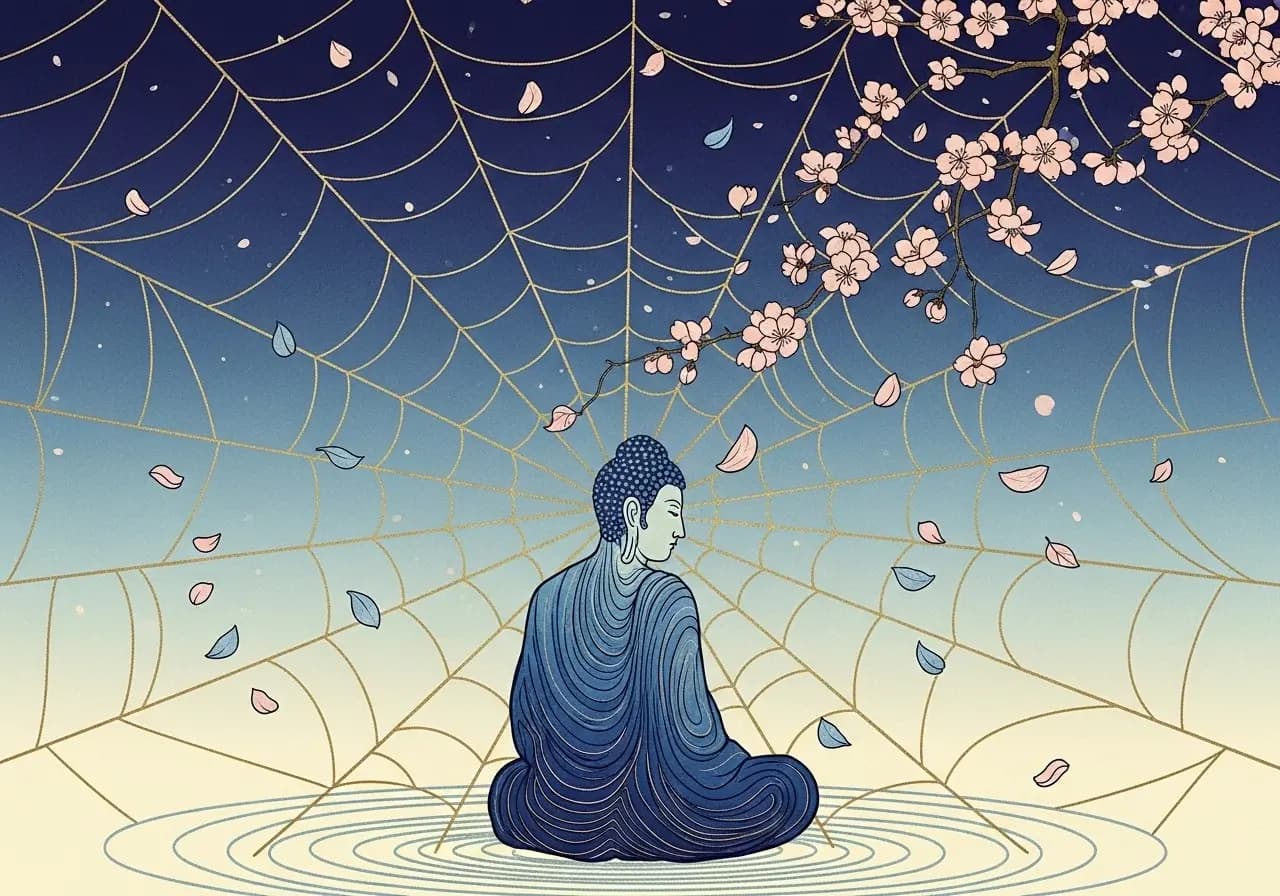
So I want to talk about this a little bit because the essence of this teaching is that it's trying to analyze a pattern that takes place. Think of the twelve links of dependent origination not as twelve links, or twelve steps, or twelve separate things. Just think of it as this massive spider web of all that is connected.
It's essentially taking all of this, analyzing it, and concluding that the process that takes place is that we crystallize something out of nothing. Then we take that and mistake it for reality.
In other words, I smell something, and it's an unpleasant smell. I don't like it, so suddenly I'm caught in this chain reaction of reactivity. All these things start taking place the moment this experience is unfolding. What this teaching is trying to help us understand is that if we could pause at any given moment, if we could pause time, we would notice that none of these things are taking place in a vacuum independent of each other or as absolute things.
What's happening in that moment when I smell something and it's unpleasant—what's taking place is a chain of reactivity. And I want to start seeing and perceiving my experiences as part of this giant web of interdependent processes. I want to recognize that often I will mistake or create this illusion of reality that is not accurate. It's forming out of all these other things.
The Core of Dependent Origination
Let me dig into this from another angle. Essentially, everything is interconnected. Everything affects everything else. Everything that is exists because of other things that are.
You can see this in terms of time. What's happening now is happening because of everything that's happened before. There's no separation between what's happened before and what's happening now. Everything that will happen next is going to happen because of what's happening now. So in terms of time, you start to see the interdependent nature of past, present, and future.
At its very core, I think, is the teaching of dependent origination. The teaching is essentially that nothing is absolute. No phenomenon exists independent of other phenomena. This is especially true for the illusion of the sense of self that I'm experiencing.
I am because other things are—namely my parents, and then everything else that's taking place. What am I? How can I be me if everything else that isn't me isn't there? The sense of self is interdependent with everything that is not self.
A Web of Causes and Conditions
All beings and all phenomena are caused to exist by other beings and other phenomena. They're dependent on these things. This makes it so that something that exists also causes other things to exist. Things that arise and things that cease to be are happening because of other things that arise and other things that cease to be.
All this arising, being, and ceasing occurs within a giant, vast web of interdependence. And there in the middle of all of this complexity is me and there is you.
Unlike a lot of other religious philosophies, in Buddhism there's no teaching of a first cause. We don't have the concept of initial creation where something arises out of nothing. All of this arising and ceasing—if it has a beginning, that's not discussed. It's not contemplated. It's not explained. The Buddha never delved into these existential questions. He didn't answer them. He emphasized the understanding of the nature of things as they are, as they are in this present moment.
That's where this teaching becomes really powerful. The understanding of this teaching isn't to figure out the beginning or to understand what will happen in the end. It's all about seeing the interdependent nature of how things are in this moment. And the way that things are is because they are conditioned by other things. You are conditioned by other people, other phenomena. And other people and other things are conditioned by you.
The Buddha's Simple Explanation
The Buddha explained it this way. He said, "When this is, that is. This arising, that arising. When this is not, that is not. This ceasing, that ceases."
That's a pretty simple explanation that on the surface you would think, "Well, duh." But when you really sit and think about that and realize the nature of interdependence, it can be a really profound experience. Suddenly you're left with this realization that nothing is absolute. This is because that is. And if this is not, it's because that is not.
Making It Personal
I like to take all of the things that I learn and that I try to put into practice through the study of these teachings and concepts. Again, it's all about me. I cannot emphasize this enough—what I try to accomplish in my practice is a very personal thing. I'm trying to understand me.
So this nature, this understanding of dependent origination, when it comes into practical day-to-day terms for me, it's me sitting with something—a feeling, a thought, an experience, whatever it is—and trying to understand: why does this feel this way? Why am I thinking this? Why, if this is, whatever this is, is it because of that? What is that?
It can be really powerful because, like I said, as we go through life and we're experiencing emotions, especially strong emotions or especially unpleasant, strong emotions, it's very easy to get into reactivity and think, "I'm feeling this. I don't want to feel this," and boom—I'm reacting. But rarely do we spend time with that emotion thinking, "Why does this feel this way? Why does this bother me? What does that have to do with me?"
That quest for understanding myself has allowed me to be much more skillful in my relationships with others, especially in my family relationships, my relationship with my spouse, and with my siblings, my parents, and my kids.
Nothing Is Absolute, Nothing Is Permanent
This concept that nothing is absolute brings us to the next big implication of dependent origination: nothing is permanent. This is related to that Buddhist concept—the teaching that there's no self in the sense of a permanent, autonomous being that's separate from everything else.
What we think of as our self, our personality, our ego—these are just temporary constructs that arise because of sensations, perceptions, mental formations, and all these other things that are taking place. In other words, this is because that is, right? This is what you are. You're an assembly of things that are taking place that form the basis for the illusion of a permanent you, separate and distinct from everything else and everyone else.
When in reality, these forms, sensations, and so on were caused to arise and assemble in a certain way because of other phenomena. Again, you cannot have this without having that. Then, as these things arise, they're perpetually causing other phenomena to arise. That's how it goes.
So there we are, entangled in this extremely complex web of things taking place.
The Fluid Nature of Self
If you start to spend a little bit of time in self-observation, what you'll start to see is the fluid nature of the self. The self that's you at home may be different than the self that's you at school or at work. The self that is hungry is different from the self that is satiated. It depends on the context of who you are.
Pause and think: Is the you right now, the you that's out hanging out with friends, or the you on a road trip where you've been sitting in the car for five hours? Is that the same you as any other you? The you that hasn't been sitting in a car for hours? The you that isn't sick right now? The you that's in a good mood versus the you that's in a bad mood?
You start to understand that the you that you are today may—and will indeed—be different than the you of tomorrow, or the you of five years ago, or the you when your mood slightly changes, or the you when your toothache stops hurting, or when your headache finally quits, or when you just got a raise at work. And now the you that makes more money than the you from yesterday—that's a different you.
There's no single self to be found anywhere in any of that process. There's no permanent one where it's like, "That's you."
Then you can take this across bigger, more obvious things. The you that was born where you were born, when you were born, and to the ideologies that you were born into, the social conditioning—that you is different than the you that would have been you had you been born on the other side of the world in a different culture, a different religion, a different gender. You'd be a different you.
That's what this is trying to help us understand: where do you find a permanent you in any of that? You change. You start to change that, and it changes this. You start to change this, and it changes that—because of the understanding of dependent origination.
The Dalai Lama on Appearance and Reality
There's something I like to share that the Dalai Lama teaches about this concept of dependent origination. He said:
Once we appreciate that fundamental disparity between appearance and reality, we gain a certain insight into the way our emotions work and how we react to events and objects. Underlying the strongest emotional responses we have to situations, we see that there is an assumption that some kind of independently existing reality exists out there. In this way, we develop an insight into the various functions of the mind and the different levels of consciousness within us. We also grow to understand that although certain types of mental or emotional states seem so real, and although objects appear to be so vivid, in reality they're mere illusions. They do not really exist in the way we think they do.
That's a lot to chew on, right? Because when you're feeling something and you're having the sensation of a strong emotion, it wouldn't be very skillful for someone to come up and say, "Hey, what you're feeling, that's just an illusion. That's not a real thing." But I think about this in terms of, say, taste.
I think of my kids, and they inherited their DNA from myself and from my wife, and now they're this unique combination of DNA. There they are sitting at the table. One of them is eating asparagus, and she loves it. The other one is tasting asparagus and he's like, "This is the nastiest thing in the world. I don't want to taste this."
As I observed this, I think, "Well, I really enjoy asparagus." Is there a permanent self—like my son, for example—that just doesn't like asparagus? That you can't help. That's you. No, right?
I understand that there's a lot of complexity going on there. One is that it could change over time. Two, I know there's an actual genome that accounts for bitter taste sensitivity. People who have it tend to like or dislike flavors like brussels sprouts or asparagus differently. But the point is there's an actual genetic predisposition for liking or being capable of tasting bitter flavors, and that will determine whether or not you like bitter or strong tastes like asparagus and brussels sprouts.
So again, what if he had a slightly different genetic combination? Would he be a different person if he did like this flavor, if he did want to eat the asparagus? Will he be different if that evolves over time? It's like there's no permanent self.
And if that's true with something as simple as taste and the things that we're experiencing when we taste, who's to say what is the reality of taste that's taking place? Is it fair to say, "When you are eating this thing, it tastes good. That is real"? But it's not real because someone else is eating this thing and it tastes bad. Which of those two realities is more valid? It's like, well, they're both valid because there's no such thing as "asparagus is good" or "asparagus is bad." That's the illusion. There's no such thing.
There's the more complex understanding: my taste buds are predisposed to like this flavor; therefore, the sensation of me liking this flavor arises. That's more accurate. But of course, we don't go around treating life that way—unless we sit there in meditation or contemplation and we start to understand that's how all things are.
How Words Create Reality
When you say something to me that offends me and I don't like it, that's not reality. That's part of the complex web of dependent origination. I was conditioned to think that this word means this. When you use that word, I'm conditioned to believe that you're thinking this about me. I've been conditioned to believe that people shouldn't think negatively of me; therefore, I'm experiencing this very strong emotion that feels real—which is, "I don't like what you just said to me."
All of that is taking place, but it's all these complex webs of interdependent processes that stem from my ability to hear, my ability to interpret that what I'm hearing means this, that this thing that I'm hearing means this is a pleasant or an unpleasant thing. I like pleasant things. Can you see where I'm going with this?
As I start to look at this and I think of these links, it starts to make sense. The six senses—hearing, for example—meeting with what's being heard, what's being said, and that's causing a feeling. The sensation of "I like this feeling"—well, that makes me want to feel more of it. Keep complimenting me. Or it's doing the opposite: "Oh, I don't like what I'm hearing. I want to avoid this sensation." So now the mental formations arise that make me want to push this away, and now I don't like you. I don't want to be around you.
All of this is just taking place because of, again, very complex webs of interdependent processes. None of it is real. At the same time, things are arising and out of nothing they're crystallizing into the illusion of reality, and I'm thinking that what I'm experiencing is real. It feels real to me, but that doesn't mean that it's real.
Breaking the Chain
So then that begets the question: how do we find an end to this? Because again, we're programmed to want to find the beginning, to want to find an end.
Well, the idea here is that when we don't understand reality properly, when there's ignorance in the mind—if there's something unpleasant, we don't want it. If there's something pleasant, we want it. We want to get rid of the unpleasant and hold onto the pleasant.
But when we start to see things through a different lens—through the lens of interdependence, for example—instead of ignorance in the mind, there's wisdom and awareness. When we experience a feeling, we don't have to compulsively or habitually grasp at it or push it away. If the feeling is pleasant, we just experience it mindfully without clinging to it. If it's an unpleasant thing, we experience it mindfully without pushing it away or resisting it.
Suddenly, the feelings no longer condition this sense of desire. There's just mindfulness. There's what I might call detachment, though I'm hesitant to use that word. It's more like non-attachment—just seeing things as they are, a sense of letting things be.
Then, when we can do that—if there's no grasping or clinging, if there's no activity that arises behind that of wanting things to be other than how they are—we're not generating that energy anymore. Suddenly, it's like we're just free to be in that complex web of interdependent things that are taking place, and we're not driven or blinded by our ignorance or our unskillful understanding of how things are.
The idea here is that every time we pause and observe things as they are, when we bring awareness into the picture, it's like we're taking a hammer and hitting that chain of conditioning. We're trying to break it. If we do this long enough and practice this extensively, what happens is the chain gets weaker and weaker until it breaks.
Suddenly, here we are experiencing life and we're free from the conditioned mind of dependent origination.
A Practical Approach
Now, there are aspects of this that I think are worth highlighting. As long as you are human, you're going to be doing the human things that we do. I don't think we should approach this teaching with the thought of, "I need to free myself entirely from this chain so I don't experience reactivity."
If somebody kicks a ball and it's coming at your face, you want to react, right? We're hardwired to do that. If somebody is going to attack you, you want to be able to react and get away from it, defend yourself, or do whatever you need to do.
The point, I think, shouldn't be that I'm trying to never be reactive. The point is I want to be skillful with my reactivity and understand when am I being reactive when I didn't need to be, and when was it good to be reactive and I'm glad I reacted. That's kind of the difference.
Where this gets really powerful to me is in the dynamic of how we relate to ourselves and to others. If I suddenly have a certain feeling, and it triggers a certain thought, and now I'm in a certain mood, I can pause and observe that. I'm not pushing away the mood. I'm saying, "Okay, this is the mood that I'm in," but I can sit with it and say, "Where did this come from? Oh, it arose out of this. Oh, and this arose out of that. This is because that is."
You start to have a more skillful relationship with the emotions that you're feeling, with the thoughts that you're having.
Extending Compassion to Others
And that's just with yourself, but then you extend this to other people and it's the same thing. Somebody says something or does something and you can see it for what it is. You can allow the feeling to arise, but you understand, "Oh, this is why I'm feeling this way. Oh, this might be why they're saying this. Oh, this might be why they did that."
It allows for a more skillful relationship to take place between you and that other person.
That to me is the more practical approach. I think it makes this such a powerful teaching. The moment I understand that this is because that is, it doesn't matter what this is. I can sit with it, observe it, and have a more skillful relationship with it because I see it as interdependent with that, whatever that is. That to me is a very skillful and useful practice.
The Practice
Hopefully you can get something out of this. I know it can at times sound like one of those things where you're thinking, "Okay, I don't get it." But if you get anything out of this topic, it's just that when something arises—whether it's a thought, a feeling, an opinion, an idea, a belief, or whatever—these things feel incredibly real to us.
The illusion is that that thing that feels so real is real when in reality it's more appropriate to see it as a link in a complex web, a chain of reactivity or dependent origination with other things. Now I can say, "Oh, this thing that I feel so strongly about—where does that come from? Oh, because of this other thing. Well, where does that come from? Oh..."
And the goal isn't to change and say, "Oh, I need to change myself." That's not the goal. The goal is I want to understand myself. "This thing that means so much to me—why? Because of that. Oh."
That's the goal. So more introspection, more awareness, understanding yourself, and having a more skillful relationship with the experiences that arise as they arise, as they unfold—that's really the ultimate goal here.
An Invitation
My invitation to you from this podcast episode, for this week or the coming weeks, is to try to notice the interdependent nature of this and that. Whatever this is, find: well, this is because of that. Try to identify what that is. See if you can start to see the interdependent nature, and notice the shift or the change in the relationship that you have with the experience as it unfolds because of your understanding of the interdependent nature of that thing with other things.
Closing
That's all I have to share regarding this podcast episode. Again, if you want to learn more about Buddhism, you can always check out my books listed on noahrasheta.com. There's No-Nonsense Buddhism for Beginners, The 5-Minute Mindfulness Journal, and my original book, Secular Buddhism.
As always, if you've enjoyed this podcast episode, feel free to share it, write a review, or give it a rating on iTunes. If you want to make a donation to support the work I'm doing with the podcast, you can visit secularbuddhism.com.
That's all I have for you now, but I look forward to recording another podcast episode soon. Thank you for taking the time to listen. Until next time.
For more about the Secular Buddhism Podcast and Noah Rasheta's work, visit SecularBuddhism.com