

Levels of Morality
Episode 95 of the Secular Buddhism Podcast
Hello. You are listening to the Secular Buddhism podcast. This is episode number 95. I'm your host, Noah Rasheta. Today I'm talking about levels of morality. So let's get started.
The Opening Reminder
Keep in mind: you don't need to use what you learn from Buddhism to be a Buddhist. You can use what you learn to be a better whatever you already are.
Building on Previous Concepts
Today's podcast episode builds a bit more on episode number 92, "Your Inner Compass." So I want to jump into this topic of morality.
The Problem with the Word "Morality"
Now, morality is a problematic word for me specifically. If you look up the definition of morality, it says "principles concerning the distinction between right and wrong or good and bad behavior."
And as you know from the Buddhist perspective, the concept of right and wrong is tricky. Who's to say what's right and what's wrong? The parable of the horse teaches us about this. It shows us how difficult and problematic it can be to draw a clear distinction between right and wrong, given the fact that space and time prevent us from seeing the bigger picture. What may have been right at one time or in one set of circumstances may be wrong or bad in another set of circumstances.
So most cultural views of morality are actually based more on principles of obedience than on principles of what's truly right and wrong. It becomes problematic to define what is right and what is wrong. Who are we to say?
Three Levels of Morality
In the book Mindfulness in Plain English, Bhante Gunaratana talks about this concept of levels of morality. I really liked what he has to say about it, and I want to share this concept with you in this podcast episode.
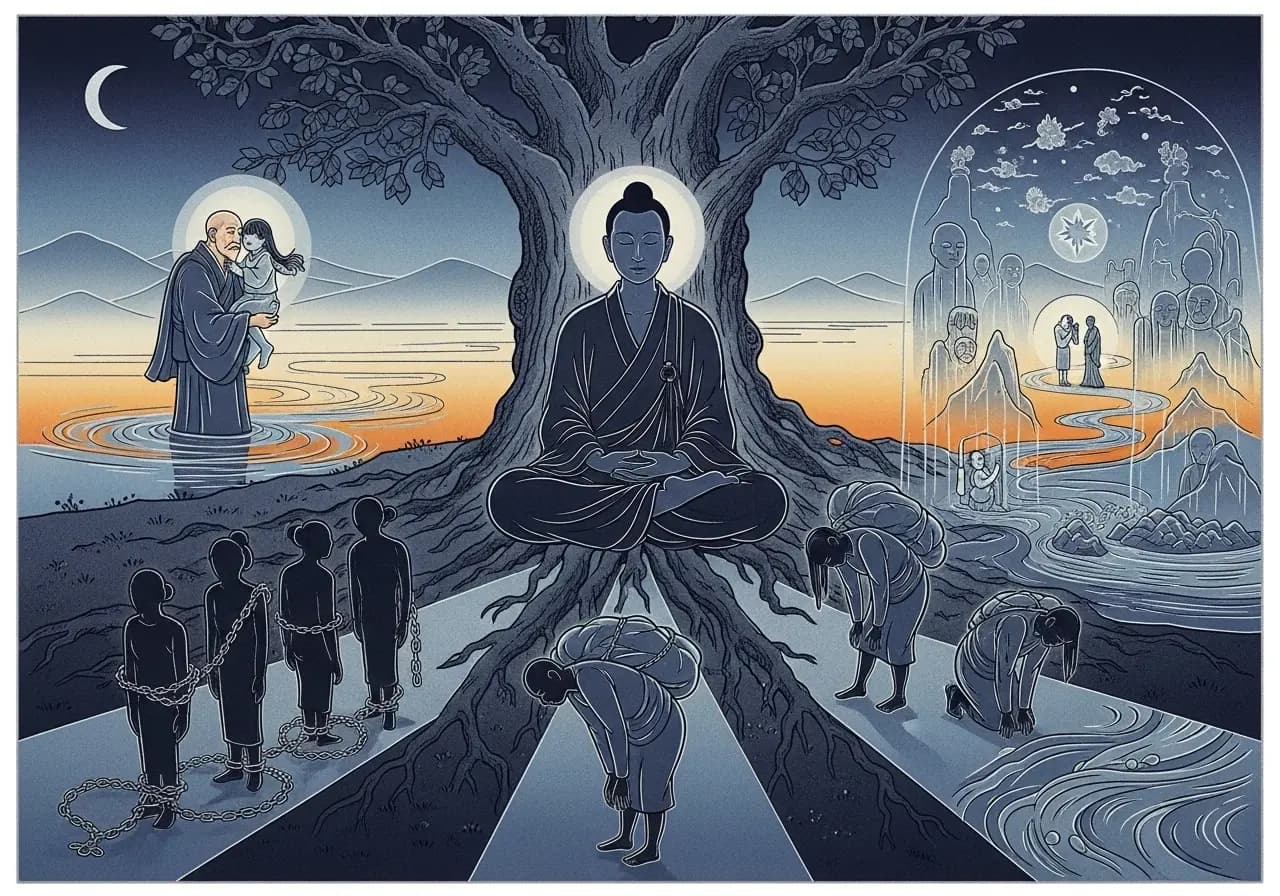
Imagine there are levels of morality. At the lowest level, we have adherence to rules and regulations laid down by someone else—a parent, a religious leader, a religious ideology or belief system, a political leader, or something along those lines.
Level One: Rule-Based Obedience
At this first level of morality, all you have to do is know what the rules are so you can follow them. This level really doesn't require a whole lot of personal thought or contemplation. You just need the rules, and then you need to believe in the authority that's giving those rules.
At this level, there's generally some kind of fear associated with breaking the rules. It's that fear that motivates compliance. For example, fear of burning in hell in the afterlife, or fear of being imprisoned by the state if you break the law. That's the first level.
Level Two: Internalized Rules
The second level of morality also includes rules, just as before. But now you may not have fear as the basis of adherence to the rules. At this stage, the rules have become internalized. You yourself are now the punisher and the enforcer. You're the one that smacks yourself when you break the rules.
So aside from simply fear, there may now be other feelings—guilt, for example. This level of morality is often where many of us tend to hover. We maybe start at the first level and then move into the second level once we've internalized the rules that society has imposed on us or that our religious views have imposed on us.
I see examples of this all the time. People want to know, "What does Buddhism say about this or that?" That's essentially a search for rules. They're thinking, "I'm coming across this system called Buddhism. That's the authority. Maybe this is an authority that I agree with or that I sympathize with. Now I want to know what the rules are that are laid out so I can decide if I agree with them or not." And every rule they find that they agree with reinforces the authority of the system.
For example, if I've already accepted Buddhism as a valid authority, then I want to know what rules that authority will give me. I found myself in this search for a while too when I was exploring Buddhism early on, trying to decide what the rules are and comparing those rules to my own logic, trying to decide what I think about each one. That's the second level.
Level Three: Ethics and Wisdom
Then there's this third level, which is significantly different from the two previous levels. At this level, I think it's better to refer to it as ethics rather than morality. Things start to change here.
Ethics is defined as "moral principles that govern a person's behavior or the conducting of an activity."
At this level, a person no longer adheres to a set of rules handed down by some authority. Instead, a person chooses to follow a path of behavior and conduct that is dictated by mindfulness, introspection, wisdom, and compassion. This level is not easy. It requires considerable effort to understand ourselves, to understand others, to understand reality as a whole. It essentially requires us to arrive at a unique understanding of what seems right given a particular set of circumstances or conditions.
For example, consider a neighbor during World War II who knows that there are Jews hiding in their home. When the Nazis come and knock on the door asking, "Are there any Jews here?" that person knows it's against the rules to lie. But they also know that it's appropriate to lie in this particular set of circumstances because there's a bigger picture taking place. That's just an example, but you can imagine what I'm trying to get at. This level of ethics takes into consideration much more than just black and white rules.
This level of ethics requires us to have greater perspective beyond our own limited view, our own point of view and understanding. So this level requires us to view, to the best of our abilities, the bigger picture. We try to balance our needs and the needs of others. And it requires us to understand our own relationship to the three poisons of greed, hatred, and delusion in order to gain a greater understanding of the other side of the story.
This level of ethics is about choosing the most appropriate set of actions that are ideal given the specific set of circumstances we find ourselves in. You can kind of see this level or this concept of morality in the famous story of the monk who carries the girl across the river.
The Monk and the Girl
If you'll recall that story, a senior monk had taken a set of vows or rules that he was adhering to: never touch a member of the opposite sex. He and a junior monk come across a girl at the bank of a river trying to cross. The senior monk decides in that moment that the skillful thing to do is to carry the girl to the other side of the river—and that's the end of that for him.
But the junior monk is operating at a lower level of morality. He adheres to a set of rules—in this case, a rule prescribed by the monastery and the system itself—that dictates never touching a member of the opposite sex. He's really troubled by the fact that the senior monk picked up this girl as if it was no big deal.
What you can see taking place here is two people at two different levels of morality. The senior monk, who is more at this third level, has no problem with what had to take place at the river. The younger monk, who is maybe at the second level of morality, continues to struggle with what he witnessed.
The senior monk then delivers that powerful lesson in the story, saying, "I put the girl down on the other side of the river. Why do you continue to carry her?"
That to me embodies this concept of levels of morality.
My Personal Practice
For me personally, trying to live a moral life is about being skillful with the relationship I have with my own thoughts, my words, and my deeds. Specifically, I try to understand myself and my tendencies, my desires, my aversions. Why do I desire some things and why do I have aversions toward other things?
I'm working with the areas of ignorance in my life—the things I know that I don't know, and the things I don't know that I don't know. All of these processes of becoming more introspective help me understand my sources of anger, hatred, or frustration.
The way to practice this form of ethical living is to continually strive to see the bigger picture. To see other angles. To understand the other side of the story. To understand others. And it requires a form of non-attachment to my own viewpoints, my own beliefs, and my own opinions.
In other words, when I can separate my own ideas, opinions, and beliefs from this sense of self that I have, I can become more skillful with dealing with difficult situations that require ethical choices or that we could say require morality.
A Common Objection
I bring all of this up because it's been brought up to me before—this concept or idea that if you don't have a rigid set of rules prescribed by a religion or motivated by a belief in a superior being or God, how could you possibly be a good person? A lot of believers have this mindset.
It's almost like saying: if you don't believe in an authority like God that gives us rules or commandments, isn't there a risk of no longer wanting to be a good person or doing good things? The implied line of thought is something like, "Couldn't you just suddenly want to go robbing banks and killing people?"
I like to usually flip the script and say, "Well, wait a second. Do you really believe that the only thing preventing you from robbing banks, killing people, kicking cats, or pinching babies is that you believe in God and you believe in a set of rules handed down from that authority? Is that the only thing keeping you from murdering people?"
If so, that's pretty scary. And I suspect for most people, they would agree that the answer is no. That's not the only reason.
So the invitation is: well then, why do you think that is? Where does your sense of right and wrong really come from? Where does your sense of morality really come from? I think that's a fascinating question to explore.
My Own Journey
When I was deconstructing my belief system and my faith, this was a situation I was suddenly faced with. Why are there certain things that feel right and feel wrong? And why do some of the things that felt right because of a specific rule or belief in a specific authority continue to feel right? Or things that feel wrong continue to feel wrong?
This has entirely been about me trying to understand me. I was trying to ask: what does morality mean to me? And that's the invitation with the exploration of this topic in this podcast episode with you.
The Invitation
What does morality mean to you? What are your personal ethics? In other words, what principles drive your thoughts, your words, and your actions? Do you simply strive to be obedient to the rules, or is there something deeper going on?
The quest in terms of mindfulness as a practice is to get to know yourself. And that's my challenge to you, my challenge to myself. Spend some time pondering this topic and asking yourself these questions.
Morality vs. Obedience
I feel like at the end of the day, perhaps morality is simply doing what seems right regardless of what we're told. And obedience is doing what we're told regardless of whether or not it is right.
There's a quote similar to that attributed to H.L. Mencken. After doing a little bit more research, there's no record of him ever having said it, although the sentiment is consistent with his line of thinking. So again, like all these quotes—quotes can be problematic because we just share them and they don't mean anything.
I wanted to personalize this one and state it as my way of thinking: I want to know which is more important. To try to be moral—and what does it mean to be moral? Or to be obedient—and what does it mean to just be obedient, and why? Which of those are more important?
Questions for Deep Introspection
In terms of this concept of levels of morality, I think it's cool to explore: what level do I feel that I'm at? Are there fears that motivate my behavior, my thoughts, and my actions? Is there the chasing after some kind of reward that motivates my behavior? Or perhaps there's something deeper—it just feels right. If so, why have I internalized it?
What would you do? What rules would you follow if you didn't believe there were any rules to follow? I think that's a really powerful introspective question to ask yourself.
Understanding a Dynamic Reality
That's the topic I wanted to explore in terms of levels of morality. From the Buddhist perspective, what we're always trying to explore is this understanding that life is dynamic. Everything is changing. In a world that's constantly changing, it's difficult to pin something and say, "Ah, this is good" or "This is bad."
You might be listening thinking, "Well yeah, but what about egregious things like child abuse? There are no conditions where that's good." And yes, I agree with you. I don't think the implication of a constantly changing world means that sometimes something will be good, though it seems really bad. That's not what we're trying to get at.
What we're trying to get at is this understanding: the source of what we consider to be good or bad is something internal. It's not an external thing.
The Final Invitation
So that's the perspective I would invite you to explore. Internalize this way of thinking by asking these questions of yourself: Where do my views of morality come from? What do I view as something good and something bad? And under what circumstances would something that seemed good maybe seem bad, or vice versa?
Because in that mental exploration, there's a lot you can learn about yourself. And that's ultimately the invitation here. What greater thing would you want to know than to know yourself? I think that's one of the most powerful realms of the universe that you can explore—you, your mind, your actions, your thoughts, and your deeds.
So that's my invitation to you.
Resources and Gratitude
As always, if you want to learn more about Buddhism, you can go back to the first five episodes of the podcast, or you can check out some of my books: No Nonsense Buddhism for Beginners, Secular Buddhism, and the Five Minute Mindfulness Journal, all of which are available on NoahRasheta.com.
If you enjoyed this podcast episode, please share it with others, write a review, and give it a rating on iTunes. And if you'd like to make a donation to support the work I'm doing with the podcast, you can always visit SecularBuddhism.com and click the "Donate" button.
That's all I have for now. But as always, thank you for listening. I look forward to recording another podcast episode soon. Until next time.
For more about the Secular Buddhism podcast and Noah Rasheta's work, visit SecularBuddhism.com