

The Five Hindrances
Episode 94 of the Secular Buddhism Podcast
Hello and welcome to another episode of the Secular Buddhism Podcast. This is episode 94. I'm your host, Noah Rasheta.
Today I'm talking about the five hindrances.
Quick Note on Workshops
Keep in mind: you don't need to use what you learn from Buddhism to be a Buddhist. You can use what you learn to be a better whatever you already are.
Before jumping into this episode's topic, I wanted to share a quick note. In the past, I've been working with other partners to develop content and curriculum that ties Buddhist concepts of mindfulness with specific topics. What I have in mind is a series of workshops, starting with a general Mindfulness 101 workshop that I'm working on now. When it becomes available, it'll be free for anyone to access. Then I'm planning a series of more specialized workshops on topics like mindful parenting, mindfulness in relationships, and mindful eating.
One of those projects is now complete. I've been working with my friend Page Smathers on a mindful eating workshop. We've done a couple of in-person workshops over the past couple of years that have been very successful, and we finally took that format and made it into an online version.
If you go to SecularBuddhism.com/workshops, you'll be able to sign up and take these various online workshops. The mindful eating workshop is now available and is hosted through Page's platform. I have a discount code for podcast listeners who may be interested in taking that online workshop. The code is "SecularBuddhism"—all one word.
You can stay tuned for future workshops coming out as well, also hosted on SecularBuddhism.com/workshops.
The Five Hindrances
Now let's jump into this week's topic. It's believed that the Buddha taught that there were five hindrances, or obstacles, to realizing enlightenment. These obstacles are commonly referred to in Buddhist teachings as the five hindrances, and that's what I want to talk about today.
The five hindrances are: desire, aversion, disinterest, agitation, and indecision.
These are mental states, and they're considered obstacles because they keep us from being mindful. In a way, they blind us by keeping us totally focused on them and preventing us from seeing things through a more skillful lens. Anger or aversion, for example, can often blind us from seeing the bigger picture and from understanding what's really going on in a situation.
I'll go through each one of these one at a time, but first I want to emphasize something important: the key is to understand that you can't just wish these things away. Instead, you spend time understanding them, learning to work with them, practicing with them. Rather than trying to push these things away, we allow them to naturally come and go without encouraging them to stay.
We don't want to repress or condemn these mental states when we experience them.
The Two Wolves
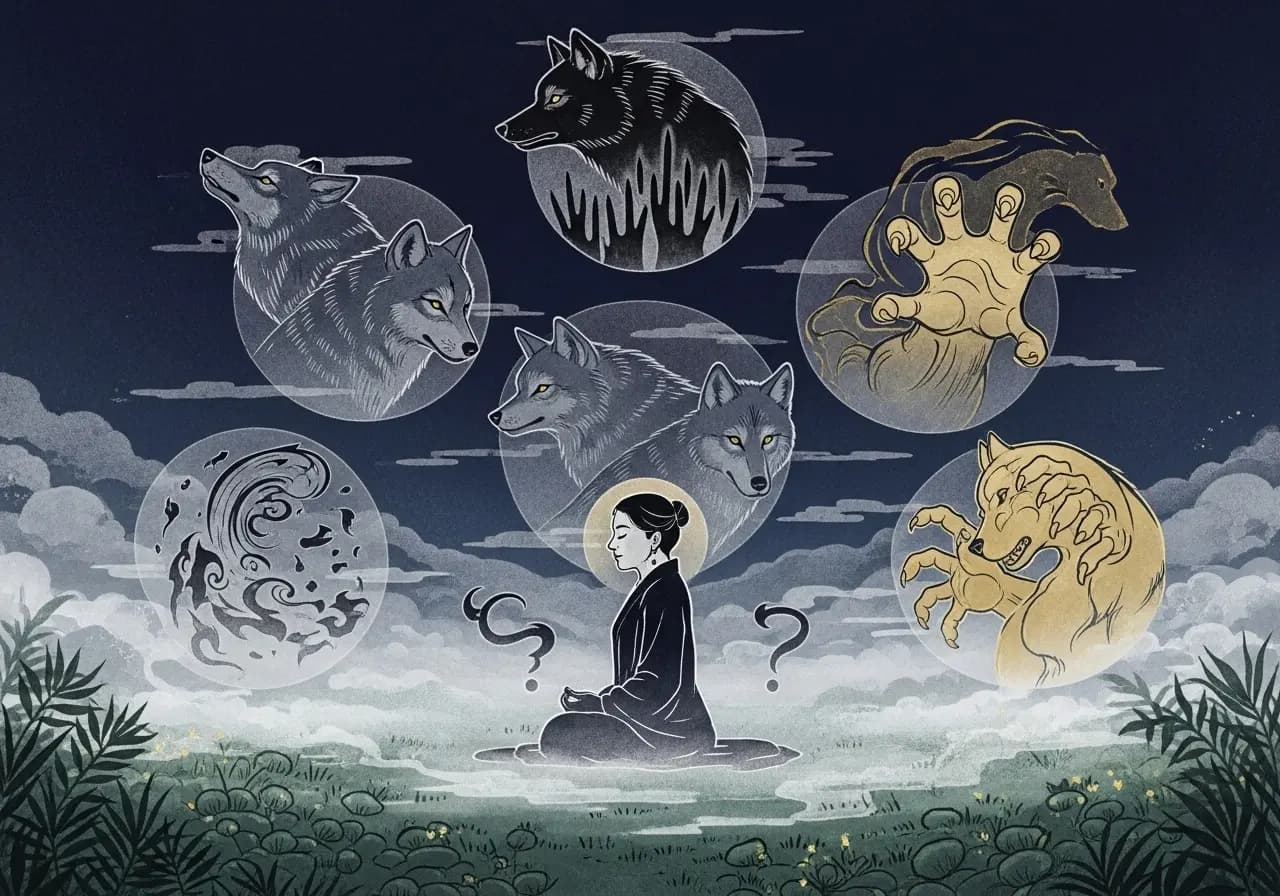
This reminds me of that old Cherokee teaching—I'm sure many of you have heard it. An old Cherokee teaches a young boy a lesson by saying there's a fight going on inside of him. And it's like there are two wolves: one is anger, envy, greed, superiority, and ego. The other is peace, joy, kindness, and compassion.
The boy asks, "Which wolf will win?"
The old Cherokee replies, "The one you feed."
The concept of "the one you feed" is important here. But rather than seeing this as two wolves—one good and one bad—imagine you have all these wolves inside of you, a whole pack. These mental states referred to as the five hindrances are like those wolves. Instead of just two, there are many. But similarly, the one that you feed and care for the most, the one you tend to the most—that's the one that ends up being the strongest.
Keep that in mind as you listen to these five hindrances.
The Irony of These States
And then take into account the irony in all of this: these are mental states that you create for yourself. But until you can perceive that, these mental states are going to be problematic.
In order to work with or practice with these five hindrances, you need to recognize when they arise, acknowledge that you're experiencing this mental state, and then understand that you and you alone are the one that makes this feel so real.
These states arise at any given moment. I'm here having a wonderful discussion with someone, and suddenly I desire to be somewhere else or doing something else. I may be doing the dishes and want to be somewhere else. Or I'm doing something pleasant, something that I enjoy, and desire kicks in—I don't want this moment to end. I can be watching a show and suddenly I'm bored or disinterested, watching it while browsing my phone and checking Facebook. Or I may want to change the channel.
All these are moments where we can practice with these mental states, these hindrances.
Practicing with the Five Hindrances
Desire
Let's start with desire, often referred to as greed. This is the desire to satisfy the senses.
When desire arises, we can observe it, we can try to understand it. We don't need to feel bad for experiencing it, and we don't need to fight it. In fact, fighting it often makes it take a more aggressive form.
What we do is observe it, watch how it makes us feel, how it makes us interact with ourselves and with others. We notice how it keeps us in this state of perpetual dissatisfaction. We're always wanting more, suffering from never having enough.
Desire isn't a bad thing. This isn't about good states versus bad mental states. It's just recognizing that when we're operating from the standpoint of desiring things and never having enough, it's an unskillful way to run your life.
So how do we practice with this? When desire arises, just try to observe it. We either desire after something—a sensory experience—or we may already be experiencing something and desire to prolong that experience. We don't want that feeling to go away, so we just practice noticing it. Observe and watch, then return to whatever you were doing before.
These things are often practiced in the context of meditation. Let's say I'm sitting here meditating and desire arises. It may be the desire to not be sitting here meditating. I can just observe it and notice it, then go back to what I was doing before, which is observing my breath.
But desire can also become an obstacle in meditation in another way. I may be sitting here meditating, wanting to experience some mental state—wanting to experience bliss, for example. And that becomes the obstacle. The point isn't to experience something; the point is to be aware of what arises, whatever arises.
So desire can be an obstacle if I meditate with the intent of achieving some kind of state. And this is kind of the big catch-22 in Buddhism in general, which I've referred to before. The very reason you can't attain enlightenment is because you want to attain it. The reason I can't be at peace in my life is because I want to be at peace in my life. Or I struggle with being patient because I want to be patient. It's the very wanting to be patient that is the definition of not being patient, right?
Keep that in mind when thinking about desire.
Aversion
The next hindrance is aversion. Aversion is like the opposite of desire. Aversion is resistance or the desire to push something away.
I'll experience something that's unpleasant—maybe physical pain, maybe someone says something unkind to me, maybe I'm in a situation that I don't want to be in. And my natural reaction is to experience aversion toward that thing. I want it to go away. I don't want to feel this way.
When we experience aversion, we're often coming from a place where we want things to be different than they are. So we practice by observing the aversion. When you notice you're experiencing aversion—you're pushing against something—just pause and observe it. Notice what it feels like. Notice how it manifests in your body. Notice what happens when you just allow it to be there instead of pushing against it.
Often our pushing against something actually makes it stronger. If you're angry and you try to push the anger away—"I'm not going to be angry, I'm going to be calm"—that struggle often makes the anger more intense. But if you can just observe it and notice it, often it will naturally dissipate.
In meditation, this might look like sitting there and experiencing discomfort—maybe my leg hurts, or I'm itchy, or I just want to move. My natural reaction is to experience aversion. I want it to be different. So I practice by just observing it. I notice the sensation without the story. There's a sensation in my leg. I can observe it without the narrative that says, "This is bad, I don't want this, I need to move."
When I separate the sensation from the story, often the aversion softens.
Disinterest
The third hindrance is disinterest, sometimes called sloth or apathy. This is a state where we lose interest or become indifferent. We may be trying to meditate, but we're bored. We may be trying to learn something new, but we just don't care. We may be in a conversation with someone, but we're not interested in what they're saying.
Disinterest can be tricky because it's often hard to notice. Desire is pretty obvious—I want something. Aversion is pretty obvious—I don't want something. But disinterest is like this subtle fog that creeps in, and suddenly we're not engaged.
When you notice disinterest arising, again, just observe it. Notice how it feels to be disinterested in something. Notice how it's different from aversion. With aversion, I'm pushing against something. With disinterest, I'm kind of checked out or withdrawn.
In the context of meditation, if I'm meditating and I notice I'm bored or disinterested, I might sit with that. What does it feel like to be bored? Where does the boredom exist in my body? What thoughts accompany it? As I just observe it, often the disinterest will shift.
The thing about disinterest is that it can often indicate that we're not fully present. We're going through the motions without really being here. So practicing with disinterest is also a way of practicing presence.
Agitation
The fourth hindrance is agitation, sometimes called restlessness. This is that state where we can't settle down. Our mind is scattered, our body is restless, we can't focus.
I may be sitting down to meditate, but I can't sit still. My mind is jumping from thought to thought. Or I may be trying to do something, but I'm just feeling anxious and scattered.
When you notice agitation, you might first pause and just observe it. Notice how your body feels. Notice how your mind is moving. Notice if there's anxiety underneath the agitation.
In meditation, when agitation arises, I don't try to force myself to calm down. That often makes it worse. Instead, I might acknowledge it—"Okay, there's agitation here"—and then gently return my attention to my breath or my body. Each time my attention wanders due to the restlessness, I gently bring it back. This is actually really good practice.
Agitation is often tied to our nervous system being activated. We're in a state of high alert or anxiety. So practicing with agitation might also involve noticing what triggered it. Sometimes external things trigger it—we had a stressful situation, we drank a lot of coffee, we're in a chaotic environment. And sometimes it's internal—our thoughts and worries are creating the agitation.
Indecision
The fifth and final hindrance is indecision. This is when we're stuck at a crossroads and we can't make a decision. We're paralyzed by the options in front of us.
In the Pali Canon, there's an example of someone walking in the desert on a path who comes to a fork in the road. They're gripped by indecision. Should I go this way or that way? Because of the indecision, they don't progress forward. They just stay there at the fork in the road and never move.
I think we do this a lot in our lives. We experience this with practices like meditation. We're trying to become better at meditating, so we sit there, and there's this mental conversation happening: "Hmm, is this really helping me? Why am I sitting here? Am I getting better at this? Shouldn't I be somewhere else doing something more productive than just sitting here meditating? No, I said I was going to do this, so I'm going to force myself to sit here. Well, what if I'm just being stubborn?"
I don't know if you've had this conversation in your mind, but the indecision prevents us from actually benefiting from the practice of just sitting there and meditating. And it also prevents us from just getting up and doing something else and being productive at that.
To practice with indecision, we simply become aware when it arises. We notice it, we observe. And we try not to stay stuck in it. You back up and observe. Okay, here's the fork in the road, here are the decisions. Notice how strong the impulse of indecision makes us want to not do anything, and how easy it is to remain there without having to make a choice.
If this takes place while meditating, just go back to observing the breath, observing the physical sensations of sitting there.
To me, indecision seems to be a common one at the start of wanting to do something, whether it's deciding to take up a meditative practice or deciding to go to the gym or eat healthier. We get stuck at this fork in the road, and then we just sit there with the indecision, and we never move forward.
Everybody's experienced that feeling: "I want to start going to the gym." And then it's like, "Okay, well when should I go? Should I go in the mornings or in the evenings?" And with every little fork in the road, it becomes easier to sit with the indecision, and years go by and you never adopt that practice because you just remained with the indecision.
This can happen with our goal of trying to live more mindfully too. We never do anything about it because we can't decide the best way to go about doing it.
How These Hinder Us
These mental states are happening all the time in all the things that we do, even the good or noble things like meditation. We pick up this practice and then we experience something we like. And now every time we meditate, we want to feel that thing that we felt that one time we meditated. That desire becomes the hindrance that prevents us from being mindful of whatever we're experiencing in the moment because we're blinded by comparing what we're experiencing to what we desire to experience.
And I think we do this in all things.
These hindrances ultimately blind us from being mindful of the present moment. Like all mental states, these come and they go. They arise and fade away.
As you continue to practice being more mindful, you'll perhaps notice these states more. And the trick is to not become attached to them. Just see the mental state as it is. Watch it arise, watch it eventually get replaced by another mental state.
Concentration is one of the skills that we develop to not allow these obstacles to prevent us from being more mindful. Concentrating on the skill of observing these mental states will allow us to develop a more skillful relationship with the mental state when we're experiencing it.
Practice Invitation
I'd invite you to give this a try this week. See what happens when you notice instances of desire, aversion, disinterest or apathy, boredom, agitation, and indecision.
Ask yourself: Are there areas of my life where I'm experiencing these things? Are these acting as obstacles for me in this facet of my life, in this relationship, or in any aspect of my life?
If they are, sit with it for a moment and notice what may be the underlying cause of experiencing this mental state. And again, not with the intent of "okay, then I'm gonna change it," but with the intent of "okay, I really want to understand this. This is what I'm experiencing, and I want to understand why I'm experiencing it."
If you can't get to the why, at least understand how this is affecting you and your life. How is this affecting others around me? Just from the perspective of observing—imagine you sat down with a little notepad and you're just observing and taking notes.
What does this look like? What does this feel like? What is this causing? Where is this coming from? Where will this go? And you're just noticing.
As with all things that we practice with mindfulness, you're trying to understand you and yourself. And I think that's one of the greatest mysteries out there. Of all the unknowable things in the universe, how incredible is it that perhaps one of the most mysterious is understanding our own selves? The motives behind why we do what we do, say what we say, think what we think, and believe what we believe—inside of you is a fantastic mystery.
You can become a little bit better at understanding yourself, and that's where this whole premise of becoming a better whatever you already are kicks in.
Spend time looking inward, practicing and noticing these hindrances. Do these things manifest in a way that they may be hindering? Or as an obstacle to experiencing something that you didn't know you could experience, or to seeing something that you didn't know you could see?
Again, internalize all of this. Make this about you, your quest and your journey to have internal or inner peace and understanding yourself better. I like to always take it back to that. We're trying to turn inward. We're not turning outward on these things.
So those are the five hindrances, and that's how you would typically practice with those hindrances.
Closing
As always, if you want to learn more about Buddhism and mindfulness, you can check out No Nonsense Buddhism for Beginners, one of my books, Secular Buddhism, or the Five-Minute Mindfulness Journal. Information on those is available on NoahRasheta.com.
If you enjoyed this podcast episode, please share it with others, write a review, and give it a rating on iTunes. If you'd like to make a donation to support the work I'm doing with the podcast, you can visit SecularBuddhism.com and click the donation button.
That's all I have for now, but I look forward to recording another podcast episode soon.
Until next time.
For more about the Secular Buddhism Podcast and Noah Rasheta's work, visit SecularBuddhism.com