

Stepping into Groundlessness
Episode 93 of the Secular Buddhism Podcast
Hello. You are listening to the Secular Buddhism podcast, and this is episode number 93. I'm your host, Noah Rasheta, and today I'm talking about stepping into groundlessness.
Keep in mind that you don't need to use what you learn from Buddhism to be a Buddhist. You can use what you learn to be a better whatever you already are.
The Invitation to Think Differently
Buddhist teachings and concepts often challenge us to think differently about life. They challenge us to question the stories that we've come to believe about ourselves and about reality. The concept of stepping into groundlessness certainly does this for me.
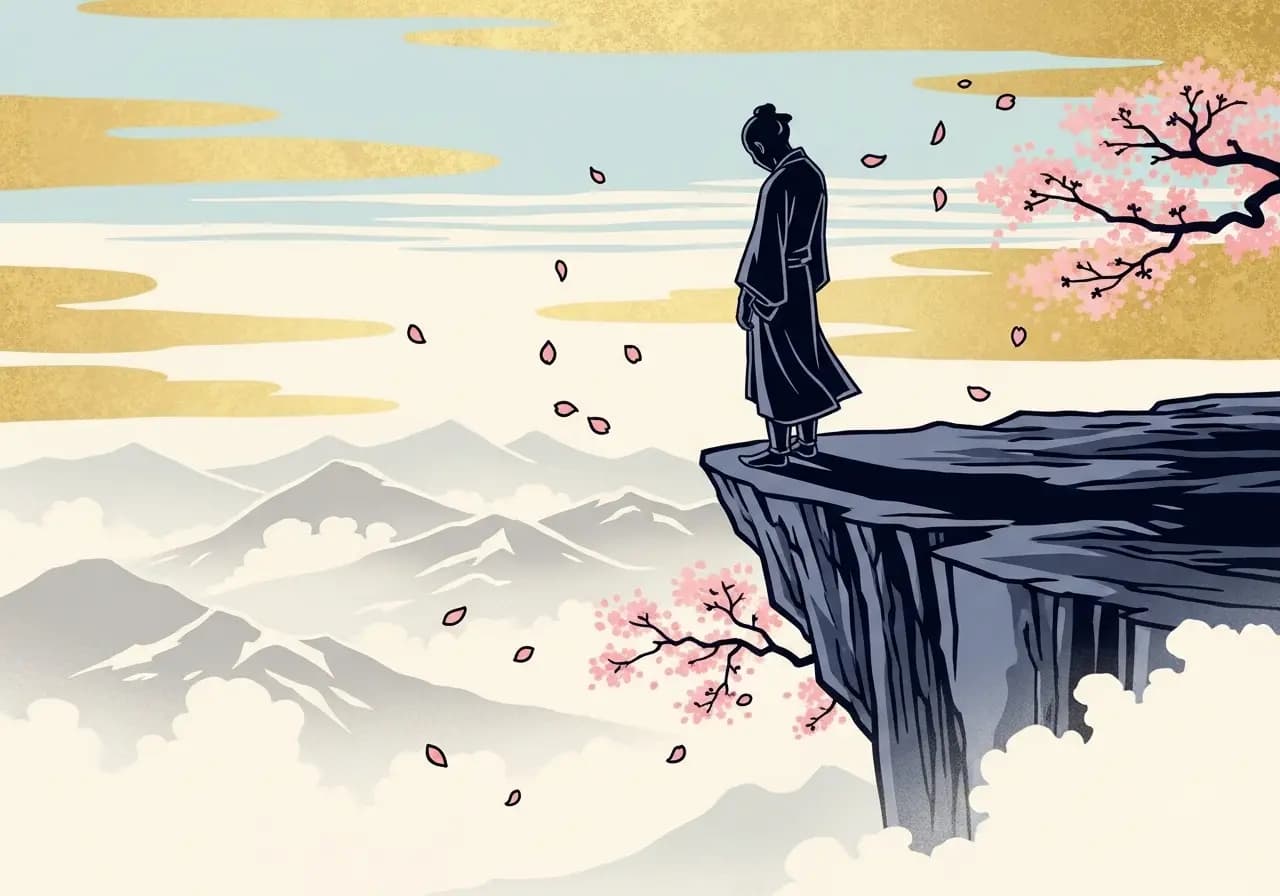
So imagine standing at the edge of a precipice. If you're like me—and I'm someone who practices paramotoring and paragliding, so I spend a lot of time in the air—you might think I wouldn't be afraid of heights. But I'll tell you, when you put me on the edge of a cliff looking down, I feel a sense of insecurity and fear. I feel this strong desire to be holding tight to something firm, like a handrail or a tree, anything really. And if my kids are there with me, it's even more scary. I don't want to let anyone else close to that edge.
I think that feeling of fear standing at the edge of a cliff is very similar to the uncertainty we face in life. The precipice becomes a metaphor for the groundlessness that we're all experiencing all the time, whether we recognize it or not.
In this podcast episode, I want to echo some of the sentiments that are expressed in Episode 78, "No Hope, No Fear," and in Episode 88, "Radical Okayness." I want to address the concept of groundlessness—this teaching that I first encountered reading some of Pema Chödrön's work.
The Illusion of a Firm Foundation
I grew up with the analogy of the dangers of building a house on sand, you know, the wisdom of building a house on rock. That's sound wisdom. But what happens when we realize that we live on a planet made entirely of sand, and everything is shifting and changing all the time? Suddenly there's this realization that the idea of a firm foundation is itself an illusion.
This is something I experienced in my life many years ago, and a friend of mine experienced this recently. Fear is a universal experience. I think it's a natural reaction to seeing reality clearly—a reality where things are impermanent and we begin to understand that we have no control over what happens next.
These are the moments where it seems the rug has been pulled out from under us, and what seemed like a solid foundation suddenly gives way to a very real sense of groundlessness.
Some good friends of ours had a recent experience with their son, who was in the backyard and fell fifteen feet and fractured his skull. It was a big deal. He was rushed to the ER, and fortunately he's doing well and recovering, but this was a very near catastrophic end. His mom was understandably upset and shaken.
What was interesting is how this experience caused her to question many things taking place in their life. They had just purchased a home. Were they doing the right thing? Questions of that nature. It's like the rug of comfort and security had been pulled right out from under her. Suddenly she was experiencing this feeling of freefall with nothing to hold on to.
I think these are the moments of insecurity where we start to see how unsolid our foundations really are. This is the very start of stepping into groundlessness.
The Nature of Impermanence
Thich Nhất Hạnh, the Zen monk, says it's not impermanence that makes us suffer. It's wanting things to be permanent when they are not. We all experience this at one point or another. We have, we are now, or we will at some point experience these close calls. Or it could be the actual loss of a loved one. These are unexpected Tetris pieces that show up and seem to smash up and rip holes into the stories that we've been enjoying so much about life—the stories we have about ourselves and others and about life in general.
And it's happening all the time. I don't think this concept of groundlessness, this teaching, is meant to make us feel pessimistic or negative or fearful. But it is an invitation to be able to learn to step into groundlessness now, before life inevitably pushes us near the edge of that cliff where suddenly we find ourselves in freefall.
Often when we're pushed into those moments, we lose it. We panic. We do really unskillful things. But if we can practice stepping into groundlessness now, we'll be better equipped to handle those moments when they come.
In Pema Chödrön's book The Places That Scare You, she says we can try to control the uncontrollable by looking for security and predictability, always hoping to be comfortable and safe. But the truth is that we can never avoid uncertainty. This not knowing is part of the adventure, and it's also what makes us afraid.
I really like that quote. The not knowing is part of the adventure, and recognizing this is also what makes us afraid. Moments where we feel fear and insecurity and uncertainty are moments that can highlight just how fragile life really is. They highlight our priorities and the things that matter most to us.
My Own Journey with Groundlessness
I remember experiencing this in my own life, the first time I had that rug pulled out from under me. I felt that feeling of falling. I was spiraling in my thoughts, and the fear and the uncertainty felt unbearable. Everything that seemed so solid and stable was gone in my life.
I remember encountering this concept of groundlessness, and I remember recognizing the strong aversion I had towards the fear and the uncertainty that I was feeling at that time. I remember thinking, "I can't possibly be facing the fact that the nature of reality is insecurity and unknowing. No, no, no, not me. I have to know. I have to have this firm foundation under my feet again."
I was determined to regain my footing on solid ground. Around that time in my life, I started reading and exploring, and I first encountered Buddhism. At the time, it seemed to me like all these ideologies and religions out there had answers for me. That wasn't the problem. There were plenty of answers. I just had to find the one that made the most sense to me—the one that could fit into the story or the narrative that I had come to believe about the nature of reality.
The more I was exploring these big solid existential questions like "Who am I?" and "Why am I here?" and "Where am I going?"—the more I read about Buddhism, the more it seemed like it was asking a different question: "Who wants to know? Why do you want to know these things?"
With time, that became the bigger question for me, the one that led me to understand myself first as the seeker. It was like suddenly what I was looking for was who was looking. This was a really profound shift for me. To me, this gets at the heart of stepping into groundlessness.
Befriending Fear and Uncertainty
I remember asking myself, "What if I wasn't afraid of being afraid when it comes to comfort? What if it was okay to be scared? What if it's okay to be afraid of not knowing?"
I realized there was a shift happening. The problem wasn't that I didn't know. The problem was that I didn't like that I didn't know. So I started to sit with these emotions, and when they would surface—as they often do at different stages of life—I began to invite these feelings and emotions in as if they were old friends.
I began to understand them. Over time, I can honestly say I've befriended my fear and my insecurity and my unknowing. And when you befriend something, when you stop running from it, it loses its power over you.
There's this practice I began doing where I would sit and I would ask myself all these uncomfortable questions: "What if one of my kids got sick? What if one of them died? What if my marriage doesn't last? What if my parents or siblings die before I'm ready?"
These are deep, troubling questions that we often avoid because they're extremely uncomfortable. We don't like to feel what we feel when we think about these questions. But for me, this has been at the heart of my practice. And what I've found is that when I lean into these questions, when I'm willing to feel what comes up, something remarkable happens.
In those moments, I suddenly feel completely grounded in this state of groundlessness. It's like "I don't know, but I do know that right now life is like this." Suddenly the present moment seems so unique and so precious. And that doesn't mean it's pleasant or good. It just is.
I find myself experiencing that sense of radical okayness that I've talked about before. I've come to find that the fear of uncertainty has become the bedrock of my stability, of my mental stability. In other words, my firm foundation is that I don't have or need a foundation.
I'm comfortable now with the freefall. I have no certainty of what comes next. I've literally found that the feeling of uncertainty, that feeling of the freefall with nothing to hold on to—that's become my normal, natural place of peace.
Living Without Needing to Control
That doesn't mean I go through life without wanting to make goals or without plans or being blown in the wind. It doesn't mean that. It just means that I try to live my life willing and ready to shift at a moment's notice. I'm constantly analyzing my Tetris game and I'm ready to adapt. I'm ready to adjust to whatever that Tetris game is going to throw at me.
It makes me feel radically okay with the game the way it is now because I'm always thinking of how the game could be. It's not that now. It's this. And with all that uncertainty, with all that fear, and often with my unconscious attempts to make life be different than how it is—in the middle of all that chaos—every now and then I pause and I find this overwhelming sense of gratitude for life just the way it is.
It's like there's a part of me that suddenly, even if just momentarily, has no desire for things to be different. And I'm grateful. I'm grateful for the fact that I'm experiencing this.
Forgive me. I get emotional exploring these concepts because I know myself so well and I know where I've been in my life. I know the stages that felt so painful, and I felt so much aversion to that pain. Now I can look back at those moments with a smile, thinking, "I am the way I am now because of everything that I've been through."
To me, this is stepping into groundlessness.
Beginning with Hopelessness
It begins with having a sense of hopelessness. I've talked about this concept before, but I want to share here Pema Chödrön's wisdom. She says:
"Hopelessness is the basic ground. Otherwise, we're going to make the journey with the hope of getting security. If we make the journey to get security, we're completely missing the point. We can do our meditation practice with the hope of getting security. We can study these teachings with the hope of getting security, and we can follow all the guidelines and instructions with the hope of getting security, but it will only lead to disappointment and pain. We could save ourselves a lot of time by taking this message very seriously right now. Begin the journey without hope of getting ground under your feet. Begin with hopelessness."
I love that sentiment that Pema shares. I feel like that's where I have found myself to have landed—in this space of hopelessness and groundlessness. I almost have to laugh when I say it because these words have negative connotations in our way of thinking, in our society. Nobody wants to be hopeless. Nobody wants to be groundless.
And yet the peace that we so desperately seek is found in that groundlessness and in that hopelessness. I can say that because that's exactly how it's been for me. I find myself in this place of radical okayness and contentment with the uncertainty, with nothing to hold on to, as I experience the freefall, as I experience the shifting sands beneath my feet, where life is constantly changing.
I have no control over the big Tetris pieces that are going to show up inevitably in my life.
An Invitation to You
So my invitation to you this week—and perhaps an invitation from now on—is to try to identify these moments of groundlessness. Notice the moments where the game seems to shift, and observe how quickly you tend to shift the story to have some sense of certainty and security again. Notice how you're clinging for that certainty and security. Notice how illusory that is.
Then try to ask yourself: What if I didn't need the sense of security? What if I could become comfortable with insecurity? What if I could find comfort in the shifting sands, comfort in the freefall, comfort with just not knowing?
I think you'll find in these moments that you actually have a lot of faith and trust in yourself. Not the kind of faith that says, "Oh, things are going to go my way. Things are going to be okay," but faith in the sense of your ability to adapt and to handle whatever life is going to throw at you.
Because when you have that sense of security in yourself, then suddenly it's not the circumstances that matter. It wasn't about the Tetris game. It was about your ability to play the Tetris game. And I think that's a fundamental, radical shift that we can all start to experience that produces a strong sense of peace.
Because it's no longer about the game or the pieces. It's about me and how I'm playing the game and how I'm handling the pieces, knowing that there will be times when it's completely pleasant and fun, and times when it will be completely chaotic and scary and I'll be insecure. And all of that's part of the game and how I handle the game.
Bringing It All Together
I wanted to correlate all of these concepts that I've discussed before—groundlessness, no hope, the Tetris analogy, radical okayness—and just see if I could mesh them all into one cohesive narrative. I hope it helps you understand what we're all facing, which is that we're all standing at the edge of the cliff holding on desperately to whatever we can hold on to, thinking that's going to prevent us from eventually falling.
The nature of reality, the nature of life, is that life eventually pushes you. And there you are in the freefall, like Alan Watts has talked about. It's like we've all been pushed off this cliff, and that's our life. We're falling. Sometimes we're clinging to things that we think are going to be beneficial when in reality they're not. We let go of them and we're still in freefall and nothing changes.
So this is the concept of groundlessness.
Further Reading
There are a few fascinating books that address this overall concept. If you want to explore this a bit more, check out The Wisdom of Insecurity by Alan Watts, When Things Fall Apart by Pema Chödrön, or Fear by Thich Nhất Hạnh. Those are a few that come to mind as I explore this concept with you.
Closing
If you want to learn more about Buddhism and mindfulness, you can always check out my books: Secular Buddhism, No Nonsense Buddhism for Beginners, and The Five Minute Mindfulness Journal. Those are all available on NoahRasheta.com.
If you've enjoyed this podcast episode, please feel free to share it with others, write a review, and give it a rating in iTunes. If you would like to make a donation to support the work I'm doing with the podcast, you can visit SecularBuddhism.com and click the donate button.
That's all I have for now, but I look forward to recording another podcast episode soon.
Until next time.
For more about the Secular Buddhism podcast and Noah Rasheta's work, visit SecularBuddhism.com