

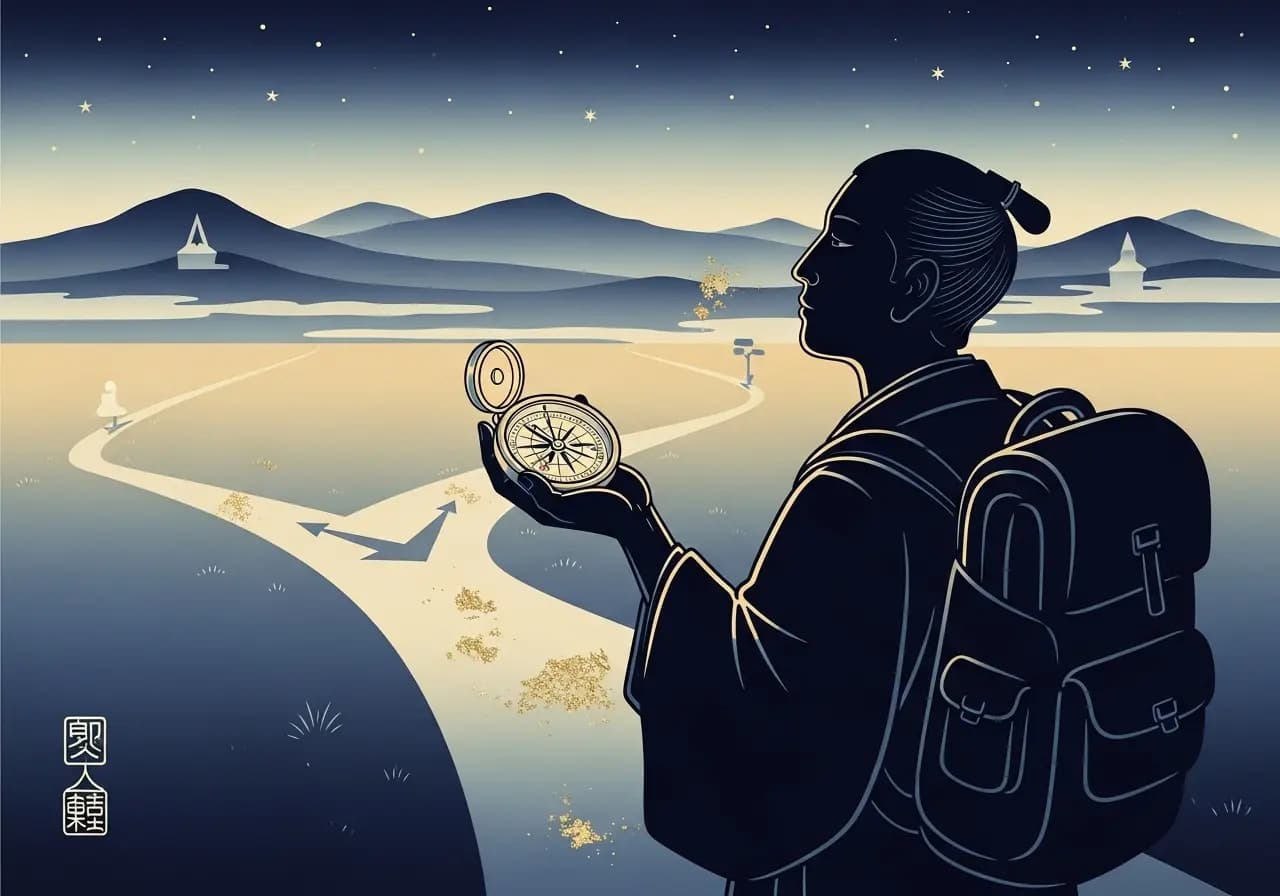
Your Inner Compass
Episode 92 of the Secular Buddhism Podcast
Hello and welcome to another episode of the Secular Buddhism Podcast. This is episode number 92. I'm your host, Noah Rasheta.
Today I'm talking about your inner compass. And I want to keep in mind that you don't need to use what you learn from Buddhism to be a Buddhist—you can use this information to be a better whatever you already are.
The Origin of This Concept
In this podcast episode, I wanted to share an experience I had last week while traveling. I think this concept of the inner compass fits really well with Buddhism in general.
I was traveling to a fly-in, which is a get-together of pilots who want to fly together. I had already spent one week in Arizona training a new group of paramotor pilots. I had five new students, and I was teaching them how to fly. Right after that event, I went with my twin brother, and we met up at this fly-in south of Maricopa in Arizona.
The location where we were meeting to fly was way out in the middle of the desert—about 20 miles of driving through dirt roads to arrive at this airport where we were training. I noticed something interesting during that drive. I had my GPS navigating for me, and I'd been using it every day prior to going to the fly-in just to get from the Airbnb I had rented to the airport where I was training the students. It was an eight-day training.
On about the fourth or fifth day, it occurred to me that every morning I would still do the same thing. I would punch in the airport and the Airbnb into the GPS just to help navigate my way out of the residential area and onto the road to make sure I wouldn't miss the turn to arrive at the airport. And I thought, how interesting that after four days, I still didn't really know my way. I was just trusting the GPS to tell me every day how to get home and how to get to the airport.
I began to wonder: why is it that the more time I spend depending on something like the GPS, the less skilled I become at trusting my own navigational abilities and my own instincts? In some ways, my ability to navigate becomes weaker—or lazier, I'm not sure what the right word is—by depending so much on this GPS.
I had this frame of mind in my head as I navigated at the end of this training session to go meet these people in the middle of the desert to spend a few days flying.
The Desert Navigation
On our way out there, I was leading my specific group because we were all meeting at different times. I have a truck that doesn't have four-wheel drive, and I'm pulling a trailer full of paramotors. I was just following the GPS navigation when I noticed that at one point it said to turn here. I slowed down—these are all dirt roads—and I looked down that road. I analyzed for a moment the ability I had to go down that road, and I realized there was no way I was going to make it. I'd get stuck if I tried to go down that road, knowing that I don't have four-wheel drive and knowing that I'm hauling a heavy trailer.
So I kept going straight. The GPS tried to reroute me, and then it said, "Okay, now turn on this road." No, that didn't work either.
It was a combination of following what the GPS was telling me to do and using my common sense—my ability to analyze what my vehicle is capable of—to keep finding the appropriate path until I made my way to the airport. And I finally got there.
When I arrived, I noticed it was very common for other people to share their stories of how they got there. Some people were routed going the south way, and there were several people who got stuck on the way.
I had this thought, and again correlating this to Buddhist teachings and to my own personal Buddhist practice: when we rely on an external source to navigate us like a GPS, in a way we become less skilled at using our own internal compass to navigate us.
These are extreme examples, right? The majority of the time the GPS is right. But knowing that it's not right all the time allowed me at one point to question the GPS and say, "No, I don't think I'm going to turn down that road." Someone else did turn down it, and they got stuck. It took them an hour to dig them out. A lot of people had that problem. They just followed the instructions, and it didn't work for them.
On a spiritual level, I feel like Buddhism is an introspective practice that's trying to get us to be better at navigating on our own. Using an extreme example, right? We have the GPS—it's super convenient. But how much more skilled is someone who doesn't need a GPS? They can just look outside, and they can tell you which way is north and south, east and west. They can navigate using the stars or by feeling the winds or however people do that.
I thought, "Oh, that's interesting. That's kind of like what Buddhism is trying to accomplish with us in a spiritual sense." The goal is to be able to rely on your own navigation skills, to be able to look around and know which way to go without relying on some external source that's telling you, "Turn here, don't turn there, do this, don't do that."
I really liked correlating that idea in my mind.
My Own Spiritual GPS
I have had the experience of just trusting a spiritual GPS system. For many years of my life, it made everything very easy. It just told me, "Do this, don't do that. Turn here, don't turn there." And it worked really well.
It wasn't until circumstances had changed—just like in my car, right? Had I been in a four-wheel-drive vehicle like a Jeep and not towing a trailer, I would have just followed that GPS, and it never would have occurred to me to question it. But I was self-aware enough to know my vehicle cannot handle what this is telling me to do.
I correlated that to my own experience in my life. Circumstances had changed to the point where the spiritual GPS was saying, "This is the right path for you." I looked down that path and thought, "This does not seem like the right path for me."
I want to be clear on the definition of "right" here. It's not that the path is objectively wrong. It's still the right path for someone with four-wheel drive—sure, take that road. But it was not the right path for me and where I was at that specific phase of my life. And I still work on this process for myself. I don't use the spiritual GPS anymore. I navigate now using an entirely different system: my inner compass that's telling me this is the path, this is where you should be. This is a more skillful way to navigate this path that you're on.
But it's not about being the right path. It's about being the skillful path for me.
Right Path vs. Skillful Path
I've made this connection before in other podcast episodes. Someone may be on one path, and you look at them and say, "Yeah, okay, they've got a backpack. They're carrying water in that backpack. They've got hiking boots and hiking poles. Yep, that is the right path for you." And then you look at that path and you look down at yourself and realize, "Well, I'm wearing flip-flops, I'm wearing shorts, or whatever else. I think that's not the skillful path for me to take. I'm going to stay on this other path that's more flat or has a handrail or whatever it is."
I think that's a lot of what Buddhism is trying to instill in us—the introspective nature of the practice. The goal is for you to be able to look and constantly make this assessment: Is this the skillful path for me?
This is why I would tell some people, "No, Buddhism is not the right path for you. Or any other ideology—this might not be the right path for you, but it might very well be the right path for you." Instead of entertaining which is the right one, what if we entertained this whole concept of which is the skillful one for you?
And not just for you in general, but for you right now. What may have been a skillful path a year ago is no longer a skillful path today. What may be a skillful path today—you'll find yourself in a few months saying, "This perhaps isn't the most skillful path anymore, and now I'm going to reevaluate another path that may be more appropriate."
Think about how much more healthy it would be if we entertained these big concepts—like paths and spiritual paths—in the context of space and time, here and now. What works today is what matters. And don't make these things feel permanent. "That path has always worked, so it should continue to work." Or "This path doesn't work right now, so it will never work." Maybe it will work in a year, but it doesn't right now.
And again, I cannot overemphasize the fact that even Buddhism is included in this. This path is not for everyone.
When I encounter people who say, "Oh, I'm really enjoying all this, and I'm sitting here meditating, but it's so hard and I'm really struggling with this," I ask, "Well, then why are you doing it? If you don't struggle with sitting and meditating, try to not sit and meditate. Do something else. You don't have to be doing what everyone else on this path is doing."
The Two Pilots and What We're Looking For
I wanted to correlate these ideas with another experience I had while on this same trip. When I first arrived at the airport and was meeting with all the other pilots, one pilot came up to me to talk about an experience he had.
He said, "Hey, did you encounter anyone on your way in here?"
I said, "No. You know, it was going slow under rough roads, but I didn't see anyone."
He said, "Well, I came the south way." He came in that south way that was kind of difficult to navigate, and the roads were washed out at several points. He said, "I'm driving along and I realize I'm not going to be able to keep going. I might get stuck. And then out of the blue, this young Hispanic kid shows up on a four-wheeler."
And here's what I thought was interesting. Right away he said, "You know, sometimes people like that show up and they're trying to distract you so that they can steal from you." Sure enough, the kid grabs his phone and puts it in his face, saying stuff. He doesn't speak English, and he's just holding his phone in his face, saying, "Uh, no work, no work."
And of course, this first pilot is paying close attention to the kid's other hand because he's expecting him to use sleight of hand—showing the phone while his other hand reaches into the back of the truck to steal something. So he finally said, "No, no, no, no, go away." The kid went away, and the pilot found another way to the airport.
He thought it was strange and wondered if anyone else encountered this guy out in the desert who could be trying to steal their stuff. As he's telling me this story, in my head I'm thinking, "Well, that doesn't sound right. It's not like you have random people in the desert on four-wheelers stealing stuff." But I let him tell me the story, and when it was all over, he left.
And I thought, "Huh, it's interesting how we tend to see what we're looking for." He was expecting that if this person fit his description in his head of a criminal or a scary person, then of course that's what he was looking for.
The Other Perspective
This is the best part of the story. About thirty minutes later, another pilot came up to me and said, "Oh man, I was stuck out in the desert for hours, and it started raining. Out of the blue, this young Hispanic guy shows up on a four-wheeler, and he's got his phone and he's saying stuff. Then I realized what he's saying in Spanish—the phone is translating to English. So I looked at his phone and read the message, and it said something like, 'I can help.'"
So the pilot said, "I was really confused, and before I knew it, this kid was under my truck digging with a shovel. He spent an hour digging me out of this sand trap I had pulled into. And it was raining, and he didn't have a raincoat. He didn't care. He was just there digging me out."
Sure enough, the kid tied a rope to the truck and used his four-wheeler to help pull it out. Come to find out, this kid is a ranch hand for one of the local ranches that has goats. He kept trying to say "goats" and explain what he does, and long story short, the pilot got out of there and was so thankful this random guy came out of the blue and was willing to help.
I was laughing as he was telling me this story because I was just thinking the other guy who had just come by had a whole different story. It was very likely it had to be the same kid—a Hispanic kid on a four-wheeler out in the middle of the desert with a phone.
What We're Looking For Is Who Is Looking
So again, it got me thinking along the lines of this concept: we tend to see what we look for. One person in that experience was looking for a crook, and he saw a crook. He saw this kid trying to do sleight of hand. The other one—well, he wasn't really looking for anything, but he wasn't looking for a crook either, and he didn't see a crook. He saw a savior who came to dig him out of the dirt. It was the same guy.
Now I don't want to highlight this story just because the right way was to look for the good in people. That's not what I'm saying. This could have been the opposite too. You see this good-natured person and trust them, and they really do steal from you. You didn't see it because you were looking for the goodness and didn't see the red flag that they were a crook or something like that. It could have been backwards, right?
That's not what I'm saying. All I'm trying to get at is that we do have the tendency to see what we're looking for.
I think this is why there's an expression in Buddhism that I really like. It often says, "What you are looking for is who is looking." That to me is a really profound expression that goes with this whole concept of the inner compass. It's like the thing you're using to try to navigate or to try to see—in reality, what it is, what you're looking for is the thing that's doing the looking.
That to me is a fascinating concept. You want to understand how the compass works? Study a compass. You want to understand the way that you see the world? It's not by studying the world. It's by studying you, yourself, the way that you see.
And all of this to me wraps up really nicely with almost every other Buddhist teaching. At the end of the day, what we're trying to accomplish is to have a greater sense of awareness about ourselves, about the way that we perceive the world. Why do I see it the way that I see it? Why do I feel the way that I feel and say what I say and do what I do?
I'm constantly trying to put this into practice in my own life in moments when I can catch myself experiencing emotions, especially strong emotions. Just yesterday I was noticing how much more impatient I was feeling with my kids. I catch myself in those moments, and I don't feel a sense of guilt or badness for being an impatient dad—everyone feels that at some point.
But what I did notice right away is: Why am I so much more reactive than normal? I took a moment to put myself in a timeout. I went and sat down in a room, and first of all, I just sat with this discomfort because I was feeling really irritated. I noticed right away that I was irritated about being irritated.
So I sat with the irritation, and the longer I sat with it, the more understanding arose. I noticed, "Okay, I just got home from a really long trip. I had spent twelve hours driving. It was a stressful drive because I hit several pockets of snow, and I had slid off the road once and had to be pulled back onto the road. A lot had happened in those previous twelve hours." And I was more reactive than normal.
But I was able to identify all of that and sit with those emotions for a moment and then sit with the impatience I was feeling. It didn't make the impatience go away, but it made me more capable of sitting with that emotion and not having to react.
Flipping the Switch
And I think that's what this concept of the inner compass is getting at. It's introspective. It's about flipping the switch, so to speak—switching from looking outside of myself at something to tell me what to do, what not to do, where to go, when to be there, all of that. And instead putting up a mirror where you essentially learn to look inward and you discover that inner compass.
I've talked about this concept of faith before in a Buddhist context. It's not that we have faith in something like the Buddha or in meditation or prayer beads or your meditation cushion or whatever that thing is. It's not about that.
The faith that we often talk about in the Buddhist context is the faith that you have in your ability. Using again this inner compass, it's like the difference between saying, "I have faith in my GPS system. It's never going to get me lost," versus having faith in yourself. For some religions, that's exactly how it is, right? The GPS system may be some form of revelation, or it may be a set of scriptures, or a preacher, or whatever it is.
Buddhism is trying to take that and say, from our perspective, what we're trying to develop is faith in our own ability to navigate. If I'm out there and I don't have a GPS, or maybe I do, but I decide that this doesn't look right, I'm trusting my instinct. The GPS says, "Turn here," but I'm saying, "No, don't turn here." And my faith is in me, my ability to make that decision.
Could I be wrong sometimes? Absolutely. Could the GPS be wrong sometimes? Absolutely. But what I have faith in is my ability. Even my ability to have made the wrong turn and gotten stuck—I'd have faith in my ability to get unstuck by going and finding help, or eventually digging myself out, or anything along those lines.
The Inner Compass Practice
So that's what I wanted to present: this concept of the inner compass from a Buddhist standpoint—developing faith in your ability to find your way. Whether that means that with time you become good at navigating with the stars, or you can orient yourself by looking at your landscape. Mountains are to the north, valley is to the east, or whatever—versus relying exclusively on some external source like the GPS.
While the GPS may be highly accurate, and maybe for some people in some circumstances they'll never ever need to question it because they live in a place where the signal's always accurate and the GPS is always updated, heaven forbid you ever find yourself in a circumstance where the GPS doesn't know what to do. Some people might be totally lost and completely incapable of questioning the GPS, much less doing the opposite of what the GPS is telling you to do.
And that's where I think Buddhist practice is coming in and saying, "What if you had faith in your ability to call that shot and say, 'Yeah, I'm following the GPS because I trust myself, not because I trust the GPS'? Or 'I'm not following the GPS because I trust myself'?"
So I just wanted to share some of those thoughts. All of that really resonated well for me this past week as I was traveling and thinking about GPS systems and my own inner compass.
Closing
As always, if you want to learn more about Buddhism in general and some of these concepts, you can find them in several books, including my books, which you can read about on noahasheta.com.
If you enjoyed this specific podcast episode, please feel free to share it with others. Write a review, give it a rating on iTunes. And if you would like to make a donation to support the work I'm doing with the podcast, visit secularbuddhism.com. You can click the donate button there.
That's all I have for now, but I look forward to recording another podcast episode soon.
Thank you for listening. Until next time.
For more about the Secular Buddhism podcast and Noah Rasheta's work, visit SecularBuddhism.com