

The Ultimate Authority
Episode 90 of the Secular Buddhism Podcast
Hello and welcome to another episode of the Secular Buddhism Podcast. This is episode number 90. I'm your host, Noah Rasheta, and today I'm talking about the ultimate authority.
The Quote That Isn't
Now I think this is an interesting topic to bring up because I usually start the podcast with a snippet of advice. I say, "Keep in mind the Dalai Lama's advice: do not use what you learn from Buddhism to be a Buddhist. Use it to be a better whatever you already are."
I've mentioned this quote roughly 90 times—once per episode—and I've referenced it on several different occasions. But it was recently brought to my attention that this isn't actually a verifiable quote by the Dalai Lama.
I did a little investigating and researching, and someone shared links to some articles. When I first encountered this quote, I came across it while reading a book by Gerald Benedict. He has it quoted in his book called Buddhist Wisdom, and it has the phrase just like I've always used it—with quotation marks around it. Naturally, I assumed that if it's in a book with quotation marks, then it's the right quote.
And then if you search for it online, you'll find the same thing. Dozens of people have used this quote, including myself and Robert Wright in his book Why Buddhism Is True. A lot of us have used this quote because we really like the message. But apparently, the actual quote can't be found anywhere.
However, it does look like there is a source for where this thought originated, and that's from a book called Amazing Grace by Kathleen Norris. In that book, she's relating an interfaith dialogue that happened a few years before she wrote it. Here's how it's worded. This is coming from her book:
"A young man I know was stunned when he went to Thailand and tried to join a Buddhist monastery. 'Go back home and become a Christian monk first,' they told him. 'Learn your own tradition.'
At an interreligious conference of Buddhist and Christian monastics held not long ago at a Trappist monastery, a reporter asked the Dalai Lama what he would say to Americans who want to become Buddhists. And his reply was, 'Don't bother,' he said. 'Learn from Buddhism if that is good for you, but do it as a Christian, a Jew, or whatever you are—and be a good friend to us.'"
So it seems logical that what happened is somebody read this passage, took the context of what was being discussed, cleaned it up into a quote, and now we've all been using it. The quote we know—"don't try to use what you learn from Buddhism to be a Buddhist, use it to be a better whatever you already are"—that is essentially what's being shared. But it's not the exact quote.
Reflecting on Verification and Authority
I thought it was really fascinating to encounter this information and realize something: if we're living in a day and age where the Dalai Lama is still alive, it shouldn't be difficult to have quotes verified when they're attributed to him, especially in the technology age we live in. Yet here we are.
And look how easy it is for an idea—which I must admit I think is still accurate in what it's depicting—to become accepted as fact. But it's no longer accurate to depict it as an exact, word-for-word quote. And that's what I've done, and a lot of us have done.
When I encountered all this, I thought: if we do this today, in this day and age with someone who's still alive like the Dalai Lama, what hope do we have of trusting anything that was written long ago and attributed to someone like the Buddha?
The Fake Buddha Quotes Problem
On the Fake Buddha Quotes website, there's a quote I'm sure many of you have heard. It says: "Believe nothing, no matter where you read it or who said it, no matter if I have said it, unless it agrees with your own reason and your own common sense."
This quote is often attributed to the Buddha, but there's no verifiable source that it's actually a Buddha quote.
However, there is the Kalama Sutta, which I've quoted from in the past. You can read it on Access to Insight, and the actual translation says:
"Now, Kalamas, don't go by reports, by legends, by traditions, by scripture, by logical conjecture, by inference, by analogies, by agreement through pondering views, by probability, or by the thought 'this contemplative is our teacher.' When you know for yourselves that these qualities are skillful, these qualities are blameless, these qualities are praised by the wise, these qualities, when adopted and carried out, lead to welfare and to happiness, then you should enter and remain in them."
The gist of what's being said in that quote, and in the actual translation, does imply this idea: don't believe something just because you read it somewhere. The sentiment translates, but the exact words don't.
The Translation Problem
Here's the irony for me: even if you take the translated text that is supposedly the authority, you're still stuck with the problem of how do we know it was even translated properly?
Anybody who speaks two languages knows that you can take an idea or concept and translate it from one language to another. If you do it based on the words, you generally won't get the right meaning. And if you do it based on the right meaning—trying to convey the message—you may use the wrong words.
I experience this all the time. I speak English and Spanish, and I encounter this in my day-to-day communication, trying to take one idea from one language to another. Well, imagine the teachings we're reading that come from any source of Buddhist scriptures or any form of teachings. These are all translations of translations of translations.
And oftentimes, before they were ever written down, they were conveyed from person to person to person as oral traditions, as stories. This is why I'm generally really cautious to share something and say, "Oh, here's what the Buddha taught." How on earth could we know? All we know is what someone says that someone says that the Buddha taught. And how many renditions of that have been tweaked by someone trying to clarify what they believe the previous person probably meant—even if it's with good intent? You're still stuck with a general idea that maybe did make it over, but definitely not word-for-word or original to any of the teachings of the Buddha, and probably not to any of his early followers either.
Where Authority Really Comes From
So with all that said, what I wanted to get at in this specific podcast episode is this topic of authority. Realizing this about the quotes—I think it's a fascinating moment to bring up what I think is a very common way of thinking in Buddhism: where does authority come from?
If you read something and you agree with it, do you believe it because someone wrote it? Think about the whole sentiment of the Dalai Lama's quote. Most of us who read that and like it, we like it because the Dalai Lama said it. What if we had been using that quote and it was attributed to Joe Schmoe who lives on the corner? We'd probably say, "I don't know." But if the Dalai Lama said it? "Oh, okay, now I'm paying attention."
Isn't it interesting that we do that? The words seem more powerful or more important depending on who said them. And this is the irony: I think Buddhism would want to flip that on us and say, "Why are we doing that? Why does this sentiment have more power just because we thought the Dalai Lama said it rather than someone else?"
This has had me thinking for days now. How natural it is for us to do this—to want to seek out some form of authority. It's an easy thing to do because then I don't have to spend the time to be introspective and decide how this works for me. I can just go off the authority of "well, I trust that he knows what he's doing, so if he says it, then I'm good."
The Appeal to Authority
I encounter this all the time when I'm talking about Buddhist teachings and concepts. People will always want to follow up—either by email or in a workshop or something—asking, "Well, what does Buddhism say about this?" or "How do Buddhism handle that?" And I always find that interesting—this appeal to authority, whether it be the Buddha or the Dalai Lama or somebody who speaks on behalf of Buddhism. They want someone to tell them, "Oh, this is how it is," and then they can go off of that authority.
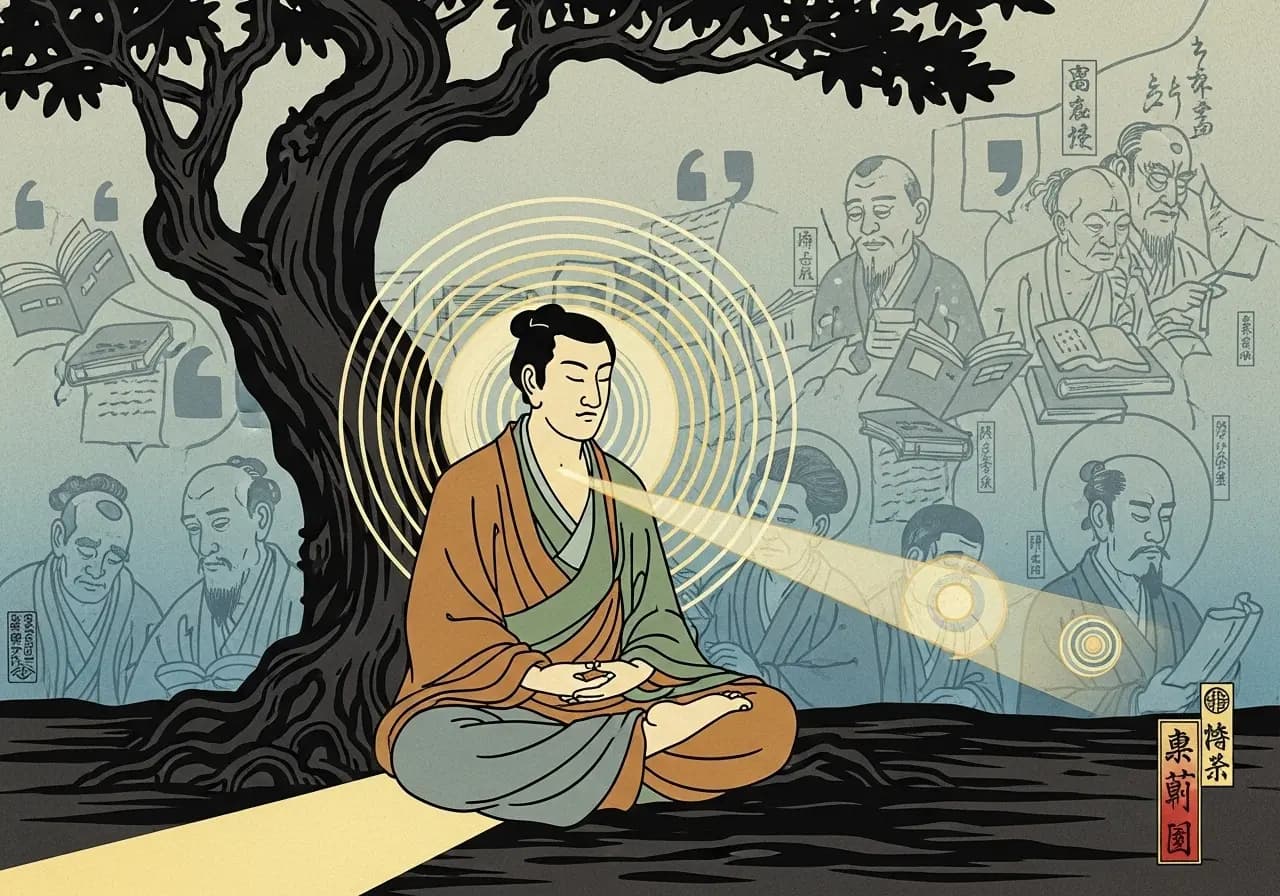
But here's the thing that I think Buddhism is really trying to convey: authority comes from within. It comes from us.
I think this is the radical realization that the Buddha had at the moment of enlightenment. According to how I understand all these stories when I read them, the Buddha had this moment where he realized he was the source of it all. He was the source of the authority. And we can have that same experience—that sudden moment of realization that what I think, what I say, and what I do, that's the only thing that matters to me.
Suddenly, I don't need to depend on "Well, what would the Buddha say? What would the Buddha do?" because it becomes more about "Well, what would I do? What would I say? Why am I saying this? Why am I thinking this? Why am I doing this?"
You are the ultimate source of authority.
My Own Journey with Authority
When I first started exploring this concept of trusting myself, here's how it unfolded for me. I was a theistic believer. I remember suddenly thinking, "Well, wait. How do I know there's a God?" The answer was: because I trust the people who told me there's a God. And that made me realize, "Well, then who do I really have faith in? I don't have faith in God. I have faith in the people who have told me about God."
But I continued to explore that line of thought and realized something: I don't have faith in them either. I have faith in myself—in my ability to trust that what these people are saying is true. So ultimately, it all came back to me again. It's like, "Well, I have faith in myself, in my ability to discern that these people are speaking truth, and I trust them, and therefore what they say is true."
And that became a problematic thought for me. I thought, "Well, wait a second. What's there? There's nothing noble in that. All it is, is I trust myself so well that I'm telling myself that yes, these guys are telling me the truth. That's trusting me trusting me. How is that anything more than that?"
That line of thought became problematic, and it's part of what started my transition away from wanting to believe in some form of external agent acting upon me for good or for bad. I thought, "Well, if all of this stems from trust in myself anyway, why not find a tradition that focuses on that aspect of it—the ability to look inward and trust myself?"
That's the turmoil I went through as I was transitioning in my belief and faith. I wanted to turn inward and ask, "Why do I trust the things I trust? Why do I believe the things I believe?" And that form of introspective questioning worked really well with Buddhism and with the approach Buddhism takes to a lot of these concepts, where it's not about an external source. It's all about understanding yourself.
Emphasizing Internal Authority
I think this is a good time to emphasize again that this path—the path of being more mindful, the path of becoming a better whatever you are—implies that this is you. There's no one else responsible for any of this.
The ultimate authority in your journey of self-understanding, of enlightenment, whatever you want to call it—it's you. You are the ultimate source. Nobody can come and tell you, "Hey, here's the truth." I mean, they could, but that does nothing for you.
What does everything for you is you understanding you—understanding why you believe the things you believe, why you don't believe the things you don't believe, why you say the things you say and do the things you do. That's where you become the ultimate authority.
Moving Forward with the Quote
In future podcast episodes, I'll probably still reference this sentiment, but not quite as a direct quote. I'm going to rethink and rephrase it. You'll probably hear it in future episodes as something like "Keep in mind the advice that..." or something along those lines. I'm not quite sure yet how I'm going to work with this. I just don't want to convey that this is a word-for-word quote when it's not.
But I do think it's appropriate to say: keep in mind the Dalai Lama's advice. He said we don't need to become Buddhists. You can be a Christian, you can be a Jew, you can be whatever you are and still benefit from the teachings that come from Buddhism. I think the advice is still spot on. I really enjoy everything conveyed in that message, and I would certainly stick to that with everything we talk about here on this podcast.
But I did want to at least make you aware that it's not a word-for-word quote. And furthermore, hopefully that makes you even more skeptical of anything anyone's going to tell you is a quote. If they do, and you think, "Oh, I really like that, especially because so-and-so said it," that's a really good opportunity to pause and ask yourself: Why does it matter so much to me that so-and-so said it? Whoever that so-and-so is—the Buddha, Jesus, or whatever your authority goes to. Ask yourself: Why does that matter so much? Why does the authority have to go there when I understand that I am the ultimate source of my authority?
You're the one that decides what you believe, and that gives you the ultimate power.
Closing Thoughts
That's what I wanted to discuss in this podcast episode: the ultimate authority. It's you.
Hopefully, as you continue to learn and listen to Buddhist teachings and concepts, keep in mind that at the end of the day, none of this means anything if it doesn't mean something to you—if it doesn't help you understand yourself better. That's what I want to share with you.
If you want to learn more about Buddhism and mindfulness, you can check out my books: Secular Buddhism, No Nonsense Buddhism for Beginners, and the Five Minute Mindfulness Journal. All three are available on NoahRasheta.com.
If you enjoyed this podcast episode, feel free to share it with others, write a review, and give it a rating on iTunes. You can also join the online community at SecularBuddhism.com/community.
And if you want to make a donation to support the work I'm doing with the podcast, you can visit SecularBuddhism.com and click the donate button.
That's all I have for now, but I look forward to recording another podcast episode soon. Thank you, and until next time.