

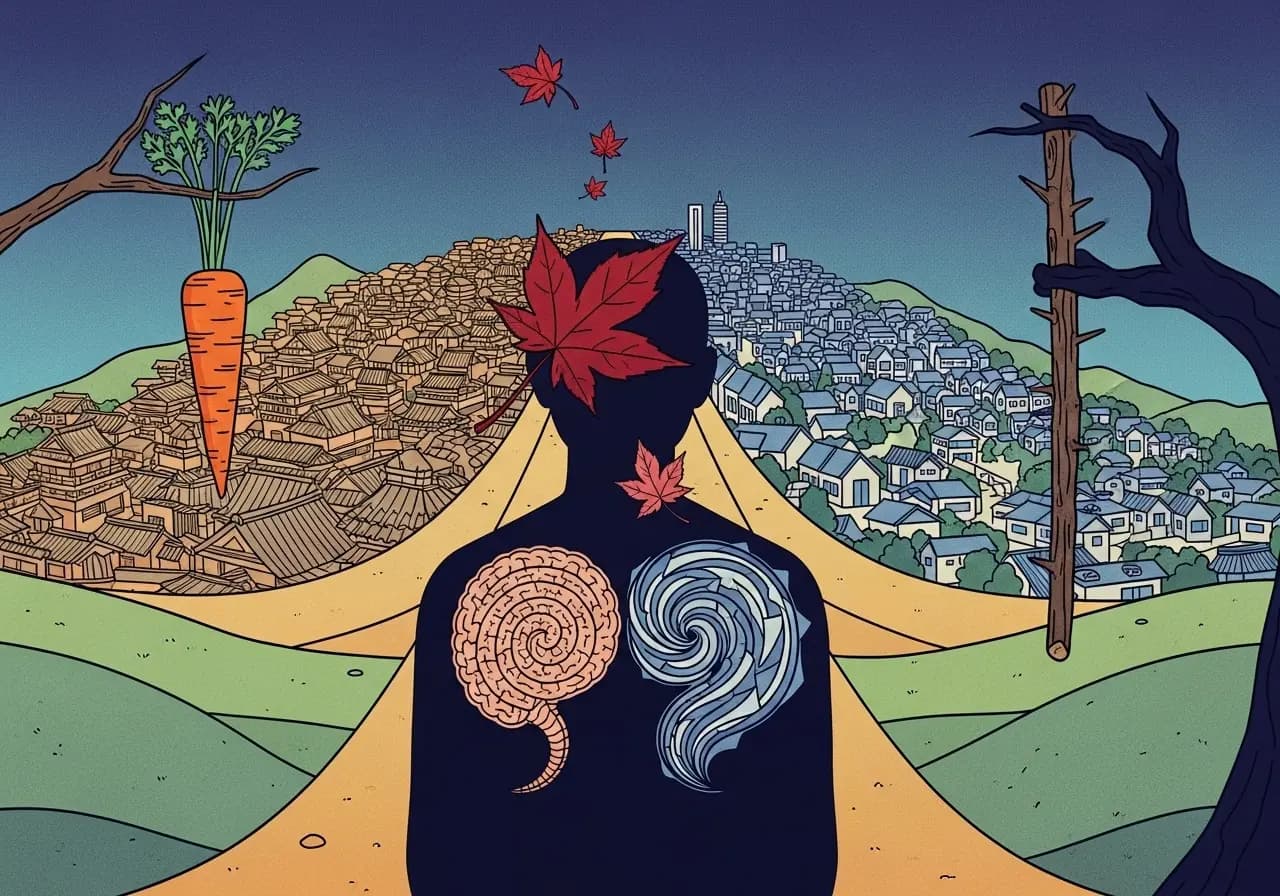
Secular Buddhism Podcast: Episode 9 — Carrots & Sticks
Host: Noah Rasheta
Hello, and welcome to the Secular Buddhism Podcast. This is episode number nine. I'm your host, Noah Rasheta, and today I'm talking about carrots and sticks—specifically, the fact that we chase carrots and we avoid sticks. You'll see what I mean in a moment. Let's get started.
Before we jump into the topic, here's a friendly reminder: the Secular Buddhism Podcast is produced every week and covers philosophical topics within Buddhism and secular humanism. Episodes one through five serve as a basic introduction to secular Buddhism, so if you're new, I recommend listening to those first five episodes in order. All episodes after that are meant to be individual topics that you can listen to in any order.
And remember, the Dalai Lama says: "Do not try to use what you learn from Buddhism to be a Buddhist. Use it to be a better whatever you already are." Keep this in mind as you listen to and learn about the topics and concepts we discuss in this podcast episode. If you enjoy the podcast, please feel free to share it, write a review, or give it a rating on iTunes. Now let's jump into this week's topic.
Understanding the Brain's Wiring
I watch a show called Brain Games on National Geographic, and the first episode of this season talks about the brain—specifically, the wiring of the brain. It compares the way our brain works to a city, and specifically to London. The show illustrates how, as a city grows, there's the downtown or center of the city, and then as the city expands, highways and bridges are added. Suburbs and neighborhoods develop, but no matter how big the city gets, the downtown remains the same. It's the old part of the city. The buildings are older, and the streets are laid out a certain way that simply isn't going to change.
Our brain is very similar. As our brains have evolved, there are aspects of how they work that are hardwired—very, very old aspects that come from ancient evolutionary processes. For example, the habitual or instinctual drives we have to seek reward or to avoid punishment—this concept of chasing carrots or avoiding sticks. This is hardwired in us in a very old part of the brain that, from an evolutionary standpoint, is like the reptilian part of our brain.
There was a time in the evolution of our species when getting the right reward—finding the right food or accomplishing the hunt—literally meant survival. Our life depended on it. And on the flip side, there was a time when being driven from your group, from your "in" group, meant life or death. The hardwiring that exists in our brain is as old as human beings are, and even older, because it traces back to how we were wired from an evolutionary standpoint before we were even human.
You can start to see the remnants of this ancient way of thinking in our day-to-day life. If someone cuts you off on the road, the habitual reactivity is to treat that like a life-or-death situation. Suddenly you're full of rage and anger, almost as if someone were trying to kill you. Or if a stranger came up on the sidewalk and insulted you, our reactive brain treats it the same way—like life or death. It's no different than how it evolved to treat actual survival threats, and it can activate our fight-or-flight response.
It's important to know that this is simply how the brain works. By recognizing that we're hardwired this way—very much like a city has a downtown that's just how it is—we can see that our brain similarly has a part that still functions this way. It treats everything as life or death, as if we're chasing the carrot with our life depending on it, or avoiding the stick as if our survival depends on it.
Recognizing Our Carrots and Sticks
I think it's interesting to take some time and pause, and think to yourself: "What are the carrots that I chase in life? What are the sticks that I try to avoid?" And notice how we treat these things as if our life depends on it. It can be comical to analyze these scenarios and think, "Wow, I make such a big deal about this, and really I shouldn't." And then to recognize: "But I can't help it. That's just what happens when I react."
When we go into that reactive mode, a very old part of the brain takes control of our emotions and our actions. That's why it's important to know, first of all, that this is how the brain works, and second, to learn how to throttle that or to control it. That's where meditation comes in.
In past podcast episodes, I've talked about the importance of mindfulness. Mindfulness is the exercise that gives us the ability to observe things as they arise and to simply observe them without having to react. The reactive mind—what we might call monkey mind or the reptilian mind—is the instinctual part of us that treats everything wrongly as if it were a matter of life and death.
But we can train our mind. Just like the city grows with new highways and new parts where commerce works well, our brain has other parts that function pretty well too. These newer parts can throttle and control, and can say, "Hey, wait a second. Don't. You don't need to react about this." Meditation is a form of exercising those parts of the brain so that when something comes up, rather than reacting, we can pause and just observe and recognize: "Oh, wow, that's what's happening. Okay."
The Practice: Finding the Gap
Going back to the example of driving: if somebody cuts you off, the instinct is there. Immediately you're going to feel anger or aggression. But you can pause for a second, then smile and think, "Oh, how funny. Who would have ever guessed that you could get so mad because somebody cut in front of you? So what? Now I'm ten seconds behind the schedule I was on. What difference does that make?"
If we know that's how the mind works, we can look at that reactivity and say, "Oh, there went the reptilian mind kicking in. Okay, I'm good now. Him cutting in front of me is not ending my life, so I'm not going to treat this like a life-or-death situation."
It sounds comical to even have to talk about it that way, but notice next time you're in that situation—or any other similar situation—how we really do treat things like life or death. If somebody insults you, that's a matter of life or death. Somebody cuts in front of you, that's a matter of life or death. You might be losing your job, that's a matter of life or death. Everything is treated like it's such a big deal. Well, that's because we're hardwired to think that way.
Maybe take some time and think about: "What are the carrots that I chase in life, and what are the sticks that I'm avoiding in life?" When we recognize that our hardwiring is what makes us this way, we can have more compassion toward ourselves. We can recognize that it's just how we are. We don't have to treat that as wrong or say, "That's something I need to change." It's just recognizing that, like the downtown in an old city, that's just how it is. That's how human beings are. That's how our brain works. But we can have compassion, and in that moment, when we catch ourselves, something shifts.
The Two Arrows: Understanding Our Self-Inflicted Suffering
This brings me to the analogy of the two arrows. The first arrow happens, and you can't control it. You've been struck by an arrow, and there's nothing you can do about it. The second arrow you do control, and that's determined by what you do with the moment after you're struck.
Going back to the car example: somebody suddenly cuts you off, and boom—there's the first arrow. You might have an emotional reaction. Whatever happens with that initial reaction is what it is. Now, if I decide to make it personal and say, "How dare this guy cut me off? Doesn't he know who I am?"—if I start adding to that story—then what happens is one thing, but the story I add to it determines whether I get that second, third, fourth, or however many arrows of suffering I compile on top of the first one. Those are all self-inflicted.
There's what actually happened, and yes, it made me upset, and it could end right there. You move on. Or you can start to feed it, and then you start getting hit with a second, third, fourth, or however many arrows—all completely self-inflicted. "Now I'm mad because I've been personally offended." Or, "Doesn't he know I needed to be at that meeting? Now I'm going to be late." You start compiling all these new layers of suffering on top of the first one. The first one was the one you can't control—it's just what happened. Everything you add to it, you can control.
One of the big misconceptions when people learn or study Buddhism is that the intention of Buddhism is to prevent or stop all suffering. That's not the case at all. Buddhism is saying that suffering is universal. Everyone is going to experience it, and there is no way to end that, because it's part of life. So you might ask: what's the point if I'm just going to suffer?
What Buddhism is trying to teach is this concept of the multiple arrows. That first arrow? You can't help it. Life is going to throw arrows at you. In one of my earlier podcasts, I talk about the concept of walking on a trail at night, and somebody comes out dressed as a bear to scare you. If you know that's going to happen, then as soon as it happens, you can recognize it. You'll still be startled, but you'll recognize: "Oh, okay. I knew this was going to happen at some point."
The aftermath of that initial scare is significantly reduced, and you recover from it much quicker. Applying this to the concept of multiple arrows: you know the first arrow's going to get you. You're going to be hit by arrows at various stages in life, and you cannot do anything about it. But now you immediately know that any follow-up arrows of suffering—if you experience those—that's on you, because of your lack of perspective and understanding what's happening. When we personalize things, when we make meaning of things, when we add to the story—that's when we start to experience the second level of suffering, the second arrow.
For some of us, it goes beyond the second. It's third, fourth, fifth, sixth, seventh, eighth, and all these layers of arrows and suffering. All of them are self-inflicted after the first one. The first one we couldn't help. I would invite you to think about that for a little bit and imagine in what ways you add multiple layers of arrows after being struck by the first arrow. Remember: the first one we can't help. It's the ones that come after that we can help.
Showing Front, Showing Back: The Way of the Maple Leaf
When we understand the way we're hardwired, we start to get a glimpse into the nature of how we are. Remember, the Buddha's very first lesson—his key teaching—was understanding the nature of who you are. This is an example of understanding the nature of how we are. We're hardwired in a certain way. When we know that, and when we can start to see that, we can then work with it.
This brings me to the next part of this conversation. There's a haiku—a Japanese haiku, which is a seventeen-syllable Japanese poem—that says: "Showing front, showing back, maple leaves fall."
That's it. That's the lesson. You might think, "Well, what the heck does that mean?" Let me tell you. The natural way of things: when a leaf has fallen from a tree—in this case, a maple leaf, and it's falling—picture this in your mind. Does it just fall straight down? Or is it drifting, showing the front, showing the back as it naturally falls? The idea is that we should be like maple leaves: when we fall, we show front and we show back.
But in reality, we try to put up a front, right? We only want to show the front, and there's no need to show what's going on in the back. If we were to live like maple leaves, we would understand that there is no front and there is no back—there's just the totality of what we are. There's nothing to hide. And in his book Everyday Suchness, [the teacher referenced here] talks about this and says: "If we were able to live as the maple leaves, showing the front as front and back, and the back as front and back, there would be no falseness, no pretense, no secrets to hide. We just show ourselves to the world. We live our life." We live a life of front and back.
I really like Brené Brown's work on vulnerability, and this ties in perfectly with that concept. Vulnerability, she says, is about having the courage to show up and be seen. She goes on to say that vulnerability is our most accurate measurement of courage. It takes considerable courage to show up and be seen, because our tendency—again, because we're chasing carrots and avoiding sticks—causes us to live a life where we treat everything as if our life depends on it. Something as simple as, "I want to be liked by this group. I want to make sure this group doesn't dislike me." So we do this and we do that, and we get caught up in a way of living where it's not vulnerable and it's not authentic. It's putting up fronts and hiding our backs.
The Buddhist life is a life of awareness. It's learning to be aware of how things are, and specifically, how we are. An important part of that is having the courage to just be exactly how we are: showing front, showing back. In his book, [the teacher referenced] talks about how what we're concerned with in terms of living like a maple leaf is to live with no shamefulness. We just live with straightforward honesty and sincerity in life. We don't have to be caught up in this way of thinking where it's like, "Is this side better to show the public? Should this side of me be hidden from the public?"
The Buddhist life is a life of honesty. It's a life where there is no front and there is no back. A true life is a life of complete oneness and totality. We want to live life like a maple leaf: showing front, showing back, maple leaves fall.
Bringing It All Together
When we understand these facts of life—how we're hardwired, what our reactive and instinctual way of living is—then we can start to live life in a new way. A whole new way of life begins the moment that you learn what you are and what life is. And what life is is always different than what we think life is. What we are is always different than what we think we are. That's why I brought up the concept of the wiring of our mind—it's part of what we are. It's part of how we are.
Like I mentioned before, the very first teaching of the Buddha was to know yourself. He taught that the most important thing in solving your problems is to know yourself first, and that means knowing what you are. Hopefully, this week you can keep this in mind: the hardwiring of the brain, the downtown part of the brain—from an evolutionary standpoint, it's what reptiles have. It's what the donkey has that's chasing the carrot. It's what the donkey has that's trying to avoid being hit by the stick. We're no different. That part of our brain is no different.
Try to notice in what ways this hardwiring shows up in your day-to-day life. When something pops up, ask yourself: how is this a stick or a carrot? And am I really, instinctually, treating this as if my life depended on it? I think you'll be surprised to find how easily we do that with everything—being in line, getting stopped at a red light, somebody cutting in front of you, the risk of losing your job, or whatever it is.
Notice how that hardwired, natural part of you that's evolved to think this way treats everything like it's such a big deal. See if you can pause for a minute, take a break, and recognize: let the newer part of that city—the newer, more evolved part of the brain—take over for a minute. Just pause and don't have to react.
There's a gap between what happens and our reaction to it. It's in that gap, before we react, that the more evolved part of the human brain can take over and say, "Oh, I don't have to react this way. My life's not in danger. This isn't that big of a deal." Try that this week. See if that's something you can work with. See if it's something you can notice. I think you might find that on certain occasions, it can be comical to realize how instantly you've been carried into a place where you were reacting as if your life was in danger.
Then you can look objectively back at what happened and realize: "Wow, that's incredible that something that minor and insignificant was causing me so much stress or so much anxiety, because my poor reptilian mind was thinking my life was in danger." And then have compassion for yourself, knowing this is how we are. This is part of being human. This is part of the evolutionary process of being human. You can have compassion for the downtown part of your brain, the reptilian part of your mind, and then try to extend that compassion out.
When you do something—next time you accidentally cut someone off and that person immediately pulls up next to you and flips you the bird—you don't have to react. You can know where they were coming from and smile and say, "Wow, I'm sorry. I didn't mean to activate the reptilian part of your mind that made you think your life was in danger. And I'm not going to escalate that because I know I probably would have done the same thing."
It's a really powerful thing to be able to know even a tiny aspect like this of how we are and what makes us do the things we do. And then you can have compassion for yourself and extend that compassion to others, because now you have a little bit more of an understanding of the hardwiring of the brain. Have compassion for the reptilian part of our mind, the reptilian part of our brain, the downtown part of the city.
Those are the thoughts I wanted to share with you guys in this podcast episode. I hope you enjoyed it. I love catching myself activating the fight-or-flight mode in my own head for silly things and then realizing, "Oh, wow, that's just what we do." And trying to pause in that gap between what happens and our reaction to what happens.
The whole key is finding that gap between the two that allows you to stop and pause and then actively decide, rather than just reacting. It's when we react that we get ourselves in trouble, because that's the older part of the brain that reacts. If you can catch yourself before the reaction, the majority of the time you're going to be able to respond in a way that's significantly more helpful than allowing that other part of the mind to just react and be instinctual.
And I promise you, for the vast majority of these things—if not all of them—your life really isn't in danger. It's not a matter of life or death, even though it can feel that way.
Thank you, and I'll catch up with you again next week with another podcast episode.
The Secular Buddhism Podcast is produced every week and covers philosophical topics within Buddhism and secular humanism. For more information, visit [website].