

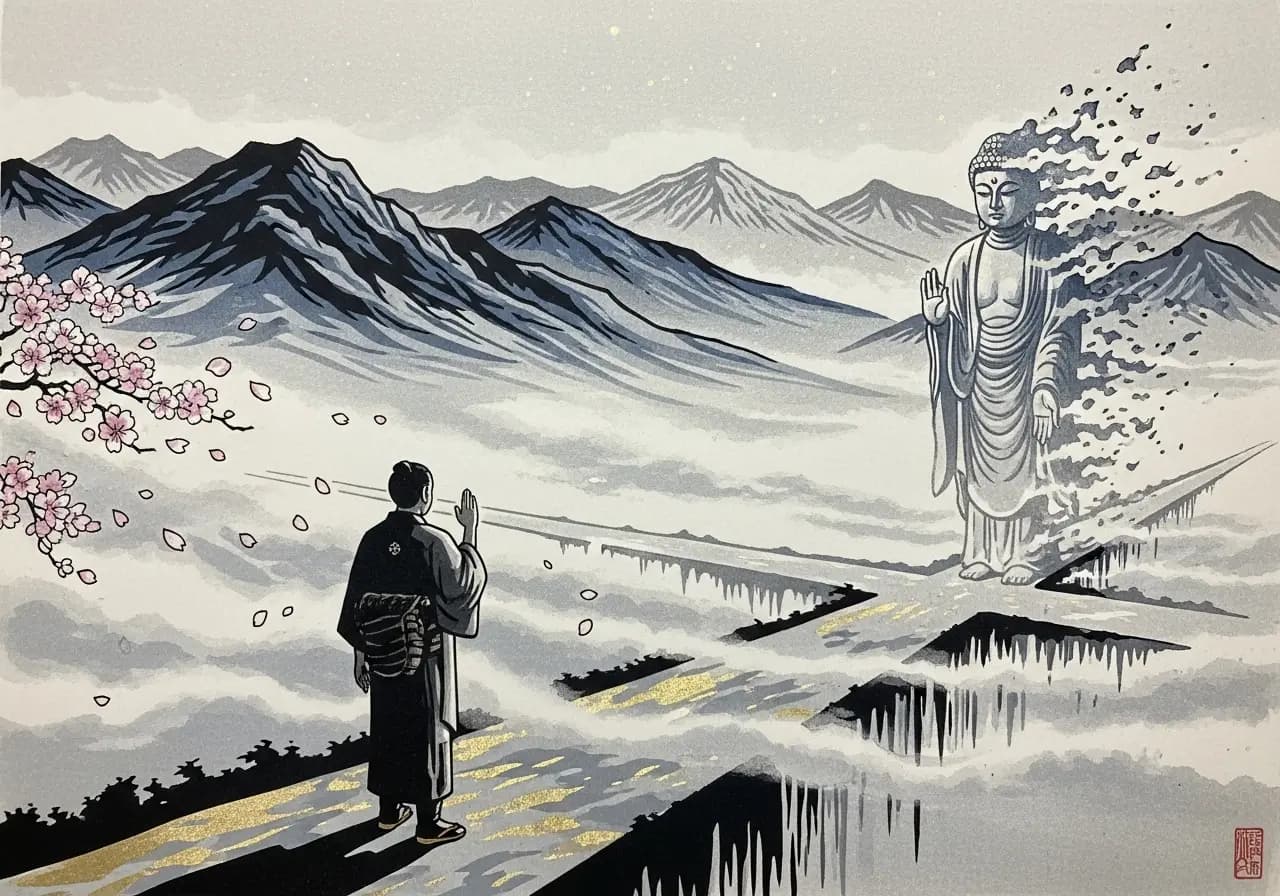
Killing the Buddha
Episode 89 of the Secular Buddhism Podcast
Welcome to another episode of the Secular Buddhism Podcast. This is episode number 89. I'm your host, Noah Rasheta. And today I'm talking about killing the Buddha.
As always, keep in mind the Dalai Lama's advice: "Do not use what you learn from Buddhism to be a Buddhist. Use it to be a better whatever you already are."
The Koan: If You Meet the Buddha, Kill Him
There's a famous quote in the Zen tradition that says, "If you meet the Buddha, kill him." This quote is attributed to Linji, a prominent Zen master, and the expression is often considered a koan.
If you'll recall, I've talked about koans in the past. A koan is somewhat of a riddle—or a paradoxical question, statement, or story that is meant to confuse the listener out of their state of habitual reactivity. The idea behind the koan is to present a question or a statement that cannot be understood with the intellect and much less answered with the intellect.
You can imagine this one doing exactly that if you are a Buddhist or a practitioner of Buddhism, especially in older times when Buddhism was very intertwined with the culture in Asia or wherever you may be living. In this case, with Linji. Imagine telling a group of monks who venerate and are trying to emulate the Buddha's example in everything that they do to suddenly be told this expression: "If you meet the Buddha, kill him."
Linji was known for his way of teaching the Dharma. This is typical of his teachings. He would say something that would really make your head turn. And that's the point of this expression.
Now, this specific koan has caught on in the West, in Western Buddhism, and it's been interpreted in many different ways by various teachers and practitioners. One of the interpretations that I want to share is actually from Sam Harris in a 2006 essay called "Killing the Buddha."
Sam Harris, who many of you know is an author, a neuroscientist, and the host of the Waking Up podcast, had this to say about the koan:
The 9th century Buddhist master Linji is supposed to have said, "If you meet the Buddha on the road, kill him." Like much of Zen teaching, this seems too cute by half, but it makes a valuable point. To turn the Buddha into a religious fetish is to miss the essence of what he taught. In considering what Buddhism can offer the world in the 21st century, I propose that we take Linji's admonishment rather seriously. As quotes of the Buddha, we should dispense with Buddhism.
That's the interpretation by Sam Harris, someone whose work I admire a lot. And I think there's a lot of truth to what he's saying, but I don't think that's quite enough.
It's true that as students of the Buddha, we should dispense with Buddhism. But I would also say that as students of any ideology, we should dispense with that ideology. So it would be accurate to also say that as students of atheism, we should dispense with atheism, or as followers of Christ, we should dispense with Christianity—or any expression along those lines. I think that gets closer to what Linji was trying to accomplish with this koan, with this statement.
A Deeper Understanding
Another thought that we can explore here comes from the book Zen Mind, Beginner's Mind by Shunryu Suzuki Roshi. In this book, he says:
Zen Master will say, "Kill the Buddha." Kill the Buddha if the Buddha exists somewhere else. Kill the Buddha because you should resume your own Buddha nature.
In this sense, "kill the Buddha, if the Buddha exists somewhere else"—it's like saying, "If you meet the Buddha, kill the Buddha." In other words, if you encounter the concept of Buddha and discover it as separate from yourself, then you are living in a delusion. You're living in the world of dichotomy.
If you've studied Buddhism or studied a lot of these concepts, you'll know that the whole idea of separation is a delusion because of interdependence. So in this sense, the phrase "killing the Buddha" is often used to mean rejecting all religious doctrine. And I think this certainly goes along the lines of what Linji was probably wanting his students to understand. But I think it goes further.
It goes beyond a conceptual understanding of the Buddha's teaching because it's about having an intimate, intuitive realization—an experiential understanding. So if we're conceptualizing it, then we're not understanding it experientially. Any conceptual understanding will always fall short of what the experiential understanding of that concept would be.
And I think that's what Linji was trying to accomplish with this quote: to conceptualize non-duality or to conceptualize Buddha nature or the idea of what a Buddha is—these are not the same thing as having an experiential understanding of what a Buddha is.
As a rule of thumb in the Zen tradition especially: if you can grasp it intellectually, then you're not quite there yet. You haven't understood it the way that it's meant to be understood, which is experientially.
Killing the Idea
I want to correlate this a little bit more into our day-to-day lives. This is a koan that I really enjoy, and I like to think of it as "kill the idea"—not necessarily kill the Buddha, but kill the idea of the Buddha.
There's nothing that unites us or separates us more than ideas—whether these be societal views, financial ideas, or especially political or religious ideas. Ideas have the power to unite us and separate us more than anything else. And ideas are powerful. They can be useful, certainly. But they can also be dangerous because at the end of the day, ideas are not real. They may lead to reality, but they are not the same thing.
They are essentially the finger pointing to the moon, but they will never be the moon.
When you think about this—the conceptual world versus the real world—one example that I like to think of often is the idea of flying. I like to paraglide and paramotor. And I belong to Facebook forums and groups where people talk about paramotoring. As you can imagine, I know you'll be shocked to hear this, but Facebook is a horrible conceptual world where we're all living in these delusions and fighting about everything.
It's so fascinating to me how a group of flying enthusiasts all they do is fight. They fight about whatever you post. "If you posted this, this is wrong. You did that, that's right. This is wrong. This is the right brand. This is the wrong brand. You'll die if you fly that kind of wing." It's almost as if you joined a group that was talking about religion.
If there were a Facebook group that said, "Hey, this is a Facebook group for people who are enthusiasts of life. Come talk about your life doctrine or your life ideology," that would be chaos. You'd have people in there promoting several different ideologies all debating and fighting each other all the time. And that's what it feels like sometimes in these paramotoring groups because people get so attached to their specific brand of wing, or brand of motor, or a specific instructor. You can fight about almost anything these days on Facebook.
I like to imagine that it's the same way with everything.
From Conceptual to Experiential
For me, the idea of killing the Buddha serves as a reminder that the idea is always conceptual and never the real thing. If I meet the Buddha on the road, I would want to ask, "Well, what does that mean? How did I decide that I met a Buddha? What makes this person a Buddha?" Because whatever those ideas and concepts are in my mind that paint that picture in my head—that says, "Oh, there's a Buddha"—well, those ideas and concepts are intellectual. They're not experiential.
There's something really interesting that happens when you move from the conceptual world into the experiential world. For example, with flying. You go to fly. You meet up with people from the most diverse backgrounds—you know, people far left on the political spectrum, far right on the political spectrum. And guess what? When we're there, nobody talks about it. Everyone's experiencing flight, and everyone cares about the other person taking off safely, flying safely, and landing safely. When we land, we all talk about what we saw and the experience of flying. It's honestly like you're on a whole different universe than the universe that we were on in the conceptual land of Facebook, talking about flying.
I think about that often—how this is with everything. Anything that's conceptual gets muddied up fast. But the moment you're in the experiential world, it seems like we connect easier. We're just experiencing together, and we don't necessarily argue and fight about it because we're not caught in our conceptual world anymore.
I feel that everyone and everything that we meet, we're encountering this. You're meeting people just as they are, where they are, doing the things that you're doing. And I like to pause and ask, "When I encounter a concept, is there aversion? Is there aversion to this idea or concept? Is there craving or clinging to it? Do I like this idea?"
To me, that's the invitation and the expression: "Kill the Buddha." How am I meeting the things that I meet? The experiences that I am experiencing, the people that I'm meeting, the circumstances that are unfolding in my life when I meet them in that moment. And am I caught in the experiential world of just feeling it and experiencing it? Or am I often finding myself in the conceptual world where I have ideas about what I'm meeting—"This should be this way, this shouldn't be that way, this could be this way"?
Again, I'm not saying that ideas are bad. I think ideas are great. If I go back to flying, the whole reason that we're flying is because someone conceptualized the idea of flying and followed that all the way until they were able to accomplish flight. So I'm not saying that ideas are a bad thing here, in the same way that meeting a Buddha isn't a bad thing.
But the invitation to kill the Buddha is a direct invitation to pause and say, "Wait a second, what do you see? And how does that compare to what you think you see?" Because those may not be the same thing. And to me, that's the difference between talking about flying and just going and flying.
What if I was able to convert this same mental disposition or attitude into the difference between talking about living and just living? I think most of us would recognize there's a very big difference between the two. When I'm talking about living and I'm just out living—those are not the same thing.
And I think, in my opinion, that's what Linji was trying to get at with this expression. I can just imagine in a room full of people who were highly devout Buddhists, monks trying to emulate every aspect of the Buddha's life. What would it have done to them in that moment to have their teacher say, "If you meet the Buddha on the road, kill him"?
You know, it would force them to say, "Whoa, wait a second, what on earth are you talking about? I thought we wanted to be him, follow him, ask him questions." And that's exactly what he's trying to accomplish: pause for a second. This may not be what you think it is.
An Invitation to Snap Awake
My invitation for you with this podcast episode is to think about this koan. Think about the expression: "If you meet the Buddha on the road, kill him." And see what comes up for you in your own life.
How can you apply this idea? How can you relate it to ideas in general? What does it mean to you to kill the Buddha? And think about the things that are meaningful and precious to you. What if someone turned around and said, "Yeah, that thing that means so much to you? If you see it, kill it."
What would that do to you? What would that make you think? And then see if you can try to understand or correlate that a little bit with what Linji was trying to accomplish as a Zen teacher, as a Buddhist teacher. He was trying to get you to snap out of that conceptual world for a moment and snap back into the experiential world.
I like to imagine that in that moment, these monks hearing this expression felt something. They felt something—probably a really strong emotion in that moment. And there's that invitation: "What did you just feel when you heard that?" You know, that's what Linji was trying to do. Get them to feel for a moment. "This is what you feel. This is real. The idea you had in your mind a second ago—that's not real."
That's what I imagine he was trying to do.
A Traveling Reminder
Speaking of meeting the Buddha on the road, I'm actually on the road right now. I'm traveling and recording this podcast episode. In the middle of my travels, my family went upstairs to have dinner and I told them, "Give me about fifteen minutes. I'm going to record a podcast episode and then I'll meet you guys for dinner."
So I'm probably going to have a window of two weeks before my next podcast. I've been trying to do these weekly, but since I'm on the road trying to find internet, it's a little harder for me to be consistent with the weekly thing. But I get home in about a week and a half, so I may miss the next Sunday window when I normally try to upload these. But you can count on more consistency once I get back.
Maybe just plan on the next one being two weeks from now so I can be safe and not promise something I can't deliver.
But again, thank you guys for listening. As always, it's a fun process for me to share my thoughts and to know that people all over the world are listening in, hearing these concepts and ideas. And again, these ideas are not real. The invitation is to go out and jump back into the experiential world for a moment and really experience being alive.
I think podcasts like these run into the very problem that Linji was trying to get at. You know, we're talking about life. And this isn't about talking about life—it's about living life. And that happens when you turn off the podcast and you're back out in your day-to-day living. So that's where I hope that these concepts are beneficial and helpful to you.
Final Resources
If you want to learn more about Buddhism in general, of course you can check out my books: Secular Buddhism, my first one; my second book, No Nonsense Buddhism for Beginners; and my newest book, The Five Minute Mindfulness Journal. You can learn about all of those by visiting noahrasheta.com. That's N-O-A-H-R-A-S-H-E-T-A dot com.
If you enjoyed this podcast episode, please share it with others, write a review, give it a rating on iTunes. And you can always join our online community by visiting secularbuddhism.com/community.
If you'd like to make a donation to support the work I'm doing with the podcast, please visit secularbuddhism.com and click on the donate button.
That's all I have for now, but I look forward to recording another podcast episode soon.
Thank you. Until next time.
For more about the Secular Buddhism Podcast and Noah Rasheta's work, visit SecularBuddhism.com