

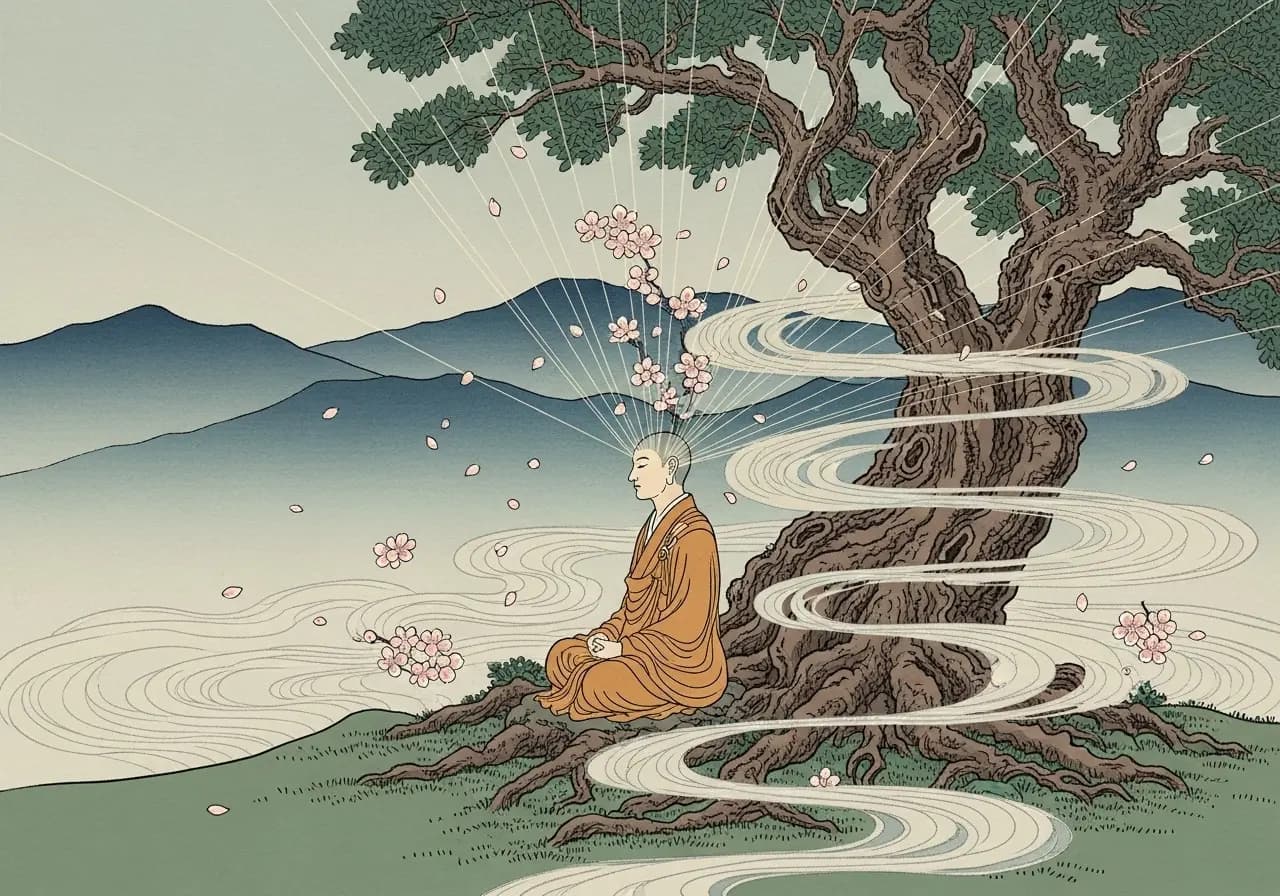
Radical Okayness
Episode 88 of the Secular Buddhism Podcast
Hello and welcome to another episode of the Secular Buddhism Podcast. This is episode number 88. I'm your host, Noah Rasheta, and today I'm talking about the concept of radical okayness, or in other words, the idea of getting to know yourself.
Keep in mind the Dalai Lama's advice: "Do not try to use what you learn from Buddhism to be a Buddhist. Use it to be a better whatever you already are."
Introduction to Radical Okayness
I first encountered the expression "radical okayness" when I was attending the Salt Lake Buddhist Fellowship, a weekly gathering in Salt Lake City run by my friend Christopher. He was giving a Dharma talk and used this concept of radical okayness, and I remember it really stood out to me. I thought it was a really cool expression that gets at the heart of what Buddhism is trying to accomplish in so many of its teachings.
You know, we always talk about the middle way in Buddhism. I like to think that in the middle of the spectrum—between "wow, life is great and that's what I'm chasing after" and "oh man, life is really crappy right now. I don't like this"—right in the middle there's just okay. Life is okay.
What a radical shift it is to go from chasing after the extremes, from chasing after one extreme or fighting hard to avoid letting the other extreme get close to us. Our habitual mode is to desire more of what we think we want and to feel aversion, to push away that which we think we don't want. But to be okay with things just as they are, when they're good and when they're bad, that to me is the essence of radical okayness.
Radical in the sense that this is not normal. Most people are caught in the game, chasing after one and fighting off the other. But what a radical shift in perspective to be okay and to stop playing that game. Just thinking: when it's good, it's good and I'll enjoy it. When it's bad, it's fine. It doesn't mean I have to like it, but I can also enjoy it. That's a radical thing for me.
Getting to Know Yourself
There's a very clear message that seems to permeate through many of the Buddha's teachings. That is the importance of getting to know yourself, knowing your own mind. And I want to correlate this with this concept of radical okayness.
The Buddha's teachings are primarily concerned with understanding suffering and the elimination of what we would call self-inflicted or unnecessary suffering. I've mentioned this before in podcast episodes—the parable of the two arrows. This is a common Buddhist teaching meant to help us understand the nature of what we could say is natural suffering, the first arrow, versus self-inflicted suffering, the suffering that we bring on ourselves, which is the second arrow.
The Buddha understood that the source of this unnecessary suffering was to be discovered within. So think about this for a moment: what are the things that generally cause you mental anguish or discomfort? For you specifically, the things that cause you mental anguish or discomfort.
Perhaps it's the fear of death—that's a big one, and it's likely rooted in the fear of uncertainty, not knowing what comes next. It's the fear of not knowing or not having control over how life is unfolding. When we feel anguish or stress or worry or anxiety, these are all mental states that arise in the mind and reside in the mind while we're experiencing them.
But this is also how pleasant mental states work. When we're in love or we look up at the night sky and contemplate the vastness of the cosmos and our smallness in this place, or we smell a flower, or we watch a sunset, or we look into the eyes of our newborn child that we're meeting for the first time—these are incredibly powerful experiences that all take place in our minds. So in this sense, pleasure and pain are both experiences of the mind.
I cannot think of a greater goal than that of getting to know myself. Don't get me wrong—I'm certainly intrigued by the great mysteries of the universe and the cosmos. I'm fascinated by what we know and by what we don't know about space and time, the Big Bang, the expansion of the universe, the origins of life and all that. But somehow, as I sit here and I really think and I feel, I'm also overwhelmed by a sense of awe and wonder at the fact that my mind can produce thoughts and feelings so intense that I can barely express the experience through words.
And then those words, as I speak them aloud and they get recorded and transmitted to another mind—in this case, your mind, the listener who right now is connecting with my mind in a way that really alters everything for all of us, for both of us. How incredible is that? All these thoughts and ideas that I share come from the thoughts and ideas that others have shared, that others have had, and they've been shared across space and time for literally thousands of years. It almost leaves me speechless as I think about it.
The Mind as the Gateway to Awakening
Our mind is the experiencer of each and every moment in our lives. Everything that I think and feel and perceive starts right here in my own mind. And getting to know your own mind not only leads to greater happiness in life, but it literally transforms the chaos and confusion of our habitual reactivity. It's the key to waking up.
To experience that awakened state is the very heart of Buddhist practice. It's really a state of freedom—it's not dependent on any external circumstances. It's anchored entirely on the profound realization that we can be fine with the ups and downs of life, the pleasant and unpleasant experiences and mental states. What we could call a state of radical okayness.
Earlier this week, I saw a meme on Facebook for a t-shirt that I thought would be really funny. You know, if you follow me on social media, I talk about this, but I'm way into paragliding and paramotoring—paramotoring is essentially just paragliding with a motor strapped on your back. I saw a t-shirt that said "The World's Okayest Paramotor Pilot," and I thought: man, that's actually quite a goal to have.
Rather than wanting to be the best paramotor pilot—what does that even mean anyway?—what if I could be the world's okayest paramotor pilot? Then I thought about this in context of other labels that I carry: the world's okayest dad, the world's okayest meditator, and others like that. I really got a kick out of that, just laughing, thinking: that's actually a really profound message when you think about it.
That kind of prompted and inspired this podcast episode to talk about this concept of okayness, radical okayness.
The Starting Point: Not Knowing Yourself
I think the process of getting to know ourselves starts with the realization that we actually don't really know ourselves very well. We think we know ourselves. We might be thinking, "Well, yeah, of course I know myself. I know myself better than anyone else." But do you know why you react the way you do about things? Do you know why you feel the way that you feel or believe the things that you believe or don't believe the things that you don't believe?
Why do things bother you? The things that bother you, why do they bother you specifically? And I think to get to know yourself, you have to become curious about yourself. You have to start observing yourself without judgment. Like a scientist studying something, you're observing your mind, your thoughts, your patterns, your reactions.
And when you start to do this, you notice something interesting. There are these recurring thought patterns that come up, and sometimes there are emotional reactions that follow. There are some that feel automatic, like you don't even have a choice in whether you react or not. But if you look closely enough, if you're curious enough, you'll start to see that in between the perception of something and your reaction to it, there is this space.
The Space Between Perception and Reaction
And in that space is your freedom. That's what the Buddha understood. That's what Buddhism is pointing to when it's talking about freedom, when it's talking about getting to know yourself. It's this understanding that there is this space, this gap, between what we perceive and how we react to it.
For most of us, we're so fast that we don't even notice the space. We perceive something and we immediately react. Someone says something to us and immediately we're offended. Someone cuts us off on the road and immediately we feel angry. We see something we want and immediately we desire it. We see something we don't want and immediately we feel aversion.
But here's the thing: that automatic reactivity, that pattern that we keep repeating over and over and over again, that is not who we really are. That's just a pattern that has been conditioned into us through experience and repetition and cultural influence and all of that. But it's not who we really are.
And when we start to get to know ourselves and we start to see these patterns, then we have the opportunity to choose a different way. We have the opportunity to respond rather than react. And that's the shift that Buddhism is talking about.
Lived Experience Versus Conceptual Experience
Now, somewhere in the layers of perceiving, having experiences, having concepts or stories that arise out of the experience, and then the emotions that arise from the concepts, we get tired and we get exhausted from playing this game of seeking after more of what is pleasant and avoiding at all costs what is unpleasant.
And the funny thing—well, perhaps the sad thing—is that we go through life thinking that we're tired from our job or that we're tired of this relationship or that we're exhausted because of the heavy experiences we're dealing with, like the loss of a loved one or something along those lines.
But in reality, it's all just our mind. We get tired because we are living our lives conceptually, not experientially. And in doing so, we often end up missing both the finger and the moon. It's like we're locked up in the prison of our own conditioned mind, and the Buddha taught that ignorance is what causes us to confuse our conceptual reality with reality itself.
This ignorance makes us believe that our stories about ourselves, about others, or about life, that those are real. That the story is the real thing. It's kind of like being asleep and having a dream and thinking that the dream is real. You'd have no reason to question the reality of the dream if you don't even know that you're asleep.
Waking Up Through Self-Knowledge
So Buddhism teaches that the key to waking up is first recognizing that we're not awake, and then we can unlock the door of our conceptual prison through self-knowledge. This is why Buddhism is such a contemplative practice. It's not about telling others what you should do or what you shouldn't do. It's entirely about looking inward and getting to know yourself.
You know, when I hear people asking, "Oh, what does Buddhism say about this or teach about that?" that's often troubling to me because I think, well, here we are getting caught up in the conceptualized form of Buddhism. Why would you want to know what Buddhism is telling you what you should think about this or that? That's entirely irrelevant. If anything, Buddhism would say that Buddhism doesn't have a position on what you should think about things.
As you get to know yourself, it's like turning on a light in a room that's been dark for so long. I love this analogy. I've used it before—the idea of being in a dark barn and confusing a coiled hose for a snake. Seeing things as they really are can bring about a sense of radical okayness. There's almost a relaxation or even a sense of humor that arises. Suddenly nothing could be better than just okay.
I can't believe I thought this coiled hose was a snake, but the moment I realized, "Oh, it's not a snake, it was just a coiled hose," there's that sense of relaxation. You would probably at that point maybe laugh about it. "I can't believe I jumped up on the counter" or whatever your reaction was. And I think so much of what we're experiencing in our day-to-day lives fits with this analogy.
So to wake up is like turning on that light and seeing, "Oh, how funny that I've been chasing after this thing, thinking that the next job or more money or whatever the thing is you're chasing, thinking that was going to do anything?"
Is This Just Blandness?
Some of you may be listening to this and thinking, "Wait a second, is this radical okayness similar to some kind of radical blandness? With this kind of awakening, does life become more bland?" And my answer, in my experience, is absolutely not.
I think life becomes more rich and vibrant. When we experience a break from our habitual reactivity and our conceptual labeling of everything as either pleasant or unpleasant, suddenly we can see more clearly, we can think more clearly, and we're free to just feel and experience life.
I think getting to know yourself is not easy. It requires you to challenge and question one of the things that is closest to you, something that is deeply meaningful to you: the story you have of yourself. But it's totally liberating to finally be able to see yourself stripped of all the concepts and stories.
The Buddha taught that the root cause of suffering is attachment or clinging. When it comes to the story you have about yourself, perhaps it's skillful to ask yourself: "Why am I clinging to this story I have about myself?" Sure, it's hard to do, but I can promise you that an incredible sense of relief and peace arises when you do. Your very freedom depends on letting go of your attachment to that story.
The Buddha's Awakening
Now when I think of the Buddha sitting and meditating under the fig tree, that moment of his enlightenment or his awakening, I like to imagine that what he achieved is a sense of radical okayness. That life was radically okay. And others who saw this change in him started to call him the awakened one, the one who is awake. That's what the word Buddha means.
He went on to live for a long time after that, doing a lot of radically okay things, teaching these ideas and these concepts to others. And if you've ever experienced those glimpses or moments of feeling that awakened sense, that feeling like you can see past your own storylines, I'm sure you've also felt that sense of peace that comes with knowing that radical okayness is actually a phenomenal state.
With this shift, we start to develop a sense of confidence in ourselves and in our ability to handle whatever comes our way. I like to think of it like a bird that comes and lands on a branch with all the confidence in the world, never having to stop and worry about whether or not it has enough faith in the strength of the branch to hold it, right? That's entirely irrelevant because the bird has faith in its own ability to fly. It's faith in its own wings.
Whether the branch breaks or not doesn't matter. If it breaks, it'll fly away to another branch. And that's the sort of confidence that I think we can develop as we go about walking on the path of life. We no longer put our faith in the path itself, that the path is going to do what we think it needs to do, that it'll go this way, or that it won't get too steep going uphill, or that it'll be a slight downhill.
What we do is we start to develop our faith in our ability to navigate the path regardless of what the path looks like, regardless of whatever turns it may take, whether it's going uphill and it's steep, or if it's going downhill.
A New Year's Invitation
As we approach the end of the year, we often look forward to the next year with goals and resolutions of how we want things to go, how we expect the path to twist and turn. Well, I'd like to invite you to add "getting to know myself" as the top priority on your list.
I cannot emphasize enough the importance of getting to know yourself and getting to know your own mind as the key to a more peaceful life, an awakened life like that modeled by the story of the Buddha.
So I wanted to share this concept with you and this topic with you as we approach the end of the year. I hope that you've enjoyed this, and I hope it inspires you to want to get to know yourself.
Resources
If you want to learn more about general Buddhism and mindfulness, you can check out my books: Secular Buddhism, the second book No Nonsense Buddhism for Beginners, and my most recent book The Five-Minute Mindfulness Journal, which does a lot to help in this task of getting to know yourself.
You can learn about those books by visiting noahrasheta.com. That's N-O-A-H-R-A-S-H-E-T-A dot com.
As always, if you've enjoyed this podcast episode, please share it with others, write a review, give it a rating on iTunes. If you'd like to join our online community, you can visit secularbuddhism.com/community to learn more.
If you'd like to make a donation to support the work I'm doing with the podcast, please visit secularbuddhism.com and click on the donate button on the top right.
That's all I have for now, but I look forward to recording another podcast episode soon. Thank you for listening, and until next time.