

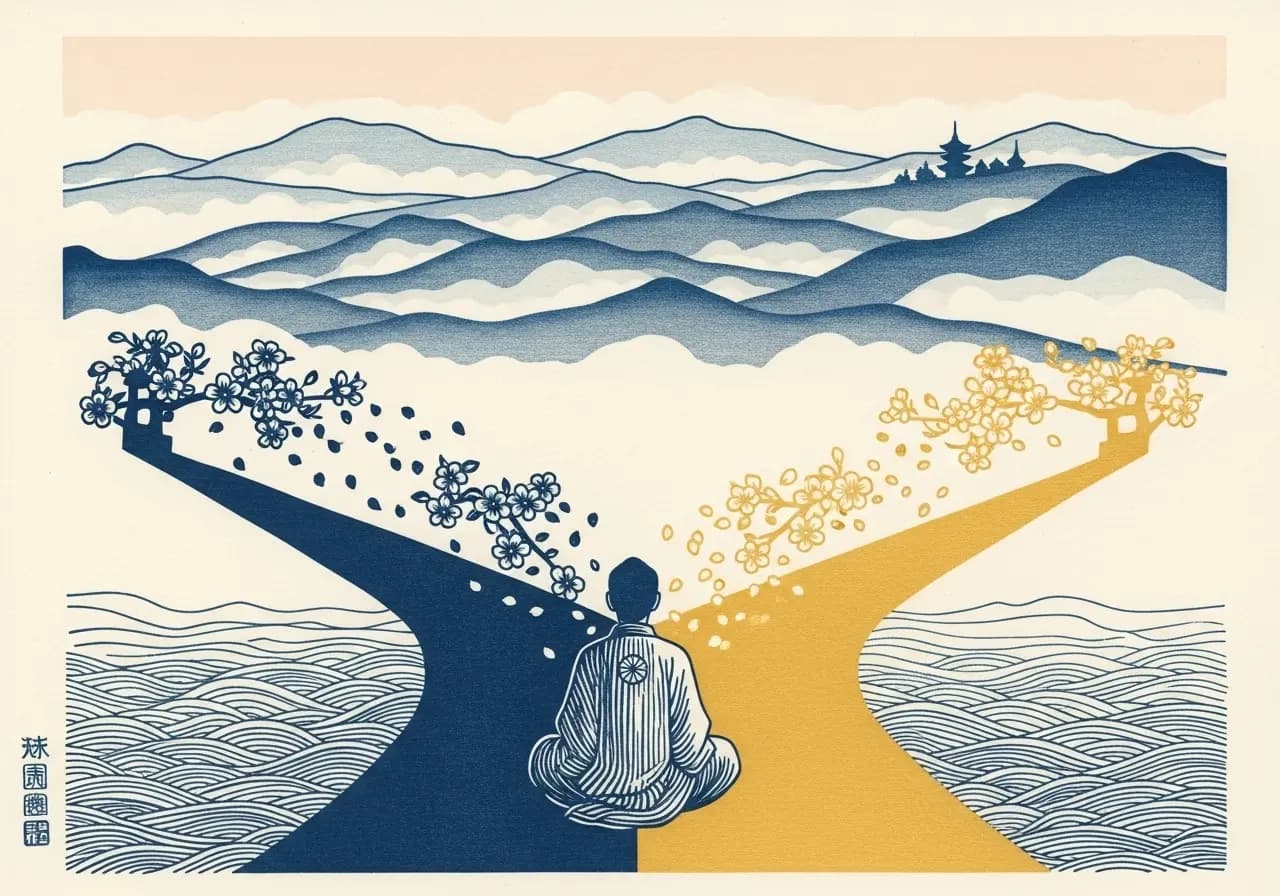
Listening to Understand
Episode 86 of the Secular Buddhism Podcast
Hello, and welcome to another episode of the Secular Buddhism Podcast. This is episode number 86. I'm your host, Noah Rasheta, and today I'm talking about listening to understand.
Before I jump into that, keep in mind the Dalai Lama's advice: do not try to use what you learn from Buddhism to be a Buddhist. Use it to be a better whatever you already are.
When We Stop Listening to Understand
I had a recent experience where I was asked about my view or stance on a controversial topic. In that moment, I felt a sense of hesitation in deciding how to answer. This experience got me thinking about the nature of the question itself. Was this being asked in order to truly gain a better understanding of my views, or was it just a test of some sort to see what team I'm on?
Now, imagine for a moment any of the hot topics of the day. It could be political questions like: What are your views on immigration? What is your stance on gun control? Or moral and ethical questions like: What do you think about abortion? Are you a vegetarian? Why do you eat meat? Or existential questions like: Do you believe in God? What do you think happens when we die? And of course, we can't leave out the hot topic of the season—your thoughts about the Christmas classic, "Baby It's Cold Outside."
As I thought about the specific question I was being asked, it occurred to me that perhaps I was being subjected to a test. Was this question just a simple assessment of whether or not I'm on Team Us or Team Them?
This got me thinking: how often are we making these assessments about others? And for me, how often am I really listening to understand?
The Drive to Belong
I mentioned before in a previous podcast episode—episode 73, titled "What Moves Us: The Five Core Social Motives"—that the first one, number one, is belonging. One of our core social motives is to make an assessment of belonging. I'm trying to determine whether I belong to a group, and to do that, I need to decide what team you're on.
Can you see how this plays out if we're all doing this assessment all the time? Do you do this in your own life? I do this all the time, and I think we all do. And some topics are more sensitive than others.
For me, it centers a little bit more around religious affiliation. More clearly, I'm trying to determine the level of religious dogmatism or fundamentalism that someone possesses, and that hits a sensitive nerve for me. I think it stems from the fact that I feel like I'm trying to determine if someone belongs to a particular team that I no longer belong to—a team that often gives off the vibe of "Hey, you're a traitor. You were one of us, and now you're not. You're a weak person because you've lost your faith."
So it seems easy for me that when it comes to religious topics or questions of a religious nature, I catch myself generally listening to assess for belonging rather than listening to try to understand.
And that's just something I've noticed about myself. What we're trying to do with all of this as a practice is internalize it. You take all this information that you're hearing on the podcast, and this is about you saying, "Okay, well, how does this apply to me? In what areas of my life am I struggling to listen to understand?"
We're Hardwired for This
Now, I want to emphasize that we're hardwired to do this for survival reasons. Back in the evolutionary days, if we weren't good at this simple assessment, it could have meant the difference between life and death. In other words, I'm not saying that this is a bad thing that we do. I'm just saying it's not the most skillful way to communicate around these difficult topics when we're all playing the game of just trying to see what side we're each on, and then we ostracize or invalidate the other view or opinion so quickly.
It's unfortunate, but I think in our culture, we've been taught to avoid talking about controversial topics because it makes both sides too upset. It makes people uncomfortable to talk about it, and we end up getting carried away by the aversion we have to the discomfort of the emotions that arise when we're talking about these things. When instead we should be focusing on learning how to have skillful conversations about difficult topics.
Now, I get that you can't change other people. This isn't about convincing someone else to be better at talking about difficult topics that are controversial for them. This is about you deciding to learn: Can I personally become better at having skillful conversations around difficult topics?
How to Listen to Understand
Well, first we need to learn to listen to understand. And when we're seeking to understand, it's important to know that we're not trying to debate the validity of another person's view, their opinion, or their belief. We're just trying to gain a bigger picture.
Thích Nhất Hạnh says, "Understanding is love's other name." And I really like that quote. I've mentioned it before in another context where he talks about how the more we understand, the more we love, and the more we love, the more we understand. I think that's something important to keep in mind.
I think one of the most powerful things that we can do individually to become better at having skillful conversations around difficult topics is to first recognize that we're not experts at everything. I don't understand why we all feel the need to be experts at everything, but I think everyone does. And in reality, there are very few things that we are experts in.
Perhaps it could be your career or something that you've spent considerable time learning. That's your area of expertise. But there are so many other areas that are not your area of expertise. For me, when someone asks me to talk about my views on immigration, for example, it's like, well, why would you want to know what my opinion is? I mean, sure, I have one, and I may feel strongly about my opinion, but that by no means makes me an expert on the topic. My view or opinion may be wrong, no matter how right it feels to me.
Wouldn't it be nice if we all carried that attitude—a little bit of wiggle room—knowing that our view may not be the right view?
The Practice of Examining Our Views
In my personal practice with Buddhism, I'm constantly trying to understand myself. Why do I do what I do? Why do I believe what I believe? Why do I not believe what I don't believe? And how do I view things the way that I view them?
I understand that I am the product of the societal views I grew up with, all my past experiences, and the opinions that arise out of all of this. But that doesn't mean that they're right. It doesn't mean that they're better than other views or other opinions. And I try to keep that in mind—to acknowledge that there may be better views or better opinions out there.
In fact, that's why I am where I am with my views. Because at one point, I measured or analyzed the views that I had with other views and thought, "Oh, these other views seem to make more sense to me." So I shifted and evolved. And that's led me to this current moment in space and time where the collective views and opinions that I have are the ones that I have.
But to become stagnant and think, "Oh, well, now I've got them all figured out"—that's a no. It continues to evolve, and I'm continually assessing my views and my ideas against other views and other ideas. There may be better views out there, and I want to hear about those. I want to listen to other views and understand them more.
And I want to be clear about this: this doesn't mean that we're tolerating or condoning harmful views, harmful ideas, or harmful opinions. But I think we can learn to engage more skillfully with opinions that we don't like, opinions that we disagree with.
But again, this whole process really starts with us.
An Invitation to Assess How We Listen
So this episode, "Listening to Understand," is an invitation to ourselves. But I think it also becomes an invitation to assess how others are listening to us.
If somebody comes to me and they're asking me a question on a hot topic, and I get the sense that they truly want to understand my view, I would happily sit and discuss it and have a civil conversation about a difficult topic. I think that would be relatively easy.
But it would be very difficult if I sensed that person is not listening to understand. They're listening to assess and listening to decide whether or not I am one of them or I am the enemy—whether I'm on the other team.
And if that's the case, I personally feel like, well, what's the point of playing that game? The moment I make it clear to you that I'm on the other team, sure, I'm going to stand firm about specific views and ideas that I hold. But there may be instances or circumstances where I think, "Well, I don't think you need to hear my view on this because it's just my view, and that's it. We don't really need to get into it. You're just going to view me as your enemy if I elaborate on this, so why elaborate on it?"
Or the other thing that I'll do often is be honest and say, "I don't know. I mean, I feel like it could be this or that, but the truth is I don't know. So I'm open." And that creates space for the person who's assessing you to think, "Okay, well, then I can discuss this more with them."
You can develop your strategy and see what works with you and what works with different people. This is different with friends than it is with family, different with close family like a spouse or partner than it is with maybe a distant cousin. But again, I think the invitation or the challenge for this week is to notice what your default style of listening is.
Are you listening to understand? Or are you defending your opinion perhaps with more zeal and energy than maybe skillfully required for the goal that you're trying to achieve?
You know, what if the goal of our conversations was to understand each other rather than to figure out who's more right than the other or how I'm going to convince you to view the world like me?
Upcoming: Mindful Trekking in Nepal
So those were just the ideas I wanted to share around this topic. But the next thing I wanted to share is kind of a news item.
In the past, I've done these trips to Uganda—humanitarian mindfulness trips. I've done two of them. And then I took a break. Rather than planning to do another one, I held off because I had in the works a tentative idea to do a trekking mindfulness trip to Nepal. And I'm excited to announce that that is now officially going to happen November 15th, 2019. So we're still about ten months out. There's plenty of time to think about this.
What I want to do is an adventure trekking slash mindfulness retreat. Why Nepal? Nepal has a lot of significance for Buddhism. It's where the Buddha was born—what is today Nepal. Back then it was India. There are many temples and pilgrimage-type sites. But what I want to do is actual trekking. Nepal is world famous for its trekking, and one of the regions there is called the Annapurna Range.
So what I'm proposing—and if any of you are interested, keep listening—is a 15-day itinerary where we would start in Kathmandu and then do a fifteen-day trek. Every day we trek to a new little town where we stay. This would be part mindfulness retreat, where every morning there would be group meditation, guided meditation, and silent meditation. Plus, plenty of walking meditation because that's what we're doing all day.
We would have group discussions around really deep concepts—getting to know ourselves—and having the time to put it into practice. You may discuss a deep concept and then it's, "Okay, let's walk for an hour and really think about this." Then pause and imagine just sitting there talking about these things and glancing over at Mount Everest or the other incredible mountains on the Annapurna Range. I think that would be a really neat experience. It's something I've wanted to do for a long time.
It'll be a small group. I'm going to cap this at probably thirteen to fourteen individuals, and we would spend fifteen days together trekking through Nepal talking about mindfulness, Buddhism, and deep concepts, just seeing and experiencing the incredible culture of Nepal. We'll visit ancient Buddhist temples and see all the cool things that we're going to encounter there.
I've put that together with a really neat outfitter group that's based in Nepal. We've been talking for just over a year now. And it's going to be an incredible trip.
Now, I don't have all the details ready to publish yet, but for now you can visit mindfultrekking.com to learn the most basic details of the trip. I will be updating that site next week with more details and the full itinerary so you can see the schedule from day one through day 15.
But for now you can go there, and if you're interested, enter your email address. That way I have it, and I can send you the notification when all the details are there and it's actually open to register. It's going to be a really cool trip.
So if you didn't get the chance—if you went to Africa, awesome! If you didn't get the chance to do any of our Africa trips, this would be a really fun one.
This trip is geared for the average person with an average level of fitness to be able to complete it. There are plenty of ups and downs. We'll never go higher than 6,000 feet in elevation. It's not an intense trek, but just keep in mind there are plenty of ups and downs and stairs that you would have to navigate over the course of these 15 days.
So if you have bad knees, that might be a consideration. But the average person with an average level of fitness would be able to complete this. So check that out at mindfultrekking.com.
Closing
If you enjoyed this podcast episode, like always, share it with others, write a review, and give it a rating on iTunes. You can join the online community—which I'm actually in the process of making a pretty big shift and change with. I'll announce that in a future podcast episode.
If you want to make a donation to support the work I'm doing with the podcast, you can visit secularbuddhism.com and click the donate button. But that's all I have for now.
I look forward to recording another podcast episode soon and giving you more details about the mindfulness retreat and trekking in Nepal. Thanks again for listening. Until next time.