

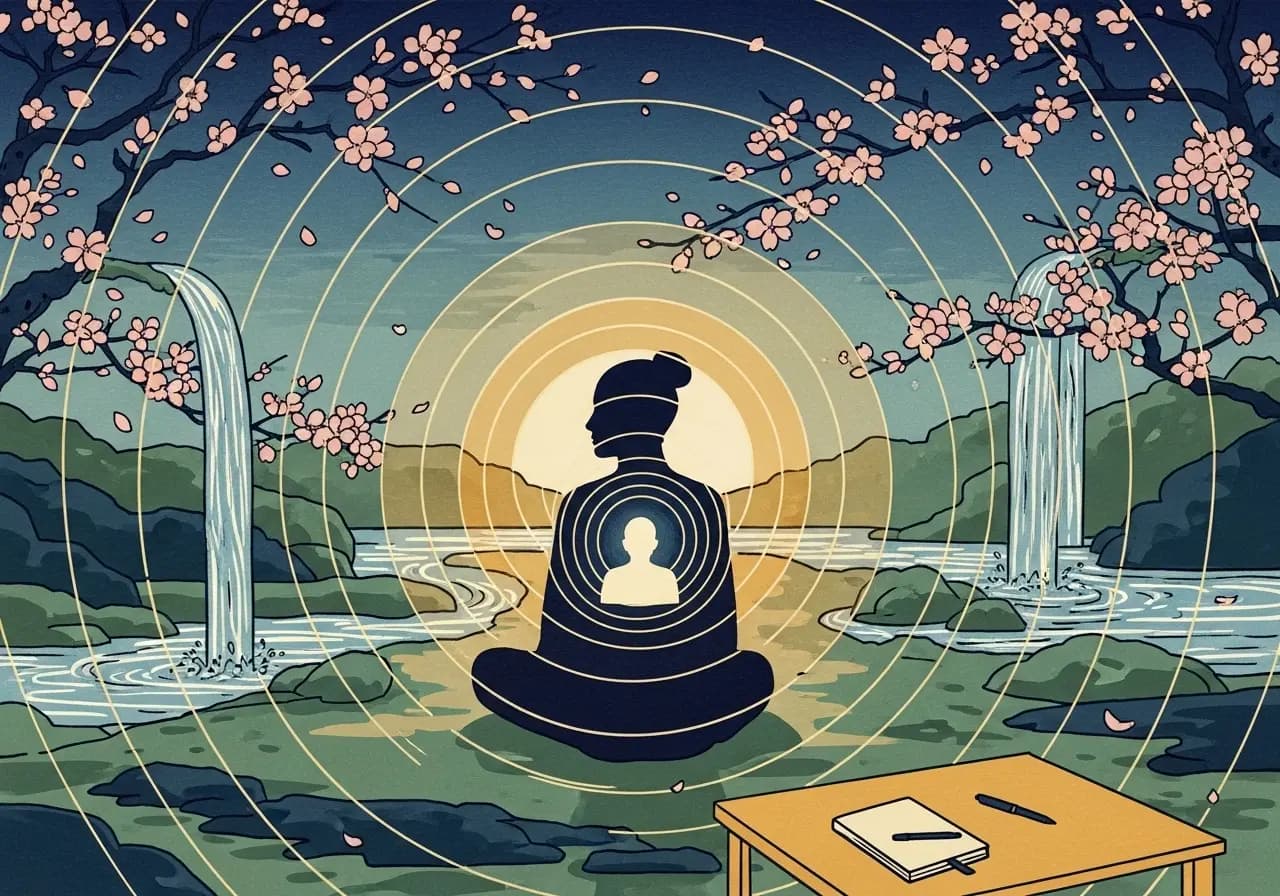
How to Practice Mindfulness Daily
Episode 84 of the Secular Buddhism Podcast
Hello and welcome to another episode of the Secular Buddhism Podcast. This is episode number 84. I'm your host, Noah Rasheta, and today I'm talking about how to practice mindfulness daily.
Opening Thoughts
Before I jump into that, keep in mind the Dalai Lama's advice: "Do not try to use what you learn from Buddhism to be a Buddhist. Use it to be a better whatever you already are."
Now, in the past couple of episodes, I've been talking about the Four Noble Truths with the acronym ELSA as a reminder to apply those as tasks. The Eightfold Path was the last episode. And today I wanted to talk a little bit about some ideas and tips and exercises regarding how to actually practice mindfulness in our day-to-day living.
Effort, Trying, and the Paradox of Practice
I want to bring something to your attention. You know, with the Eightfold Path, it can seem like there's this structured way of trying to go about living, and that can seem to contradict other episodes where I've talked about the idea of living artfully. I had a recent message from a podcast listener who brought up this point. They said, with some of the concepts that I share from time to time—like the idea that when you try, you've lost the whole point—or teachings like the Gateless Gate, at times some Buddhist concepts and teachings can seem contradictory in their implications. What's being taught seems to contrast trying to do something and having effort versus not trying to do something and just going with the flow. And in that case, why even try?
So what I explained as a response to this email was the idea that effort is something that we exert at any given time for many different reasons. It's always happening. So the idea is to be more skillful in where we exert our effort.
I gave an analogy in my response—I don't know if it's the best one, but it was to visualize the events taking place on the Titanic in those final hours. As it was sinking, there was a lot of effort being exerted to accomplish certain things. I'm sure in what you call the bridge, where the captain and all the officers were, there was a lot going on. We know that on deck there was a lot of effort being made to keep the band playing music. I'm sure somewhere in the kitchen somebody may have been exerting effort to put away the dishes or clean them up. But the point is to be able to pause and say: Where is the most skillful place to exert my effort?
In the case of the Titanic, it would have been to get as many people on the lifeboats as possible in the quickest amount of time. And we know that's not how it went down, unfortunately. So it's kind of like that. It's being able to pause and take inventory in our own lives with whatever the situation at hand is. Am I exerting the most skillful effort in the most skillful direction? That's kind of the point here.
It's not saying that we shouldn't have effort, that we shouldn't do things, that we shouldn't try to be better. It's saying try to understand why do you feel the need to be better in the first place. Because when you understand yourself, you can be more skillful with where you exert that effort.
Why Practice Mindfulness?
Which brings me to the point of this episode. I want to talk about why even practice mindfulness. What is the point of being more mindful?
And I want to emphasize what I've echoed before in previous episodes: You don't need to be more mindful. This content is relevant information for people who want to be more mindful. It's like the saying that goes, "Ignorance is bliss." That's true up until the point where ignorance isn't bliss. Ignorance can be bliss in some circumstances, in some instances, and for a certain amount of time. But then life changes—just like the game of Tetris—a new shape shows up and suddenly you are living in a new set of circumstances where the ignorance isn't bliss. It's causing yourself and those around you a lot of unnecessary suffering.
And I think this happens a lot. This is certainly what happened with me in my own life. I experienced going through changes and events in life that caused me to suddenly be experiencing a lot of suffering, and a lot of my suffering was passing on to others around me—those closest to me. There came to be this moment where I didn't want to feel that way anymore. I wanted to understand the nature of my emotions, my thoughts, and my feelings. And that path allowed me to exert more effort to be more mindful—in other words, to learn more about myself.
And that's something I cannot emphasize enough with this entire discussion and journey about Buddhism and mindfulness and all of this stuff. It will never give you the answers to life's big questions or the mysteries of the cosmos. It's not about that. It's going to unlock something that I believe is incredibly more mysterious and profound: the nature of your own thoughts. Why do you think and say and do the things that you do? Only you can discover that about yourself, and that's the whole point of mindfulness as a practice.
The Nature of Mindfulness Practice
Now it's important to recognize you cannot force yourself to be more mindful. It's not like I can just sit here and will myself to be more mindful in the same way that I cannot force myself to be more smart. You know, if I want to learn something, it's going to take time, it's going to take effort. I'm going to have to pick up a book, read about this subject or topic that I want to learn more about, get a study manual, highlight things in the manual, watch tutorials and educational videos online about it. It takes effort on my part to learn about a new subject, it does for all of us. And it's the same way when it comes to learning more about ourselves.
If you want to be more mindful and aware of yourself, well guess what? It's going to take some time and you're going to have to spend some time studying and observing yourself. And in that sense, that's where mindfulness as a practice comes in. It's something that you continually work on and you can continually get to know yourself. And the game doesn't end because of the nature of things being impermanent. The you that you're getting to know is a changing you.
So if you think you finally figured yourself out, well, guess what? The game keeps going because you're always a new you. So keep that in mind in all of this.
The Two Layers of Mindfulness
Now when we typically talk about mindfulness through most Buddhist schools and traditions, they would mention that mindfulness has essentially two layers. It's being in the present moment, and I think this is the most important part: having a non-judgmental awareness of being in the present moment.
For example, if I am sitting with the experience of being angry, I'm allowing myself to feel angry because that is the natural thing that I'm experiencing. That's the first layer. The second layer is experiencing anger and not judging myself for having the experience of feeling angry.
So it doesn't mean that we're eliminating the stories that give rise to these emotions. It's more about changing the relationship we have with our stories. It's about no longer believing our stories and recognizing that our stories are just stories.
One of those stories in this example I just gave is that it's wrong to be angry. So if I have the story "it's wrong to be angry," and now I experience anger, I'm adding a more complex layer because now I'm angry that I'm angry. That's something that we start to dissect in this whole process of exploration of trying to be more mindful.
And keep in mind that mindfulness is not just about feeling good. Although you can feel really good about being mindful and practicing mindfulness, it's more about being good at feeling. Because you will feel everything that arises—the instances of discontent, anger, sadness, and all of it. You're going to be really good at feeling.
The Five-Minute Mindfulness Journal
This is why I recently wrote my newest book, "The Five-Minute Mindfulness Journal." My goal was to create a resource where mindfulness doesn't have to be this complex, time-intensive, complicated process. Sometimes we have this illusion that mindfulness is something that can only be truly practiced in a quiet, peaceful meditation space where you sit for hours and hours. But the reality is that mindfulness can be practiced in five minutes or less, every single day. And if you do that consistently, it can have a profound impact on your life.
The book is structured as a journal that takes five minutes or less every day. It has various sections and exercises and questions that you work through. And the goal is really to facilitate a conversation between you and yourself. It's about understanding yourself more and having a better relationship with yourself. And that's what this whole discussion is about—getting to know you so that you can change the relationship you have with yourself and ultimately change the relationship you have with the world around you.
Understanding Your Inner Narrator
One of the biggest components of this entire journey is understanding what I call the "inner narrator." This is that voice in your head that's constantly narrating your life, judging situations, and offering commentary on what you're doing and what others are doing. We all have this voice. It's constantly running in the background.
And what's interesting is that this inner narrator has been conditioned by our upbringing, our culture, our family dynamics, and all sorts of things. And sometimes this narrator can be pretty harsh. It can be really judgmental and critical. We often feel guilty about things because of what this inner narrator is telling us. We feel shame. We feel embarrassment.
But here's what's important to understand: part of its job is to protect us. We're hardwired as a species to survive. So a lot of the harshness that comes from this inner narrator is coming from a place of love, you could say—a place of instinctual survival. It says, "Don't wear that. You look like an idiot," because ultimately it's trying to protect you. Because if you look like an idiot, you may be ostracized from the group. If you're not in the group, you're going to be cast out. And if you get cast out, we're going to die, right? Like that's the thinking going on underneath the meanness at times of this inner narrator. And I think that's important to know.
Befriending Your Inner Narrator
So what we want to try to spend time with is imagining that you're meeting the inner narrator, and I want you to think of five compliments that you could give your inner narrator. It may be difficult to conceptualize this as you meeting your inner narrator. An easy way to do this is to just imagine that you are meeting yourself from yesterday. The you of yesterday is meeting the you of right now. And what would be five compliments and perhaps five complaints? If you want to have a frank discussion with yourself, what are five things you like about yourself and five things you don't like about yourself? Try to analyze these things through the lens of introspection—of you, the inner narrator, trying to protect yourself, often from things you don't realize are the hidden motives of why you are the way you are with yourself.
So keep that in mind and look at this list of the five complaints and five compliments and see what insight arises out of that.
Another exercise you can do is think of a good friend. What are some of the characteristics of a good friend? What is it that makes a good friend a good friend? Write down some of these qualities or attributes. Again, this is what separates a friend from a good friend. Everyone's list is going to be a little bit different, but think about what that entails for you. What makes your good friends your good friends?
And then look at that list. Now imagine what would it be like if you were that good friend to yourself? How would your life be different if you were a better friend to yourself? And list five things that you can start doing right now to be a better friend to yourself.
This exercise works even when you're thinking of others too. If you want to just be a better friend in general, how can you be a better friend to others? How can you go from being a friend to a good friend to someone else that you care about? So this kind of has a two-part thing where it can benefit your relationships with others, but it's meant to really start with the core, which is you befriending yourself.
There's a quote that says: "You yourself, as much as anybody else in the entire universe, deserve your love and affection." I want to end on that note.
The Structure of the Journal
This is why I wrote the Five-Minute Mindfulness Journal as a place where you can visit. Literally, it takes five minutes or less every day looking at some of these questions and exercises. The book is packed with them. I've given you what, three or four? The book is packed with them and it's broken into various sections.
Section one is "You Are Not Your Thoughts." Two is "The Inner Narrator." Three is "Befriending Your Inner Narrator." Four is "Finding Peace in the Struggle." Next is "Self-Acceptance," then "Gratitude," and then the last section of the book is exercises around cultivating loving kindness.
The way this book is structured as a journal, it's meant to be a book that you read and that you write in. These exercises that you work on and the things that you write are meant to give rise to insight and wisdom into the nature of yourself, your own mind, your thoughts, your feelings, your emotions, the things that you say and think and do. It's a journal about you. It's about you getting to know you, having a better understanding, and ultimately changing the relationship that you have with yourself.
I can guarantee you there's nothing mysterious that you're going to gain in this about the cosmos or about life. There will absolutely be aha moments when it comes to understanding you and yourself, which I think is incredibly more profound, at least in my opinion.
A Personal Reflection
But again, as I mentioned earlier, who am I to think that my ideas are good? Obviously, to some people they're not. I haven't gone to Antarctica yet, but it's still in the works. But now that I've talked about this and recalled that story, I think I've rekindled the desire to get that one crossed off my bucket list and go to Antarctica. Hopefully my wife will think it's a good idea. Hopefully she'll want to come with me now that this is like ten years after that. We'll see. I guess you'll know when you hear about it if and when I go. If she comes with me, you guys will all be a part of that inside joke knowing that story about us and our past and her thinking what a dumb idea it was for me to want to go to Antarctica.
Closing
Okay, so that's all I have for this episode. Hopefully you've enjoyed the sequence of thoughts and ideas from the past three episodes, starting with the Four Noble Truths, the Eightfold Path, and then this one—the invitation to start to apply practices where you sit and get to know yourself. I can promise you that one of the most impactful changes that you'll have in your life is the change in the dynamic, the relationship that you have with yourself, with your own thoughts, with your feelings, and with your emotions. To be able to be skillful in where you exert this effort of controlling who you are and how you want to be and the things that you want to do.
That's the invitation with this podcast. You can pick up the book. It's available now on Amazon. It's called "The Five-Minute Mindfulness Journal." You can search for it just with my name or with the title of the book. I will have a link, so if you go to secularbuddhism.com you can find it there as well.
If you want to learn more about these concepts, you can check out the other book, "No Nonsense Buddhism for Beginners," and I think that will complement this one pretty well. That one covers the teachings, concepts, and ideas, and then this one is practices and exercises. You can learn more about that on Everyday Buddhism or Secularbuddhism.com.
And as always, if you've enjoyed this podcast episode, please feel free to share it with others, write a review, or give it a rating on iTunes. You can join the online community at secularbuddhism.com/community—it's just a Facebook group. And if you'd like to make a donation to support the work I'm doing with the podcast, please visit secularbuddhism.com and click the donate button.
That is all I have for now, but as always, I look forward to recording another podcast episode soon.
Until next time.
For more about the Secular Buddhism Podcast and Noah Rasheta's work, visit SecularBuddhism.com