

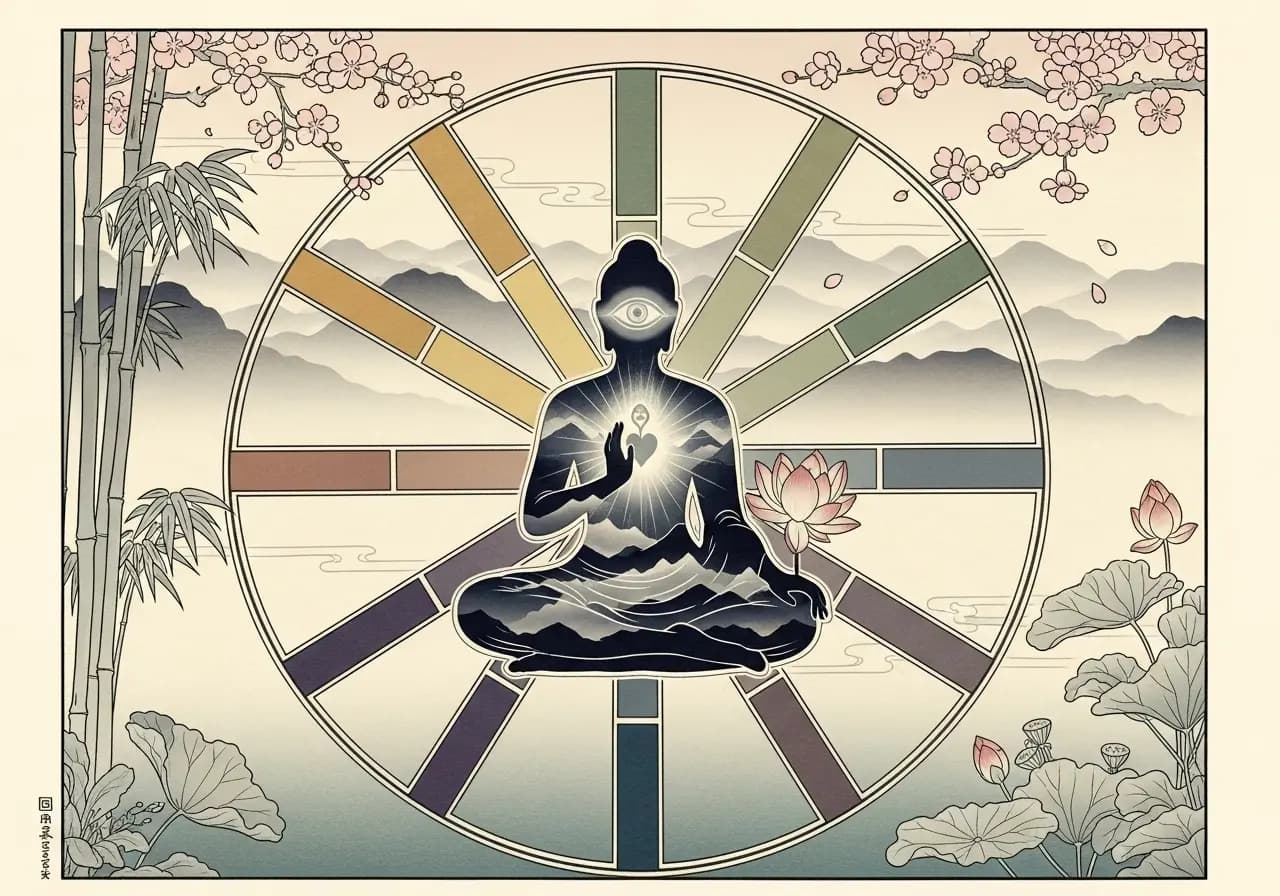
The Eightfold Path
Episode 83 of the Secular Buddhism Podcast
Hello and welcome to another episode of the Secular Buddhism Podcast. This is episode number 83. I'm your host, Noah Rasheta, and today I'm talking about the Eightfold Path.
As always, before I jump into the topic, keep in mind the Dalai Lama's advice: do not use what you learned from Buddhism to be a Buddhist. Use it to be a better whatever you already are.
Recap: The Four Noble Truths
I want to recap the last podcast episode where I talked about the Four Noble Truths—or the four truths for those who would be noble, or the four tasks, however you want to think of that framing. I used the acronym ELSA to break it down.
E is embrace the instance of suffering—the first truth.
L is let go of the reactive pattern. And remember, what we're letting go of is the pattern, not reactivity itself. I think this is a misconception I want to be clear about. It's not that we let go of reactivity and now we won't react negatively when something arises. That's not what this is about. This is about the reactive pattern—that one thing leads to another, which leads to another, which leads to another. Somewhere in that chain of reactivity, you can pause and see the stopping of reactivity, which is the third one.
S is see the stopping of reactivity. When you see the stopping of the reactivity—the pattern—you let go of the reactive pattern. That's not the same thing as letting go of reactivity. I just want to be clear about that. With this process of seeing the stopping of reactivity, it's like asking yourself: is the observer of the emotion also experiencing the emotion? That's kind of what it's like to see the stopping of reactivity.
A is act skillfully. Keep in mind this word skillfully is used deliberately because it's not about acting the right way versus the wrong way. It's about understanding ourselves, our intent, and trying to make the most skillful choice with whatever it is that we're about to do and whatever the situation at hand is.
So the podcast episode for today—the Eightfold Path—is essentially this: act skillfully. How do we act skillfully? In what areas of life? That's what I want to talk about in this episode.
The Path: Marga
In the original writings when referring to the Four Noble Truths, the fourth truth is referred to with a word called marga, which is a Pali word meaning "path." The idea here is that what we're talking about is a path. The Buddha taught this concept of the path in one way or another in all of his teachings. It may have been explained differently to different people according to where they were on their own individual paths.
The Buddha was known for speaking to people and explaining things from where they were—not explaining something that would go over their heads. But the essence of the Buddha's many discourses and teachings can essentially be found in this idea of the Eightfold Path, often referred to as the path of liberation or the path to the cessation of suffering.
Three Categories
The eight parts of the path are typically grouped into three categories: wisdom, ethical conduct, and mental discipline.
The Eightfold Path isn't meant to be followed in sequential order. All eight areas are typically developed simultaneously in an ongoing way. They're all linked in the sense that each one helps with the cultivation of the other parts of the path.
Here's how the eight parts break down:
Wisdom consists of:
- Skillful understanding
- Skillful intent
Ethical Conduct consists of:
- Skillful speech
- Skillful action
- Skillful livelihood
Mental Discipline consists of:
- Skillful effort
- Skillful mindfulness
- Skillful concentration
The Eightfold Path is not a path that we walk once or in a particular order, like you master one, then move on and master the next. It doesn't really work that way. You'll notice how various segments of the path seem to overlap and rely on each other, and some of them flow into or relate back to each other as well.
It's also not a moral code intended to be followed in the sense of the Ten Commandments in Christianity. It's not really like that.
Right Versus Skillful
The components typically have the word "right" attached to them. If you pick up a book on Buddhism, you'll probably find that the Eightfold Path is explained with language like "right understanding," "right intent," "right speech," "right action." I think that can be a little bit misleading because in our Western way of thinking—our dualistic way of thinking—"right" has an opposite. It has a wrong. So if I'm doing "right speech," then what is "wrong speech"?
That doesn't really arise in a lot of Eastern thinking because a lot of Eastern thinking is non-dualistic. There's no problem with saying "right something" because they're not opposing that with "wrong something." But we do in the West, so I find it more beneficial to use the language of "skillful" when we're talking about these things.
Don't think of these in terms of right versus wrong. Instead, think of them as wise or skillful ways of living. The Eightfold Path is meant to be a guide for specific areas of life in which we can experience and discover the nature of reality. Walking the path is an ongoing practice that can bring a new sense of awareness and perspective in our lives because we're always on the path.
Wisdom: Skillful Understanding
What does it mean to have skillful understanding? Wise understanding starts by simply recognizing that what we're seeing might not actually be what we think it is or what it appears to be.
I've used this analogy before, but imagine walking into a barn and you see a coiled hose and you mistake it for a snake. You wouldn't be experiencing reality, but rather the picture of reality in your head. You might immediately react as though there really were a snake—giving a gasp, being startled, or turning and running away. Yet in reality, there is no snake.
Wisdom is like turning on the light in the barn and revealing that the snake was actually a hose. We're continually seeking wisdom to help us learn and see the world the way that it really is.
The Four Noble Truths and the three marks of existence—suffering, impermanence, and the concept of no-self or non-self—help us to have a wise understanding of the nature of reality. The wisdom of understanding is not about acquiring more knowledge. In fact, I would say it's the opposite. It's about trying to unlearn the concepts and ideas that prevent us from seeing reality as it is.
Wisdom: Skillful Intent
What does it mean to have skillful intent? If we want to reduce suffering, we need to be aware of the intentions we have regarding the things that we say and do. When our intentions stem from anger or hatred, they're more likely to cause harm than if they stem from happiness or gratitude.
When we behave reactively, it's very difficult to be mindful of the intent behind our words and actions because typically we're just reacting. It takes practice to become aware of our intentions. You can start this practice by asking yourself: why? Why am I reacting this way to the things that are unfolding in life? What is the intention behind what I'm about to do?
This practice is a form of introspection. It helps us step back and evaluate what's driving our behavior. When we do this, we create space between the impulse to act and the action itself. And in that space, we have the opportunity to choose a more skillful response.
Ethical Conduct: Skillful Speech
Skillful speech means communicating with others in a way that does not cause harm. This is one of the most significant areas of the Eightfold Path because we're constantly communicating.
Think about how much of our lives we spend talking. We talk to our partners, our families, our coworkers, our friends. And often, without thinking, we say things that harm relationships or hurt people's feelings.
Skillful speech doesn't mean withholding opinions or ideas. It means we're mindful of the intention behind the communication and we ask ourselves: will what I'm about to say do more good or more harm? Is it true? Is it necessary? Is it kind?
Lying, gossiping, and hurting other people's feelings is not skillful speech. And in our day and age, this concept extends beyond just speaking. It includes texting, emailing, and writing—all forms of communication. When we practice skillful speech, we're taking responsibility for the impact our words have on others and the world around us.
Ethical Conduct: Skillful Action
Skillful action means acting or behaving in a way that is not harmful to ourselves or to others. Because we understand the nature of interdependence—how everything is connected—wholesome intentions naturally lead to wholesome actions.
When we understand that our actions ripple out into the world and affect others, we become more conscious about how we behave. We start to ask ourselves: how will this action impact the people around me? How will it impact my own well-being?
This isn't about being rigid or following rules. It's about being awake to the consequences of our actions and choosing to act in ways that reduce suffering rather than increase it.
Ethical Conduct: Skillful Livelihood
Skillful livelihood addresses how we earn a living. We need to determine for ourselves if what we are doing for a living is causing harm to others and ourselves, or if it is neutral, or if it is helping.
This is something worth examining. Many of us spend a huge portion of our lives working. If what we're doing for work is causing suffering to others or to ourselves, we might want to explore other options or at least be aware of it. Skillful livelihood also includes how we interact with others while doing our jobs—how we treat coworkers, customers, clients, and everyone we encounter.
This doesn't mean everyone needs to quit their job and become a monk. It means being mindful of how your livelihood aligns with the value of reducing suffering. Sometimes that's possible right away. Sometimes it takes time and planning. But the awareness is an important first step.
Mental Discipline: Skillful Effort
Skillful effort is what it takes to put into practice all of the other parts of the path. Without effort, there is no practice. We must be determined to put into practice all the other points of the path if we want to experience any kind of positive change.
I think a lot of times in our culture, we want things to be effortless. We see an advertisement for something and we think, "Oh, that would be amazing, but I'm not willing to put in the effort." There's not enough motivation to meditate, or to read books to understand the nature of human psychology, or to do anything other than just want it without having to do anything.
And that's where we run into trouble because without effort, how do you have these things? Effort is a form of introspection where we evaluate ourselves and ask: how much effort am I putting into the thing that I'm trying to accomplish? Whether that's achieving better health, deeper relationships, spiritual growth, or anything else we value.
In the Buddhist practice and in the sense of the Eightfold Path, it's the effort required to be more awake, to be more mindful, to live with more contentment and joy. And ultimately, in the Buddhist sense, it's the effort to achieve enlightenment, to aspire to put in the necessary work to wake up the way the Buddha woke up. That's what we're after here.
Mental Discipline: Skillful Mindfulness
What does it mean to have skillful mindfulness? Is this about meditating? Well, skillful mindfulness is about paying attention. Whether we're meditating or just going about our daily tasks, being mindful helps us to stay anchored in the present moment. And staying anchored in the present moment keeps us in touch with reality as it is.
Thich Nhat Hanh describes it in this way, which I really like:
"When you have a toothache, the feeling is very unpleasant. And when you do not have a toothache, you usually have a neutral feeling. However, if you can be mindful of the non-toothache, the non-toothache will become a feeling of peace and joy. Mindfulness gives rise to and nourishes happiness."
I really like that. In this sense, mindfulness helps us become aware that at any given moment, we are capable of experiencing contentment and joy. It's just a matter of increasing our sphere of awareness. It's about noticing all of the non-toothaches that we're currently experiencing. That's how I like to think of this concept of skillful mindfulness.
Mental Discipline: Skillful Concentration
The final point of the Eightfold Path is skillful concentration. What does that mean? Is it about sitting and focusing on something? Is this the ultimate goal of meditation?
Skillful concentration is the practice of focusing the mind solely on one thing—whatever it is we're doing at the moment. Meditation is a great tool to practice concentration. When we think of meditation, we typically think of sitting cross-legged on the floor with our eyes closed on a cushion. And yeah, that's definitely one way to practice. But meditation can be so much more than just sitting. We can practice meditation while we're washing the dishes, while we're walking, when we're listening to our partner or spouse, to our kids, or doing virtually any other activity.
I find it helpful to think of the opposite of skillful concentration as distraction. Distraction is everywhere—the chime on our smartphone indicating that a new text has arrived, thousands of advertisements that compete for our attention. Distraction prevents us from seeing life as it really is and from seeing the truth about the nature of ourselves and others.
I've told this story before, but one time I decided to ride my bike to work instead of driving. While rounding the bend in the road, I noticed a red barn behind a cluster of trees out in the field. I had driven past this exact spot almost daily for years, focusing on driving, distracted either by the radio or just thoughts about work. I'd never really noticed this building. But on this specific day, going slowly and paying attention, I discovered something new that had been there all along.
That's kind of the idea of skillful concentration. Imagine how many things are waiting to be discovered or seen about others, about ourselves, when we simply slow down and pay attention and stay aware. That is the essence of skillful concentration.
It's not just about physical things like a red barn. It's also introspective. It's like saying, "I've never sat with my emotions long enough to try to understand them." A huge example of this is sitting with an emotion like anger long enough to understand that the anger was actually not anger—it was anchored in something deeper, like a sense of shame or embarrassment.
When you sit with an emotion and try to understand it more, you learn something about it that was there all along, but you didn't know it because you were often distracted with other thoughts, memories, and emotions. We try to push some emotions away, some thoughts away, and we don't sit with them long enough to concentrate. What does this really feel like? What does it feel like to be experiencing this emotion? Where could this be coming from?
When you sit like that in that form of concentration, insight arises. You understand: oh, that's why I'm feeling this way. Oh, that's why that means so much to me. That's the goal of concentration—to gain new insight.
Bringing It All Together
Those are the eight sections of the Eightfold Path. What I hope to do in the next podcast episode is give some examples of ways that we can actually practice being mindful. Because with the Four Noble Truths as tasks and the Eightfold Path with descriptions of it all—that's all great. But in our day-to-day lives, what things can we do to actually start practicing this?
Do we just sit on a cushion for fifteen minutes? Like, what is that going to do? I want to get into that deeper and give you some actual examples of practices that I do, practices that I apply, and practices that I've recently put in my newest book, the Five Minute Mindfulness Journal. Because the goal of all of this is to have something tangible that you can actually put into practice and start applying and see beneficial change come from this practice.
So I'm going to share that in the next podcast episode.
Resources
For now, thank you for taking the time to listen to the podcast. If you want to learn more about these concepts, you can always check out the book No Nonsense Buddhism for Beginners. You can also check out my newest book, which is available starting today on Amazon as a pre-order: the Five Minute Mindfulness Journal. It will be available on December 25th, but it's available for pre-order now. The whole purpose of that book is to have actual exercises that you can do in five minutes or less to start applying mindfulness into your day-to-day life and gaining more insight and understanding about the nature of yourself and the nature of reality.
You can learn about both of those books if you visit my website at NoahRasheta.com. I have links there, and I also have a link to the new book on SecularBuddhism.com.
As always, if you've enjoyed this podcast episode, feel free to share it with others, write a review, or give it a rating on iTunes. If you'd like to join the online community, visit SecularBuddhism.com/community. And if you'd like to make a donation to support the work I'm doing with the podcast, you can visit SecularBuddhism.com and click on the donate button.
I look forward to recording the third section of this overall discussion in the next podcast episode. So until then, thank you, and until next time.
For more about the Secular Buddhism podcast and Noah Rasheta's work, visit SecularBuddhism.com