

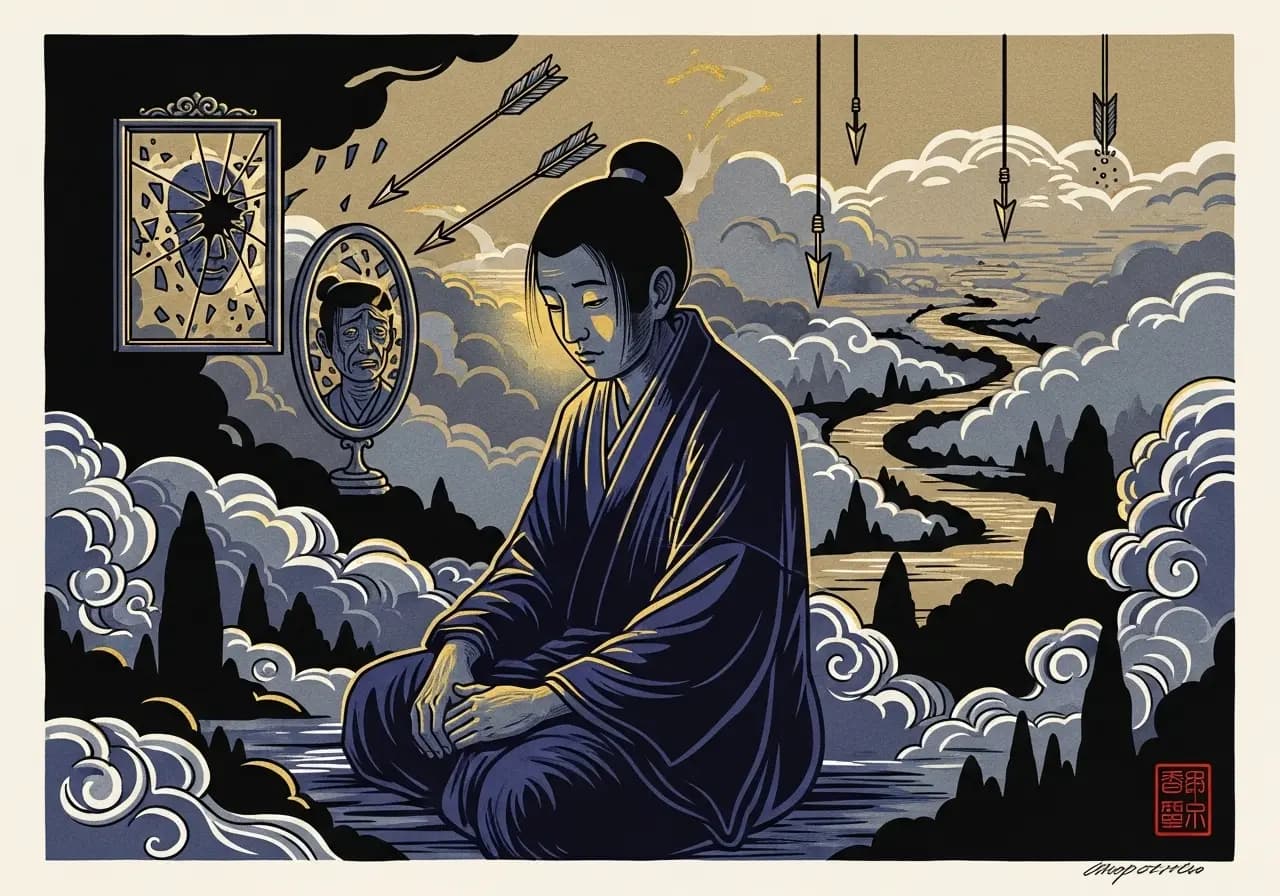
Dealing with Dissatisfaction in Life
Episode 82 of the Secular Buddhism Podcast
Hello and welcome to another episode of the Secular Buddhism Podcast. This is episode number 82, and I'm your host, Noah Rasheta.
Today I'm talking about something we all deal with, have dealt with, or will deal with at some point—and most likely many times throughout our lives. That is the dissatisfaction we experience in life.
Before I jump in, keep in mind the Dalai Lama's advice: do not use what you learn from Buddhism to be a Buddhist. Use it to be a better whatever you already are.
With that in mind, let's explore this topic.
The Universal Experience of Dissatisfaction
It doesn't matter who you are, what you do, how much you have or don't have. The reality is that as human beings, we all deal with dissatisfaction in life—this fundamental unsatisfactoriness and stress of ordinary existence.
If Buddhism were to be summarized into one key teaching, that teaching would be about the nature of suffering and the cessation of suffering. This is what we know as the Four Noble Truths. This teaching is found in every school of Buddhism and serves as the core foundational teaching of Buddhism.
Over this episode and perhaps the next one, I want to revisit these topics. I talked about them in the first five episodes when I started the podcast, but that was years ago now. I thought it would be valuable to revisit this with a little more depth and explore the teachings of the Four Noble Truths and the Eightfold Path more thoroughly. The Eightfold Path will probably be the subject of the next episode, so for this one, I'm going to focus on the Four Noble Truths.
Understanding the Four Noble Truths
These are often referred to as the four truths for those who wish to live a noble life, or sometimes referred to as the four tasks that we can work with to have a life with more satisfaction. I don't want to get too hung up on the wording—the point is that when things aren't the way we want them to be, we experience dissatisfaction. We all experience this from time to time.
Before we go any further, I need to talk about a key word: dukkha. The essence of the Buddha's teaching is the nature of dukkha and the cessation of dukkha. In early Buddhist texts, the Buddha is reported to have said, "Both formerly and now, it is only dukkha that I describe and the cessation of dukkha."
This word dukkha is often translated as "suffering," and that's where the expression comes from that says life is suffering. The problem is that dukkha means more than just suffering. It's a proper translation to say suffering, but so is dissatisfaction, stress, anxiety, or unsatisfactoriness. The word carries all these meanings, so it gets tricky if we try to hang on to just one word to translate it.
The thing is, when we say "anything that is temporary is dukkha," we're getting at something deeper than just the word suffering conveys. Everything is temporary, and that's why the expression is used that life is dukkha, life is unsatisfactory, life is there's dissatisfaction in life. There are several variations of how to translate this idea, but I think if we just look at it as an idea, the concept is that from time to time life unfolds in a way that we don't want it to be. We all know this feeling. That is dukkha.
The Four Truths and Their Pali Terms
The Four Noble Truths each have a word in Pali. Let me break them down:
The first is the truth of dissatisfaction or the truth of suffering, which is the word dukkha. The second teaching is the cause of suffering, represented by the word samudaya. The third is the truth of the end of dukkha, which is called nirodha. And the fourth is the truth of the path that leads to the end of dukkha, represented by the word magga.
So you have these four Pali words: dukkha, samudaya, nirodha, and magga. I may not be pronouncing those perfectly, but the point is that we lose a lot in translation. By telling you the original words, I'm trying to convey that each word carries a deeper idea. The moment you translate a word into another language, something gets lost. That's inevitable, and that's okay. So whatever this is making sense as, just know that there's probably more to it. It's not just suffering—there's more to it. Keep that in mind.
The Medical Model
You can think of this teaching of the Four Noble Truths in terms of a medical practice. The doctor—in this case, the Buddha—diagnoses the problem: dukkha, the fundamental dissatisfaction that we experience in life. The doctor then identifies the underlying causes, determines the prognosis, and finally prescribes a course of treatment, just like you would if you visited a doctor.
In that sense, it makes sense to look at the Four Noble Truths as an action plan for dealing with the inevitable dissatisfaction that we experience from time to time in life. Rather than viewing these teachings as abstract truths, we can view them almost as tasks—things that we do rather than things we believe in.
The ELSA Framework
I talked about this when I interviewed Stephen Batchelor on my podcast quite a while back. He explained the teachings of the Four Noble Truths as tasks and gave us an acronym to make it easy to remember: ELSA.
E is Embrace the instance of suffering. L is Let go of the reactive pattern. S is See the stopping of the reactivity. A is Act skillfully.
So ELSA: Embrace the instance of suffering, let go of the reactive pattern, see the stopping of the reactivity, and then act skillfully. This teaching forms the core of all Buddhist paths, schools, and traditions. The essence of the Four Noble Truths is to address and embrace the truth of the human condition—that in life we deal with dissatisfaction.
The First Noble Truth: Embracing Suffering
Let's start with the first one. What does it mean to embrace the E in ELSA—embrace the situation at hand, or embrace the instance of suffering?
Well, this is the word dukkha. It recognizes the presence of suffering or dissatisfaction in life. In other words, it diagnoses the problem: in life, difficulties arise, and we suffer. It's not a matter of if, it's a matter of when. Sickness, old age, death—these are some of the most obvious examples. But of course there are countless difficulties that we encounter in life, from losing your job to dropping your phone and cracking the screen.
The nature of reality is that difficulties arise. And when they do, we all experience this feeling of unsatisfactoriness. We will experience suffering no matter how hard we try to avoid it. Whether we search for a magic formula to remove it, accumulate enough money to buy it off, seek fame to drown it out—it doesn't matter whether we pray, meditate, or perform rituals to try to shield ourselves from it. The point is that suffering and dissatisfaction in some form will find us. It's the central problem of human existence.
This is the universal diagnosis that the Buddha talked about. It's not just you—it's all of us. Whether you're rich or famous or powerful or holy, it doesn't matter. Everyone experiences difficulty. And if you think you're alone with the difficulties you experience in life, just spend some time talking to others and ask them about their problems. You'll soon discover that everyone has struggles and everyone has pain and difficulties that they contend with.
What we learn from the Buddha about embracing suffering is that life is going to be easier for us when we truly accept that suffering is just a part of life for everyone. There's no way around it.
Acceptance Is Not Resignation
So this is the idea of embracing the instance of suffering: when you're experiencing a moment of general dissatisfaction, you can pause and just allow yourself to fully feel it. That's what embracing means.
Now, here's something important: embracing doesn't mean accepting a situation and resigning yourself to it. That's not the point. I've talked about this extensively, and I'll address it again: acceptance is not the same thing as resignation.
What we're accepting is this: I don't like how things are, and I can accept that I don't like how things are. That's kind of what we're after.
Acceptance seems like a lot to ask sometimes. People will say, "Are we supposed to just accept all the bad things that happen in the world?" The answer is no. The purpose of Buddhist teachings is to try to help us better understand the nature of reality and gain a clearer understanding of how things really are. Acceptance from the Buddhist perspective is not about giving up. It's not about ignoring bad things like injustice or suffering. Acceptance in the Buddhist sense is about not resisting or fighting against reality.
For example, if you're feeling a certain emotion—let's say loneliness—you have to accept what it is you're feeling before you can skillfully do something about it. If you shy away from acknowledging that you're feeling lonely and instead try to ignore that uncomfortable feeling, anything you do to alleviate that discomfort is going to be unsuccessful or much more unskillful because you're aiming at the wrong target. You're not dealing with reality. Reality is: this is how I feel. I'm lonely.
And I think we sometimes equate acceptance with resignation or giving up, but they're not the same thing.
A Personal Journey with Acceptance
Several years ago, I was dealing with a difficult situation in my life where I experienced a breach of trust from someone close to me. I was upset and I was hurt. And at the time I felt that I shouldn't be angry. So I felt like it was my responsibility to accept what happened and get over it. I was viewing this idea of acceptance almost as if it were resignation, and this attitude only aggravated the situation. I probably remained angry about what had happened for longer than I otherwise would have.
It wasn't until several years later that I learned what acceptance really was. I had never fully accepted how I felt. I had just pretended to feel a certain way. In reality, I was angry about the situation, and then I was angry that I was angry. I didn't accept how I was feeling, and that prolonged my own pain and discomfort.
Upon discovering this, I decided it was finally time. I was finally ready to accept not the breach of trust itself, but the fact of my own anger. That's what I accepted. I was angry, and it was perfectly okay to be angry. And it felt so liberating to accept my emotions and to stop resisting what I was feeling. This marked the beginning of my healing journey. It all started with accepting my reality and giving up my fight against my reality: I am angry.
So from the Buddhist perspective, it's not that we're accepting the bad things that happen. We're just accepting that bad things happen and that we have real emotions about them. Once I accept the reality of a situation, I can ask, "Well, now what am I going to do about it?" That's how acceptance becomes the start of skillful action.
Acceptance is about working with reality and not against it. Think about that for the first noble truth—the idea of embracing the instance of suffering.
The Second Noble Truth: Letting Go of Reactivity
Now let's talk about the second one: What does it mean to let go of the reactive pattern? This is the second noble truth. You might say, "The way to reduce suffering is to become less reactive to difficult things that happen to us," but let's be honest—that's hard. How do we let go of that reactivity?
The second truth addresses the cause of suffering, the cause of that dissatisfaction. The main cause of our dissatisfaction is the way we habitually react to life as it unfolds—telling ourselves stories that ascribe meaning to events, wondering why painful things happen to us, wishing things were different, and so on.
In the example I gave before, in my case, the cause of much of my dissatisfaction was the story I was telling myself that I shouldn't be angry. I had a belief, an idea, a concept that had been embedded in me since I was young: you're not supposed to be angry. You're not supposed to feel anger. You're supposed to turn the other cheek or things of that nature.
And that allowed me to deal with an alternate reality. The reality was that I was angry, but my alternate reality was: "No, I'm not angry. I shouldn't be angry." That was the source of a lot of my suffering.
The Problem Isn't the Pain
Suffering emerges when we want life to be different, when we want things to be other than how they are, when we struggle against what is. We get frustrated when the world doesn't behave the way we think it should, and this causes us to suffer and then react.
Here's the key insight: experiencing suffering isn't the real problem. The problem arises in how we react to that suffering.
The Buddha taught this beautifully. He said that when touched with a feeling of pain, the ordinary, uninstructed person sorrows and grieves and laments, beats his breast and becomes distraught. So he ends up feeling two pains—physical and mental—just as if they were to shoot a man with an arrow, and then right afterward shoot him with another one.
I've talked about this parable in past podcast episodes—the two arrows. Reactivity in this sense becomes a vicious cycle because the more we dwell on our sense of suffering, the more we reinforce the very cause of it: wanting life to be other than it is. The more intense the suffering, the more we want to get rid of it. But the more we want to get rid of it, the more intense the suffering becomes. That's the vicious cycle.
Dealing with Reactivity
Anyone who's ever punched a hole in the wall or said something in anger and later regretted it has experienced this reactivity that the Buddha was talking about. The emotional discomfort of suffering can be so great that it seems like the only logical next step is to react to the discomfort—for example, by punching the wall.
So letting go of reactivity is letting go of the need to punch the wall. It's not letting go of feeling whatever we were feeling that made us want to punch the wall. And I think that's an important distinction to understand.
The need to react to our own suffering—whether that be in rage or despair—only creates more suffering when we have to get stitches or repair the hole in the wall. Ceasing reactivity doesn't mean we need to let go of the discomfort that makes us feel like punching the wall in the first place.
And let's be honest, that's not really possible, right? It's not like you have a choice—that the moment something makes you upset, you chose to be upset. It's not that simple. As much as we would want to think that it's that simple, it's not.
So letting go of reactivity is about avoiding the second arrow. It's more of an act of liberation than a sacrifice that we have to make. Eventually we come to understand that letting go of pain is actually no sacrifice at all. That's the teaching of the second noble truth.
The Third Noble Truth: Seeing the Stopping
You might say, "That does sound better—sounds like a better way to deal with life—but is it realistic? Is it really possible to end this sense of suffering or dissatisfaction that the Buddha talks about?"
Well, for that, let's look at the third noble truth.
As mentioned before, we suffer when we crave for life to be other than it is. The third noble truth helps us to understand that in the cessation of suffering, it's not suffering that ceases, but our craving not to suffer. That's what stops.
If the third task is "See the stopping of the reactivity," let's explore this a little bit. Buddhist practice doesn't end suffering—and I think that's important to clarify. Suffering is a lifelong reality. But we can let go of our attachment to avoiding suffering, which paradoxically causes us so much unavoidable suffering.
This is a tricky concept to grasp because we can't do away with our craving to not suffer by simple force of will. In fact, when we try to no longer cling to it, we're clinging to the idea of not clinging. So if we desire to not desire, we're still caught by desire. We can't just say, "Okay, from now on, I won't cling to anything," because the causes and conditions that give rise to clinging will still be present. That's the idea that's going on here.
Observing the Observer
When you're experiencing anger, you can pause and notice that you are observing this experience. You're aware that you are having an experience. In that moment, ask yourself: Is the observer of the emotion also angry?
Because in that moment you can distinguish between the emotion that you experience and the observation of the emotion that you're experiencing. In that observation, there is a pause that allows you to essentially stop and see the reactivity that's unfolding. That's what's meant by "see the stopping of the reactivity"—that pause of observation.
Ideally, you'll be able to see the emotion and allow it to just be. Seeing the stopping of the reactivity reinforces embracing the instance of suffering. It's accepting: "Wow, I'm really mad that this car cut me off. I'm feeling anger, and that's okay. It's okay that I'm feeling anger. Now I don't have to act on the anger."
And I think that's one of the misconceptions with this whole idea. People will say, "Well, I'm trying to practice all this being mindful stuff, but I still get angry when a car cuts me off." And it's like, well, that's okay, because the point wasn't to not get angry. The point is to deal more skillfully with the anger that you feel when it arises. Those are two very different things.
Keep in mind that idea of the second arrow. That's what leads us to the fourth noble truth.
The Fourth Noble Truth: The Path
The fourth noble truth is the path. This is what we often talk about as the Eightfold Path. This is a teaching in Buddhism that is pretty extensive because it deals with eight different areas.
The fourth noble truth is asking: What is the path that leads to the end of suffering? How do we start down that path? I will talk about the Eightfold Path in the next podcast episode.
Summary: The ELSA Framework
To summarize what we've discussed today, remember the acronym ELSA when you're faced with a moment of dissatisfaction in life or unsatisfactoriness in your career or whatever it is you're dealing with—that feeling of dukkha.
First, E: Embrace the instance of suffering. Accept that this is what you are actually feeling. Don't fight against it.
Second, L: Let go of the reactive pattern. Remember the reactive pattern—for example, I'm angry and my reaction is that now I'm angry that I'm angry. That's the part I'm trying to stop. Why am I angry that I'm angry? Why not just be angry? We're not stopping the anger itself. We're stopping the second layer of reactivity.
Third, S: See the stopping of the reactivity. This is observing in that instance that what I am feeling is one thing, and the observer of what I'm feeling is another. Is the observer also angry? That distinction is key.
Fourth, A: Act skillfully. This is where the Eightfold Path comes in, which we're going to talk about in the next podcast episode. Now that you've embraced the suffering, let go of the reactive pattern, and seen the stopping of the reactivity, how do you act skillfully after having done that?
I just wanted to clarify some of these things because over the years since the first time I talked about this topic, I've thought about it and explained it, I think, in greater detail. Most recently in my book No Nonsense Buddhism for Beginners, I addressed this and wanted to share some of these ideas with you.
Stay tuned for the next podcast episode, where I will get into the fourth of these teachings: How do we act skillfully? How does that apply? In what areas of life do we act skillfully? This is essentially the teaching of the Eightfold Path.
If you want to learn more about these ideas and concepts, you can check out the book No Nonsense Buddhism for Beginners. There's information about that on EverydayBuddhism.com.
As always, if you've enjoyed this podcast episode, please share it with others. You can write a review or give it a rating in iTunes. You can join our online community at SecularBuddhism.com/community to continue discussing these ideas.
And of course, if you would like to make a donation to support the work I'm doing with the podcast, you can visit SecularBuddhism.com and click the donate button.
That's all I have for now, but I look forward to finishing this topic in the next podcast episode. Until next time, thank you for listening.