

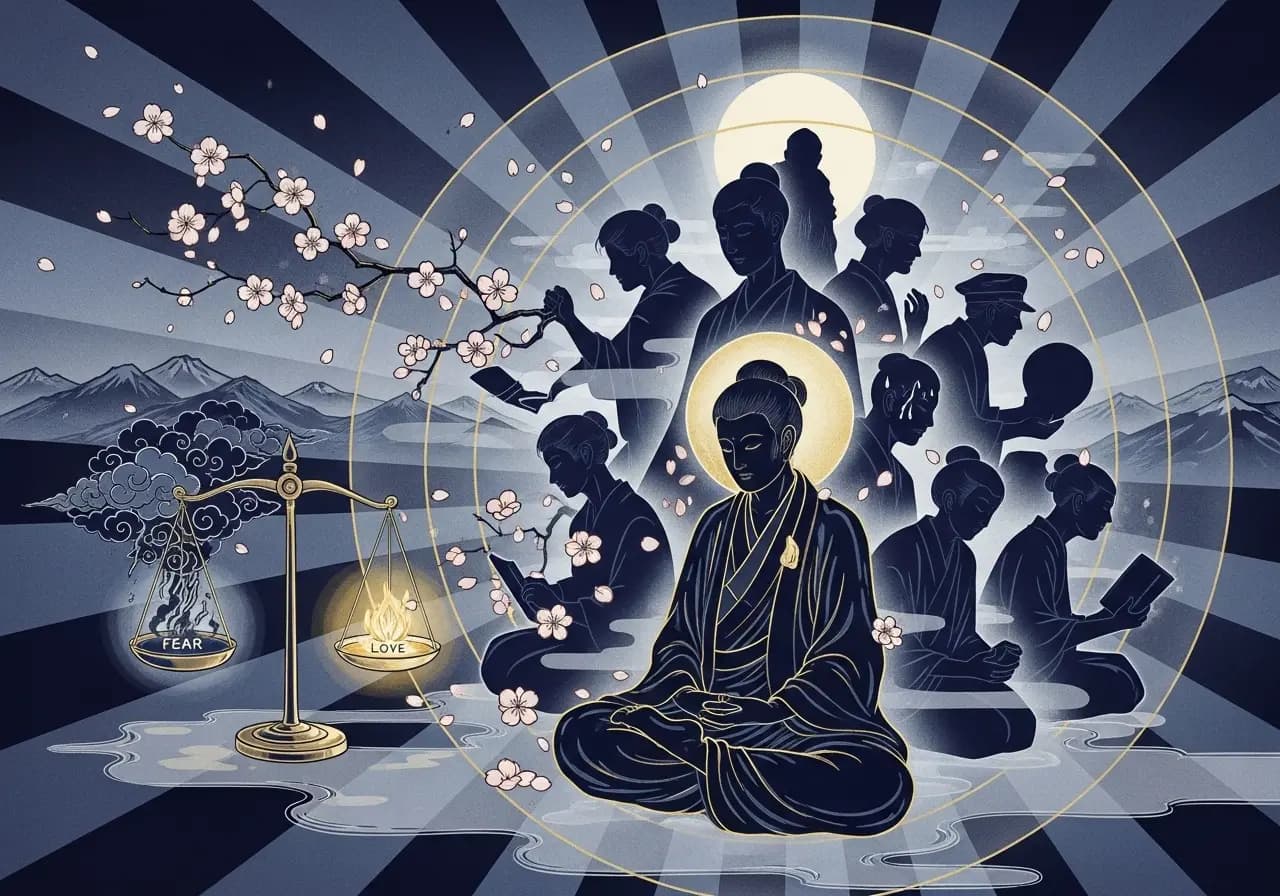
A Tale of Many Tales
Episode 81 of the Secular Buddhism Podcast
Hello. You are listening to the Secular Buddhism Podcast, and this is episode number 81. I'm your host, Noah Rasheta, and today I'm talking about stories—the stories we have about ourselves, and the stories we try desperately to ensure that others have about us too.
As always, keep in mind the Dalai Lama's advice: "Do not try to use what you learn from Buddhism to be a Buddhist. Use it to be a better whatever you already are."
Housekeeping: About Secular Buddhism
Before jumping into this podcast episode, I do want to address a couple of housekeeping items.
The first one is regarding the use of the term "secular Buddhism"—what it is, and what separates it from other forms of Buddhism. This stemmed from a conversation I saw taking place in the Secular Buddhism Facebook group, asking whether secular Buddhism is a form of self-help, and kind of the accusation that secular Buddhism as a bigger movement is not equivalent to what I'm doing in this podcast, and that in some ways what I'm doing has nothing to do with Buddhism.
I read specifically one comment that said I don't teach Buddhism, so I wanted to address this a little bit.
I have some concerns with Buddhism in general. I feel, as I've mentioned before, that whatever the original teachings were of the Buddha, they've evolved into teachings about the teachings. Over time, what we tend to focus on more than anything is this: What is Buddhism? How should it be interpreted? What was taught? What did the Buddha say?
To me, all of these things are, by and large, just teachings about the teachings. And the problematic part for me is that it was hundreds of years from the time these teachings, however they were originally talked about or shared, before they were ever finally written down. And that in and of itself is problematic because now we have somebody who heard from somebody who heard from somebody for hundreds of years deciding, "Oh, I'm going to write this down and this is what the Buddha said."
The truth is we don't know what the Buddha said. We know what we think someone said the Buddha said.
And that's fine. There's a lot of great content that comes from there, and all the various schools that have emerged over thousands of years have done a fantastic job of really getting to the heart of what these teachings are about.
I mentioned in a previous episode that to me this is a lot like whoever first started talking about algebra. As the understanding of algebra emerged and spread, it's become a way of understanding reality and the universe. It's no longer that relevant to know who was the first one who talked about algebra or what he said about it, or whether there's a specific or proper way to study algebra. It evolves over time.
In the same way, languages and accents evolve. When a language emerges, what makes it valid is that everyone who is speaking the same language has a general consensus that this word means this and that word means that. And that's what allows us to communicate. However, accents immediately morph and change pretty quickly.
This is why you see this with English as it spread from where it originated. Look at the various accents: Australia, the United States, Scotland, England, Ireland—they all have very unique accents. And even words start to change. The word you would use in one place is not the same word you would use in another place because that word may mean something else.
It's very easy to visualize and I think very helpful to imagine ideas in the same way we view languages. Buddhism, like a language, as it spread to the various countries where it took root, has been adopted and morphed into what works for that specific time, that specific culture, and that specific language. So you have all these various accents of Buddhism.
Which one is right? Well, that's not the right question. There isn't a right one, in the same way that we don't entertain this question when it comes to language and say, "Well, which accent of English is right?" Sure, some people might argue that British English is the most accurate because that's where English comes from. But that's not necessarily true because English has already evolved from the way it was first spoken to how it is now. If it's always changing, there just isn't a right one.
So rather than focusing on which form of Buddhism is right, I think what we should really be exploring is which one works well for me? Which one is easier for me to understand? Which accent makes the most sense for me? Or, if you're already speaking that language, asking questions like: Why do I sound the way that I sound? Why do you sound the way that you sound? Because I'm trying to understand—oh, you are Scottish. Well, that helps me understand you better because in Scotland you guys say this or that.
To me, that's a more skillful approach to Buddhism. And that's why on this podcast I don't focus on saying, "Hey, here's what the Buddha said about this and here's what we should think about that." In fact, you're never going to get that on this podcast because I feel that's one of the biggest obstacles to understanding what Buddhism is all about and what it's actually trying to do.
In that sense, I view secular Buddhism as a new accent that's emerged in our Western culture. I certainly don't view it as a separate form of Buddhism, distinct from any other school of Buddhism. It's just another accent that we're trying to figure out. And it works well for me because of the time and the culture and the place where I live. It happens to be an accent that makes sense for me in my form of communicating.
I want to clarify that I am certainly not a spokesperson of secular Buddhism. It happens to be the name I chose for the podcast because it's an approach to Buddhism that I like. But I am not putting out content that represents, "This is secular Buddhism." I don't view it that way. I just take what I've learned about Buddhism and I try to express these teachings in a way that applies to my day-to-day living, my everyday life, and I share that with you.
So from this podcast, you will always hear stories. You'll hear about how Buddhist teachings or ideas have helped me in my day-to-day life and how I experience reality. I share my views and my understanding, but these things evolve.
A couple days ago I had an email from someone mentioning how they disagreed with a statement I made in an earlier podcast. I think it was "Living Artfully" where I mentioned that birds don't have a reason, they don't need a reason to sing—they just sing for no reason. And this person mentioned in the email that birds do sing for a reason. You know, they're singing to find a mate, or there may be reasons. Just because we don't know why they sing doesn't mean they don't have a reason.
And I totally agree with that. I feel like Alan Watts' quote applies here: "I'm under no obligation to be the same person that I was five minutes ago." That mentality absolutely applies to the podcast and to earlier episodes. I replied and said I absolutely agree. I think the more appropriate expression, if I were to re-record that now, would be that birds sing because that's what birds do.
So my own views on a lot of these topics are constantly changing and morphing as they should. That's the nature of reality—constant change—and it should be that way for you too.
The other accusation was that this is just a form of self-help. And man, that really depends on how you define self-help. I think, for one, what's the point of any of this if we're not trying to reduce some of the self-inflicted suffering that we bring upon ourselves or that we cause for others? Is that self-help? I don't know. How do you define that?
This is not a podcast about self-help in the sense of, "Hey, if you do this, your life will be better, and if you do that..." It's not that. I view this as a constant invitation for you to get to know yourself better, to become a better whatever you already are.
In this podcast, like I mentioned before, you will never be told, "This is how this is or this is how that is and this is how you should think about this or what you should think about that." That is not my goal. It is never going to be my goal. In my opinion, that is not the Buddhist way.
The Buddhist way is an invitation—a constant invitation to look inward, to be more aware of who you are and why you think the things that you think, say the things that you say, and do the things that you do. This is about you. I share these things and what I've learned and what works for me as an invitation for you to look inward and find what works for you. Not as a way of saying, "Hey, this worked for me, therefore this should work for you." That's absolutely not the case.
So that's the housekeeping I wanted to share with regards to secular Buddhism and why and how I'm approaching these topics, and why you won't hear me in these podcasts saying, "Hey, everyone, take out the certain sutta and we're going to read this verse and do that." I don't do that because that doesn't seem relevant with the style in which I try to share Buddhist teachings. But I absolutely do share Buddhist teachings and concepts throughout this podcast. And this is not just a self-help podcast.
Okay, so with that, I want to jump into the topic I wanted to share for today: the tale of many tales—so many stories in our lives.
Stories, Fear, and Love
I have a couple of stories that I'm going through right now with career changes, and I wanted to share a little bit of this with you. There's a concept that Thích Nhất Hạnh talks about in his book Fear, where he mentions how the root of everything that we do is either rooted in fear or it's rooted in love.
I thought about this recently with a career change that I've been making. Most of you know my story—leaving the business and entrepreneurial world after eight years of having my own company, that whole thing came crashing down, I went through bankruptcy, and then I got a job. I've been at that job for over a year now and it's been fantastic. I really enjoy what I do there.
But I recently made the decision to leave that behind and pursue another career opportunity doing something I really enjoy and am passionate about: paramotoring and paragliding. Last week, I went and took a week and a half of training in Oregon to become a flight instructor.
In order for me to do that, I didn't have vacation time to leave work. So I was kind of forced to choose between my job and this opportunity to become a flight instructor. I spoke to my boss about it and told him I was going to resign and pursue this other thing, and hopefully arrange it so I can keep working for them as a freelancer rather than as an employee.
As this was unfolding, I realized I had been reading Thích Nhất Hạnh's book, and I realized that some of the decisions we make are based on fear. For example, the fear of losing a stable income or the benefits and insurance I had at work. Those were valid and real things I had to take into account with this decision. Those were rooted in fear.
But then there was this other part: the opportunity to go teach, to become a flight instructor, and eventually have a career doing something I really enjoy—those decisions were rooted in love. My love for having freedom of my own time, my love for spending time in the sky and flying.
So I was weighing these things. Trying to think about whether this decision was rooted more in fear or more in love. The decision to stay is rooted in fear. The decision to go and pursue this new thing is rooted in love. And ultimately, that helped me feel more confident about the decision I made, which was to go.
I've thought about this with other milestones in my life too. My faith transition, leaving the belief system of my upbringing—that's a very difficult process to go through, and there were a lot of decisions being made that were rooted in fear and others that were rooted in love.
I think typically what's rooted in fear is stronger because of the negativity bias. We're so much more keen on focusing on the negative, the things that are scary, because that's a survival technique and survival mechanism. The things we fear are much more powerful. They seem to weigh more on the scale compared to the things we love.
But it's important to spend time and analyze your situation, whatever decision you're making—whether it's to stay or go in a job, stay or go in a relationship, buy a new vehicle. You could make a list: What are the fears driving this decision? And what parts of this are rooted in love? That can be a very introspective process.
I just wanted to share that because that's something I recently thought about and I correlated it to Thích Nhất Hạnh's book. If you want to learn more about that concept, you can pick up Fear.
The Tale of Many Tales: Stories About Ourselves
But the actual topic I wanted to discuss today is the tale of many tales—the stories that we tell about ourselves.
I get to spend a lot of time with people who are learning to fly. I had this experience not long ago with a couple of people who had just come out of the military and were adopting the hobby of paramotoring.
If you don't know how paramotoring works, it's essentially a paragliding wing. It kind of looks like a parachute, but it's not a parachute—it's an actual wing made out of cloth that you fly over your head. Then you have a motor strapped to your back or in a little cart like a go-kart with wheels, and you fly.
The process of learning to fly these things starts with learning to kite the wing in the wind, just like you would fly a kite, but it's connected to you and you learn to control it by flying it when there's some wind. You just stand there and you kite the wing over your head and you learn how to fly it that way. You never take off. You just kite it.
Well, if the wind is strong, that's a pretty big wing you have over your head. It's going to lift you up and drag you around and do whatever it wants with you because it's a big wing.
I was watching this person who had a very clear story about himself. I could see it. The story was: "I am very tough. I can overcome anything. I can control life and everything that's happening to me because I am so strong and so tough."
That was translating into this process of learning to kite the wing—trying to muscle this thing over his head and will it to do what he wanted it to do. Well, unfortunately, the nature of these things is that no amount of strength is going to will the wing to do what you want it to do. You have to understand the aerodynamics of the wing and give it the right inputs to get the wing to do what you want it to do using the elements that exist. There's a lot of wind, so I'm going to slightly pull on this string and it's going to slightly go this way. So rather than dragging me around, it's kiting over my head.
What I noticed was that this very strong, tough person was really struggling to kite the wing, and the wing was literally dragging him through the sand and pulling him around.
When it was all over and we were talking about it, here's the part that fascinated me: the story of "I am tough and I can do anything" was so strong and so prevalent for this person that they could not see reality clearly. The reality was that this is a big wing, you cannot get it to do what you want. You have to learn to fly it. You can't just force it to do what you want. You can't just pull these strings and expect it to do what you want.
He couldn't see that. And what I found interesting to watch was thinking, if you didn't have such an attachment to the story you have about yourself being so tough, maybe you would realize that you're not tougher than the wind and a twenty-eight-meter wing that's just going to drag you around.
When Reality Conflicts with Our Stories
I had another experience recently, actually on our trip to Iceland with my wife. We had this moment where we were out exploring an old plane wreck, and you can go out there and kind of look around, climb up on top, and get pictures.
We were out there and she was up there waiting for me to get the drone set up to do a little flyover to get a video of her. She didn't realize that someone at the bottom was waiting for her to get down so they could get up and take a picture.
The time it took me to get the drone set up and running, this person who was waiting got fed up and yelled at her: "Hey, you've been up there long enough. Get down. Let other people take pictures."
My wife immediately felt embarrassed. This is where the story kicks in.
My wife has a very strong story about herself: "I am a person who follows all the rules. I comply with the way things should be. I'm not a troublemaker. I'm very independent. I don't need to be told what to do. I'm going to do it right the first time."
Well, all of this came together for her in that moment of being yelled at. It made her feel extremely angry at this person for yelling at her because, you know, if that's your story about yourself, why would anyone ever need to chastise you? You know the rules. You always follow the rules. You never break the rules.
So her story was running up against an issue: the story she has about herself right now, in this moment, is not the story this person has about her. He was yelling at her as if she were a troublemaker, and that's not who she is. This was causing a lot of internal conflict for her.
She immediately got down, she was immediately angry, and was trying to avoid this person. As we were touring other parts of that area, she's like, "No, there's that person. I do not want to be around him."
A little bit of time went by, and I said, "Why is that still bothering you so much?"
She said, "I just, I'm really angry at him and I don't want to be around him."
And this was a neat opportunity to say, "Well, that's fine to feel really upset, but do you know why you're really upset?"
She said, "No."
I said, "Well, what is the problem with being yelled at? Why is that a problem? He just yelled at you and then you got down and that fixed everything. But why would that continue to be a problem?"
She sat with that and explored it, and on our way back to the van, she said, "You know, I think I figured it out. What's really going on is I'm embarrassed because that's not who I am. I'm not the type of person that you would typically need to yell at to comply with a rule because I don't bend any rules. I'm very black and white when it comes to things like that."
I said, "Yeah, I think that's right. That sounds like exactly why you would be so upset about it."
That understanding she gained about herself was very insightful.
It reminded me, and I've mentioned this in the podcast before, of a time in my own life with my own stories. Some of the unnecessary suffering I was experiencing had to do with reality conflicting with the story I have about myself.
One example for me is when I was an entrepreneur. The thought of my company failing was extremely traumatic because the story I have about myself was crumbling. The world was going to perceive me as something I didn't perceive myself as: a failed entrepreneur. And that was really painful until I realized, "Oh, okay, that's just a story. And the more attached I am to that story I have about myself, the more suffering I'm experiencing with the life circumstances I'm in right now."
So that's what I wanted to get at with this: we all have stories about ourselves, and how wise and beneficial it can be to understand our stories.
What is the story you have about yourself? You can try to identify this by asking questions like: "What is something I'm really proud of about myself? What is something I'm really happy about in how I am? What character trait?" Explore that a little bit and see if you can find or identify what the story is that you tell about yourself.
Then notice how much effort goes into protecting that story or ensuring that story matches with the story others are creating about you. Just notice that.
The Ego as Shadow
The goal here isn't to eliminate our stories. This is something I wanted to discuss with regards to the concept of ego and the self.
I think one of the biggest ego trips I see in this Buddhist tradition is the ego trip of "Now I have no ego." It's like what an incredible ego trip that is—to think that you no longer have an ego!
I like to visualize the ego as I would a shadow. There you are, and when the causes and conditions are right, the sun is up. It casts a shadow on you, and you see the shadow, and the shadow is there. It's very much a part of you and everything you do. And yet, in some ways, it's just an illusion. It's just there.
I think our ego emerges through these stories—the stories we have about ourselves, the stories that we think others have about us. This gives rise to the ego, the shadow, the shadow self that's there following us no matter what we do.
We give it so much importance because the more attached we are to our stories, the more that shadow seems like a real, tangible part of me. That the essence of me is my shadow. Well, that would be silly when I think about it with my actual shadow because I would just see my shadow as a shadow.
And the shadow changes as I change. If I put on a hat, well, guess what? There's the shadow wearing a hat. I think the ego, the sense of self that we have, is a lot like that. It's just always there.
So it's not about eliminating the shadow. It's about understanding that a shadow is a shadow. It's not me. It's like going through life thinking that your shadow is you. And awakening is realizing, "Oh, it's just a shadow. It's an illusion. It arises and it's there and I see it, but now I'm not so scared of my shadow because I understand it and see it for what it is."
I think transcending the ego is a lot like that. It's not that the ego goes away. It's that you understand yourself and you know your stories. You understand why you feel attached to your stories, and you can have moments where you don't feel so attached to them. And the ego isn't a problem anymore.
If you're standing somewhere and someone yells at you because they were waiting in line, you can feel bad for a moment, but then you immediately understand why that makes you feel bad because you know your stories. And then you get over it and think, "Okay, sorry. Your turn. You can go." You don't harbor all this anger and resentment because there's no story to defend. You realize it's just a story, and you allow that thing to pass.
I've experienced this in my own practice, trying to identify my own stories. One of the strong stories I had growing up, and it still arises from time to time, is that I am very dependable and I can handle anything. You don't have to ask me twice to do things. All of that is part of a story I have.
So if I'm ever in a situation where I fail to do that and somebody says, "Hey, why didn't you?" I immediately start coming up with stories to defend the story I have about myself. "Oh, it must have been this or that." Then I can pause and say, "Wait, wait—sorry, I just got scatterbrained for a moment. Sometimes I'm not as dependable as I think I am. I literally forgot. I have too many things on my mind. Sorry."
And then I can correct it and I don't hold resentment that somebody viewed me as someone who's not dependable because I can say, "Well, in that moment I wasn't dependable. Sorry, but I'm going to try from here on out to not forget." At least that's how it's worked in my experience.
The more I understand my stories that I have about myself, the more unattached I am to those stories. They're still there. They're still stories, and I understand some of them—where they come from, how I was raised, beliefs I had. I understand that about myself, and that gives me more power with how I relate to my stories.
It doesn't eliminate the stories all the time. Some do. Some have changed. Some have gone away, and I've actually gained some new ones. So the stories are always there, but the relationship I have with the stories is what I believe has been the most drastic of all the changes.
I don't get so caught up in my stories because I see them for what they are. They're stories, like shadows. They're just there. And I understand them better, so I have a better relationship with them.
Understanding the Stories Others Have of Us
So that's the concept of these stories—the tale of many tales. The story about all the stories that you have about yourself, the stories that you have that others have of you.
Now you could spend a lot of time understanding yourself and your stories and that would be very beneficial. You could also look at what are the stories you try to make others have of you. And that one gets really muddy because the truth is you don't know what's the full story that others have of you. All you know is that they're not really accurate. I mean, they may be accurate to some degree, but you don't control the story that someone else has of you.
I face this all the time in my own community. When you don't share the predominant views or worldviews or beliefs of a community, you can bet that stories are created about you: "Oh, there must be this reason why. This is why he doesn't believe this or this must be why he's doing that." I don't get to control those stories. I have no control over that.
So the stories that other people have of me at times can be stressful. But what matters to me most is that every day I'm getting better and better at understanding what are the stories I have about myself. And I become more skillful with them, which in turn allows me to be less reactive to things as they unfold. And which in turn allows me to experience more peace and more contentment.
And at the end of the day, that's my journey. I'm trying to have more peace and contentment and joy in life just because I understand myself better and I understand the nature of reality a little bit better. And all of this comes from Buddhist teachings and Buddhist practices applied in the context of a secular form of it.
An Invitation to Explore Your Stories
So that's what I wanted to share: the tale of many tales.
What is your tale? What are your stories? What are the stories you tell about yourself?
I would hope that over time, as you get to know your stories and get to know how you react when reality conflicts with the story you're trying to project onto yourself or that you want others to project onto you, you notice the suffering that arises. Notice how that feels—to see the conflict between reality and the story. And how difficult that can be at times.
But the most skillful practice to me in all of this is you knowing you. You understanding your story. Seeing which of your stories you tend to be most attached to. And then notice what happens as you try to change the relationship you have with your story—to be less attached to that story, to be more flexible with it.
And hopefully you'll notice what I've noticed in my own life as I try to practice all of this: more peace, more contentment, more joy.
So my invitation to you for this podcast episode is to sit with your stories. What are they? Try to identify a couple of them. And then work with them and see what it feels like to play with the idea of maybe this is just a story. What if it's just a story and it's not reality? What does that feel like?
That's the tale of many tales.
Closing Remarks
If you want to learn more about Buddhism in general, I do have a book called No Nonsense Buddhism for Beginners, which has over sixty questions and answers around Buddhist history, concepts, teachings, and practices. You can learn more about that by visiting everydaybuddhism.com.
As always, if you enjoyed this podcast episode, feel free to share it, write a review, or give it a rating on iTunes. Join the online community, which is our Facebook group called the Secular Buddhism Podcast Community. You can find that at secularbuddhism.com/community.
And if you want to support the work I'm doing with the podcast, you can visit secularbuddhism.com, click the donate button, and that's all I have for now.
But as always, I look forward to recording another podcast episode soon. Thank you for listening, and until next time.
For more about the Secular Buddhism podcast and Noah Rasheta's work, visit SecularBuddhism.com