

Life is Not Fair
Episode 80 of the Secular Buddhism Podcast
Hello, and welcome to another episode of the Secular Buddhism Podcast. This is episode number 80. I'm your host, Noah Rasheta, and today I'm talking about the idea of fairness in life.
Opening Reflection
Before we get started, I want to remind you of the Dalai Lama's advice: "Do not try to use what you learn from Buddhism to be a Buddhist. Use it to be a better whatever you already are."
As we jump into this topic—Life is Not Fair—I'd like you to join me in a little thought experiment.
The Highway Scenario
Imagine for a moment that you're driving along the highway in your car. Suddenly, you hear a pop, and you have a flat tire. You pull over, get out of the car, and look at the flat tire, trying to decide what you're going to do next.
Then you look up and realize a really nice car has pulled over to assist you. Picture whatever a nice car means to you. Out gets someone who comes over, looks at your flat tire, and says, "I feel really bad for you. You know what? I'm going to give you a thousand dollars, and hopefully this will help you have a better day."
Imagine for a moment how that would feel as the recipient of this cash. How would you feel about this person? How would you feel about what you just received?
Most people are probably going to feel very grateful for what just happened. And who wouldn't? A complete stranger just gave you a thousand dollars out of the blue.
The Twist
But let's continue the thought experiment. While you're there, another car suddenly pulls over behind the nice car. It's an older car, maybe not much different than yours, but this car has a flat tire too. The person gets out and starts working on fixing their tire, removing the tools to take off the wheel.
The person who gave you the money walks over to this other person, and you think, "Oh wow, they're going to offer them a thousand dollars too."
But instead, you hear the following: "Oh no, looks like you got a flat tire too."
"Yeah," the person says. "I got a flat tire, and the timing is horrible. I'm on my way to a job interview. I just lost my job, so I'm trying to get another one. And I'm dealing with all these issues at home..." They go on to give a more elaborate picture of their current life situation.
Then you hear the wealthy person say, "You know what? I feel really bad for everything you're going through. Here, I'd like to give you one hundred thousand dollars."
Now, how do you feel?
Everything that just took place with you receiving your thousand dollars felt a certain way. But now that you saw this person happily extend one hundred thousand dollars to this other person because of all these other complications in their life—now how do you feel?
If you're like most people, you probably feel a sense of frustration and anger. You're thinking, "Wait a second. Why didn't I get more? I could certainly use the hundred thousand dollars too." There's this sense of fairness that comes into play, and suddenly what felt good doesn't feel good anymore. It's not fair.
The Interesting Paradox
Here's what's fascinating about this thought experiment. When you think about receiving a thousand dollars out of the blue, that feels a certain way. But when you have the comparison—when you receive a thousand dollars coupled with the thought that you could have received a hundred thousand dollars—that changes your entire relationship with the thousand dollars, doesn't it?
What just happened is that the value didn't change. The money didn't change. Your situation didn't change. What changed is the comparison, the story you created in your mind about what you should have received.
The Monkey Experiment
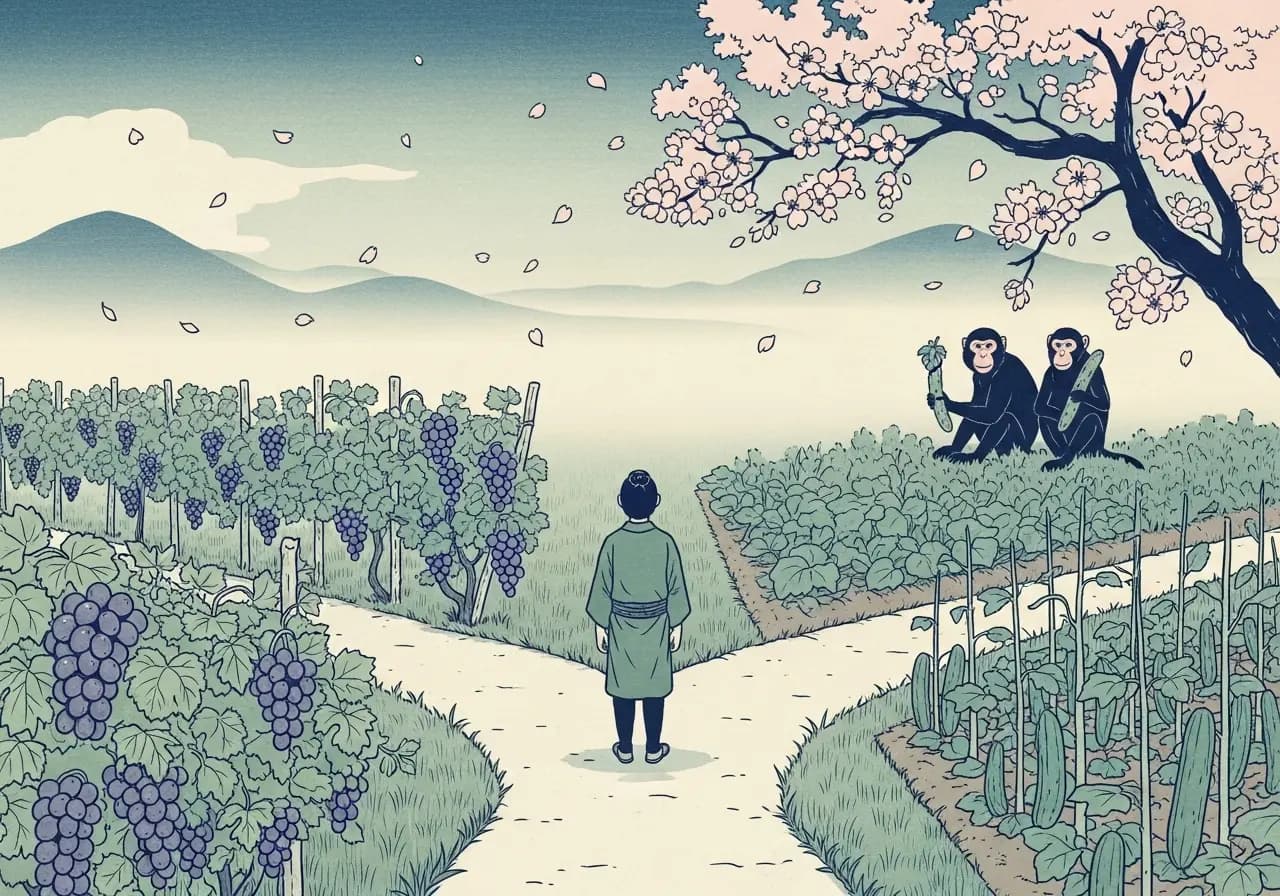
This thought experiment is actually based on real research that has taken place—not with cars and money, but with monkeys. Capuchin monkeys, to be specific. You can find videos of this on TED talks and YouTube if you search for something like "unfair monkey experiment" or "grapes and cucumbers."
The experiment works like this: Researchers had two monkeys in separate cages right next to each other. They taught each monkey that if they handed the experimenter a rock, they would be rewarded with a cucumber. At first, the monkeys were very happy to receive the cucumber. They ate it happily.
Then the experiment continued with both monkeys doing the same task. Both got cucumbers. But then came the twist.
The experimenter goes back to monkey number one and hands them a cucumber in exchange for the rock. But this time, monkey number two exchanges their rock and gets a grape instead of a cucumber.
Well, monkey number one sees this and right away recognizes, "Oh, okay, next time I do this, I'm going to get a grape too."
So monkey number one goes back, exchanges the rock, and gets another cucumber. But this time, the monkey doesn't just accept it. The monkey looks at the cucumber and immediately throws it at the experimenter and starts shaking the cage.
The experimenter repeats with monkey number two, giving them another grape.
Now monkey number one is really realizing, "Oh my gosh, this is so unfair!"
The experimenter puts their hand out again asking for the exchange of the rock. Monkey number one thinks about it for a moment, finally hands over the rock, and once again gets a cucumber. At this point, the monkey is really upset, shaking the cage, and doesn't accept the cucumber. The monkey throws it again at the experimenter.
What's Happening Here
Here's what's fascinating about this: The monkey's relationship with receiving the cucumber was completely neutral when it was by itself. In fact, there was gratitude for it. The monkey was happily enjoying the cucumber.
But something changed when the cucumber became compared to something else—something perceived to be better. A grape. And suddenly, at the thought of not receiving the grape, the perceived injustice and inequity of the exchange made the monkey no longer care about or even want the cucumber.
It's just like in the thought experiment with the thousand dollars. If you just think about receiving a thousand dollars and how grateful you would be, there's probably a lot of natural gratitude. But when you realize you could have had a hundred thousand dollars like the other person who had complications—well, that gratitude suddenly evaporates.
What Evolution Has Done to Us
What's taking place in these experiments is that we've evolved—so to speak—to perceive injustices. We're not happy with injustice. We're not happy when we perceive that something is not fair. This is totally normal. It's natural.
We've all felt this since we were kids with toys. But we continue to experience this in our day-to-day lives when we compare our situation or assess whatever we have and compare it to what we think we should have.
I want to connect this to the Buddhist practice of seeing with the eyes of wisdom—seeing the interdependent nature of things and the impermanent, continually changing nature of things.
When we start to see the uniqueness of each moment, it becomes more habitual for us to appreciate the cucumber for being a cucumber and not comparing it to a grape. It's not the same as a grape. Or the thousand dollars being unique—it's the thousand dollars I received, not the hundred thousand dollars I didn't receive.
An Important Clarification
Now I want to be clear: I'm not advocating that we turn a blind eye to the injustices in the world or that we start to accept inequality. That's not where I'm going with this at all.
What I'm trying to highlight is our natural tendency to compare and contrast our moments. And while we should work to correct injustices and inequalities that we see, I think it's equally important to understand that there's a sense of uniqueness to every situation and every moment that happens in our lives. They're not meant to be compared in a way that destroys our peace of mind.
The Culture of Discomfort Avoidance
I want to talk about something else that I think relates to this. We live in a time and culture where there's a strong message that we shouldn't have to sit with discomfort. Everything is marketed toward the idea that if you just buy this thing or use this service, you can avoid discomfort. You can fix the problem. Buy this product today.
That's essentially the marketing message you're going to get about anything—any product, any service. The goal is to make you realize that you don't have to sit with the discomfort.
Now, I'm not saying it's a bad thing to sit with discomfort. I'm glad we've progressed as a society. We've been motivated by discomfort to make life better. We thought, "Enough with walking everywhere. Let's invent the wheel." Things like that. I'm the beneficiary of that kind of progress. I love to fly paramotor and paraglide—technologies that certainly arose out of a sense of discomfort with life, a desire to do something more.
I'm not saying that sitting with discomfort is always the answer. Sometimes it's not. But in a lot of instances, it can be an answer to living more skillfully.
The Mismarketing of Mindfulness
I think sometimes the mindfulness movement that's prevalent in our culture—and even Buddhism, you could say—is kind of preached the way marketing works. It's saying, "Hey, this philosophy, this practice, meditation—it's going to remove the discomfort from your life. Just meditate and it'll all be well."
But the truth is, that's not how it works. You're still going to deal with all the same challenges you had before. That kind of stuff doesn't necessarily change.
So what does change? Well, what changes is our ability to sit with that discomfort. Our relationship to it. That's where peace comes from. It's not the external world that's changing. It's your relationship to that external world that's changing, and that's where peace arises naturally inside.
A Personal Story
I experienced this just recently over a weekend. I was uncomfortable about something, and I could have tried to avoid that discomfort—distract myself, buy something, do something to make myself feel better. But instead, I just sat with it. I let myself feel what I was feeling.
And something interesting happened. The discomfort didn't destroy me. In fact, it became easier to sit with it. And in that sitting with it, there was a kind of peace that came from just accepting what was happening rather than resisting it.
An Invitation
How does the need to avoid discomfort manifest in your own life? This is an invitation for you to sit with this for a moment and think about it.
For me, I noticed that I didn't like being judged. I didn't like people disagreeing with my views in life. So I became a people pleaser. That's still true about me, actually. But I'm a lot more comfortable now with the discomfort that arises from people not agreeing with me.
I'm totally fine being around people who don't like my ideas at all. People who might say, "Oh, you're going down this path to hell because you're not following the right ideology." They could tell me that, and honestly, it wouldn't bother me at all because I'm totally comfortable with the discomfort that was arising when I was experiencing conflict like that.
The Challenge
So here's the challenge I want to extend to you: Try to sit with discomfort for a moment and see what that's like.
And again, I'm not advocating resignation or giving up. Too often we experience discomfort and we just give up. We don't like it, so we run from it. We try to drown it out by chasing after whatever we think is going to make us forget about the discomfort.
We avoid the hard discussions. That's a common example. We avoid having conversations we know are going to be uncomfortable because we're not willing to experience the discomfort it might take for things to actually be better.
I've experienced this numerous times in my own relationship dynamics. There are topics I know are going to be uncomfortable to bring up, but I bring them up anyway because I know that sitting through the discomfort is the path to something better on the other end.
Seeing This Moment for What It Is
Try to see this moment for what it is, not for what you think it should be. Try to see it for just what it is.
I think this is why so many meditation practices start with just noticing the breath. When I'm sitting here noticing my breath, I'm experiencing just being for a moment. We're here. We're breathing. How unique is this moment?
The truth is, life is not fair. But that's not a problem unless we make it a problem. It's not about fairness. We can still strive to correct any injustices or inequality that we see out there. I applaud the people who spend time, resources, and efforts doing that.
But I do think it's important to also understand that there's a sense of uniqueness to every situation and every moment that happens in our lives, and they're not meant to be compared.
Rebellion Against Comparison
Think about all the instances in our own lives where we are that monkey, comparing the cucumber to the grape. We do this on social media all the time, don't we? Someone got that job. I got this job. Someone married that person. I married this person. Someone drives that kind of car while I drive this one. Someone gets to go on all those fun trips while I never leave.
And we're making ourselves miserable like the monkey in the cage. Naturally. We do this naturally.
But remember the episode I did about rebellion? We can rebel against this natural game. We can say, "This isn't the game I want to play. I'm not going to do this anymore. I'm not going to keep throwing the cucumber back at life."
Instead, we can say, "Wait a second. This is a cucumber. What did it take for this to arise?" And you start to change the nature of the game, the relationship you have with it. You do this out of almost an act of rebellion—a rebellion that says, "I'm not going to keep doing this the way I've been doing it."
Closing
So that's what I wanted to share with you in this podcast episode.
As always, if you want to learn more about Buddhism, you can check out my book, No Nonsense Buddhism for Beginners, with sixty questions and answers around Buddhist history, concepts, teachings, and practices. You can learn more at everydaybuddhism.com.
And as always, if you enjoyed this podcast episode, please share it with others. You can write a review or give it a rating on iTunes.
If you'd like to join our online community, visit secularbuddhism.com/community.
If you'd like to make a donation to support the work I'm doing with the podcast, visit secularbuddhism.com and click the donate button.
That's all I have for now. As always, I look forward to recording another podcast episode soon. Thank you for listening, and until next time.