

Episode 8: Problems with Terminology and Symbols
Podcast: Secular Buddhism Host: Noah Rasheta Episode: 8
Hello. You are listening to the Secular Buddhism podcast. This is episode eight. I am your host, Noah Rasheta, and today I'm talking about misunderstanding terminology and symbols within Buddhism. Let's get started.
Introduction
Hey guys, welcome to the Secular Buddhism podcast. This podcast is produced every week and covers philosophical topics within Buddhism and secular humanism. Episodes one through five serve as a basic introduction to secular Buddhism and general Buddhist concepts. If you're new to the podcast, I recommend listening to the first five episodes in order. All episodes after that are meant to be individual topics that you can listen to in any order.
Before we dive in, I want to share something the Dalai Lama said: "Do not try to use what you learn from Buddhism to be a Buddhist. Use it to be a better whatever you already are." Please keep this in mind as you listen and learn about the topics and concepts discussed in this podcast episode.
If you enjoy this podcast, feel free to share, write a review, or give it a rating. Let's jump into this week's topic.
The Origin of This Discussion
I want to talk to you today about Buddhist terminology and Buddhist symbols. Back in 1986, there was a book and a pamphlet published by a Japanese Buddhist named Gyomay Kubose. He addresses the idea of American Buddhism because Buddhism was finally spreading in the West, and there were a lot of misunderstandings among Westerners about some of the standard Buddhist terminology and symbols.
I want to clarify a couple of the things that he discusses in his book American Buddhism and in his pamphlet called Buddhism: The Path of Enlightenment, because these concepts are completely relevant to the secular Buddhism approach that I like to teach.
Buddhism as a Way of Life
Kubose talks about Buddhism as a way of life. I've discussed this before—whether Buddhism is a religion, a psychology, or a philosophy—and in reality, the answer's yes to all of those things. From the secular Buddhist approach, I want to clarify something important: there isn't really a secular Buddhism that's different from Buddhism. There's just Buddhism.
The various schools of thought within Buddhism—like Zen, Jodo Shin, or secular Buddhism—are just different schools of thought for understanding specific ways of interpreting the teachings of Buddhism. But there's really just Buddhism. These different traditions don't compete with each other. Secular Buddhism isn't an approach that says, "Hey, Zen Buddhism is wrong," or "Hey, Tibetan Buddhism has too much of this or not enough of that." It doesn't work that way.
Buddhism teaches one fundamental thing: understanding suffering in life. I really appreciate the way that Gyomay Kubose describes the Four Noble Truths. He says, "Difficulties are facts of life, which cause emotions to arise. Emotions can be wisely harnessed, and that's what leads to the Eightfold Path." His way of talking about the Four Noble Truths is essentially understanding that difficulties are facts of life.
Buddhism revolves around this concept: in life there are difficulties, and there are things we can do to diminish or eliminate those difficulties—at least the self-induced difficulties. That's it. That's pretty universal across all schools of Buddhism.
If you have a secular understanding or a secular-minded approach to life, then secular Buddhism will work for you. But I would never say the secular Buddhist approach is the right approach. I wouldn't discourage you from learning about Tibetan Buddhism, Zen Buddhism, or Jodo Shin. In fact, I would encourage you to explore. If you have a more devotional aspect and you like ritual, then I would say, "Look at the Jodo Shin school of Buddhism. That might appeal to you."
I don't think any true Buddhist would want to pull someone toward their interpretation and say that another way is not valid. Every genuine Buddhist understands that there are many valid paths.
The Essence of Buddhist Teaching
With this in mind, let me talk about the secular Buddhist approach that resonates with the American Buddhism that Gyomay Kubose describes. There are aspects here that really resonate with me as a starting point to this entire approach. He says: "Buddhism emphasizes truth rather than God, meditation rather than prayer, enlightenment rather than salvation, and universal life rather than an individual soul."
Buddhism emphasizes the Buddha as a teacher, not a deity. Furthermore, heaven and hell aren't places that one goes to after death—they're states of mind that are created by us here and now.
Understanding Buddhist Symbols
With that foundation in mind, I want to talk about terminology and symbols. When Westerners—especially secular-minded Westerners—first learn about Buddhism, they often encounter symbols and ask, "What does this mean?" There's sometimes an aversion to any symbolism because we tend to think symbols carry deep meaning beyond what they actually are. I want to explain the actual Buddhist understanding of some of these symbols, because it will help clarify a lot of the misunderstandings around them.
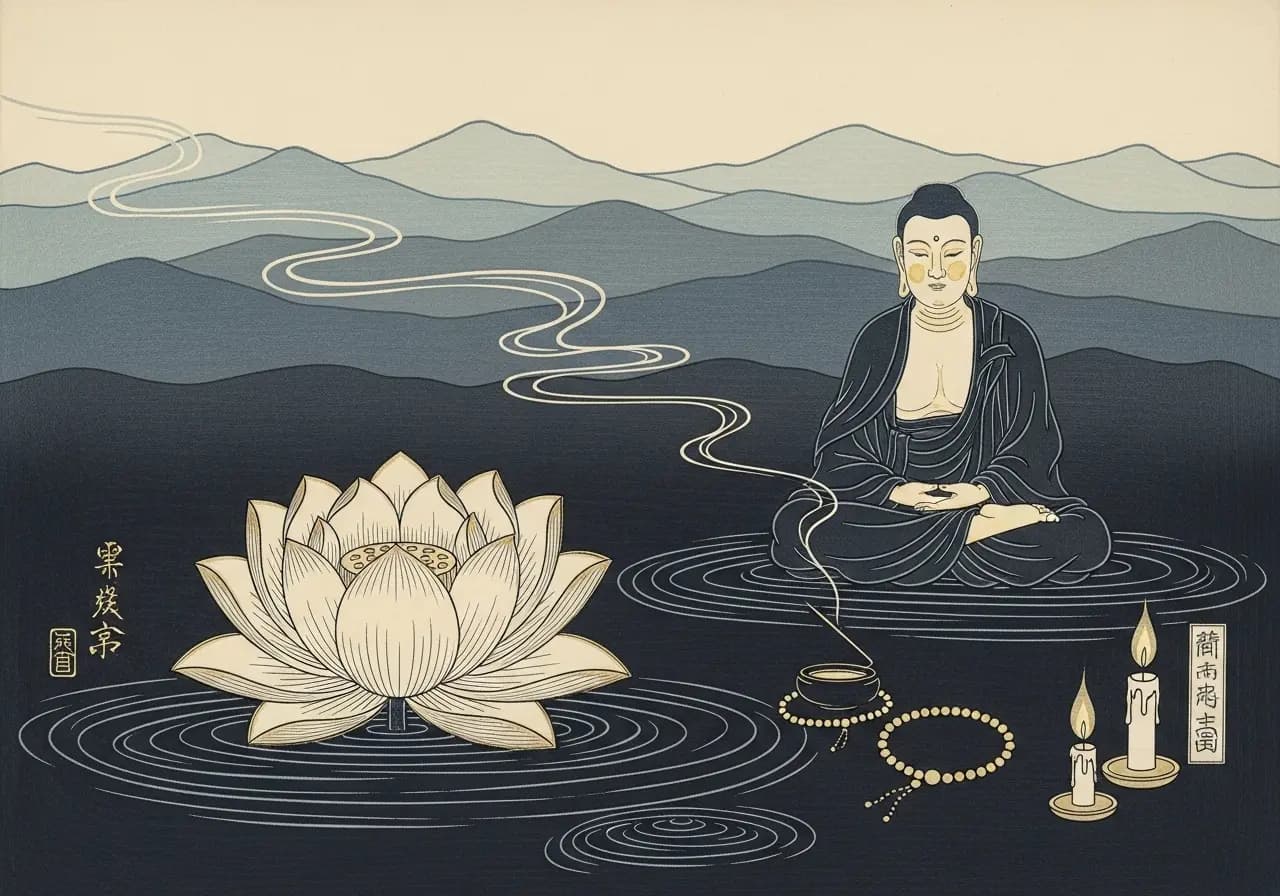
Statues of the Buddha are seen in Buddhist temples, but they're not idols to be worshipped. They're symbols of enlightenment, usually representing specific ideals like wisdom or compassion.
Incense is a symbol of the transcending of ego to become one with all of life.
Flowers symbolize impermanence because they're there, and then they wither away. All things are in constant change and need to be appreciated in the eternal now.
Candles symbolize both wisdom and impermanence. The light of the candle enables us to understand truth through direct experience.
Gassho—when you see Buddhists with their hands together—this is a Japanese term for a gesture where the hands come together to symbolize unity between oneself and all of life. It's a gesture of respect and deep gratitude, symbolizing the understanding of interdependence. We're not just individuals disconnected from all things.
Buddhist beads are used to enhance rituals, and while they're sometimes called prayer beads, that's not quite accurate since there's not really prayer in the way that Westerners typically understand it in Buddhism. They're symbols of unity and harmony. Think about it: one bead by itself doesn't make up a bracelet or necklace, but combined with all the other beads, it becomes part of a whole that's greater than itself. Again, it's just symbolic.
The lotus flower is a powerful symbol in Buddhism. Thích Nhất Hạnh talks about this beautifully: "No mud, no lotus." The lotus emerges from within a murky pond and mud to become this beautiful flower. This symbolizes that we are the same. Despite the murky or muddy waters that represent how and where we live—our circumstances—the lotus can remain pure and beautiful despite that. I love that teaching: no mud, no lotus.
The Concept of Sin
Here's something important to understand: the idea of sin is not a Buddhist concept. The Buddhist concept is that anger, greed, and ignorance can be overcome through wisdom. That's a crucial distinction.
The reason all this is important is, as Kubose mentions in his book: "The only real value of Buddhism for the individual is determined by how one understands and lives it." I want to talk about how Buddhism can be understood.
For a typical Buddhist, Buddhism can be a religion as well as a philosophy, a psychology, a form of ethics, a form of art. It can be one of those or all of those, or none of those. But essentially, it's what makes a person feel free and brings joy, harmony, and creativity into their life.
For me specifically, I really enjoy seeing Buddhism as a way of life. As a secular-minded person, the idea of religion can be off-putting because it carries connotations of things that are supposed to be believed or understood. In the Buddhist understanding, there really is nothing to believe. There are only things to observe. But the terminology has been hijacked over years by other religious groups, and a lot of these words carry so many connotations that we don't enjoy.
A Helpful Analogy
Something that really helped me when my teacher talked about the concept of symbols was his example of the American flag. Just imagine the flag of your specific country. The flag is composed of stars and stripes, and it stands as a symbol of the nation. We're taught to honor it, and we don't need the flag in order to be a fine, strong, and outstanding country. Yet countries have flags because they're a way to bring people together under a symbol of one thing.
In Buddhism, it's very similar. There are different kinds of symbols—statues, flowers, beads—but they don't inherently mean anything. A symbol is just a thing.
When we look at symbols and ask what they mean, they can mean different things for different people, and they certainly mean different things for different schools of Buddhism. But that's how they're to be viewed: as simple symbols, just as you would view a flag. There's honor and respect for your flag, but you don't worship it. You understand that there's no inherent meaning behind it other than what it symbolizes. That's how these things are to be viewed in Buddhism.
Addressing Terminology
Let me talk about some of the problems with terminology. It's important to note that Buddhists understand that all things are evolved rather than created. They're not created by someone or something. Everything has its causes and conditions. I've talked about this in a previous podcast episode. There's no single, primal, original cause. Instead, whatever exists is the result of many causes, and this goes on and on and on, all the way back to the Big Bang and then whatever caused the Big Bang. Science is the tool that allows us to continue adding to that story, but for now, that's as far as we can go.
Therefore, everything just has its causes and conditions. Since things are evolved through natural processes, they just are. They have nothing to do with good or bad in terms of inherent goodness or inherent badness. Things just are. This is a recurring teaching of Buddhism: to see things just as they are.
Ignorance vs. Sin
Buddhists use the word ignorance instead of sin because ignorance is the cause of all the troubles that we have in life. This is an important distinction because the word "sin" carries a lot of connotations in our society and culture that are very religious in their background. Ignorance is the appropriate word.
If you ever hear the word "sin" in any Buddhist text or context, what's implied is ignorance—not an inherent evil, and not an inherent good or bad thing. It's ignorance.
Enlightenment vs. Salvation
Then we have enlightenment, which is the opposite of ignorance. Mankind is freed or saved only through enlightenment or awakening. The concept here, again, is not like the Christian understanding of salvation. The Buddhist concept, rather than salvation, is freedom or liberation—freedom from ignorance. That is called awakening or enlightenment.
Here's something crucial: no one can actually enlighten another or awaken another. The whole thing that we strive for in Buddhism is to become awakened or enlightened oneself, and that happens by walking the path or the way. The teachings of Buddhism are taught in a way to help somebody understand that you are your own prison guard. You can free yourself from your own prison and awaken to the fact that you are your greatest teacher. You can't awaken someone else. There's nothing that I can say to you that causes your awakening. At most, I can teach you that through meditation, introspection, and contemplative practice, you can come to understand that you are awakened.
Kubose talks about how we become free and peaceful only through enlightenment or awakening. Awakening is the opposite of ignorance, and it's the very purpose of the Buddha's teachings. All Buddhist teachings have the purpose of awakening us to become free. I often talk about this in the classes I teach: the purpose of Buddhism isn't to obtain happiness. It's to obtain freedom. Yet freedom is the only condition required to have happiness.
The Concept of Life
Another important concept is life. Life never dies. It's like electricity. It's something that's there and everywhere, and electricity flows through things. Think about a light bulb: there's electricity and then there are light bulbs. The light bulbs turn on or exist because of the electricity.
This is compared to life. We are like the light bulbs. The concept here is that there's life, but nobody owns his or her life because nobody created themselves. Life is always manifested through individuals, and any differences between the life of various individuals has to do with the makeup of those individuals—their physical, mental, and emotional natures, and the nature of their culture, social, and family environments.
This applies to anything that's living. Any form of sentient being works the same way. All of us may be different according to our various natures and environments, but aside from that, we're all the exact same thing. We are life.
Heaven and Hell
The concepts of heaven and hell in Buddhism are the contents of life right here on Earth. Rather than viewing these as places to which one goes after death, we make life heavenly or hellish all by ourselves. We're creating our own heaven and hell in the present moment.
In some Buddhist texts, you'll hear references to heaven or hell, but this is the understanding of heaven and hell through the Buddhist lens. That's how it should be viewed—not as actual states to which one goes.
Prayer and Worship in Buddhism
Now I want to talk about the concept of prayer because the word prayer is used in Buddhism, but again, it's not the same as what's understood by the typical Western understanding of prayer. There is no prayer, so to speak, in Buddhism, because there's no one to pray to. We use the word meditation instead of prayer.
There's no form of praying to either Buddha or to a god because nothing can prevent the law of cause and effect. As soon as there is a cause, there will be an effect. We're responsible for our own actions and their results. Meditation is what makes a person more serene and quiet, and it's that serenity and quietude that makes a person see things more clearly and enables one to see things just as they are. Meditation is the word that replaces prayer, but if you ever hear the word "prayer" in a Buddhist context, what it's really referring to is meditation.
The Word "Worship"
The word worship is also inappropriate in Buddhism because it connotes prayer, a service, or some form of rite showing reverence for a deity. Since there's no deity in Buddhism—the Buddha is a teacher, not a deity—the understanding of worship doesn't really apply.
Even the word service isn't quite suitable for Buddhist groups. A word that's more common, which Kubose mentions in his book, is gathering. I like that because people do gather—they gather to meditate and study, to seek wisdom and express compassion. People can gather around a teacher and listen to teachings, but the teacher doesn't necessarily preach. It's just a discussion and pointing out mistakes or misunderstandings in life or perspective based on experiences and truths according to what that teacher has learned.
The word preach has the connotation of giving somebody a set of instructions. Words like "preacher" and "sermon" don't really apply in the Buddhist understanding. There may be an address, a discussion, a lecture, or a discourse, but it's not a sermon or preaching. It's not the same.
Buddhism and Dualism
Buddhism really focuses on trying to stay away from anything that's dualistic—anything that divides man and God, us and them, creator and created, body and soul, life and death. Buddhism tries to stay away from anything dualistic in nature because Buddhism understands that everything exists as one and in totality. There is no life without death. There is no death without life.
It's important to understand that Buddhism is a way of life, while other religions may be focused on a specific set of beliefs or a specific way of living based on faith or beliefs.
The Four Noble Truths: A Fresh Perspective
Now I want to end with the Four Noble Truths, which are found in every major Buddhist tradition. I've talked about this in a specific podcast episode early in the series, but I love the way that Gyomay Kubose talks about the Four Noble Truths in his book American Buddhism. The way he states it is: the Four Noble Truths state the universality of suffering, the cause of suffering, the overcoming of suffering, and the ways in which suffering can be overcome. It's very simple when it's explained this way.
The word suffering sometimes has a negative connotation, and people hear it and say, "What do you mean suffering? I've never suffered. I don't have any suffering. None of this Buddhist stuff makes sense to me or I don't like it because it's just pessimistic and negative."
The way Kubose reframes this in his other teachings makes a lot more sense. He says that in life, difficulties arise. That's something I think anyone can understand because it doesn't carry the same connotation as the word "suffering." Suffering is the word that comes closest to the original concept of dukkha, the way it's taught in the original language. Some people may not like the word suffering, so let's just understand that in life difficulties arise. Everyone would recognize that yes, there are absolutely going to be difficulties in life.
Self-Inflicted Suffering
Of the difficulties in life, some arise naturally because we can't do anything about them, and others arise out of our own fault. This is the area where Buddhism really focuses. It's the self-inflicted suffering.
In some teachings, this is called the two darts or the two arrows. The concept is this: if you're struck with an arrow once, you can't do anything about it. That's just what happened. The second arrow that strikes in that spot causes you to experience suffering that was unnecessary.
Here's an example. Somebody cuts you off while you're driving. Your first instinct may be anger—that may be habitual, reactivity. That's the first arrow. Then you experience it, observe it for what it is, and can act on it. The moment you feel that anger and then start the second arrow, you're thinking, "That idiot cut me off because..." and you're creating a story. Whatever that story is creates this second layer of suffering that's completely unnecessary. We hold onto the anger because we personalize the action, and that can be really dangerous. We do this with everything.
Something as simple as being cut off while driving—I think everyone's experienced that. But it doesn't have to be that dramatic. You come home and your spouse says something or alludes to the fact that you haven't done the dishes or taken out the trash. That's the first arrow, where you feel frustrated. Then the second arrow would be you start playing up the story around it, personalizing it, or remembering feelings of being rejected in your youth. Now because you felt rejected for a brief moment, you're experiencing the second layer of suffering because you're adding to the story.
Buddhism is trying to resolve this second layer of suffering, this second layer of pain that we experience—not necessarily the first one. This is something I'm going to address separately in a podcast that goes in depth with that teaching of the two arrows or the two darts.
Why This Matters
Today, I just wanted to bring that up because I think it's important to understand that the word suffering may not resonate with some of you listening. But the word difficulties, I think, does make sense. We can all acknowledge and recognize that in life, difficulties arise. Buddhism is all about looking at those difficulties: Why did they arise? What kind of suffering or emotions do we experience because of those difficulties? And how do we minimize or eliminate that reactivity?
I wanted to bring all this up because I think for several listeners, Buddhism is a new concept. When you're listening to a podcast like this one where it's presented in a secular frame, it's easy to say, "This is really interesting. I like this. I like the way it's explained." Then you go buy a book to learn more about Buddhism, and in that book you're starting to encounter terms like salvation, truth, or sin. Then it becomes a big turnoff again because "I don't like those terms."
That's what happened to me when I started studying Buddhism. Then it all made sense when I understood the context behind the terms. The authors pick words that make sense, but they're not always words that make the most sense in terms of current meaning because those words already carry a lot of meaning in our society. The word "sin" has all these connotations, especially if you come from a religious background. Same with "salvation." Same with symbols in general—flowers, candles, incense—"What is all this?"
I try to explain it again through the secular lens to make it more simple to understand. At the same time, I want to clarify that when you encounter terminology or symbols, they don't need to be rejected immediately. Ask yourself: Why does this symbol bother me? Or why does that word bother me? You'll find that it's because we have meaning attached to the word—whether that's a definition, a cultural view, or a societal connotation that we don't enjoy.
I just want to be very clear: these words don't carry those meanings in the Asian or Eastern culture where Buddhism comes from. The concept of sin has never existed there the way that Westerners and Judeo-Christian societies think of the word sin. Same with salvation. When you encounter these words, just recognize the meaning behind what's being implied in the description, and think of the terminology that I've explained in this podcast. It'll make much more sense.
Closing Thoughts
The last thing I want to close with is this concept from Kubose's book: "Buddhism emphasizes truth rather than God, meditation rather than prayer, enlightenment rather than salvation, and universal life rather than individual soul." I hope this explanation clarifies a few things for you.
If you have any other questions about terminology or symbols used in Buddhism, reach out to me. I can be reached by email at [email protected], or you can communicate on our Facebook page. We also have a secular Buddhism group on Facebook. Just reach out and ask questions because if something doesn't make sense, it's possible that there's a misunderstanding attached to it, and that can be explained, clarified, and discussed.
Again, the intention here isn't to convert anyone to Buddhism. I think, if anything, Buddhism is trying not to add anything new to how you view the world. It's trying to help you understand that it's the layers of how you're viewing the world that need to be stripped away before you can see things as they really are. That's my goal with presenting these concepts, the terminology, and the symbols of Buddhism.
These things, when they have meaning and stories attached to them—and because of our society and backgrounds, we naturally do attach meaning—it becomes hard to understand what really is. What really is, is very different than what we make of it sometimes.
Please reach out if you have any questions, and I look forward to sharing more in a future podcast. Thank you.
Contact Information Email: [email protected] Facebook: Secular Buddhism group