

The Blind Leading the Blind
Episode 79 of the Secular Buddhism Podcast
Hello. You are listening to the Secular Buddhism Podcast, and this is episode number 79. I'm your host, Noah Rasheta, and today I'm talking about the parable of the blind men and the elephant—or as it's more commonly expressed, "the blind leading the blind."
Keep in mind the Dalai Lama's advice: "Do not try to use what you learn from Buddhism to be a Buddhist. Use it to be a better whatever you already are."
The Parable of the Blind Men and the Elephant
So let's start with the parable of the blind men and the elephant. In the original story, you have six blind men who approach an elephant and touch it in different places. Based on where they touch it, they each begin to describe what they're experiencing. One describes the tail, another describes the trunk, another the leg, another the ears, and so on.
The idea is that all six are certain that their experience of having felt the elephant is the accurate and correct interpretation. Yet they fail to understand that the other descriptions were also correct, and that their own descriptions were also incomplete, since they each only felt one part of the elephant.
I heard this parable once in a particular context—the lesson being something like, "How fortunate for us, the ones who are not blind, to be able to see the whole picture." But I think this interpretation misses the real depth of what the Buddha was trying to teach us.
We Are All Like the Blind Men
Most of us who think about this parable are probably not literally blind, so the idea of blindness is already difficult to truly comprehend. It's very easy to make the mistake of approaching this parable thinking, "I get it. All these blind people are trying to describe the elephant. I understand why they don't get it, but I can picture an elephant. I've been to the zoo. I've seen them in videos. So I have the whole picture."
But the moment we do that, I think we're misinterpreting the deep lesson of this parable. The mistake is thinking that you are not like the blind men. That you have the bigger picture, that you understand. What the Buddha was trying to accomplish, in my opinion, with this parable, was to truly convey the reality that we are all like the blind men.
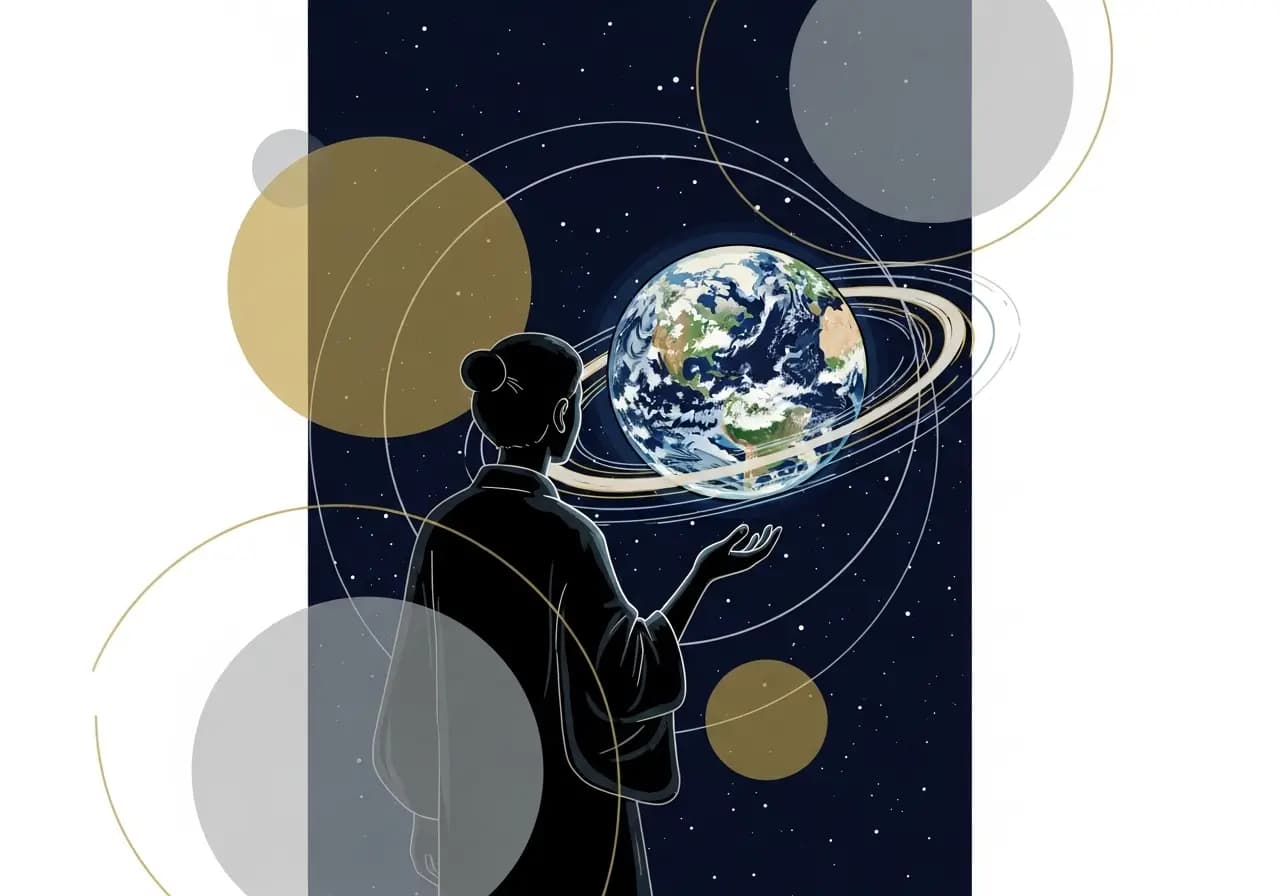
Let me reframe this parable with a modern scenario that works really well for me: Imagine yourself at any point in space, looking back at Earth. You've probably seen those pictures from space looking at Earth, and here's the key insight—depending on where you are in space, Earth is going to look unique to you. If you're on one side of the planet versus on the other side in space, the view is completely different.
And of course, the planet is rotating. But at any given moment, wherever you are in space looking at Earth, you have an incomplete picture, because there's an entire other side of the planet that you can't see. It doesn't matter where you go—whether you're at the top or the bottom or anywhere else in space looking at the planet—you're going to encounter this unchangeable reality: you cannot see the whole picture. It's literally impossible to see the whole picture at the same time.
That's starting to get closer to the deep lesson of this parable: you cannot see the whole picture. It's impossible.
Add Time to the Equation
Now let's complicate this a little bit more by thinking about time. We know that in terms of space, wherever you are, whatever you're looking at when you observe the planet is an incomplete picture. We get that. Now add time to it.
Whatever you're looking at now is different from what it was before, right? If you recall looking at a picture of Earth from space, you see land, but you also see water. And then of course you see clouds—all of these incredible patterns of clouds. Well, those are changing from moment to moment.
What I was looking at ten minutes ago is now slightly different. The planet has rotated a little bit. The cloud shapes have all changed, just a little bit. It may be very subtle, but give it an hour, give it a day, give it three days. What you were looking at three days ago is not what you're looking at now, and what you're looking at now is not what you'll be looking at three days from now.
So in terms of both space and time, we cannot hold a picture in our head and say, "This is the accurate picture of the planet that is applicable throughout space and time." It's impossible.
In the context of space and time, what we have is an ever-changing planet that we're looking at. Because of that, we are essentially like the blind men. What I'm looking at right now is all I can see. It's going to be different in the future. It's different from what it was in the past. And it's going to be different if I'm standing here or there.
That really resonates with me as the core lesson the Buddha was trying to accomplish with this parable.
The Third Dimension: Person, Place, and Time
Now, space and time are not the only two variables that influence the perspective we have of reality. When we're looking at other things—when we're looking at people, at ideas, at beliefs—our views are bound not just by space and time. They're also influenced by our unique perspective, and our perspective is tied to our culture and cultural background.
If you're raised in one part of the world versus another, that influences the way you see things. Your memories, your upbringing, your experiences—they influence how you view things. Of course, inherited beliefs from family or religion also affect the perspective you have.
My friend and teacher Koyo Kubose would say it this way: person, place, and time. The view that you have is bound by three things. First, person—who you are. Your upbringing, your beliefs, your views, your opinions, and everything that makes you you. Second, place—which is space. And third, time. So with this understanding of reality, let's consider the idea of the blind leading the blind, or the parable of the blind man and the elephant.
What this implies is that when it comes to views, when it comes to ideas and beliefs, we are essentially the blind leading the blind. We become so intertwined with our views that we hold so deeply. We think, "This is it. This is the absolute way that things are. This is the right belief, or this is the right opinion, or this is the right approach." And the moment we do that, we fail to recognize person, place, and time.
We fail to recognize that this is just how you see it, and how you see it makes sense to you, but it may not make sense to someone else. It may benefit you, but it certainly doesn't benefit them. And things of that nature.
A Real-World Example
Let me touch on this with an experience my wife had recently. My wife is not very much of a dog person. And I know that for some people, that's unfathomable. People who love dogs love dogs, and they cannot understand how on earth somebody could not love a dog.
And it's not just dogs, right? It could be cats. It could be whatever your thing is, whatever it is that you love. It's very difficult to understand how others wouldn't love it the same way. This is also common with kids. People who have young kids love them and love them climbing all around and saying funny things. Then you go to a restaurant and you think everyone else loves them the way you do. You want to share that funny joke or that moment with everyone around you.
We all know that situation of people who allow their kids to run around or jump on things and don't mind, but the other person sitting there might mind. Well, the same is true with dogs or cats or anything else.
In this case, my wife experienced something that really exemplified this. Someone she knows had gotten a new puppy and was just thrilled about it. This person comes over very enthusiastically, wanting to share the experience of their new puppy. And my wife's reaction was, well, it wasn't the same level of enthusiasm. The puppy was jumping on her, and she found it to be more annoying than endearing.
Now, the person who owns the puppy couldn't quite grasp this. They were blind to the idea that not everyone experiences puppies the way they do. So from their perspective, "How could you not love this puppy? Look how cute it is! Look how playful it is!" They were genuinely confused. They couldn't understand it.
And this is a perfect example of the blind leading the blind. The puppy owner is blind to the perspective that someone might not love puppies. My wife is also in a way blind to the puppy owner's perspective—though she can understand intellectually that they see it differently, her lived experience is different.
But here's where it gets interesting. We can recognize that both of them are right from their own perspective. Both of them are looking at this situation from their own person, place, and time. The puppy owner has a different history with animals. They have different preferences. They have different experiences. My wife also has her own history and preferences.
And the moment we recognize that, we can then approach these differences with curiosity and compassion instead of judgment.
The Blind Leading the Blind in Relationships
This idea of the blind leading the blind becomes particularly important when we're in relationships with people who have different beliefs from us. And let's be honest—that's all of us. Every single one of us is in relationships with people who have different beliefs.
I'm in a mixed-faith marriage. My wife was raised in the LDS tradition, and I was also raised in that tradition but have since moved away from it. So we have different beliefs about religion, about spirituality, about many things. And early on in our marriage, we had a lot of difficulty with that.
We would debate. We would try to convince each other. We would each present our arguments for why our belief was right or more accurate. And it created a lot of friction. Because when you approach it from the perspective of "my belief is right and yours is wrong," or "my belief makes more sense than yours," you're essentially saying "I see the whole picture and you don't." You're not recognizing that you're both looking from different vantage points in the space-time-person spectrum.
So over the years, we've learned to navigate this differently. And I want to share some practical tips that have helped us, because I think they apply to anyone dealing with the blind leading the blind scenario—which again, is all of us.
Five Practical Tips for Mixed-Belief Relationships
The First Tip: Communicate
The most obvious one, but also the most essential. You have to talk about these things. You can't avoid it. You can't just pretend that you don't have different views. Open, honest communication is the foundation. But here's the key—when you communicate, you do it not with the intent to change the other person's mind, but with the intent to be understood and to understand them.
The Second Tip: Go to Values, Not Beliefs
This is a game-changer for us. When we're in conflict because of different beliefs, we try to shift the conversation to underlying values. To me, values are much more important than beliefs.
You'll find that for the most part, we all have very similar shared values. We want to be happy. We want others to not experience suffering. These are shared values that are going to be relatively universal across varying beliefs and ideological systems.
When you highlight those with the people you're in relationship with—when you understand that you have shared values—then the belief becomes secondary. It's like, "Well, here's your belief, but I understand that you believe that because ultimately, this is the value you espouse. Well, from my perspective, this is the same value I espouse, but my approach to it and my understanding of it may be different because my belief is different."
In my case with my wife, we sit and talk about drinking. In Mormonism, you don't drink. Alcohol is the problem. From my perspective, there's no problem with drinking in moderation. So how do we reconcile that?
Well, our shared value is this: being intoxicated and not being mindful—that's not skillful, and we both agree with that. So we arrive at the same shared value, even though the belief may be different. Her belief may be that alcohol is bad. My belief is that alcohol is fine. But both of us agree that you shouldn't drink when you're underage and that drinking and being intoxicated is not skillful. And I believe that understanding why you drink is important, because someone who drinks as escapism is engaging in an unskillful practice.
So we find our common ground anchored in values, not in beliefs.
The Third Tip: Seek to Understand, Not to Change
This is very important in any relationship. From an evolutionary standpoint, we are all hardwired to detect threat and to detect acceptance. If we're accepted by our group, we feel safe. If we're not accepted, or if someone is trying to change us, we have very good systems in place that detect that.
When you're communicating with a family member or loved one with the intent to change that person—whether they consciously know this or not—all of their defenses go up to prevent that change. And we do the same. If somebody's ever communicated with you and you know there's another agenda, that they're trying to change you, guess what? You're not capable of being completely open and accepting with them because your defenses are up.
So instead of trying to change each other, what if we're just trying to understand each other? In my case, that has been a very profound shift in our communication style. Rather than listening with the intent of rephrasing things back so that I can change her mind, it's not about changing each other. It's just about understanding.
So instead, it's: "Let me explain this more." And she'll explain something, and I'll say, "Okay, I think I hear where that's coming from. Where does that come from? Why do you feel that's so important?" And so we're continually trying to understand each other. That has been a very powerful shift, and I think it's a big part of why our relationship works.
The Fourth Tip: Embrace Discomfort and Difficulty
None of this stuff is easy. It's difficult when you're communicating with somebody who has a different view than you, whether those are deeply held beliefs or just different perspectives. You're driving too fast. I'm like, no, I'm driving just the right speed. It doesn't matter what it is—embrace the discomfort of having differences. Embrace the difficulty of talking about those differences and saying, "Well, that's your view. Here's my view."
With time, you'll find that you get better and better at articulating your view and why it's your view. But never with the intent to convince them that yours is right or wrong, because it's not about right or wrong. It's just: this is how I view it, and maybe this is why I view it. Because I was raised this way. When I grew up, this happened. And then, you know, suddenly you understand yourself better, and they understand you better.
So embrace that discomfort and difficulty.
The Fifth Tip: Shift from Right and Wrong to Skillful and Unskillful
This is a Buddhist framework that I find incredibly helpful. Instead of thinking about beliefs and behaviors as right or wrong, I think about them as skillful or unskillful. Skillful means it leads to well-being and reduces suffering. Unskillful means it leads to suffering or conflict.
This reframing takes the moral judgment out of the conversation. You're not saying, "Your belief is wrong." You're saying, "From my perspective, this particular behavior or approach seems unskillful because it leads to these outcomes." And that's a much more productive conversation.
The Bigger Picture: We're All Blind
These tips can be very helpful practices that help you communicate more effectively in mixed-belief relationships. But here's the thing—that's everyone. All of us recognize, or should recognize, that we're all just the blind leading the blind.
I'm blind, and I'm doing the best that I can. My spouse is blind, and she's doing the best that she can. So are our kids. So are my parents. So is everyone that I work with and communicate with.
Because we're all somewhere in space and time looking at reality, thinking that the thing that we see is Earth, not even seeing the other half. And with Earth, roughly half of it you can't see because it's the other side. But when it comes to everything else, I think that the proportion of what we know and what we don't know is exponentially bigger. There's this fraction of a sliver of reality that I understand. The rest of it I do not know. I cannot know. I'm completely incapable of knowing it because of where I am in space and time.
So keep that in mind. Recognize that we're all just the blind leading the blind. We're all trying to do our best and trying to figure it out. And the more we try to understand each other, the better off this is all going to go.
Closing
So that's what I wanted to share about the concept of the blind leading the blind. Another reminder: if you want to learn more about Buddhism, you can check out my book, No Nonsense Buddhism for Beginners, which includes concepts, teachings, and practices. You can learn more about the book by visiting everydaybuddhism.com.
If you enjoyed this podcast episode, share it with others, write a review, give it a rating in iTunes. You can always join the online community on Facebook at secularbuddhism.com/community. And if you would like to make a donation to support the work I'm doing with the podcast, you can visit secularbuddhism.com and click on the donate button.
That is all I have for now, but as always, I look forward to recording another podcast episode soon.
Thank you for listening, and until next time.
For more about the Secular Buddhism Podcast and Noah Rasheta's work, visit SecularBuddhism.com