

No Hope, No Fear
Episode 78 of the Secular Buddhism Podcast
Hello and welcome to another episode of the Secular Buddhism Podcast. This is episode number 78. I'm your host, Noah Rasheta, and today I'm talking about hope and fear, and specifically how these two things correlate with mindfulness.
Keep in mind the Dalai Lama's advice: "Do not try to use what you learn from Buddhism to be a Buddhist. Use it to be a better whatever you already are." I like to emphasize that at the beginning of every episode because it's very important to understand that Buddhism isn't something that's meant to be preached. I'm going to emphasize that every time, every podcast, except for the ones where I forget, which I know there have been several.
The Correlation Between Hope and Fear
So, this idea of "no hope, no fear"—what does that mean?
Well, we know that suffering arises when we want things to be other than they are. Where there is hope, there is fear, and where there is fear, there is hope. They're like two sides of the same coin. When we feel uneasy, when we get restless, when we want something to change—something to be different about ourselves or about others—we hope that things could be another way.
With that in mind, this concept of having "no hope" is that having no hope can be a radical affirmation of acceptance. It's like when you truly accept things as they are, you don't hope for them to be any different than how they are. That's kind of the mental game that's going on with this expression of no hope, no fear.
Working with a Koan
In past episodes, I've talked about the concept of having a koan. A Zen koan is like a riddle, an expression—it could be a sentence. It's something that you work with. It's an expression and it's meant to be baffling. It's meant to kind of shake you up a bit and think, "What are you talking about?"
I think this expression, in a way, could serve as a koan, maybe for many of you hearing this idea of no hope, no fear. You may sit there with this riddle somewhat and think, "Well, what does that mean? I don't like this. I don't like the idea of not having hope." I want to clarify this because I hope you can sit with this expression and work with it over the months or years of your life as an expression: no hope, no fear.
But I do want to clarify a few things as I get into that topic. Pema Chödrön says, "Hope and fear come from the feeling that we lack something. We hold on to hope and hope robs us of the present moment." That is a really powerful statement. And I get why the expression of no hope could, at the same time, feel really disheartening.
Because on the other side of it, you could be looking at this thinking, "Well, if there's no hope, if I don't have hope, then what's the point? What do I have if I don't have hope?" And I know this feeling.
A Personal Journey
I allude to this many times in the podcast episodes of a time in my life that was incredibly difficult for me. I was going through an intense feeling of having been deceived, lied to, cheated. And when you're going through an experience like that, I remember for me, hope was all I had at some stages of that grief and pain.
But the more that I thought about it, the more I pondered on this while going through all of this, the more I realized that the hope I had wasn't maybe a pure hope. It was the hope that things one day would be as if that thing had never happened to me. And I don't know that that's the right sense of hope. That's certainly not the hope that I think is talked about in this expression of no hope, no fear.
So I want to walk you through an experience I had not long ago with my family. We were on vacation. I can't remember if I mentioned this on a previous podcast episode, but if I did, forgive me. We were on a family trip on a cruise, and on the cruise ship they had a giant chess game on the top deck of the ship. My son, Riko, is learning to play chess, and he was really excited to see that and he wanted to play. Every day he wanted to go there and play, and he wanted me to play with him.
I know how to play chess. I know the basic rules. I'm certainly not an expert at it by any means, but I know the general rules of chess. So I'm playing chess with him. And of course, chess is one of those games that always stands out to me because I feel like I used to play life like I was playing a game of chess.
I saw this in him as we're playing. He was teaching me strategies that he'd learned. He'd taken some classes and learned that if you start with this piece, then it should be countered with this other piece, and if they do that, then you do this. He was kind of showing me as we were playing and we were having fun. I was certainly not being too easy on him—I didn't want to be—but I was surprised that once he got ahead of me, I could not figure out how to get past him. I made one terrible move with my queen and didn't realize that he had set me up. He had set me up so that he could take the queen, and he did. We were laughing when that happened.
As I sat there seeing the joy in his face as he was winning this game of chess against his dad, I had this mini flashback to a stage of my life where I was playing life like the game of chess. I thought that I was a few steps ahead of everything in life, and that life was going to go the way I expected it to go because I was influencing it to go that way.
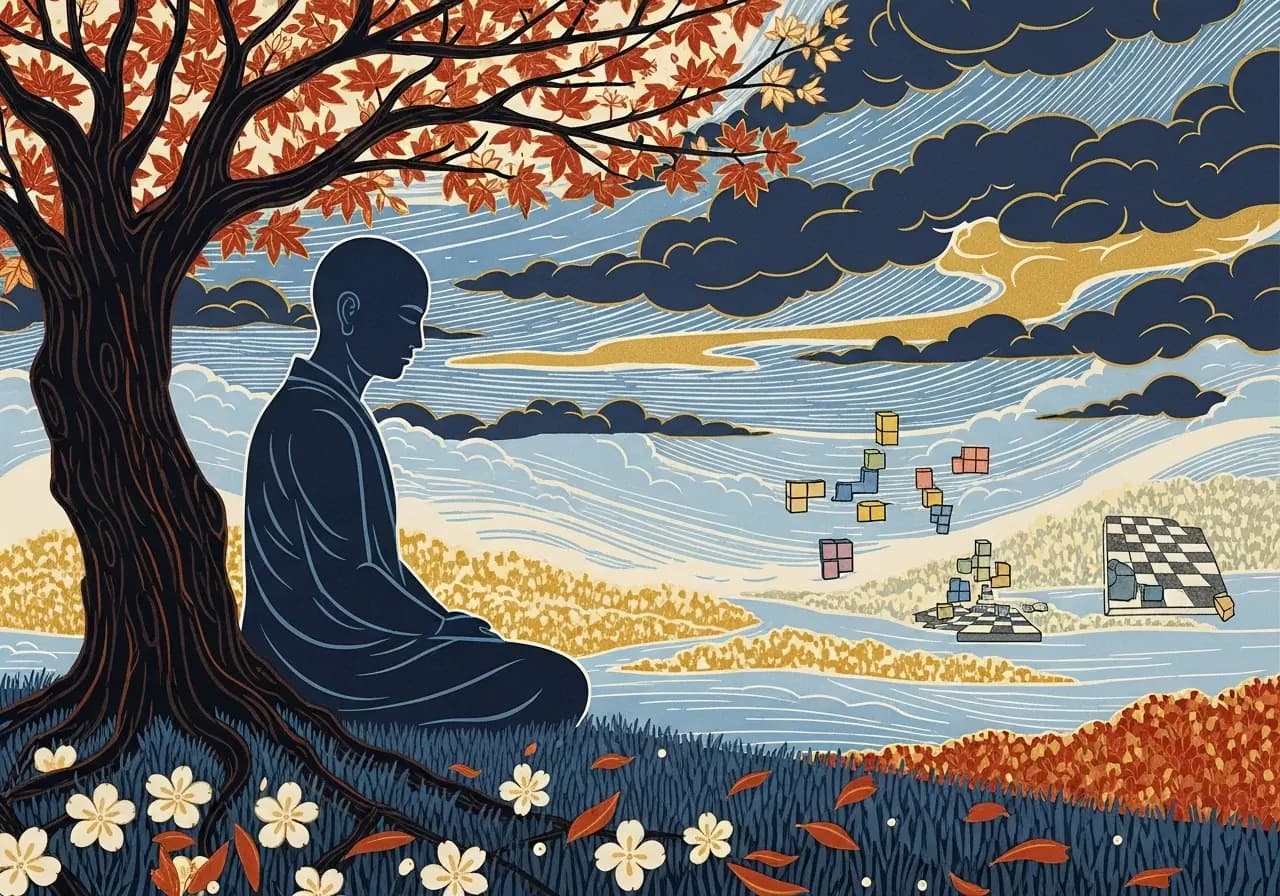
That leads me back to this moment that I've alluded to many times in past podcasts, which was a blindside. Life essentially gave me a Tetris piece that blindsided me, and I was very upset. I was dazed and confused. I was hurt. And I couldn't figure it out. I couldn't figure out why this happened.
When you think you're playing the game of chess, you make a move and life presents a move, and you're really baffled. You're like, "Why did this happen?" At the time, I attributed it to God. I thought, "Maybe God is the one playing the other hand here. Why did you do that?" I just couldn't reconcile the move that was made with the pain that move was causing me. It was a really difficult stage for me.
So as I sat there playing chess with my son, having this flashback, I had this intense moment of gratitude as I could play it all back in my head. Here I am eight or nine years after that move was made, and I'm looking at the game. I no longer see life like a game of chess. You guys know I see it like a game of Tetris. And I just felt gratitude for that piece.
As painful as that piece was, as unpleasant as it was to experience it, all these beautiful things have come from it. It led to a new dynamic in my life, a new outlook, a new worldview. It's led to this very podcast. The fact that you're listening to this right now wouldn't have happened had that piece not presented itself.
I had this moment of gratitude for the unwanted Tetris piece in my life. I had this thought: as I was going through that painful stage and I had hope for things to be different than how they are, in hindsight I look at that and there's no hope associated with those events. There's just gratitude for how it is, gratitude for how I handled it, gratitude for how others handled how I handled it. But there's no hope in there. There's no hope for me in the sense of wanting it to have been any other way than how it was.
That's a strong statement for me to have arrived at. When you look back at an incident in your life that was unpleasant or painful or difficult, and it's not quite like saying, "Oh, I'm so glad that happened, but I wouldn't have it any other way." That's the honest truth.
A Shift in Perspective
This is where this expression of "no hope, no fear" starts to make sense to me. Because when I look back at those events without hope, without wishing they had happened differently, I'm also without fear. There's no fear there either. Because what is there to fear when you've already been through the thing you feared and you see that you handled it? You see that you survived it. You see that beautiful things came from it.
I have faith in my ability to adapt with whatever pieces life throws my way. How powerful is it to be able to sit with that and recognize that come what may, I'm gonna figure it out. And what is there to fear when that's the attitude, when that's the perspective?
In that sense, hope doesn't really fit into the equation. I don't hope to only have pleasant experiences and no longer have unpleasant ones. I don't have that kind of hope anymore. If anything, my sense of hope is that I hope I get to experience it all. I hope I get to feel it all. I hope I know what it is to love in a way that cannot be measured. I know what it is to hurt and to feel pain in a way that can't be measured—to feel let down, to feel unwanted. All these negative emotions, but they make me feel alive.
Hope is not part of that equation anymore. I think in our society, hopelessness has a negative connotation. But you know, think about it: what if hopelessness is actually the start of peace and contentment?
The Koan as Practice
So my hope—and yes, I'm using the word "hope" here as a koan—I hope that you can take away from this the expression "no hope, no fear" and work with it. Play it out in your mind. What does that mean? What are your hopes? Why are they your hopes? What would happen if those hopes were never met? Work with them that way in your own mind and see what comes of it.
Remember, mindfulness as a practice is very introspective. So the idea here is not that "Oh, I need to drop all my hopes." No, I don't know that that's accurate. It's more: "I need to understand what my hopes are and why are those my hopes?" Because if you don't even know why you hope the things that you hope for, well, there's no wisdom to be had in that. That's a form of going through life habitually reactive to whatever you think you're going after—because that's what you hope for.
Think of hopelessness in that sense. For me, in my darkest days, hope helped me. It helped me to wake up. It helped me to want to keep going. But I understand now that it wasn't hope in the sense of changing the situation or the circumstances. It was hope that one day there would be peace in my heart. And that peace that I finally did achieve only took hold when I no longer wanted to have that peace.
That's kind of the irony here. As I went through the stage of grief that I went through, I felt a lot of pain and I didn't want to feel it. It wasn't until I allowed myself to realize, "You know what? I do want to feel this. I want to know what this feels like. If someone else ever goes through that thing that I went through, I would know what that feels like," that I opened up to accepting the hurt, the pain, the frustration, the anger, the hatred—all these things I had been pushing away for so long.
And it was that moment when I opened up and allowed those things to just be what they were that I realized I just wanted to be free. Free to feel my pain, to embrace the hurt, to embrace the suffering. And that was the very moment that became the start of the most intense peace and the most intense contentment that I had never experienced before.
Another Koan: "There Is Nothing I Dislike"
This kind of reminds me of another koan to work with. You're going to have several koans coming out of this. You've got "no hope, no fear," and then here's another one from an old Zen master from roughly the 600s named Linji. L-I-N-J-I is the spelling. He has a koan that says, "There is nothing I dislike."
This is one that was presented to me when I was doing my lay ministry program and I was reading the Book of 101 Zen Koans. I remember hearing this and thinking, "Huh, what does that mean? There's a lot of things I dislike. I dislike the suffering in the world. I dislike poverty. I dislike abuse of children. You know, there are plenty of things to dislike. What could this possibly mean? There is nothing I dislike."
I've thought about it and I've worked with it, and this has been one of the koans that I've worked with for myself to see if I could ever arrive at this expression of "There is nothing I dislike." And I feel like I can. I feel like I have.
To me, what it means is that the immediate experience that we have in life—we have emotions and thoughts and feelings—that's what's being talked about here. There's nothing I dislike in terms of the experience I have of living. When I'm having the experience or the emotion of disliking the injustice in the world, I don't dislike that I dislike it. Does that make sense?
So I can say there is nothing I dislike. I like all of the feelings and thoughts and emotions that I have, even the unpleasant ones that stir me to want to take some kind of action to correct the injustice. To me, that's how I've worked with this koan in my mind.
And again, there's not a right way or a wrong way to these. These are expressions that you work with. So the invitation here is: what does that mean for you? What would it feel like for you to be able to say "there is nothing I dislike"?
Closing Thoughts
That was the main topic I wanted to share in this podcast episode. I have a few other fun ideas I've been wanting to share, but this one kind of stepped over and became the next one in the list, even though it wasn't originally meant to be.
But again, I want to thank you for taking the time to listen and for being part of this journey with me. It's been a really fun experience. So thank you for listening and for taking time out of your day. As always, I hope these concepts allow you to be more skillful with how you navigate life and the experiences that you have, and the various Tetris pieces that come your way. Because we're all in different places.
If you want to learn more about Buddhism in general, you can always check out my book No Nonsense Buddhism for Beginners, which has history, concepts, teachings, and practices. You can learn more about that by visiting everydaybuddhism.com.
I'm also excited to announce that as far as practices go, my next book is going to be a Five-Minute Mindfulness Journal with several practices and things that you can work on that are meant to help you practice mindfulness in your everyday life and in your day-to-day settings.
As always, if you enjoyed this podcast episode, feel free to share it with others. You can write a review or give it a rating on iTunes. You can join our online community on Facebook—Secular Buddhist. If you want to make a donation to support the work that I'm doing with the podcast, you can always visit secularbuddhism.com and click on the donate button.
That's all I have for now, but I look forward to recording another podcast episode soon. Thank you for listening. Until next time.
For more about the Secular Buddhism podcast and Noah Rasheta's work, visit SecularBuddhism.com