

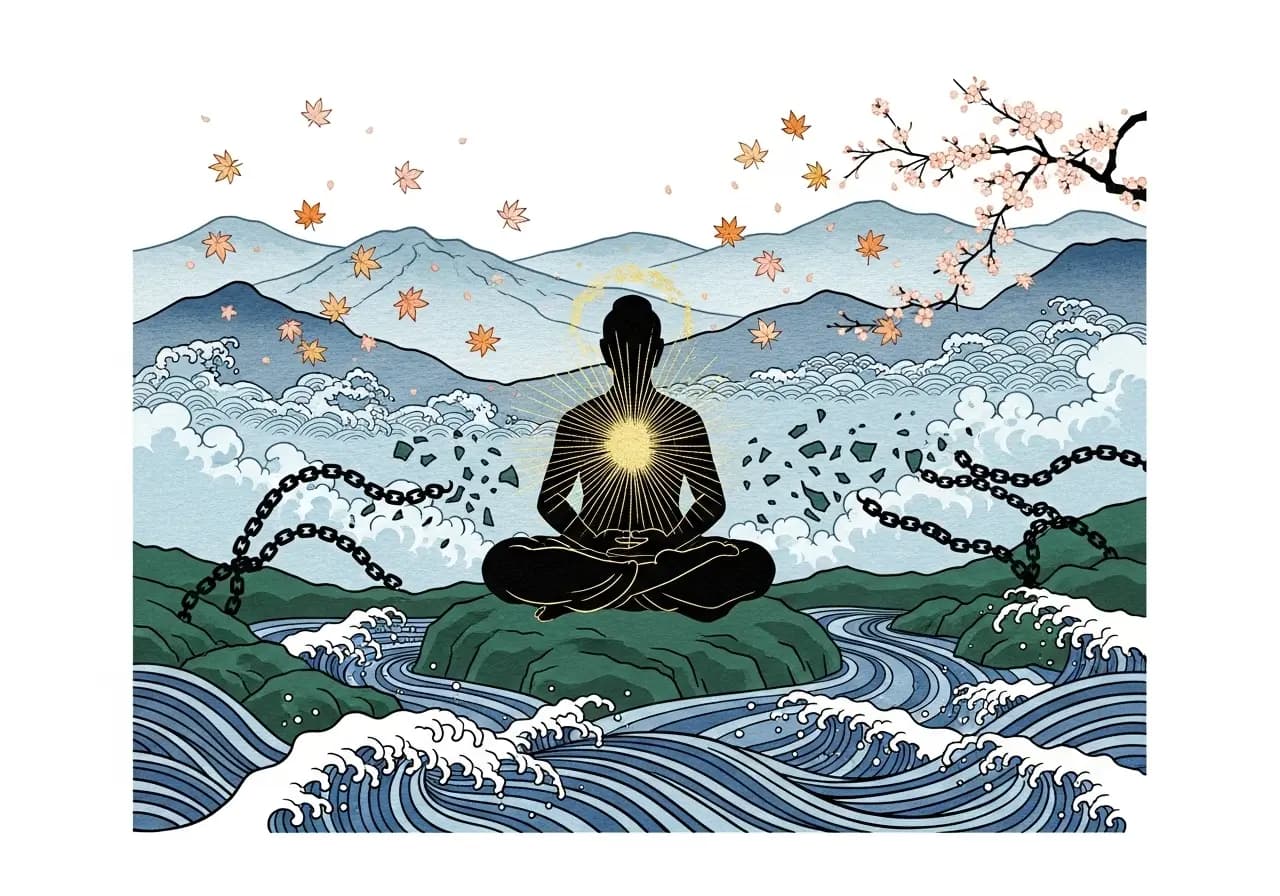
Embracing Rebellion
Episode 77 of the Secular Buddhism Podcast
Hello and welcome to another episode of the Secular Buddhism Podcast. This is episode number 77. I'm your host, Noah Rasheta, and today I'm talking about the art of embracing rebellion and how that relates to mindful living.
Keep in mind the Dalai Lama's advice: do not use what you learn from Buddhism to be a Buddhist. Use it to be a better whatever you already are.
What Is Rebellion?
Before jumping into this topic, I want to clarify what I mean by embracing rebellion. What is rebellion? What is a rebel?
I think of rebellion as the act of disrupting the established order. In the sense of mindfulness, it's like changing up the way things have been to explore whether or not there's a way that things can be better. The rebel is able to look at a situation and say, "Yeah, this is how things have always been, but what if we did things differently? What if we were able to change things up?"
People like the Buddha, for example, were rebels in their time. He questioned the established order of how things were. He questioned the caste system where one person ranks way up here and another one is way down there to the point where they're untouchable. He questioned the way things were. He questioned the answers of the time that were given to life's existential questions. In the end, he presented a new way—the Middle Way. But to embrace his ideas fully, I think we need to be rebels ourselves.
Rebellion Against Natural Selection
When we talk about rebellion, I want to use Robert Wright's explanation here in his book Why Buddhism Is True. He says, "I think of mindfulness meditation as almost a rebellion against natural selection."
He goes on to say that natural selection is the process that created us. It gave us our values. It sets our agenda. And Buddhism says we don't have to play this game. This is the type of rebellion I'm interested in talking about.
You know, to be able to look in the mirror of introspection—to see ourselves, the way that we have habitually done things, our thoughts, our feelings, the things that we do—to be able to pause and look at all of that and say, "I don't have to play this game. I don't have to react the way that I always react." In this sense, I think it takes an act of rebellion to be able to change things about ourselves.
Breaking Habitual Patterns
Now, I don't know about you, but have you ever experienced or tried to do things just slightly differently than how you normally do? I'm not talking about big things. I'm talking about the small stuff.
Every time I wake up, I always get out of bed the same way. I roll to the same side and put my left foot down first. You may not notice this about yourself until you start to pay attention. And then you say, "You know what, what if I do things a little differently and get out of bed differently?"
Or take other simple things. When I put my socks on, it's always left foot then the right. What if I try the right then the left? On your drive to work, it may be the same route every single time. What if you try a new route? Just changing things up a bit for the sake of doing it.
I first came across this concept in a book—I can't remember which one it was—but the idea was about how our brains grow and develop. Like the mind of a child, there's no set way. They're figuring that out. And that flexibility to do things in different ways is instrumental in their ability to learn and acquire information because their mind is in that open mode.
The idea in that book was that if you start changing things up from the habitual patterns that get hardwired in the mind, once you pick a way, that's the way—you always do it that way. The mind isn't interested or geared to be adding new stuff. So the idea was that you can kind of tweak the brain or hack the brain almost by just changing things up and doing them differently. It puts your mind in this mode of, "Oh, we're doing something new. I need to be more aware and pay more attention because I'm not used to this."
So it's kind of breaking out of that cycle of habitual reactivity. And that's more along the lines of what I'm talking about as far as a mindfulness practice. It's being mindful of the habitual tendencies that we have and then trying to break up that routine just a little bit.
A Clarification on the Bird and the Kite
Before going further into this concept, I do want to clarify something from last week's podcast episode. I think it kind of fits in here with this topic.
I received some feedback on the analogy of the bird and the kite—you know, discovering which one you are. I received a few emails or Facebook messages from people saying, "I don't necessarily agree with this because what you're implying is, what about this scenario where the bird or the kite is stuck as a kite and can't ever be a bird because it's afraid? Maybe fear or aversion to the fear causes the kite to stay stuck in this state of being a kite and never discovering that it was indeed a bird."
I like that notion, and I want to clarify it a little bit because there are a couple of things that need to be clear about the comparison.
The first one is understanding that there's not a gradual ranking system. We can't say a bird is better than a kite or a kite is better than a bird. It's not fair to compare them that way. When a kite realizes it's a bird, "Oh man, it becomes even more beautiful!" That's not what we're saying here. Because it's important to notice that birds are birds and kites are kites. That's what I'm trying to imply.
You could get this across by comparing apples to oranges. It's not like, "Oh, an apple, once it becomes an orange, that's even more beautiful." No, they're just two separate things. Apples are apples, oranges are oranges. Birds are birds, kites are kites.
But there's absolutely something to say to this notion of, "What if I'm stuck where I am and I'm not realizing my true potential because of fear?"
The example I gave last week in the podcast was paramotoring or paragliding, and I think that's a good example because it very well may be that there are people out there who say, "I don't want to try that. That's kind of scary." And if they did try it, they would realize, "Oh my gosh, this is an incredible feeling! I want to keep doing this." They would get into the sport and then probably look back and say, "My only regret is that I didn't do this sooner, and the only reason I didn't do it sooner was because I couldn't get past the fear."
That's a very valid assessment. So I want to clarify that, in the way we're talking about these things, that's something we need to keep in mind.
What we're trying to decide is what we are. We're not trying to compare and say, "What's better, a bird or a kite? Which one am I? Which one do I want to be?" What we're trying to discover in this whole process is, "What can I learn about myself? What are my fears? Why do I have this fear? What would happen if I overcame this fear? Would I discover that this thing I've been afraid of would actually open the door to all these beautiful new experiences?"
Yeah, that's part of the journey.
What I was trying to clarify in last week's podcast is that some things aren't for everyone. And that's a very important thing to know. Because the nature of a kite is that it flies because of the string. Cut that string and what a sad sight. Same with the bird. What a sad sight to see a bird tethered to a string.
So it's important to be willing to spend the time to work past the fears to discover which one I am. And then to decide. And that may take some steps that are scary. Like, you know, the kite saying, "Well, I'll experiment and see what this is like without the rope for a minute. Oh no, I didn't like that. Going back to the rope."
Change is inevitable. And I think that's important to clarify here. Again, going back to apples and oranges.
The Present Moment Is Everything
I want to pivot a bit and talk about something that relates to this idea of rebellion. And that's the concept of embracing the present moment. This is what I consider to be a radical act of rebellion.
You know, we spend so much of our lives looking ahead. We're thinking about what we're gonna be doing tomorrow, next week, next month, next year. We're constantly looking forward to this payoff, this moment when things are gonna get better. Or we're looking back, ruminating on things that have happened, wishing they could be different.
But the reality is, all we ever have is this present moment. This is it. This is the only moment that's guaranteed to us. It's not guaranteed that we're gonna see tomorrow. It's not guaranteed that we're gonna be able to have that experience in a week that we think we're gonna have. But right now, this moment? This is real. This is happening.
And more than that, this moment is completely unique. It'll never be like this again. Sure, it may be unpleasant, it may be pleasant. That's beyond the fact that it's unique. This is the only moment we've ever had. This is the only moment I'm experiencing—the present moment.
And the source of everything that we're looking for—whether that be to be more kind, to be more mindful, or to have more joy and peace in life, whatever it is that we're looking for—the source of it is found here, in this very second, in this very second of this present moment.
And I think we do ourselves a great disservice when we look ahead for that thing, looking for that payoff, because we're gonna miss the whole point. And the whole point is that it's always been here and it's always been now. This is the moment that you have. This is the moment that you're living for. This is the moment that you're alive.
It's the only guarantee that you have—that you are existing in this moment with whatever configuration of Tetris pieces life has presented to you. This is it.
The Rebel's Acceptance
And it takes an act of rebellion to embrace this present moment and to accept it just the way that it is. To accept your bank account as it is. To accept your relationship in the current state that it is. To accept your partner just as they are, or your children, or your siblings, or your parents. To accept life in general—just see it, for a brief moment, as "This is it. Now what do I do?"
Because now I can look at it and say, "Well, what's more skillful?" Again, this is the rebel speaking now. The rebel that says, "This is how it is. Can it be a little bit better? Can I make some changes that make this a little bit more skillful?" And that's where the rebel speaks.
This concept is discussed in Robert Wright's book Why Buddhism Is True. But it also comes out pretty heavily in another book that I often recommend to people—Dzogchen Ponlop's book called Rebel Buddha. That's one of the first books that I read when I started studying Buddhism, and I loved the concept of the Rebel Buddha.
You are the Rebel Buddha. There's a rebel inside of you that's wanting to break free from the habitual reactivity that has trapped us for so long. From reacting to the same things in the same way over and over and over.
It's like the movie Groundhog Day. If you've seen that movie, the main character is reliving that day over and over and over. He tries every possible combination of living that day. And in the end, he discovers that when he accepts the day as it is and learns to love and to be loved—just as, without any of those caveats of putting things in the future as the payoff—that's when something shifts. He gives up the game and, ironically, it's by giving up the game that makes the game end. He wins the game. He gets to wake up, and finally it's the next day.
But that's us in a way. We're going through life, and it's like we're in Groundhog Day, reliving a lot of these same moments and reacting the same way. Having aversion to all the same feelings every day. There's anger again. "I don't like anger. I'm running from it." Or there's sadness. "I'm running from sadness." And we do this over and over and over, day in and day out. Nothing will change until that rebel inside of us says, "I'm not playing this game anymore. I'm tired, and I'm done running away from what I don't like, and I'm done running toward the things that I think are gonna be the things I like. You know, the clinging, right? If I could finally have this or that."
You give up that game and you say, "This is the life I have. I'm embracing it wholeheartedly. This is who I am. I accept myself wholeheartedly." And in that moment, the rebel changes the whole game. The rebel in us changes the game, and it's a beautiful moment.
And I think that is the essence of enlightenment. I don't think there's anything grand or mystical beyond that.
Think about it. Think of truly accepting yourself just the way that you are. You would have total peace. You would have total serenity. You would have this total contentment that you see portrayed in the figure of the Buddha sitting there with total serenity in his face.
It's not that he discovered some great secret that "Oh, I've got to go figure that out too." It's not that.
I think it's as simple as this: absolute acceptance of "This is the present moment, and I don't need any of it to be any different because I recognize that it will be different whether I want it to or not." So I'm gonna accept it the way that it is. I accept myself the way that I am.
And now I can be more skillful with embracing whatever change comes next because we already know that's the inevitable part.
Patience with Ourselves and Others
That's what I wanted to discuss in today's podcast episode—this concept of embracing rebellion. I wanted to clarify a little bit from last week's topic, the idea of having patience with ourselves and others.
I think it takes a lot of patience to be able to sit with myself in this present moment, in this present configuration, however it is. Not thinking, "Well, I'm mad. I'm not gonna sit with this right now. I'll wait till I'm happy. Then I'll sit with myself." No. Sit with yourself while you're mad, while you're hurt, while you're in pain, whatever state you're in, that's the state you're in. And that's the essence of embracing rebellion.
Closing Thoughts
So hopefully these concepts make sense. Sometimes I feel like I just jot notes down and then I start rambling, and I hope that it comes out as a cohesive narrative that builds off of past ones and makes sense.
Because again, what's the point of any of this if it's not practical and pragmatic? If it doesn't affect skillful change in your day-to-day life?
We're all going through crazy stuff in life. All of us. Everyone's going through something. And I think it takes an act of rebellion to be able to sit patiently with life the way it's configured right now, with the current Tetris pieces that you have. And then it gives you this tremendous sense of peace—come what may, I'm not scared anymore. Because whatever's gonna come, I'll figure it out. My faith is in my ability to adapt.
That's the wisdom of adaptability. That's what I'm after with this concept and this topic.
So hopefully some of this has made sense to you.
If you're listening to this and you're new to the podcast and you want to learn more about Buddhism, you can check out my book No-Nonsense Buddhism for Beginners. You can learn more about that at everydaybuddhism.com.
If you've enjoyed this podcast episode, feel free to share it with others. You can write a review or give it a rating on iTunes. If you want to discuss these topics a little bit more, join our online community. You can find that info at secularbuddhism.com/community.
And if you want to make a donation to support the work that I'm doing with the podcast, visit secularbuddhism.com and click the donate button there.
That's all I have for now. But as always, I look forward to recording another podcast episode soon. Thank you for listening. Thank you for being a part of this journey with me, and until next time.
For more about the Secular Buddhism podcast and Noah Rasheta's work, visit SecularBuddhism.com