

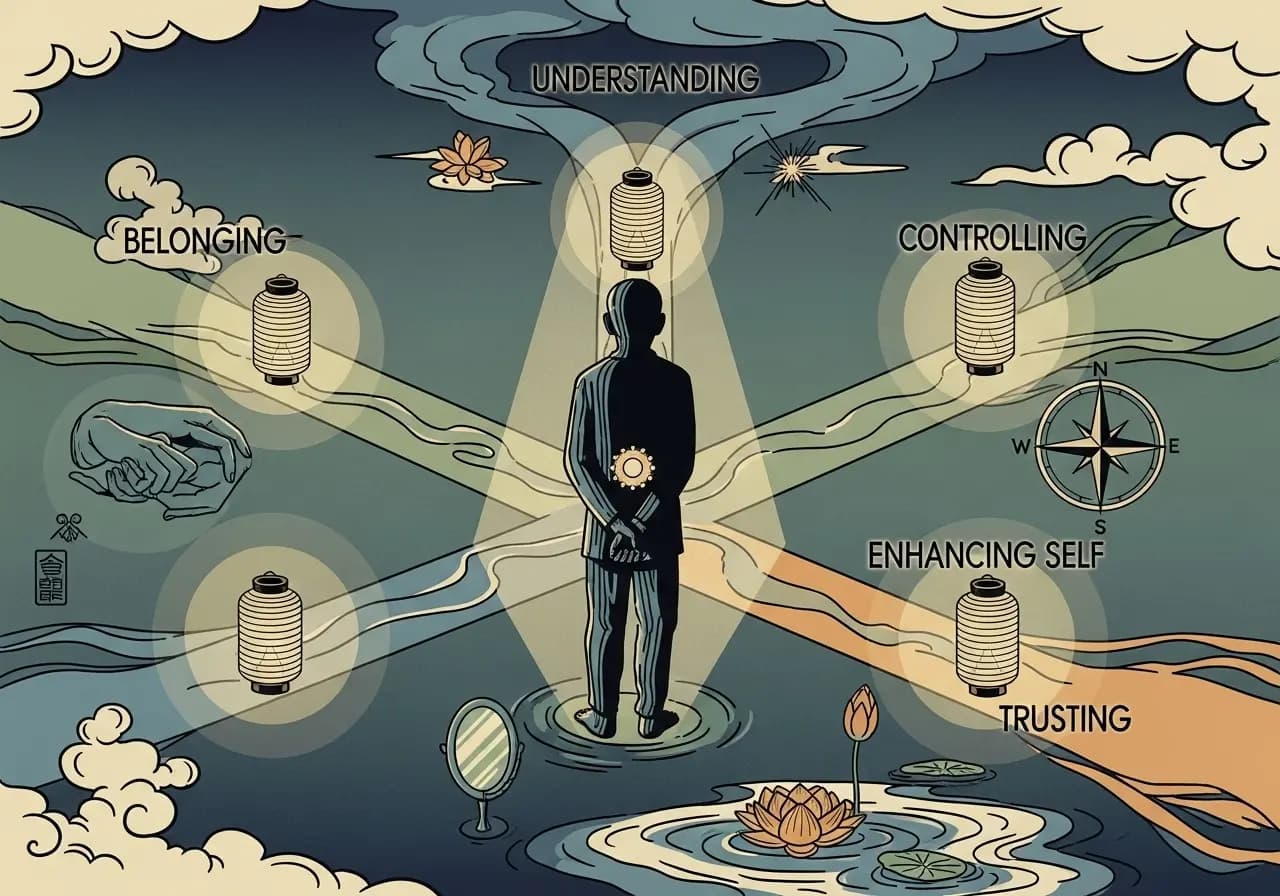
What Moves Us: The Five Core Social Motives
Episode 73 of the Secular Buddhism Podcast
Hello, and welcome to another episode of the Secular Buddhism Podcast. This is episode number 73. I'm your host, Noah Rasheta, and today I'm talking about what moves us—specifically, the five core social motives. But before I jump into the topic, I want to remind you of the Dalai Lama's advice: Do not use what you learn from Buddhism to be a Buddhist. Use it to be a better whatever you already are. This has always been a key message that I try to reinforce throughout the podcast and in my general approach to teaching Buddhist concepts.
How This Topic Came About
The idea for this episode started with an email I received from a podcast listener. I receive emails regularly with ideas for podcast episodes, and this particular listener asked me to address the topic of rejection. With a little bit of context and understanding about the idea of rejection, I thought, "You know, that's a really powerful topic," because to some degree, all of us fear rejection. We all know what it feels like to not be picked for the team or to not have the approval of parents, siblings, or friends. To some degree, everyone has experienced some form of rejection, and I think all of us fear it.
There's a reason why. I think we're hardwired as social creatures to really fear rejection. When I saw this email and started thinking about rejection, I thought, "Well, it might be interesting to combine a little bit of Buddhism with what psychology teaches." I wanted to explore what psychology findings and social behavior research reveal about what moves us and what motivates us.
I came across a book by Susan Fiske called Social Beings: Core Motives in Social Psychology. Susan is a Professor of Psychology at Princeton University, known for her work on social cognition, stereotypes, and prejudice. Social cognition is the overall topic of this book, and it's really fascinating.
Psychology has always been interesting to me. I think it's one of the things that drew me to study Buddhism in the first place. Buddhism is a philosophy that delves into understanding yourself—why do I think the things I think, say the things I say, and do the things I do? It ties really well with what we're finding in psychology. That's where the topic for this podcast episode came from. I wanted to present to you what the five core social motives are according to Susan Fiske.
The Five Core Social Motives
According to Fiske, core social motives are fundamental, underlying psychological processes that impel people's thinking. They motivate and underlie the way we think, feel, and behave in situations that involve other people. The specific core motives described by Fiske can be memorized with an acronym: BUCET. B-U-C-E-T. These are the five core motives:
- Belonging
- Understanding
- Controlling
- Enhancing self
- Trusting
All five motives orient toward making people fit better into groups, thus increasing their chances for survival. This is where the evolutionary psychology part comes in. We're hardwired to fear rejection and avoid it at all costs, which fits perfectly with Fiske's work on these core social motives that govern everything we do. Let me talk about each one and then correlate them with some Buddhist teachings and concepts.
Belonging: The Root Need
The first one is belonging, and this is the root need. It's the essential core social motive that the others are said to be in service of—they facilitate or make possible the way we function in social groups. This first one is the most important one.
This is what came to mind when I read that email about rejection. The opposite of rejection is belonging, and that happens to be the core social motive that Susan Fiske highlights in her book. I thought it would be a neat way to approach the topic of rejection by talking about belonging. Why do we have this intense longing for belonging?
According to Fiske, belonging is the idea that people need strong, stable relationships with other people. Belonging to a group helps individuals survive psychologically and physically. From an evolutionary standpoint, at some point in time, our survival was literally dependent on whether or not we were able to belong with a group. Individuals had a much less likely chance of survival out in the wild than if they were in a cohesive group like a tribe.
Think about this for a second from an evolutionary standpoint: we're hardwired to want to fit in. We can't help it. We can't help that we fear rejection—whether it's individual rejection from someone we care about or someone we like, or rejection on a bigger scale with a group. You can see how this longing for belonging influences the way we want to fit in with a political group, a political ideology, a religious group, or beliefs we might hold. Think about that in the context of this core motive of wanting to belong.
Understanding: Making Sense of Uncertainty
The second one is understanding. Understanding is the motivation of individuals to understand their environment, to predict what's going to happen in case of uncertainties, and to make sense of what doesn't happen. We're not very good at sitting with uncertainty. I've alluded to this before.
I think this is why, at some point in the past, when the first volcano started erupting, a group somewhere wasn't content with not knowing what was happening. So they decided, "Oh, the gods must be angry. We need to cut people's heads off." Right? Why would we draw faulty conclusions to things we don't know? Because we're so uncomfortable with uncertainty. It's one of the core social motives—to understand, to make sense of things. That can be a good thing, but the downside is that we often find ourselves as individuals, as groups, as a society, as a species, assigning meaning to things that don't have any meaning. That can create problems like the volcano example.
Controlling: The Illusion of Control
The third one is controlling. According to Fiske, this encourages people to feel effective in dealing with their social environment and themselves. Control entails a relationship between what people do and what they get.
What comes to mind for me with controlling is that we're playing life as if it were a game of chess. We're thinking that if we could just be smart enough and figure this out, we can do a checkmate on life. The reality, like I've mentioned many times, is that life is a lot more like a game of Tetris.
This need for us to control is often projected externally. We want to control our spouse, our kids, our work, our environment—everything. But I think where Buddhism comes in as an effective tool is by saying, "This need to control can be turned inward." It can be projected toward yourself. The question becomes, "Why do you want to control the world if you can't sit and just be with whatever you're experiencing?" This sense of control is a core social motive, a need that we have, but we can turn the focus inward rather than outward. That becomes much more skillful.
Enhancing Self: Proving Our Worth
The fourth one is enhancing self. What does that mean? According to Fiske, this involves either maintaining self-esteem or being motivated by the possibility of self-improvement. Remember, all of these tie back to the first one, which is belonging.
You can see how this sense of enhancing self correlates very closely with the first one. It's about wanting to prove myself worthy of belonging, so I'm going to do whatever I think you think I need to do to prove myself worthy to belong with you—you as the group, speaking collectively. This is a need that arises naturally in us. It's a need to want to enhance ourselves to the point where we no longer have this fear or doubt about not being worthy to belong. You can see how that can be affected tremendously when coupled with societal views, societal norms, religious views, and religious norms.
In Buddhist philosophy, this is countered by the concept of Buddha nature—the understanding that people are basically inherently good. Our natural tendency is to want to be kind, to want to end or minimize the suffering we see in others. You see a wounded puppy crossing the road. Most people—granted, not everyone, but most people—have this natural tendency to want to help, to minimize suffering. Most people can feel empathy when you're telling them a story and you become emotional. Most people will tend to empathize and feel those same emotions. That is our natural position. According to the Buddhist worldview, that's the baseline.
If that gets muddied up with concepts, beliefs, and ideas, it can become difficult to see as the natural position because we become blinded to it. A good example would be racism. It's not a natural thing you're born with. It's a concept you develop or acquire through conditioning—cognitive conditioning. You can be taught to be racist, but that's not natural to us. So I'm correlating this to the concept of enhancing self.
The Buddhist approach would say, "What is there to enhance?" If anything, we want to uncover what I mentioned in a previous episode. We want to peel back the layers that are preventing us from seeing that inherent nature of kindness and compassion.
Trusting: A Benevolent World
The fifth one is trusting. According to Fiske, this is "seeing the world as a benevolent place." Again, you can see why this is so important for us—to perceive that the world is a good place. What would it be like to live without a sense of trust? We would be on edge all the time. We see this in societies where there's a lot of fear and not a lot of trust. Other things start breaking down pretty quickly. So one of the things that motivates us is to want to trust, to want to see the world as a benevolent place.
The Buddhist Lens
When we start to look at these five core social motives through the lens of impermanence and interdependence—which is the Buddhist way of trying to understand things—it can be a powerful way of understanding ourselves.
Going back to belonging, if belonging is the core social motive that all the others are in service of, and if the fear of rejection is on one side of that coin, we can start to see in ourselves a lot of the decisions we make, the things we say, and the things we think. We can correlate them to this core social motive to want to belong. Or, the flip side of the same coin is the fear of rejection. The fear of rejection is not really any different than the desire to belong. It's two sides of the same coin.
I think almost everything that we do in our lives is motivated by one or the other side of that coin. We're trying to belong, or we're trying to avoid not belonging. We're trying to avoid rejection, whether that be in personal relationships or in group relationships. It's fascinating to sit and analyze my own actions, words, and thoughts, and to think of it in this context: "Why am I doing this? Where do I see the core motive inside me that's just trying to belong? I'm trying to not be rejected, to not risk being rejected."
Now, I bring this up because we're hardwired this way. It's not like we can just stop being this way. We'd be going against millions of years of evolution. Rather than thinking, "Okay, if this is how things are, I need to make sure I don't think this way anymore or feel this way anymore," we want to approach this from a different angle.
The Heart of Mindfulness Practice
Earlier this week, I posted my thoughts on the Heart of Mindfulness Practice. I think this correlates with what we've been talking about. Everything we perceive with our senses—sounds, sights, tastes, smells, physical sensations, and especially thoughts—gives rise to feelings about those perceptions. We end up liking or disliking the experience. We feel comfort or discomfort about what we're perceiving.
If we like what we see, we keep looking at it. If we don't like what we see, we close our eyes or turn away. If we taste something we like, we want more of it. If we don't like it, we're going to spit it out or never taste it again. We do this with thoughts too. We cling to the comfortable thoughts, and we feel emotional distress about the uncomfortable thoughts. This is craving and aversion. We're craving after some perceptions and having aversion toward others. We're pushing and pulling, liking and disliking.
The Heart of Mindfulness Practice is to first see and recognize our tendency to pull toward or push away from these feelings. Second, instead of reacting out of habit to these feelings, try to remain steady with the feeling that arises. The benefit of practicing this is that we can become more adept at placing a gap between the direct experience and our reaction to the feeling that arises from the experience.
If we correlate this with the five core social motives, what we're trying to understand is this: the goal here isn't to change it. It's not about rewiring yourself. The goal of mindfulness practice is not about changing the feeling that arises or changing the nature of how things are. Instead, it's about understanding the relationship we have with the feelings that arise.
This is critical. When I understand what motivates me through the lens of these five core social motives, it's helpful to know, "Okay, this is why I felt this way. This is why I said this. This is why I reacted the way I did." We just see it. That starts to change the relationship we have with it. It's not about changing the thing itself.
A Personal Story: The High School Reunion
Let me share a quick example from my own life. Last week, I went to Mexico for my 20-year high school reunion. It was fun getting together with everyone, but I had an experience I want to share with you. One of the things I struggled with in high school, about halfway through, was related to being a twin. I started to have this feeling that most of my friends weren't really my friends—they were our friends. They were only friends with me because they were friends with my brother. I had this perception that my brother was the funny one, the one everyone liked, and I was just the sidekick, the one stuck there because I was the twin.
Some people had ways of identifying us in a joking way that aggravated this. They'd always call me the serious one and him the fun one. This was evident in the nicknames we were given. I started to really struggle with this concept. Now, as I study psychology and Buddhist concepts, I see these core social motives very evident in my own life and past. I had this fear that without my brother, I'd be totally rejected. I wouldn't belong to the group because what made me belong was that I was attached to him. That was very threatening for me.
It caused a slight rift between my brother and me in the last year of high school because I needed to find out who I was. I needed to explore whether I was capable of having my own friends on my own without him. After high school, we moved away to different countries. That life essentially ended 20 years ago.
Well, all of this resurfaced last week when we went back. We stepped back in time with a lot of these friends we hadn't seen since high school. The relationship and engagement they had with us was from that time, from 20 years ago. They had no reference of who my brother is now or who I am now. We were working with versions of us from 20 years ago.
A couple of days before the reunion, we were making plans and trying to see our friends. I would text someone and say, "Hey, we're going to be doing this or that. Where are we going to see you?" They'd text back, "Oh, I already texted your brother and made plans." The first time, I didn't think anything of it. The second time, I was like, "Oh." The third time, when a third separate friend made it very clear that nobody was talking to me—they were all communicating with my twin brother to make plans—all of a sudden, all these emotions flooded back from high school.
I realized this was that fear of rejection. It's the fear that I'm not good enough. It's that longing to prove myself worthy of these friendships because I'm just the sidekick here along for the ride. All of these feelings welled up again, just like from high school.
But here's the thing—this time, unlike back then, I knew what was happening. I understood the core social motives. I see the world differently now through the lens of Buddhist teachings and psychology. So the experience was different, though the feelings were the same.
I want to be clear about that. The feelings of fear of rejection were just as real as they were back then. The strong desire I was feeling to want to belong—I felt like I didn't belong, and I just wanted more than anything to be part of the group. All of those feelings were very real, just like they were the first time I felt them. What was different this time was the relationship I had to those feelings.
As they surfaced, I was able to look at them and almost smile, thinking, "Huh, I know where this is coming from. I know why I'm feeling this. I know what some of the causes and conditions are that give rise to these feelings." That understanding alone changed the situation. I didn't take anything personally. I didn't feel down and out. I just thought, "Oh, how interesting."
I reminded myself that the dynamics we were working with were the dynamics from 20 years ago. It was like we went to this book that's 20 years old and just turned the page to what would have been next, had we stayed there. In that context, of course they would all be working with him. He was the point of contact for us back then. That was the very issue I was dealing with. He was the focal point, and I always just fell in line as the other one.
It was very interesting to go through that experience with an entirely different relationship to the feelings, but the feelings themselves were the same. It was fascinating.
It made me feel really grateful for the time and dedication I've spent trying to understand myself, trying to have a clearer picture of the reality of why I think the things I think, do the things I do, and say the things I say. That's the Heart of Mindfulness Practice. I saw it in action at my 20-year high school reunion—having an entirely different relationship to the feelings while experiencing the very same feelings. That was fascinating for me.
I was very grateful for having a better understanding because there was no need to be reactive. There's nothing to react to. What I was doing was just watching and seeing what would arise, allowing it to be valid, thinking, "Oh, I know why I feel this way," and understanding that it's a totally valid point of view, a totally valid feeling to have—that fear of rejection, that longing to belong. I just watched it for what it was.
Bringing It All Together
What I hope to convey in this podcast episode is that the Heart of Mindfulness Practice, applied to what moves us, shows this: when you understand the five core social motives of belonging, understanding, controlling, enhancing yourself, and trusting with greater clarity, you'll understand the nature of how you are. Notice I say "how you are," not "who you are." You'll be more skillful with how you relate to the feelings you have, the thoughts you have, and the emotions you have. That's what this is about.
To the person who reached out in the email about the topic of rejection, I want to say this: Yes, rejection is a very real thing, and we feel it when the causes and conditions arise that allow that fear of rejection to surface. It will arise. If you've ever been betrayed by someone, anything that triggers that feeling—if you had issues growing up with how your parents or siblings treated you—there are so many ways this fear of rejection can arise and be triggered over and over throughout your life.
It does for me, and I'm sure it does for all of you listening in some arena or aspect of your life. It's natural because we're hardwired to want to belong. The flip side is that we're hardwired to fear rejection like it's the scariest thing on earth, because at one point, it was. It was literally a matter of life and death.
We work with that. It's almost instinctual how it comes up. When it does arise, rather than riding the chain of reactivity, we can pause and say, "Okay, I know why this feels this way. Now, what do I do next? How do I handle the situation skillfully rather than with the habitual reactivity that might have taken me down a path I didn't want to be on?"
That's what I wanted to talk about today.
Resources
If you want to learn more about this concept, I highly recommend Susan Fiske's book, Social Beings: Core Motives in Social Psychology. If you're into psychology, this will be an interesting book. Otherwise, it may be a pretty dense read. But you may have gotten in this episode the summary you wanted from the book. If you do want to go more in depth, check that out.
Now, if you're a regular listener to the podcast, I've got to plug my book here. If you're probably interested in all of the essential concepts of Buddhism and how they relate to your daily life, then in my newest book, No Nonsense Buddhism for Beginners, you'll gain a fundamental understanding of Buddhism and how to apply these philosophies in your everyday life. For those of you who have read it, you know this book has a question-and-answer format. It's written to be very easy to understand these concepts, teachings, practices, and history. If you're interested in that, check it out. You can learn more about that book on everydaybuddhism.com.
Like always, if you've enjoyed this podcast episode, please share it with others. Write a review and give it a rating on iTunes. You can also join our online community to continue these discussions. Go to secularbuddhism.com/community to get links to our Facebook pages. If you want to make a donation to support the work I'm doing with the podcast, you can visit secularbuddhism.com and click on the donate button.
That's all I have for now, but I look forward to recording another podcast episode soon. Thank you for listening. Until next time.
For more about the Secular Buddhism Podcast and Noah Rasheta's work, visit SecularBuddhism.com