

Breaking the Chain of Reactivity
Episode 71 of the Secular Buddhism Podcast
Hello, and welcome to another episode of the Secular Buddhism podcast. This is episode number 71. I'm your host, Noah Rasheta, and today I'm talking about breaking the chain of reactivity.
A Quick Word About the Book
If you're a regular podcast listener, you're probably also interested in the essential concepts of Buddhism and how they relate to your daily life. In my newest book, No-Nonsense Buddhism for Beginners, you'll gain a fundamental understanding of Buddhism and how to apply the philosophies in your everyday life. The book consists of a simple four-part structure addressing the Buddha, key Buddhist teachings, key Buddhist concepts, and current Buddhist practices. It's written in a straightforward questions-and-answers format that simplifies the vital concepts of Buddhism into easy-to-understand ideas, all presented in a conversational style.
You can learn more about the book by visiting everydaybuddhism.com.
An Important Reminder
Before I jump into today's topic, I want to remind you of the Dalai Lama's advice: "Do not try to use what you learn from Buddhism to be a Buddhist. Use it to be a better whatever you already are." This has always been one of the key messages I try to reinforce throughout the podcast and in my approach to teaching Buddhist concepts. All of this is about helping you become a better whatever you already are. It's not about changing you from something into something else. So keep that in mind.
Mind the Gap
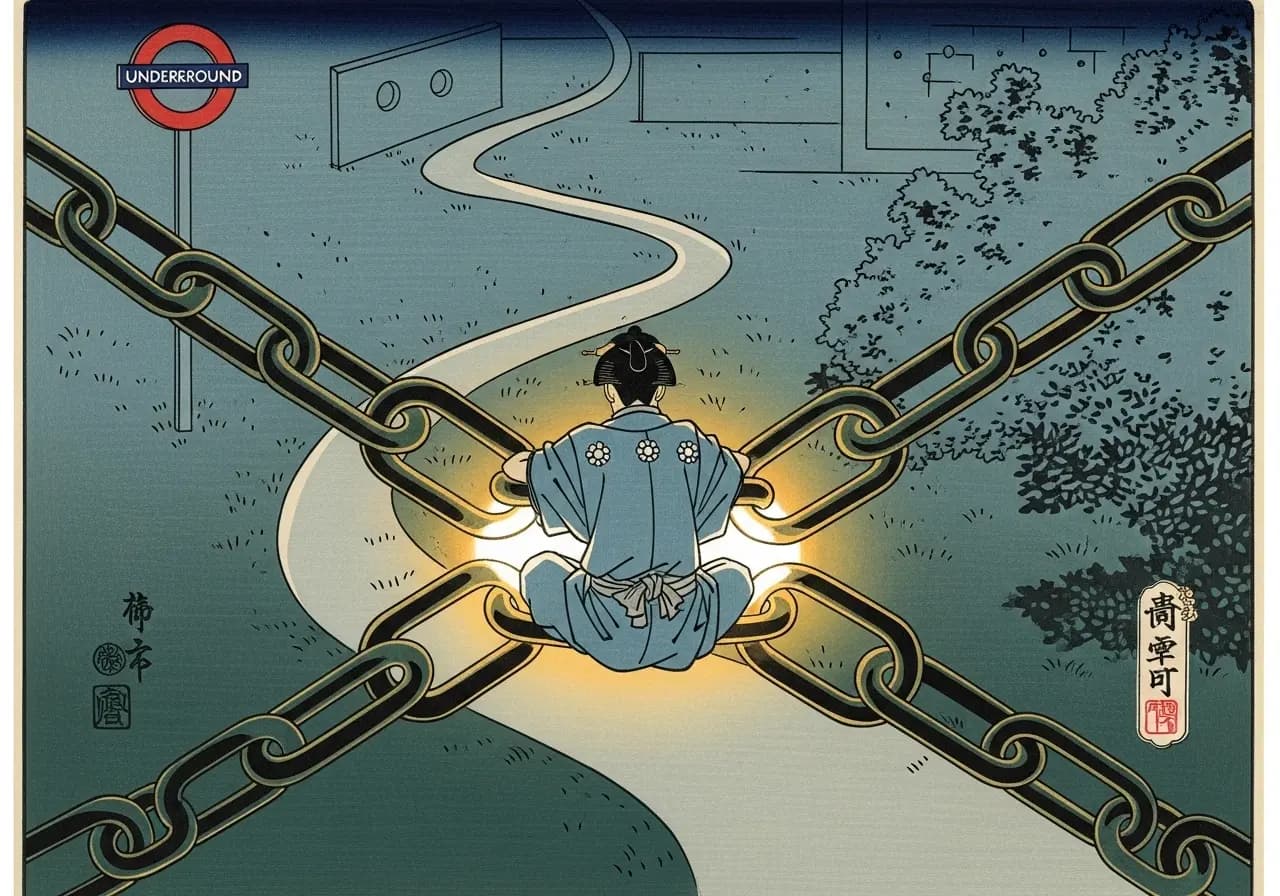
The topic I've prepared for today is called "Breaking the Chain of Reactivity." I think this is a really important topic, so let me start with an image that will help us explore it.
If you've ever been in London and traveled on their Underground subway system, you'll recognize the phrase "Mind the gap." It's on a yellow line down by your feet when you're about to board the train. The message plays over the intercom over and over again, and it's become such an iconic part of the London experience that you can buy shirts, mugs, and street signs with the Underground logo and this message.
It's fun because the expression also serves as a metaphor for something much deeper. The gap between stimulus and response. I have a friend whose family has adopted this as a motto. Instead of "Mind the gap," they say "Gap the mind"—as a reminder to put a gap in their mind between stimulus and response. That conversation actually prompted me to clarify something important in this podcast episode, because there's a common misunderstanding about how this gap actually works.
The Misconception About the Gap
Most people think the gap between stimulus and response exists in an external circumstance—how you feel or react to that circumstance. For example, you might think: "You called me a name, and now I'm feeling angry. I wasn't capable of putting the gap between that stimulus and this response."
That's the misconception I want to address. This is why I'm calling this episode "Breaking the Chain of Reactivity," because I want to bring attention to the fact that it's not just a simple stimulus and response. It's more than that.
The Chain, Not Just the Gap
It's a chain. It's stimulus and response, and that response becomes the stimulus of the next response. And that chain goes on and on and on. At any given moment, everything that's happening now is happening because of what happened before. This is the overall teaching of interdependence.
If you look at this through the lens of interdependence, you start to see that the stimulus itself is actually a response to some prior stimulus. And that goes on and on, because it's a chain. The complexity spreads out to the point where we really have no way to know all the causes and conditions that have led to this moment. We interact with it, and then we perpetuate the causes and conditions from this moment going forward.
I remember a friend posting something funny on Facebook that really captured this. She said, "I'd love to see the gap between stimulus and response when somebody's throwing a ball at your face." It's a humorous image, and it makes a point. There's the stimulus—the ball coming at you. And there's your response. Do you put a gap there and think it through? Do you really have time to analyze how fast that ball is coming? Of course not. You react. You duck. Boom. You've been hit if you didn't react fast enough.
We're Hardwired to React
This visual actually perpetuates a misconception I want to clear up. We are hardwired to react. That's biological reality. If you're walking on a trail and the bushes start rattling, or you hear a rustling sound, you're hardwired to jump and run because we've evolved to prioritize our safety and survival. It doesn't help your survival to sit and think through whether it's a rattlesnake and whether you really need to get away from that spot. That's not how our biology works.
So going back to the chain of reactivity, what I want to highlight is this: It's not just about the stimulus and response. The real question is, "Where am I in the ongoing chain of reactivity? And at this moment, can I put a pause and become more skillful with how I handle whatever comes next?"
Where Is the Real Gap?
Let me give you a visual that helps explain this. I always show a slide in my workshops when I'm talking about this topic—a wall with a hole in it. It's obvious from the picture that this is a hole somebody punched into a wall. This represents the chain of reactivity.
Here's where the actual gap lives: It's between the emotion and the reaction to the emotion. Not necessarily between the event and the emotion.
In the example of the wall, something happened that made that person angry. That's one stimulus and response. But then comes the next one: "Here I am feeling angry, and I can't seem to contain this anger, so I'm going to do something about it. I'm going to punch the wall." That was another stimulus and response. The stimulus was feeling anger. The response was punching something.
Here's the misconception that many people have about mindfulness: They think mindfulness will help you no longer feel angry. That's not true. It's not about not feeling emotions. That's impossible. Emotions are natural. They're normal. Some are pleasant. Some are unpleasant. You're going to feel angry sometimes. You're going to feel sad. You're going to feel frustrated. That's all natural and normal.
It's Not About the Feeling—It's About What You Do With It
What we're looking at here is something different: "What do I do with that emotion now that I'm experiencing it?" That's where I put the gap. That's where mindfulness comes in.
Looking at this as a chain, it may be that the gap happens several links into the chain. "I'm angry. I punched the wall. My hand is bleeding. I'm going to the hospital. I find out how much the doctor costs. Now I start swearing." Maybe that's when you finally put the gap: "Oh, okay. Now what do I do next?"
The very next thing can be a continuation of unskillful reactivity, or it can be the start of a skillful action. That's the choice point.
The Gap Doesn't Have to Be at the Beginning
What I want to emphasize here is that the gap doesn't have to be at the very beginning of the chain. It may be six links into it that you're finally capable of stopping and seeing the reactivity, and saying, "Okay, I'm not going to be reactive anymore. Now I'm going to be more skillful."
With time, this gap might come earlier. But it will never reach the point where you never react. That's not the goal. The goal isn't to never be reactive. The goal is to stop your reactivity once it starts, because the reactivity sets you up for more reactivity. I react. That becomes a new stimulus. And then there's a new response. That's the chain.
The invitation here is: "Can I put a gap anywhere in the chain?" Sure, it may have been 20 links into it. But that's better than spending your whole life in reactivity, never putting a gap in it at all.
Even if it's 20 or 30 links into the chain, once you realize it's all a chain, you might as well stop it there, because it could have kept going. So in that sense, what we're really trying to stop is the reactivity to the reactivity. The continuation. That's what matters.
A Personal Example
Let me give you a personal example to illustrate this. Eight years into a business decision I had made, I paused for a moment and recognized something about what I was doing. I realized I was doing this because of something that had happened years before that made me feel like, "I need to prove myself. I'm going to build this or do that."
Here's the background: I had an issue with my sense of self-worth. I had this view that if I could build up a successful company and prove that I'm a great entrepreneur, then I could restore that sense of self-worth. So there I was, eight years later, with a really successful business, looking at the whole thing and thinking, "Oh, how interesting. I can see it now."
I finally stopped and could see that eight-year chain of reactivity. I was here because of something I felt eight years before that made me feel like, "This is how I prove myself. I build a business." I was caught in that reactivity the whole time.
Now, seeing this didn't make me immediately give it all up. That didn't happen. It took a few more years, and my company eventually dissolved for other reasons. But in that moment of introspection, I was able to see one aspect of my life where I was caught up in a chain of reactivity, and I could pause and ask myself, "Do I really want to keep going like this? Or can I be more skillful with what I do next?"
That gave me a sense of freedom with my career choices. And that insight came from pausing to see something that had started long ago—the beginning of that specific chain of causes and conditions that I was caught in.
You Can Look at This in Many Areas of Life
You can apply this to many aspects of your life. But I do want to emphasize something: The purpose of this isn't to say, "Okay, I'm going to change everything right now, immediately." That might not be skillful either, especially with relationships. It's not like, "Okay, well, fine. You were my friend, but I see that I became your friend out of reactivity, so I don't need your friendship anymore." And then you get rid of the friend. That's not it.
It's about putting the gap—wherever you are in the present moment—and asking, "Could this be more skillful?" That's what you're after.
Skillful Action Versus Unskillful Reactivity
Why do we want to mind the gap? Why do we want to break the chain of reactivity? Here's how I'd frame it: Don't think of this in terms of right and wrong, or where you are versus where you could be that would be better. Think of it in terms of skillful action versus unskillful reactivity.
What I'm trying to accomplish through this exercise is to see in what areas of my life I'm caught up in unskillful reactivity. And can I put a pause there and change that to have more skillful action moving forward?
Just imagine for a moment how much more enjoyable your life could be if you developed the ability to be more skillful in your actions rather than just remaining unskillfully reactive to everything that unfolds. Imagine if, instead of looking back 10 years later and thinking, "Oh man, I've been reactive this whole time," you developed this ability to pause in the moment and ask, "What am I reacting to? What in my life am I doing out of a sense of reactivity? Is it skillful at this point to pause and say, how do I want to move forward next?"
That's really what this is about.
Karma as Action
All of this connects to the concept of karma, which is a teaching I've mentioned before. The word karma simply means action. That's all it means. At any given moment, we're all acting on the karma that has been set in motion by others and by life in general.
The central teaching of karma is that we can pause, and we can break the cycle of reactivity. It's in that mindful pause that we have the freedom to choose a more skillful action. We can contribute something different to that never-ending web of causes and conditions that we're all a part of.
When I start to see that in myself—that life is unfolding in all these complex ways, and yet I am interacting with life as it unfolds, and my very interaction affects everyone else—it becomes real. Some of the obvious ones for me are my kids and my wife, people close to me. There's how I'm handling life and the things that life throws at me that are directly affecting their lives. I'm influencing the causes and conditions that they'll be working with in their lives.
For me, there's a sense of responsibility where I can pause and ask, "Am I doing this in the most skillful way possible?" And I want to be clear: It's not, "Am I doing this right or wrong?" None of us are doing anything right. We're all just trying our best with the very limited knowledge we have about what we're doing.
The Liberation From Reactivity
What I'm really trying to get at is this: Could I be more skillful with the way I'm handling life as it unfolds? Or am I just reacting to everything? Do I want to go through life unskillfully reactive to everything? Or do I want to be more skillful with my actions as life unfolds?
This isn't about results. I think we get caught up in this sometimes—thinking it's all about the results, about what happens. But we often don't know what the results are going to be. We do something and something happens that we didn't expect. We don't know. Remember the story of the horse and who knows what is good and bad? We don't know.
This is about the action itself. Is the action I'm taking skillful, or is this just a form of reactivity? That's the invitation with this discussion. I hope you can listen to this and ask yourself, "What areas of my life am I more reactive in? And what would life look like if I could swap that reactivity for something that's just a little bit more skillful and deliberate with my actions?"
And here's something important: This isn't about getting rid of reactions. The example of walking down a path and hearing rustling in the bushes remains true—you're hardwired to be reactive. Reactivity isn't the problem. The problem is taking that natural tendency to react that we've all evolved with and extending it into everything.
You lose your job. Boom. You react as if the bush is rattling. In one of those scenarios, it's not so skillful to react the way you're reacting. So the real question becomes, "Can I put a pause in the reactivity to the reactivity?" Not in the initial reactivity. The pause happens in the reactivity to the reactivity, somewhere in that chain.
And like I said, it might be five links in. It might be 20 links in. And then you're capable of pausing and saying, "Okay, is this the most skillful way to handle what's happening? Maybe yes. Maybe no. And if it's no, then I'm going to change my course of action."
That is karma in action. At that moment, the action you took is more skillful than the action that would have been taken had you continued down the path of reactivity only. You minimize suffering for yourself and others. That's how it works.
The Misconception to Release
The misconception to release is thinking, "I'll never react." Don't think of it like that. Think of it as, "At what point in my reactivity can I notice that I've been reactive? And now I'm going to be skillful with what comes next in that chain of reactivity."
That's the invitation I have for you.
And if you can start to see that in your life, you'll feel an incredible sense of liberation. What is the liberation from? It's liberation from the reactivity. Nobody wants to be caught up in a reactive way of living. That's not enjoyable. And the moment you can see that, and you understand interdependence, you become liberated from the reactivity. That's what you become liberated from.
Man, it's a great feeling to see that in your own life in different aspects and say, "I'm not going to continue this reactivity. I'm going to try something different."
Final Thoughts
So that's the topic I have for you. I hope you've enjoyed this podcast episode. Feel free to share it, write a review, and give it a rating wherever you listen to podcasts.
As always, if you would like to join our online community to continue conversations around these topics, you can visit secularbuddhism.com/community. On that page, there are links to our Facebook groups.
If you would like to make a donation to support the work I'm doing with the podcast, you can visit secularbuddhism.com and click on the donate button.
That's all I have for now, but I look forward to recording another podcast episode soon. Thank you for listening, and until next time!
For more about the Secular Buddhism podcast and Noah Rasheta's work, visit SecularBuddhism.com