

Beware of the Guru Mind
Episode 70 of the Secular Buddhism Podcast
Hello. You are listening to the Secular Buddhism Podcast, and this is episode number 70. I'm your host, Noah Rasheta, and today I'm talking about the guru mind—that is to say, the mind that seeks a guru.
A Quick Opening Note
Before jumping into this topic, I want to say something: if you're listening to this podcast, it's probably safe for me to assume that you are also interested in the essential concepts of Buddhism and how they relate to your daily life. One of the goals of the podcast is to take Buddhist concepts and teachings and then explain them in a way that's easy to understand and practical for everyday life.
In addition to the podcast, I've also written a book to help with this process: No-Nonsense Buddhism for Beginners. With this book, you'll gain a fundamental understanding of Buddhism and how to apply the philosophies in your everyday life. The book has a simple four-part structure addressing the different aspects of Buddhism: the Buddha, key Buddhist concepts, the Buddhist teachings, and current Buddhist practices. It's written in a straightforward, question-and-answer format that simplifies the vital concepts of Buddhism into easy-to-understand ideas.
I've also included what I call "Everyday Buddhism Sidebars"—little anecdotes that make Buddhism a little less abstract by offering down-to-earth examples from my own everyday life. Presented in a simple conversational style, the information and guidance in No-Nonsense Buddhism for Beginners provides the groundwork necessary for building or continuing your own Buddhist practice. You can learn more about the book by visiting everydaybuddhism.com.
I want to emphasize something that I haven't mentioned in a while—the advice from Tenzin Gyatso, the 14th Dalai Lama: "Do not use what you learned from Buddhism to be a Buddhist. Use it to be a better whatever you already are."
I really want to emphasize this. The world doesn't need more Buddhists. The world just needs more people who are awake and aware of things—people who are striving to have more understanding, people who want to make the world a better place by being more conscious, more kind, more compassionate, more willing to listen and see more deeply, and ultimately to see the impermanent and interdependent nature of all things.
We're all in the same boat here: Planet Earth. Given that today is Earth Day—and I'm recording this on Earth Day—I wish we could see ourselves as just Earthlings and not be so divided by our isms. I'm reminded of a quote by Dr. Mark Epstein, who asked: "What is the difference between a Buddhist and a non-Buddhist?" He goes on to answer: "The non-Buddhist thinks there's a difference."
Unfortunately, I know a lot of practitioners of Buddhism who don't quite understand what this means. In a way, this is implying that even if you see yourself as a Buddhist, you still don't get it—because you see yourself as separate from being a non-Buddhist.
It's just a fun thing to consider today. What are the labels that separate me from others? What are your isms? Now, this isn't to say that we need to get rid of all of our isms. I don't know that that's possible. But the attachment that we have to them—I like to view Buddhism as something that I practice, something that I teach, something that I really enjoy. But it's not something that I am, because I'm just me.
While today I follow this path, five years ago I didn't. Ten years ago I had no clue what any of this stuff was. I would have identified as something else. Whatever the ism is, hold loosely to it. Hold it, but hold it without the death grip.
The Origin of This Topic
So, enough about labels. The topic I've prepared for today is called "Beware of the Guru Mind."
This all started because there was a lot of attention on a show that came out on Netflix called Wild Country. It's the story of the Rajneeshees—a group that came from India following their leader, now known as Osho (at the time, his name was Rajneesh). It's a group of people who followed a lot of tenets of various religions. A lot of people would say they were a cult. At the end of the day, what happened is you had an influx of a specific group into a small community, and it really disrupted the community. The documentary paints the picture from both sides—what was happening to this small community that was being absorbed by this larger group, an influx of people who believe very differently.
I can see this playing out, and I understand how difficult it would be, because I live in a very small community and we deal with the influx of people coming in from the city, building developments and homes. I hear people in town frustrated with that. Their way of life is changing because of this influx. This also resonates with me from my past, being raised Mormon. There's a story with the Mormon community: when Mormonism was growing and spreading, they ran into this same problem. They were like the Rajneeshees—moving into communities and then overtaking them because of their population growth. The community would resent them and want to kick them out. They were always battling this process of infiltrating communities until they finally headed west for the big pioneer trek and established themselves in Utah.
Ironically, now here, where the Mormon Church has a strong population, there's also this same resentment of outside influence coming in. And if the population of outside influence gets too big, then the ideas of the non-Mormons overtake the ideas of the Mormons, and there's this same feeling of, "Oh no, let's not change things." It's just kind of funny, actually.
All of this resonated with me as I was watching this documentary, but it really got me thinking about the concept of a guru in general. I wanted to address this on a couple of different levels.
What Is a Guru?
First of all, what is a guru? It's a Sanskrit term, and it refers to someone who is a teacher, a guide, an expert, or a master of a certain field of knowledge. The word "guru" has all these connotations. Let's just replace it with the word "teacher," and then some of these things might make a little bit more sense.
First question: is it bad to have a teacher? Is it bad to have a guru? When I say the word "guru," some people are probably thinking, "Uh-oh. This is cult-like language. I don't need a guru." But let's replace that with "teacher" for a moment. Is it bad to have a teacher? No, absolutely not.
The Paramotoring Analogy
Let me give you an example. One of my favorite pastimes, one of my hobbies, is paragliding and paramotoring—specifically paramotoring. Paramotoring is paragliding but with a motor on your back and a propeller on your back that pushes you through the air. The difference is: with paragliding, you have to go to the top of a mountain or big hill and start up there, then float your way down (unless you can ride thermals and stay up). With a motor on your back, you don't need to start up high. You can find a field or a parking lot, take off from there, and you're powering yourself. That's one of the main differences between paramotoring and paragliding. I do much more paramotoring than I do paragliding.
When you're learning to paramotor, if you want to go about it safely, you're going to find a teacher—somebody to teach you how to do this. One of the first things they do in the process of learning to paraglide or paramotor is connect you with a line to a winch, a pulley winch system that tows you. They'll set this up maybe 500 feet away from you, or 1,000 feet away—I don't remember exactly how far. But you've got this line tied to your harness, and then there's the parachute-like wing behind you. It's called a wing because it's not quite a parachute. A parachute is intended to control the fall. A wing is intended to actually fly. If the wing has enough speed, it will develop lift, so you can fly with it.
So you've got this wing behind you that looks like a parachute, and then this towline starts to pull you. As it pulls you, you start running, the wing inflates behind you, it comes up over your head, and the faster you go, you start to gain lift. So now you've got this rope pulling you, this wing over your head, and it's lifting you up in the sky. For all intents and purposes, you're essentially a kite. You look like a kite. You're being pulled and you're flying because there's tension on this rope pulling you. That forward motion gives you lift, and there you fly.
At some point, you cut the towline. You have a little pin there on your harness, and you pull that lever or push the button, depending on the setup. The line cuts from you, and now you're just soaring on your way down. So you come down, and that's how you practice, right? You have a big field that tows you up, you get the feeling of what it's like to fly, and then you cut that line, and then you soar down and then you land. You practice this over and over and over.
What you're trying to get used to is the feeling of running and inflating the wing behind you to the point where it's over your head, gaining enough speed, and then taking off.
From Kite to Bird: Applying the Analogy
In this process of learning, applying this to the idea of a guru or a teacher, it was absolutely important for me to have a teacher who understood the dynamics of where I was with my skill level and at what point it was safe to say I no longer needed that towline. Then I could put the motor on my back and power myself.
I want to draw a correlation here because it takes skill on the part of both the teacher and the student. When the student feels ready, the student can say, "I'm not sure I need this towline anymore. Let's go strap the motor on my back." The teacher needs to have the skill to say, "Yeah, I think you're right. I think you're ready to try this," or, "No, let's tow you a couple more times because I've been noticing you're pulling really strong on this line, or you're doing this or that which could be dangerous. You could get yourself into trouble."
At some point in this process, if both parties realize the time has come, then you detach from the towline, you put the motor on your back, and you're liberated. In a very literal way, you're liberated. You're free to go fly and explore on your own. I think that's one of the greatest accomplishments for the teacher at that moment—when the teacher says, "Let's go fly. Let's go explore. Let's go up that mountain. Let's fly around this lake." Some of the most enjoyable aspects of flying for me have been in the companionship of my former instructor as a friend. Now we're co-exploring. We go explore and fly, whatever it is, but there's complete liberation now. There may still be some guidance in those first months and years—like, "Hey, you've gotten really good, but I notice you have this tendency or that tendency." But at some point, you become equals. You're both just pilots, and you fly.
I've thought about this in the spiritual sense, like with Buddhism, for example. That's very much how it should be. The job of the teacher is to know when to cut the towline, liberating the student. I like the analogy of going from kite to bird.
The Kite and the Bird
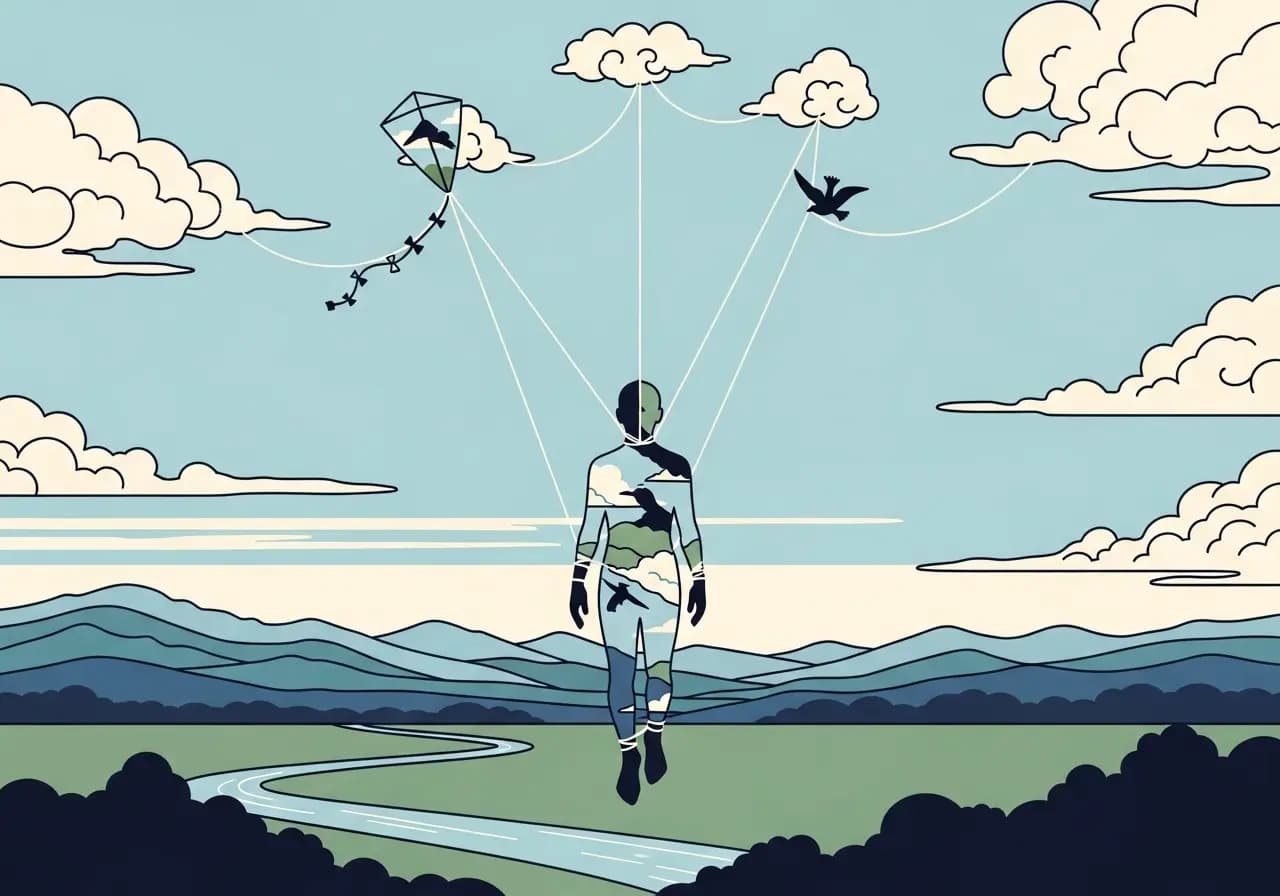
I've heard it said before that the guru can be a person, a system, an ism, your belief system—it can be a lot of things. But when we create a dependency on it—that towline, so to speak—that's not necessarily a bad thing. But just imagine this as a visual. There's nothing more sad than taking a kite that's flying perfectly and then cutting that rope, because the moment you cut that rope, what happens to the poor kite? It flips and flops and comes down and lands and crashes. It's no longer flying. It's detrimental to the kite to not have that line.
It's also detrimental to a bird to have the line. Let's say you have a bird up there soaring. There's nothing more sad than the picture of a bird with a string tied to it that it can't escape from. Some would say—and I've heard it said before—"Your religion, your belief system, it's like this towline, and you are the kite. This is what allows you to fly and gain altitude and to soar there in the wind. But the moment that you detach yourself from your religion, you're going to come crashing down."
Okay, that's a good analogy in some sense, but the false assumption—in my personal opinion—is this takes some skill and knowing. Am I a kite, or am I a bird? Was I a kite that just figured out, "Oh my gosh, I have wings and they flap. Okay, now I'm a bird. Now I don't need that line"? Or the flip side—maybe it's thinking, "I'm a bird," and realizing, "I just keep coming crashing down. Maybe I'm not a bird. I'm more of a kite. I better find the right towline that keeps me in the wind and keeps me soaring."
It's not to say that you need to be one or the other. It's more along the lines of figuring out which one you are. Because if you're a kite, you may want a towline. You may need that rope. If you're not, then you may not need the towline. I encounter this all the time because I think sometimes there's this assumption that the concepts I'm teaching with Buddhism—especially secular Buddhism—are an indication that the right direction is to go from kite to bird. I don't think that's true.
If we're being completely honest, we all know that some people are kites. They need the line. They need the rope that helps them know what to do, what not to do, who to be like, who not to be like. Some people are birds, and the towline becomes a hindrance. Treating everybody like birds is wrong, and treating everybody like kites is also wrong.
I want to clarify that. For me, growing up, I had a towline. A very efficient towline—a belief system that was rigid. It helped me to know: go this way, don't go that way. Do this, don't do that. I think perhaps one of the most important aspects is that it gave me a model to follow. Anyone who was raised Christian knows the expression, "What would Jesus do?" For most intents and purposes, that's a safe bet. That's a good example of what you should and shouldn't do that's going to minimize suffering for yourself and others. But it's not always the case.
The Question We Can't Answer
The truth of the question "What would Jesus do?"—or apply this to Buddhism, or any other system—"What would the Buddha do?" The answer to that question is, "I don't know." That's the true answer. But the answer that most of us get, we're getting from a guru—the guru who says, "Well, I'll tell you what he would do. This is what he would do."
So when I'm answering the question "What would the Buddha do," really I am inserting the answer of what you're telling me the Buddha would do—whoever my guru is, right? Whoever your teacher is, your priest, your prophet, your Zen master. Whoever your guru is, that's the real answer to the question. "What would so-and-so do? What so-and-so tells me so-and-so would do." That's the truth, right? Because the real answer—"What would so-and-so do"—I don't know. I didn't know that person. I don't live in that time.
For me, this becomes a really important thing when it comes to introspection. I want to know: what would I do? What would I do, and why would I do it? Buddhism is an invitation to look inward. It's an invitation to discover for yourself that you are the greatest guru. This is something that I really enjoy about Buddhist concepts and Buddhist teachings.
The Path of Siddhārtha
When you study the life of the Buddha—and I've alluded to this before in the podcast, but I think it makes a lot of sense to bring this up in this specific episode and context—the journey of Siddhārtha Gautama, the seeker, he was seeking wisdom and advice. He was like the kite with the string. He went from one guru, one teacher, to another, and then to another. But what was happening in this process is that he was realizing, "This can only get me so far. Having this line can only get me so high. It can only get me to this certain place." That wasn't enough. He wanted to understand things differently. He wanted to see the world differently.
I imagine, going back to my analogy as a student learning to paraglide, that the truth is the towrope phase of learning is a lot of fun. It's like, "Wow, I'm getting towed up in the air, and I can look around. Then I come down, and I do it again and again and again." At some point up there, you may look around and say, "Hey, this is all great, but I want to see what's over that next hill. I want to see what's up higher. I want to follow that river."
In the moment I decide "That's me—that's my curiosity"—the curious me that wants to see more, now this very line becomes my hindrance. It's like, "Oh, now this is the thing that's in the way."
I think that's what was happening for Siddhārtha. He would learn what he could, and then that was it. He needed to find more. His spiritual path takes him on this journey to the point where he finally cuts that line. In my opinion, this understanding of his moment of liberation is key. He was like the paraglider pilot who said, "Okay, let's cut the line, turn on the engine, and here I go. I've actually got my own propeller now, and it's going to propel me from here." That was really the key to his transformation—his liberation. That's why we call it liberation.
The Moment of Liberation
From that moment on, he realizes several key things. First: "Oh my gosh. I am the source of all of it. The good deeds that make me want to be kind and compassionate—that's me. That's my own mind. The thoughts that make me feel anger or hatred or wanting to hurt someone—well, that's also me. It's not some external agent acting upon me. It's internal processes that are steering me to do and feel certain things."
Just imagine feeling anger and then realizing, "Oh my gosh. This anger is fueled by fear." That's a radical realization you can have about yourself. "What am I feeling? What do I say? What do I think? What do I do? And where, and why?" That leads back to further insight: "Oh, this is why I think what I think. This is why I say what I say."
I imagine that's what that moment was like for him. The moment of liberation was this radical realization that he was the source of it all. This is what Buddhist teachings have been for me in my own life—this radical transformation of realizing, "Oh my gosh, I am at the helm here. It's my own mind."
Often, the detrimental things that I would say or do stem from my own mind. The more I've learned to understand myself, the more I've learned to minimize that self-inflicted suffering and the suffering that often carries over to other people. This has been a profound change for me in my own relationship with my wife and my dynamic as a parent with my kids. That's what this has all been for me.
The Invitation to Look Inward
The invitation of this episode is to look at what are the towlines? What are the lines that I'm attached to? Again, not from the perspective of "I need to get rid of all my towlines." That's not what it is. Buddhism itself is a towline.
If you recall the parable of the raft—I think this is, to me, one of the most profound teachings that the Buddha gave. He invited his monks, towards the end of his life, to understand that Buddhism itself is the raft. If you're on one side of the shore and you're trying to get to the other side, he asks them, "If there's no other way to do it, and you spend all that time and energy to build a raft, once you get to the other side, what is the wise thing to do? Keep the raft, or leave it behind?"
I think anybody would answer the same. "Well, common sense tells me I should leave it behind. If I need another one, I'll build another one. For now, I'm headed up that mountain. This is a big, heavy raft. I don't need it."
Shockingly, that's what he tells them. Essentially, these teachings—the dharma—that's the raft. You can make the raft your obstacle. I think this carries over in our day. It's like saying, "Hey, Buddhism teaches all these incredible things, but be careful, because Buddhism can also be the obstacle. It can be the very raft, the thing you attached to, and now that's the thing that you carry around."
When I'm thinking of these towlines, when I'm asking what are the towlines that I have, again, it's not from the perspective of "I need to cut everything off everywhere! Drop all my isms! Leave my religion!" Don't be drastic. Look at everything. Look at your life from the perspective of: is this a skillful line? Yes? Then stay on it. Is it skillful to cut it? Maybe, or yes? Okay, well then cut it. The answer may be no. Nobody can answer that for you. That's the thing here.
At the end of the day, the guru can give you advice, but that line that's up on your harness when you're paramotoring? It's you that hits the button and detaches from the line. It can be done down at the bottom, but then the line dangles, right? That's for safety purposes. What I'm trying to get at is working with a teacher can be very powerful, but if that teacher sets you up in a position where you become dependent on him or her, then now it's detrimental.
Maybe it won't be, but at some point it will be, because the nature of this path—of Buddhism—is a path of liberation. If you find a teacher on this path, a guru (I like the word "teacher" better, but just somebody who guides you), and their intent is saying, "Now you need to depend on me, because I am the source of interpreting all this stuff for you," then beware.
Beware of the Seeking Mind
When I say beware, I truly want to make this pointed towards yourself. It's not beware of that teacher. It's beware of yourself thinking, "Do I really need this? Do I need a teacher?"
The invitation here to beware of the guru mind is an invitation to look inwards. Who is the one looking for the guru? I'm less concerned about the guru than I am about the me that thinks I need the guru. Who's that? Who's the one looking for the guru?
Buddhism always tries to point things back towards you. At some point in Siddhārtha's quest, he was confronted with this very question: "Who's the one looking for the guru?" He found that one. When he found the one looking for the guru, he didn't need the guru. He became his own guru, his own teacher.
I cannot stress this enough. This is one of the potential consequences of studying this stuff: you'll discover that you are your greatest enemy and your own best friend. It's you. That's the moment of liberation.
Not About Right or Wrong
That was the topic I wanted to share today: "Beware of the Guru Mind"—the mind that seeks the guru. Again, I'm not alluding to gurus being bad, teachers being bad, or isms being all bad. I'm not saying that whatever your religious system is, it's bad. I'm not saying that at all. I'm saying there's a careful balance between that realization of "I am a kite, and I need this line" and "I am a bird, and this line is hindering me."
Extending this same wisdom to your family and friends, I see this all the time in the world where I live, in the community where I live. People will leave a religion and then say, "You need to leave it, too." Or people who are in the religion will talk to someone who's left their religion and say, "You need to be in it." What you've got is kites talking to birds, and birds talking to kites. It's not helping. That's not going to do anything.
This is not about deciding what's best for you. It's about me as the student saying, "What I'm learning here, I still need this towrope. Maybe I always will. I don't care to see what's on the other side of that hill. I don't want to follow this river. I just want to be towed here and soar in the air. I love this towline." That's a legitimate place to be.
But it's also legitimate for the one with the personality to explore who says, "Well, this towrope—I don't like it. I want to be cut loose, and I want to fly a little bit and see what's over there." You may fly over there and decide, "You know what, I don't like this exploring stuff. This is kind of scary. I'm going to come back, and let's just attach to that towline, and I'll stay here and soar like a kite." That could happen.
There's not a right or a wrong way to be. There's a skillful and a non-skillful way to be. The only way to know which way is skillful for you is to have a greater understanding of yourself. Again, this is the quest. Who is the one seeking the guru? That's who you should be seeking—the one that's doing the seeking—because that points everything back to you.
Closing Thoughts
That's the topic I had prepared for today. Hopefully, some of that makes sense. I know sometimes these concepts get a little hard to understand because people will listen and say, "Well, I just want to know: do I do this, or do I do that? Do I follow someone? Do I not follow someone? Should I believe? Should I not believe? Should I have a teacher? Should I not have a teacher?"
There's not an answer to any of those questions. Again, point it inwards. Who's the one who's looking? Seek the one who's seeking. There you will find all the insight you're looking for. When you seek the one that's seeking, you look inward.
That's my invitation for today, following on my invitation from Earth Day. Try to see yourself for a little bit as just an Earthling. You and every other creature on this planet—we share that in common. This is our home. This is our pale blue dot, as Carl Sagan would say. This is our home.
What can we do to be more skillful in how we deal with each other with our ideologies, our beliefs, our opinions, our political views? Whatever it is, at the end of the day, we're just Earthlings, and we're all here. We're all trying to figure it out. We're all just trying to make this work.
How can I be more skillful in that process from my little corner of the world? That's my invitation to you.
If you enjoyed this podcast episode, please feel free to share it with others. You can always write a review or give it a rating in iTunes. If you'd like to join our online community, you can visit secularbuddhism.com/community. If you'd like to make a donation to support the work I'm doing with the podcast, please visit secularbuddhism.com and click on the donate button.
That is all I have for now, but I look forward to recording another podcast episode soon. Thank you, and until next time.
For more about the Secular Buddhism podcast and Noah Rasheta's work, visit SecularBuddhism.com