

Secular Buddhism Podcast: Episode 7
Acceptance vs. Resignation
Hello. You are listening to the Secular Buddhism podcast. This is episode number seven. I'm your host, Noah Rasheta, and today I'm talking about acceptance versus resignation.
Hey guys, welcome to the Secular Buddhism podcast. This podcast is produced every week and covers philosophical topics within Buddhism and secular humanism. Episodes one through five serve as a basic introduction to secular Buddhism and to general Buddhist concepts, so if you're new to the podcast, I recommend listening to the first five episodes in order. All episodes after that, including this one, are meant to be individual topics that you can listen to in any order.
Before we start, I want to share something the Dalai Lama once said: "Do not try to use what you learn from Buddhism to be a Buddhist; use it to be a better whatever you already are." Please keep this in mind as you listen and learn about the topics and concepts discussed in this episode.
If you enjoy this podcast, please feel free to share, write a review, or give it a rating. Now, let's jump into this week's topic.
What is Acceptance?
I think there's a common misconception around the idea of acceptance, and it has to do with the semantics of the word itself. It's common to associate the word "acceptance" with the word "resignation," so I want to spend some time discussing what acceptance is and clarifying what it's not. Buddhism does not encourage resignation. It encourages acceptance.
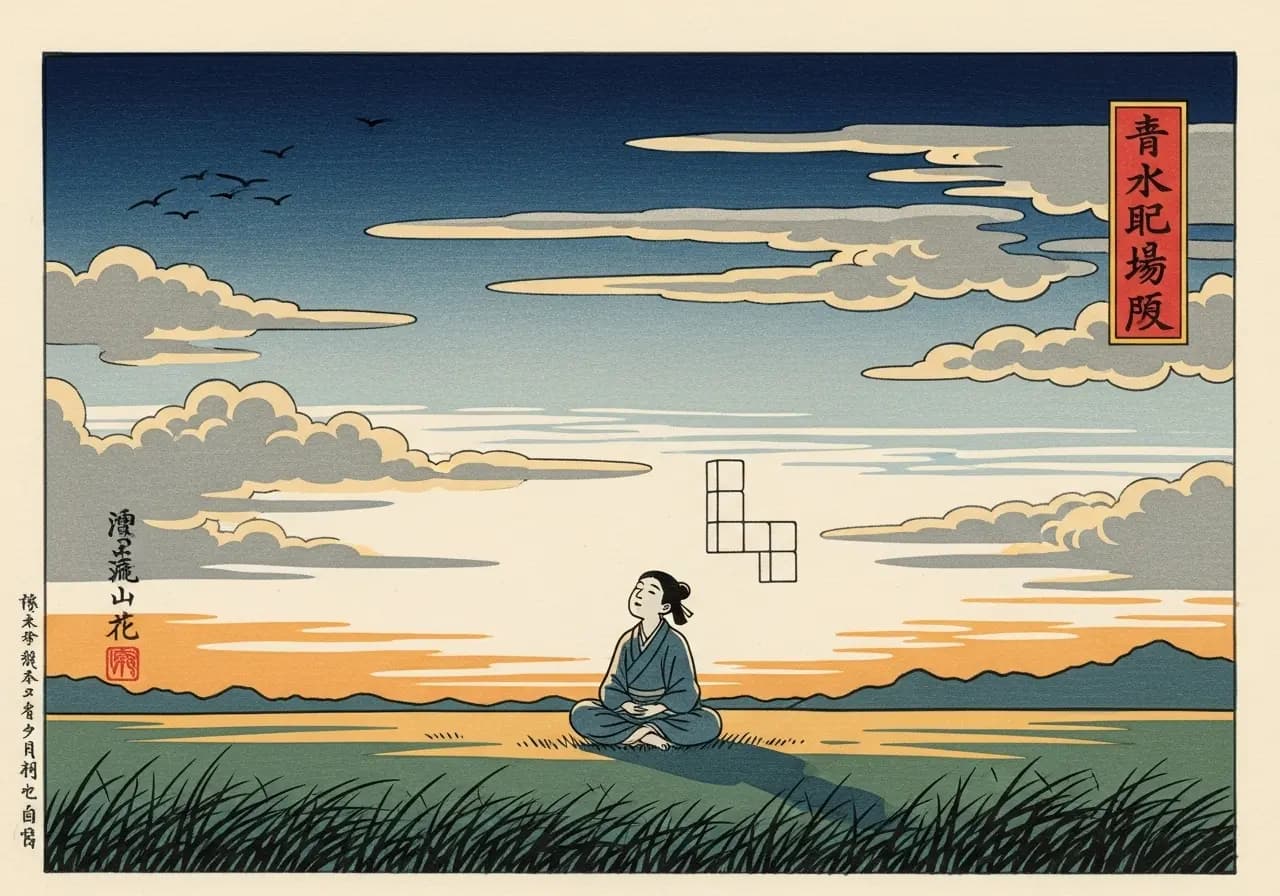
Acceptance is kind of like sitting in a field, looking up at the sky, and watching the clouds go by. There's no resistance to the moment-to-moment experience; there's only observation and acceptance. It'd be silly to watch the clouds and be upset that they're not forming into the specific shapes that we want, and yet that's exactly what we tend to do in life.
I like to compare the experience of being alive to the experience of playing a game of Tetris—I've mentioned this before in other episodes. If you've played Tetris, you know that the whole point of the game is to wait and see what shape will appear next. Then you have to work with it to position it in the best way possible in order to continue playing the game. Isn't that the very game of life?
Now, imagine for a minute that you're watching someone play Tetris, and every time a new shape appears, they go into a tantrum. They yell and scream at the game, saying, "This is not the shape I was expecting!" or "This is not the shape I wanted!" How silly would that be? But isn't that exactly how we tend to play the game of life?
Acceptance vs. Reactivity
Acceptance is like playing the game of Tetris without resisting the shapes as they appear. Life is the same. Acceptance is being open to the actual feelings that we're having and the moment-to-moment experience of life, and being willing to just feel that—whatever it is. Anger, happiness, fear, jealousy, anxiety, joy. We can learn to simply be with our experience, or we can try to control the experience. But when we try to control it, that's the opposite of acceptance.
Any time we're trying to manipulate our inner experience, we're doing the opposite of accepting it. Think about the image of the person playing Tetris and yelling at the game, and you'll see how reactivity restricts our ability to accept. You see, reactivity prevents us from being able to respond. Acceptance is a form of responding instead of reacting. Resignation would be an example of reacting, while acceptance would be an example of how we choose to respond.
So how can we learn to break the cycle of habitual reactivity that we experience in this game of life? How do we stop yelling at the game, so to speak? How do we stop our desire to throw the game console and break it any time a new shape comes up because it's not the shape we wanted or it's not the shape we expected? We do this by developing the courage to accept the present moment.
You see, this is the very essence of Buddhism—it's to obtain freedom. Freedom from reactivity. Our ability to accept whatever shape is going to pop up in the game becomes the key to our freedom to just enjoy the game for what it is. It's the same with life. Our ability to learn to accept whatever life throws at us is the key to freedom. Acceptance is the key to freedom. It's so simple, and yet so profound, and yet so difficult.
Acceptance in Meditation
When we sit in meditation, we learn to observe our thoughts, very much like observing the clouds in the sky. It's not that we're trying to control the experience. We're just accepting and observing. Acceptance is what we become present to in that moment-to-moment experience of observation. It's what happens before you choose to act. Acceptance is what allows you to respond wisely versus just reacting.
You see, we tend to associate the word "acceptance" with action or with behavior, but acceptance doesn't have anything to do with behavior. Acceptance is not resignation. It's not denial or defeat or ignoring. It's what has to happen before there can be any action, before there can be any behavior.
Acceptance in Action: The Twelve-Step Program
Consider the example of an addict. In the twelve-step program proposed by Alcoholics Anonymous, the very first step is admitting that one cannot control one's addiction. That is acceptance. That's not resignation. It can't be resignation because there's no action yet, and resignation would be an action. Acceptance is what frees us to choose. It's the key to being able to respond to any given situation and no longer be trapped by reactivity.
Try to recall a specific experience in your own life where you ended up resigning or giving up. We've all felt that at some point. How does it feel when we resign or we give up? Now try to recall an experience where you accepted a situation and then responded by selecting a specific action. How does that feel? Can you sense the difference?
I want to be completely clear about this concept of acceptance and, again, clarify that the Buddhist understanding of acceptance does not encourage or condone in any way resignation or disengagement.
A Critical Distinction: Acceptance is Not Passivity
If you're in an abusive relationship, acceptance is not, in any way, an attitude of saying, "Well, oh well. I'm not going to do anything about this," or "It is what it is." Acceptance is simply recognizing: this is the situation I'm in. Now, what am I going to do with it?
It's seeing the new Tetris piece, the new Tetris shape that shows up, and immediately recognizing, "Okay, this is the shape I have. Now, what do I do with it?" If you don't want to go through life in a state of constant reactivity, yelling at the game, "I don't want this shape," then you need to learn to accept what it is. Then you have the freedom to respond. Acceptance is the key to having the freedom to respond.
Acceptance is Love
I think a wonderful example of acceptance comes from how we view our own kids. Those of you who are parents will hopefully understand and appreciate this. When you have a child, you accept them without any conditions, right? I have a sweet little girl who's four months old now. She's my third child. When I was at the hospital holding her for the first time, I couldn't help but notice what I considered to be complete and unconditional acceptance. As I was holding her in my arms, there were no conditions whatsoever that could disqualify her from my unconditional love.
In this sense, acceptance is really nothing other than love. For my daughter, it won't matter if she turns out to be a lawyer or a doctor or whatever career she chooses. It won't matter if she's a Republican or a Democrat, or if she prefers ketchup with her scrambled eggs instead of hot sauce like I do. None of those things matter because unconditional love requires unconditional acceptance.
This idea makes sense with our kids, but why is it so hard for us to extend that to how we are with other people? I think even with our spouses, our understanding of what acceptance is becomes distorted because we think we're accepting others when, in reality, what we're dealing with is simply accepting what comes up in ourselves in relation to that other person. We don't know how to accept what comes up in ourselves because we've never practiced acceptance on ourselves.
Practicing Acceptance on Ourselves
When we're experiencing something, whatever it is, and we think to ourselves, "It's okay. This is what it is," but we don't really mean it, that's resignation. That's not acceptance. When we practice meditation, we start to experience our resistance to everything that's happening inside of us. By just staying with that experience from moment to moment, regardless of how difficult that experience may be, we start to develop the capacity to pause and respond with something other than our typical conditioned reactivity.
I hope this explanation of acceptance has been helpful as a clarification of the difference between acceptance versus resignation. I sincerely hope you'll never feel compelled to simply resign or surrender when life presents you with new circumstances, when that Tetris game throws out a new shape that you weren't expecting. I hope you'll learn that acceptance is the key to freedom. They're not the same thing at all—acceptance and resignation. They're very different.
If you have any thoughts or questions or you want to add to this conversation, please visit secularbuddhism.com and look for the post called "Acceptance vs. Resignation."
I'll end this discussion with a quote from Henry Wadsworth Longfellow: "For after all, the best thing one can do when it's raining is to let it rain."
Thank you guys, and until next time.