

Questions About Buddhism
Episode 68 of the Secular Buddhism Podcast
Hello. Welcome to another episode of the Secular Buddhism podcast. This is episode number 68. I'm your host, Noah Rasheta, and today I'm talking about questions about Buddhism.
How This Project Started
When I started this podcast a few years ago, I began receiving several emails with questions people had about specific topics or to clarify certain teachings. I've been answering these questions for quite some time, usually by email. Then as the podcast grew, I was eventually approached by a publisher who offered me the opportunity to write a book about Buddhism. It just recently came out and is available for pre-order now on Amazon.
The book is called No Nonsense Buddhism for Beginners: Clear Answers to Burning Questions About Core Buddhist Teachings.
I'm really excited to have this book out because it's formatted in a question-and-answer format and broken into four specific parts. Part one addresses questions about the Buddha. Part two covers questions around core concepts. Part three has questions and answers around core teachings, and part four focuses on questions around core Buddhist practices.
This book is intended for anyone who is new to Buddhism, but it's also meant to help practitioners who are looking for a resource to answer questions from friends and loved ones. You may have noticed that as you start to apply these concepts in your life, it's common for people to ask, "Oh, you're interested in Buddhism? Well, what does Buddhism say about this or about that?" If you're like me, you've probably noticed that this is a common question from friends and family. So this book serves as a good platform to address some of these questions and answer them in a way that people who aren't familiar with Buddhism or any concepts around Buddhism would be able to understand.
Part One: Questions About the Buddha
In part one, I address 16 different questions around the topic of the Buddha. Who was he? What language did he speak? Did he have a family? What happened to him? How did he die? All of these questions center around the historical figure of the Buddha.
Let me give you one example. One question is: "Who was the Buddha? Was he a real person or is he a myth?"
This is how I answered it in the book:
Buddha is a title that was given to a man named Siddhartha Gautama. Siddhartha lived around 500 BCE in Northern India in what is now Nepal. Generally, when people refer to the Buddha, they are referring to Siddhartha, the man whose teachings became the foundation of what we now call Buddhism. There's little scholarly debate around Siddhartha's existence. However, there is some debate around specific events in his life. As is common with many ancient traditions, the historical Buddhist teachings have evolved into teachings about the teachings.
This opens up more room for individual teachers' interpretations, but it brings into question the historical accuracy of modern-day retellings. However, we can still tell a lot about the Buddha through his teachings that have been passed down. We know that they center on two main themes: the problem of human suffering and the methods that can bring about the cessation of suffering. The Buddha taught a method of living that tended to be practiced rather than a set of ideas he asked his followers to believe. His teachings, known collectively as the Dharma, invite us to look inward and study our own minds in order to gain a clearer understanding of ourselves and the nature of reality.
There are 15 other questions in that section that all center around the topic of the Buddha. I think all 16 of those questions in part one are probably going to be new to most podcast listeners, unless you've been digging into studying Buddhism on your own from other sources.
Part Two: Core Concepts
In part two, where I start to address core concepts, I spend a lot of time discussing concepts. I haven't spent hardly any time on the podcast talking about the historical figure known as the Buddha, so the first part might be mostly new to you. But part two, which covers core concepts, you may recognize some of these topics from the podcast.
Here I address 19 questions and answers around core concepts. Let me share two of them with you, because these may be somewhat new.
What Does Buddhism Teach About Good and Evil?
One of the questions is: "What does Buddhism teach about good and evil?"
Here's how I answered that question:
From the Buddhist perspective, good and evil are not inherent forces out in the universe. Instead, they're internal states of mind. Buddhism teaches us to look inward. There we can find the source of all the good things we say, think, and do. Likewise, we discover that we ourselves, our own minds, are the source of any evil. This understanding gives us a greater sense of responsibility over our own thoughts, words, and actions.
Rather than thinking of evil as an external agent acting upon us, Buddhism teaches that greed, hatred, and ignorance are the sources of what we typically think of as evil. In Buddhism, these three qualities are called the three poisons or the three fires. The challenge the three poisons pose in our lives is that they drive us to look outside of ourselves to try to achieve happiness or to avoid suffering. Because external things like money, fame, or power can't bring us lasting joy or contentment, we're setting ourselves up to experience unnecessary suffering by chasing after them.
Material things can be nice to have for a time, but the happiness and fulfillment we seek is not found in external sources.
Do Buddhists Believe in Reincarnation?
Another big question that people want to know is: "Do Buddhists believe in reincarnation?"
This is how I answered that question:
Buddhists believe in rebirth, which is not quite the same thing as what you probably have in mind when you think about reincarnation. The traditional concept of reincarnation is that you—some kind of soul or spirit—go on to inhabit a new physical form, whether it be a person, animal, or plant. Though some Buddhist schools think of rebirth as something closer to this idea of reincarnation, it doesn't fit with other Buddhists' understanding of impermanence and non-self.
We're changing form every day, experiencing rebirth even from one moment to the next. The you that's listening to this is literally not the same you who will be listening at the end of the podcast as the you that was listening at the beginning. If there is no permanent you, which part of you could transcend death to become reincarnated?
When we observe nature, we see constant rebirth. After all, the law of conservation of energy in physics states that energy can't be created or destroyed. It can just be transformed from one form into another. A cloud changes form and becomes rain. The rain becomes part of a river, flows into the ocean, and then gets heated up and evaporates into the air where it may become a cloud and start the process all over again. What was for a time a cloud is transformed into something new, and we don't say the cloud dies when it changes form into raindrops. Are we really any different from the cloud?
When we die, our bodies change form as they decompose and become part of nature, but they never cease to exist. Buddhists believe that humans, like everything else in nature, are part of a continual cycle of change.
Part Three: Core Teachings
In part three of the book, I talk about core teachings. I have 17 questions and answers that I address in this section. Let me share one of them.
The question I received was: "It seems like 'I' am the source of a lot of important things—awareness, suffering, good and evil. What else can Buddhism teach me about the nature of myself? What makes me me?"
This is how I answered that question:
According to Buddhist teachings, our "self" is a perspective. It is a product of our perception. Our sense of self is an event that occurs rather than a thing that exists. Imagine pausing a movie to see a single still image. Every film is made up of those individual frames, but when we watch movies, we perceive them as one continuous moving image telling a connected story. Ourselves are like the film strip—a collection of unique still frames that are generated in each moment-to-moment experience of being alive.
If you could pause time and see the individual frame in this specific moment, you would see that it's slightly different from the ones just before and after it. In other words, the you of right now is not the same you of the previous moment.
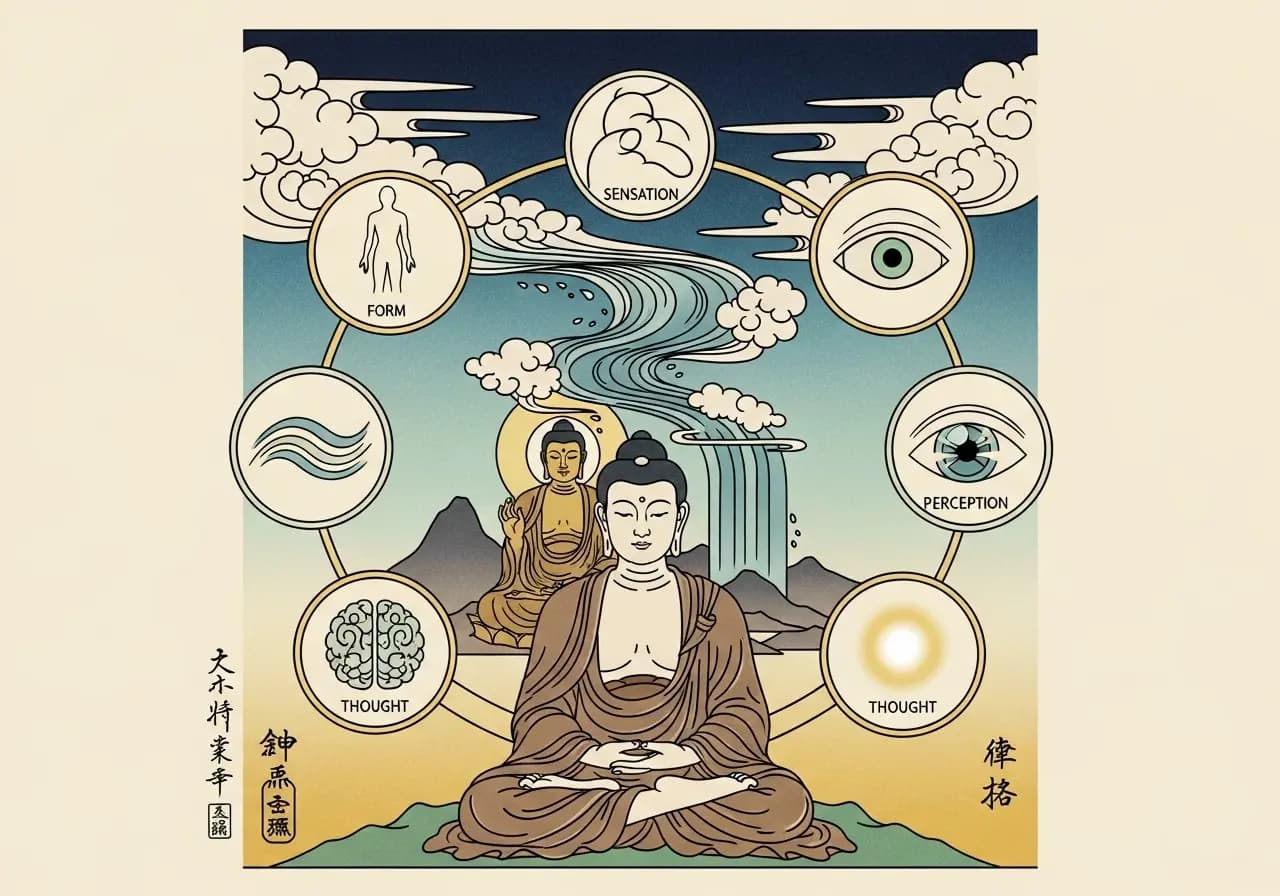
The Buddha taught that we are made up of five components that come together to create the perception of a distinct individual "I" or "me." These five components are called the five skandhas, a Sanskrit word meaning aggregates or heaps. The five aggregates are form, sensation, perception, mental formations or thoughts, and consciousness.
On this subject, the Buddha further taught that we sense reality in our world through six sense organs. The eyes sense visible form, the ears sense sound, the nose senses odor, the tongue senses taste, the body senses tangible things, and the mind senses thoughts or ideas. You'll notice that the first five senses are the ones we're all taught in school, but Buddhism also considers the mind to be a sense organ since our minds sense thoughts and ideas.
I go on to answer follow-up questions about each of the five aggregates specifically, so in the book you would certainly get a lot more information on the five skandhas than what I just shared here.
Part Four: Core Practices
In part four, the final part of the book, I talk about core practices. Practices are not really addressed much in the podcast. The podcast almost exclusively addresses Buddhist concepts. Part one, part three teachings—you get a mix of that in the podcast. Part four, practices—those are going to be all unique topics that I've never really gone into on the podcast.
One of the questions that I address in part four is: "Everybody talks about meditating and the Buddha found enlightenment through meditation, so it seems like an important practice. But how do you do it? Is there a correct Buddhist way?"
This is how I answered that question:
There are countless meditation techniques and methods taught among the various schools of Buddhism. Some schools of Buddhism don't practice meditation at all. One of the most common techniques is mindfulness meditation. The goal of this technique is to learn to become an observer of the world and our own experiences.
We spend so much of our time in thinking mode, ascribing meaning to our thoughts and emotions. We chase after thoughts with other thoughts or try to control our thoughts, which only aggravates the overall problem of being habitually reactive. Mindfulness meditation helps us break out of the cycle of reactivity.
The technique can be as simple as observing your breath. Notice what it feels like to breathe. Can you feel the slight temperature fluctuations at the tip of your nose between the in-breath and the out-breath? Do you notice the subtle rise and fall in your chest, shoulders, or abdomen with each breath? When we observe, we pause our reactive thinking and stop making meaning.
For example, when we're sitting outside watching the clouds float by, we don't have the tendency to ascribe value to the shapes that we see. We don't think, "Oh, this is a good cloud or that's a bad cloud. This cloud isn't puffy enough or that cloud is too tall." In these moments of observation, we just see the cloud for what it is. When we turn this process inward, we can start to experience the same unbiased, nonjudgmental attitude toward our own thoughts and feelings. Suddenly, we're not judging our anger as good or bad. We just notice that we're experiencing an emotion and allow it to remain without resisting it or trying to fight it off. Before we know it, the emotion will dissipate or be replaced by another, just like the clouds in the sky.
Under core practices, I address several Buddhist practices from chanting to meditation—12 different questions and answers in that section.
The Complete Picture
The book overall has 64 total questions. These are questions that I've collected over the years of having the podcast and teaching workshops. I'm really excited to present this book as an introduction to Buddhism. It's like the title suggests, Buddhism for Beginners, but really it's for anyone who's interested in understanding what the core Buddhist concepts, teachings, and practices are, and of course, who was the Buddha and all the questions centered around the historical figure that we know as the Buddha.
It's a book that I think would be really helpful for any practitioner who's wanting to have a deeper understanding of these concepts. That's where I was at the beginning of all this—at the start of my journey with Buddhism. What I found was that Buddhist practices were really helpful, specifically meditation. It was really working for me. It was helping me to find peace in my life, and I wanted to understand where does this come from? Who came up with this? Why does this work? That journey of trying to understand meditation as a practice led me to study and understand Buddhism with greater depth and clarity.
My attempt with this book is to take, in a question-and-answer format, all of that information and make it easy and accessible for you as the reader, or for anyone who may approach you with questions about Buddhism.
An Exciting Next Step
One of the things I do plan on eventually doing with this book is something I'm really excited to announce today. I've traveled around and done one-day workshops where we introduce mindfulness or Buddhism. There are limitations with doing that because if I'm going to travel somewhere, there are expenses associated with that. I have to get there, so I have to charge to do these workshops.
Well, I'm really excited to announce that my next project, now that this book is complete, is to launch an online workshop that will be available for free for anyone who is interested in learning about this stuff. This book will serve as a companion to that workshop. That's something that's on the horizon, and I'll announce more about it as it gets closer and as I have dates lined up.
For now, the main thing I wanted to do was introduce you to this book, give you examples of some of the questions and answers that are addressed in it, and let you know that there are 64 total questions there that if you're interested in learning, you can explore.
You can visit secularbuddhism.com, where you'll see the link there for the book, or you can visit everydaybuddhism.com. That's a URL that links directly to the book and makes it easy to remember. So secularbuddhism.com—you'll find it there. Everydaybuddhism.com—you will also find it there.
If you enjoyed this podcast episode, please share it with others, write a review, and give it a rating on iTunes. If you would like to join our online community, you can visit secularbuddhism.com/community.
That's all I have for now. I look forward to recording another podcast episode very soon. Thank you, and until next time.