

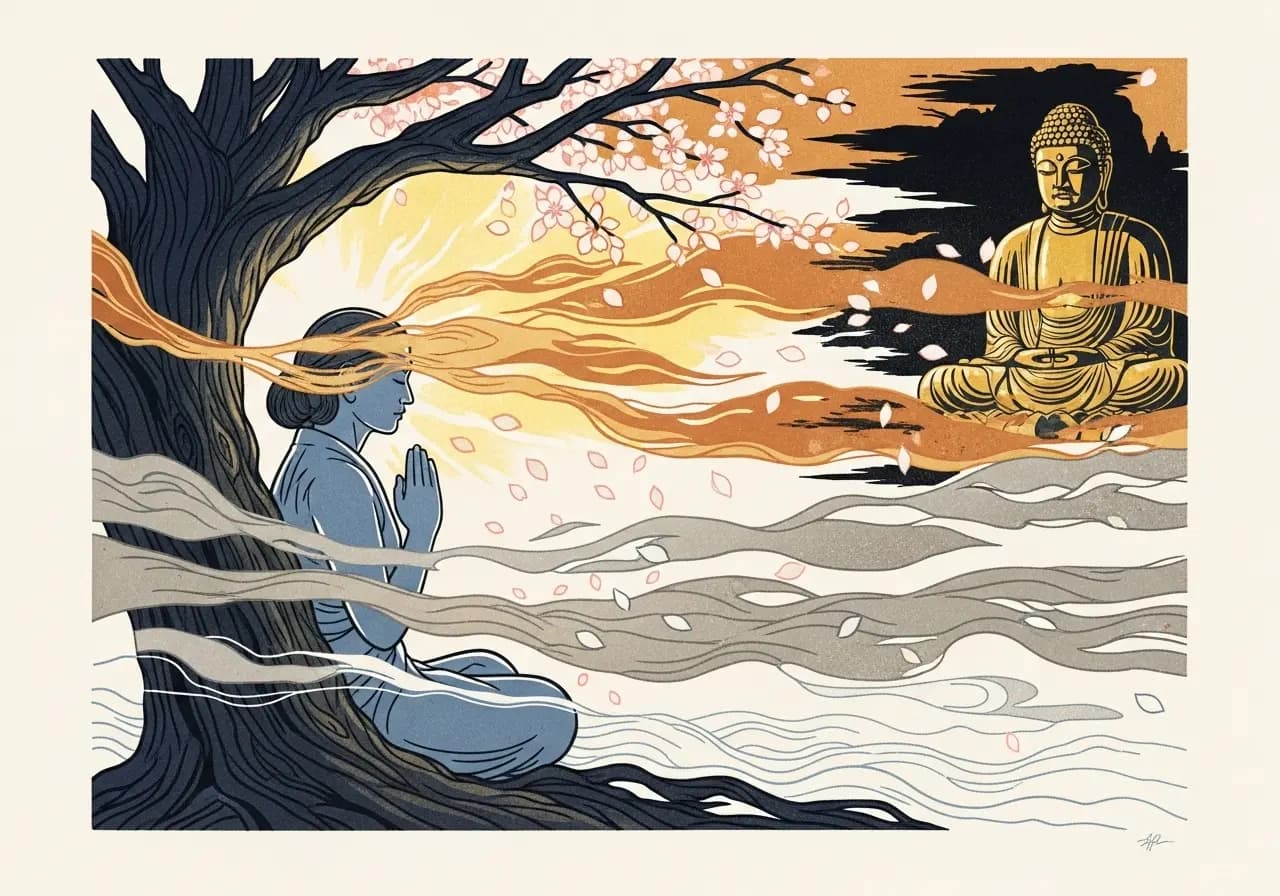
We Don't Need to Change Ourselves
Episode 64 of the Secular Buddhism Podcast
Hello. You are listening to the Secular Buddhism podcast, and this is episode number 64. I'm your host, Noah Rasheta. Today we're talking about a concept that might sound counterintuitive: we don't need to change ourselves.
Welcome
Hey, welcome to the Secular Buddhism podcast. If this is your first time listening, thank you for joining. SecularBuddhism.com is my website and blog, and this podcast goes along with it. The Secular Buddhism podcast covers philosophical topics within Buddhism and secular humanism, and it's produced every week.
The Teaching from Pema Chödrön
Recently, I've been sharing snippets of teachings from Pema Chödrön, a Tibetan Buddhist nun and American teacher who brings Buddhist teachings from the Tibetan tradition to Western audiences. There's a book called The Pocket Pema Chödrön by Shambhala Pocket Classics—a small book that contains short teachings. I've been sharing some of these teachings on the Secular Buddhism Podcast community Facebook group, and I wanted to discuss one of the conversations that emerged from those teachings.
The teaching I shared from Pema is this: "When people start to meditate or to work with any kind of spiritual discipline, they often think that somehow they're going to improve, which is a sort of subtle aggression against who they really are. It's like saying, 'If I jog, I'll be a much better person. If I could only get a nicer house, I'd be a better person. If I could meditate and calm down, I'd be a better person.' Or the scenario may be that they find fault with others. They might say, 'If it weren't for my husband, I'd have a perfect marriage. If it weren't for my boss and I not getting along, my job would be great. If it weren't for my mind, my meditation would be excellent.'"
Pema goes on to explain that loving-kindness, or maitri as it's called in the Tibetan tradition, toward ourselves doesn't mean getting rid of anything. Maitri means that we can still be crazy after all these years. We can still be angry after all these years. We can still be timid, jealous, or full of feelings of unworthiness. The point isn't to try to change ourselves. Meditation practice isn't about trying to throw ourselves away and become something better. It's about befriending who we already are.
The ground of practice is you or me or whoever we are right now, just as we are. That's the ground. That's what we study. That's what we come to know with tremendous curiosity and interest.
The Challenge
After sharing that teaching, I posed a challenge to our community: What if you could accept yourself and others just the way you or they are right now? No need to change anything. Sure, you can still strive for change, but that happens because you can change, not because you should change. In a past podcast episode, I talked about shifting from "should" to "can."
What if you really saw yourself, others, and life as inherently perfect just the way you are right now? What would that feel like?
This question opened up a discussion in the Facebook group that was really wonderful. One person in particular, Callie, raised a question that I think is really important to clarify. Callie, if you're listening, thank you for interacting on the Facebook group and bringing this up—it's helped me think through this concept more deeply.
The Perfection Question
Callie asked: "I believe this perspective is very valuable, but only to a point. The power of changing should to can is immensely liberating, but surely at some point, moral imperatives must also come into play. For example, if I frequently lash out in physical violence at my husband and children, how can that be considered inherently perfect?"
This is a really good question. If we talk about not needing to change, how can we talk about a concept like inherent perfection when there are people out there who could surely be better than they are now?
Here's how the Buddhist perspective addresses this. The idea of perfection from the Buddhist perspective isn't a moral qualification. There is no "should" or compulsion in ethical or moral behavior from the Buddhist perspective. This might sound strange, but it's because from that same perspective, your inherent nature is kindness and goodness.
Think about this for a second. We are physically hardwired to be receptive to kindness and to goodness. When a human is born, think about how many years it takes before a human being can live all on their own. We require the care, the kindness, and the compassion of others for a significant portion of our lives. It's a survival mechanism. In this sense, we are hardwired to receive and to respond to loving-kindness, to the care of others. It's innate in us.
From the Buddhist perspective, rather than saying that you should be kind, the Buddhist approach is to gain more insight and understanding into the mental conditioning that may be preventing you from experiencing that inherent nature. The idea here is that if we start out inherently kind and inherently receptive to kindness and compassion, something happens along the way as we grow that starts to muddy that innate nature. It gets covered up.
The concept of being inherently perfect is to say that you already have in you the ability to not be physically or verbally violent. It's just a matter of discovering what conditioning is causing the unnatural behavior.
The Golden Buddha
There's a story in Buddhism about a golden Buddha statue in a monastery in Thailand that was once covered in clay and mud to hide it from an invading army. The monks who did this never returned to the monastery—maybe they were killed, or maybe something else happened. The point is they never came back. The golden statue remained hidden under clay for decades, perhaps even centuries.
Many years later, new monks occupied the monastery. They had no idea about the secret hidden beneath the layers. One day, a monk was cleaning the statue and chipped off a piece of the clay. There it was—the true nature of the statue revealed. It was gold all along.
In a similar way, the Buddhist view of humanity is that we are like this golden Buddha: inherently perfect but often covered in the clay of mental conditioning. This conditioning comes in the form of bad ideas, harmful beliefs, and hurtful concepts. This conditioning drives a lot of our thoughts and actions. Yet at our core, we are inherently perfect because our true nature, when uncovered, when the conditioning is peeled away, we are already enlightened.
Buddha Nature and the Paradox of Change
This is why from the Buddhist perspective, there's a paradox in wanting to become enlightened: you can't become something that you already are. I think this is why Pema talks about not needing to change ourselves. In that sense, there is nothing to change. There are only layers of conditioning to peel away.
The irony is that as those layers of conditioning peel away, our way of being certainly changes. But who we are at the core doesn't necessarily change. That's a foundational piece that we've always been. From the Buddhist perspective, this is called Buddha nature. It's your inherent nature. That's why from this line of thinking, from this perspective, it's appropriate to say we don't need to change ourselves.
The aim of Buddhism is to help us understand the nature of reality, the nature of ourselves, the nature of suffering, and to let go of the causes of suffering. This process starts with taking a critical look at how we see the world, and perhaps more importantly, how we see ourselves. This is where this concept of "we don't need to change ourselves" comes from.
Removing the Concepts
Thich Nhat Hanh, a Zen Buddhist monk, says that the secret of Buddhism is to remove all ideas, all concepts, in order for the truth to have a chance to penetrate and reveal itself. I've always loved this quote because what it evokes for me is a visualization of that clay statue.
The wisdom of Buddhism is the peeling away—the process of peeling away the layers of clay to uncover what's really there. When we do this process with ourselves as an introspective, contemplative practice, we're looking inward. What we're seeing is that we're covered in this clay of concepts, ideas, beliefs, and opinions—all of these conceptualized ways of being. It's not about adding more to that. This is why from the Buddhist perspective, wisdom isn't about gaining knowledge. It's about unlearning. It's about unlearning our concepts.
Like Thich Nhat Hanh says, the secret of Buddhism is to remove the concepts. As you start to peel away these layers, these ideas that you have about the world, about others, and specifically about yourself, what you start to discover is what's been there all along: this inherent nature to be kind, to be compassionate. Because we're all hardwired for that.
The Illusion in Our Society
Now, think about how ingrained this concept of change is in our society. Everything that we see in marketing and advertising is telling us that something needs to change. When you buy this product, that's when you'll finally be happy. That's when you'll be the better version of yourself. When you lose weight, that's when you'll finally be you. When you look this way or that way, that's when you'll finally be who you're meant to be.
That's the illusion. What Buddhism is saying is that all of this is based on a conceptualized belief—the belief that there's who I am and how I should be, and they're not matching. Until I become who I think I should be, I'm not capable of being content with who I am. Buddhism is trying to switch that and say you can only ever be who you are.
We talk about this all the time: wherever you are, that's where you are. The idea of "getting there" is an illusion because you get there and there is no there. You get there and it's here. It's always here, and it's always now. You cannot escape that. The same line of thinking applies to how you view yourself.
You're always going to be you. The you that you are is the only you that you'll ever be. Now, that's not to say that you're not going to change. You absolutely will change. One of the things we discover about the nature of reality is continual change. This is the whole teaching of impermanence. Things are always changing.
You can see this clearly by looking back at who you were a year ago, five years ago, ten years ago, or even further back. Think about the five-year-old you compared to the you who is listening to this podcast right now. It's not the same you in almost any way. Yet we're presented with this idea in our society that we need to change and become the version of ourselves that we think is the most authentic version.
The truth is there isn't one. The you that's always you is the one that's always you. The one that's in the present, in the here and now—that's the only one.
Deep Seeing and Interdependence
I want to extend this line of thinking with another concept that came from an email I received from Donna. Donna is a skydiver and interacts in our Facebook community. She's a really cool person, and we've had some great discussions. Donna, if you're listening to this podcast episode, thank you for the interactions and the discussions we've had by email that have helped clarify these concepts.
Something that Donna brought up while we were discussing impermanence and interdependence relates to a teaching I've shared on several occasions. It comes from Thich Nhat Hanh, and it goes like this: if you've ever seen a flower and all you saw was the flower, you've never actually seen the flower. To really see the flower, you have to see the sun, the clouds, the rain, the soil, the mud—everything that it takes for a flower to be a flower. The flower is made up entirely of non-flower elements.
This is a very powerful visual teaching of interdependence. Donna was talking about how helpful this teaching is, but it didn't really click for her until she applied that way of seeing to people. In her case, it was a coworker. She mentioned how sometimes with certain people, it seems like their goal is just to make your life miserable. For her, a radical shift happened when she was able to see the person in the same light as seeing the flower: What are all of the non-person elements in this person?
That's when it really started to hit home and make an impact in how she sees others—and herself.
This reminds me of a concept I've been playing with in my head called "deep seeing." In our society, we've all heard of deep listening—the idea that you listen past what's being said and hear what's being said in conjunction with where those words are coming from, what might be causing them. This is really useful in relationships.
I like the idea of deep seeing. Deep seeing implies that whatever it is I'm looking at—whether it's a coworker saying something to you, your spouse or partner saying something, whatever instance is taking place—to see deeply means I'm going to look through space and time. In terms of space, I see interdependence. In terms of time, I see impermanence.
Let me give you an example. Say somebody says something to you that rubs you the wrong way. In that moment, you can see it for what it is: hear the words, notice how it makes you feel. That's the instance, that's the experience unfolding.
But to see deeply, I would spend just a brief moment thinking, "What did it take for this moment to arise in terms of time?" You could ask, "What events in the past have led to this moment, to this person saying what they said?" It could be on a small scale of time: Did they wake up in a bad mood? Did they not have breakfast? Did a car cut them off on their drive to work? What small-scale things may have contributed to this moment?
You can go back further in time and imagine: Is this how this person was raised? Is this a thought that was taught to them by their parents? Where do you really draw the line and say, "Okay, that's what's causing this person to say what they're saying right now or to do what they're doing"?
The point here is that this exercise allows you to see that the experience unfolding has much more to it than the present moment. There's pretty much everything that's ever happened in the past that's led to this moment. That softens the intensity of the moment as it's unfolding in the present.
Now do this in terms of space and interdependence, and you have the same thing. You take this event and what was just said, and you start connecting it to all the things that allow this to unfold the way it is—just like you would the flower. There's the flower (the present moment experience), but what allows that to be what it is in terms of space? You've got the sun, the rain, the clouds, and all those processes.
You do that with people too. As the experience in the present moment unfolds, try to go back and look at space and time, at impermanence and interdependence. What should happen is that in that moment, you realize there is so much more to this than whatever is happening. Somebody's here insulting you—but there's so much more to this. They don't even know that. They are the culmination of all these causes and conditions. They may not even realize that.
That's kind of the idea that Donna was talking about, which I really like. It's taking the concept of the flower and applying it to people and applying it to yourself.
The Bigger Picture
I think this correlates pretty well with the concept of "we don't need to change ourselves" because when we see ourselves as we truly are—interdependent with all these other non-you elements—we start to see the bigger picture. When you do the same in terms of time, you start to see the impermanent nature of who you are. You start to see that the illusion of a permanent self is truly an illusion. There's no aspect of us that is permanent. Everything about us is impermanent, constantly changing, and furthermore, completely interdependent with everything else.
What we have in that moment is a more appropriate view of ourselves in terms of the nature of reality. That's what Buddhism is trying to get at. That's what Thich Nhat Hanh means when he says the secret of Buddhism is to remove all ideas and all concepts in order for the truth to have a chance to penetrate and reveal itself.
If you want to discover the truth about yourself, try to remove the concepts and the ideas that you have about yourself and just look there for a minute. See what you see. See how that feels. What you should discover is exactly what Pema is talking about. In seeing that, you discover that we do not need to change ourselves. We are inherently perfect just the way that we are.
Then you can ask, "Now what? Now that this is what I see and this is exactly how it is, what am I going to do about it?" Because change is inevitable. That's the irony. Change will happen, but you're not fighting against it. You're just going with the flow. You're an impermanent, interdependent entity in an impermanent, interdependent world, and you're going with the flow.
That's the line of thought that holds up this concept of why we don't need to change ourselves.
Moving Forward
That's what I wanted to share today. It all stems from a discussion that took place on the Facebook group. I've been posting teachings and lines of thought every day, and it's been fun to engage with many of you, expanding on these ideas. I'm really happy to be back to this format of the podcast where I'm just sharing a specific teaching that stands out to me or a concept and then expanding a little bit.
As you know, the past several episodes have all been interviews, and they kind of stacked up. I probably should have spaced those out more, because now I don't have any interviews scheduled for the immediate future. That's fine. I don't want to switch to primarily doing interviews—I just wanted to have occasional interviews to throw on the podcast. In the future, I'll space those out more. It might be one a month or one every two months.
What I do want to do more often is share this kind of podcast episode—a shorter, topical-based episode like I did in the past. I'm aiming for at least once a week to give you this format. I think this is what works best for the podcast, and I hope you find it valuable.
The Final Challenge
The challenge or question I'd like to leave you with is the same one I posed in the discussion: What if you accepted yourself and others just the way that you and they are right now, understanding that there's no need to change?
Sure, change is going to happen, and it will happen because it can happen. That's the nature of reality. What if you removed that sense of "should" out of the equation? Things will change, but they shouldn't have to change. They just will.
What if you really saw yourself, others, and life itself as inherently perfect just the way that you are right now, just the way that life is right now? Try to uncover the layers of conditioning—that clay that hides the inherent nature of how you really are, how someone else really is. Try to peel away those layers and see someone for how they really are.
Now, here's something interesting. You may understand this about someone, and that changes the way that you see them. But they may still see themselves as being made only of clay. You see them differently because you know what's underneath that clay. Just explore that concept a little bit and see what that feels like when you extend that view onto someone else. Where this gets really powerful is when you can extend this view onto yourself—the way you view yourself.
Suddenly, there's this peace and acceptance: you are just how you are.
Those are the ideas I wanted to share with you. Hopefully, if you enjoyed this podcast episode, you'll be willing to share it with others, write a review, or give it a rating on iTunes.
Community and Support
If you'd like to join our online community, visit SecularBuddhism.com/community. There, you'll find the link to the Facebook group. If you're not interested in joining the Facebook group, you can always join our online weekly sangha. We meet through a program called Zoom on Sunday mornings. People call in or join via video conference where we practice meditation, and then there's a topic or discussion shared at the end.
Both of those options are available on SecularBuddhism.com/community. If you'd like to make a donation to support the work I'm doing with the podcast, please visit SecularBuddhism.com and click on the donate button.
That's all I have for now, but I look forward to recording another podcast episode soon. Until next time.
For more about the Secular Buddhism podcast and Noah Rasheta's work, visit SecularBuddhism.com