

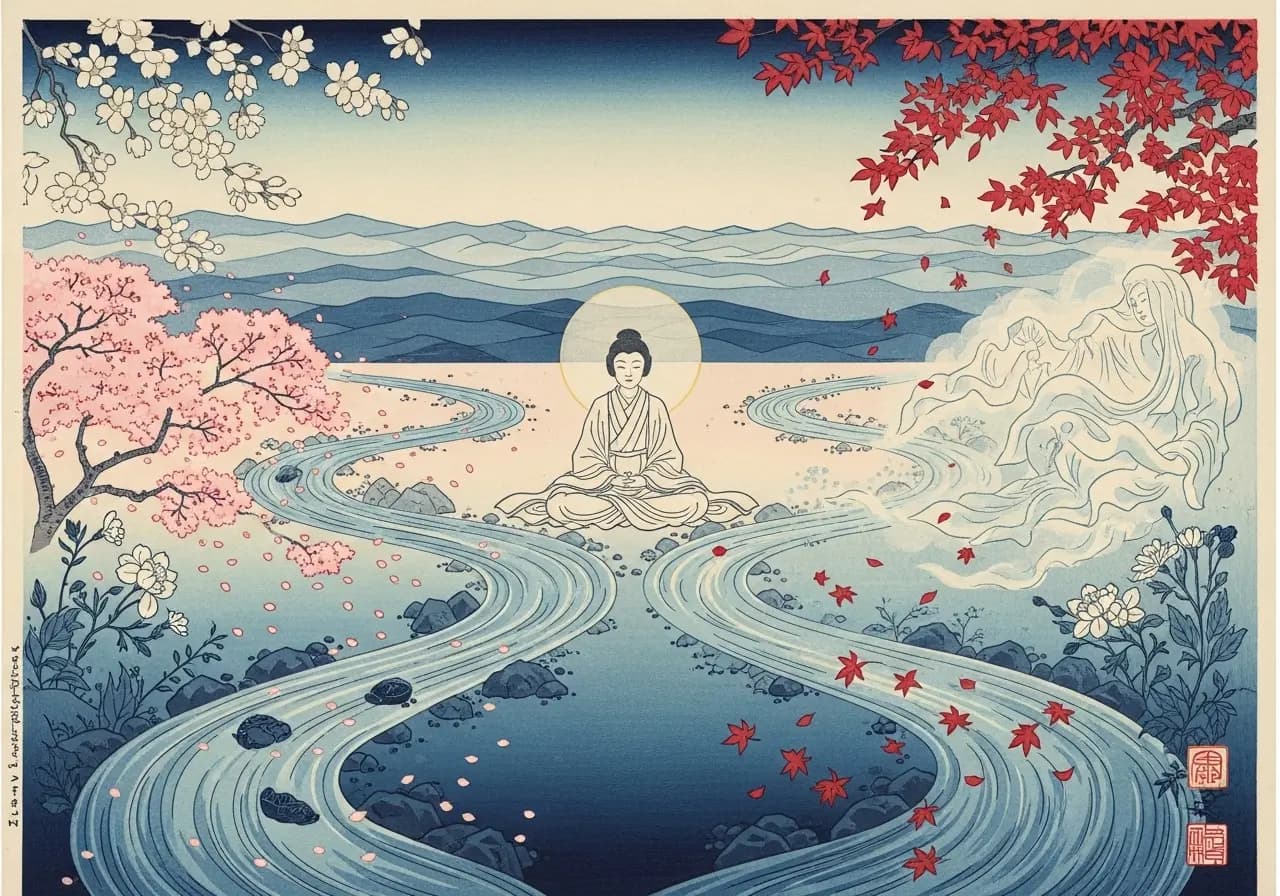
Discovering What Death Can Teach Us About Fully Living
Episode 62 of the Secular Buddhism Podcast
Guest: Frank Ostaseski
Welcome and Introduction
Noah Rasheta: Welcome to another episode of the Secular Buddhism podcast. This is episode number 62. I'm your host, Noah Rasheta, and today I'm sharing the audio of a discussion I had with Frank Ostaseski on the topic of death.
Death is perhaps our greatest teacher. It's the awareness of death that can be said to be the secret to life—the secret to living life fully. Frank is an expert on this topic. He's a Buddhist teacher, an international lecturer, and a leading voice in end-of-life care. He co-founded the Zen Hospice Project, which was the first Buddhist hospice in America. He created the Metta Institute to provide innovative educational programs and professional trainings that foster compassionate, mindfulness-based care. He's the author of a book called The Five Invitations: Discovering What Death Can Teach Us About Fully Living.
I've been excited to interview him because the topic of death is perhaps, as I mentioned, one of the most powerful topics we can approach when it comes to living more mindfully. I don't know of a single thing that can trigger a more profound shift in perspective than having a close encounter with death. Whether that's on a personal level—encountering death directly—or finding out a loved one has cancer, or learning that a loved one has lost someone they care about. Any time we brush with death, it seems to trigger something in us—a more mindful way of living.
Oftentimes we find that the things we thought really mattered don't, and the things we discard and don't think matter—we find out those are the things that really do matter. It has a tendency to flip things upside down almost.
I've been wanting to have this discussion because I think it's a profound topic. Unfortunately, death is something we don't think about or talk about very often in our society. I understand why. I think it makes us sad. At the core of everything that Buddhism teaches is this premise: where there is discomfort, we run from it. We don't want to talk about it. We don't want to think about it, because it's not comfortable.
I love how the Buddhist approach says the opposite. It says, "Wait a second. This is perhaps the only certain thing that we have in life. Why not look towards it? Why not use death as an ongoing way of living fully, of living more mindfully?"
Several years ago I tried this experiment myself—to think about death often. Not just my own death, but the death of the people closest to me, the people I love and care about. It is uncomfortable, but over time it settled into this sense of reality. I know I'm going to lose everyone I care about. I know when I interact with people that they're not going to live forever. I'm not going to live forever.
It has the ability to change the way we interact with people. It helps us not get so bent out of shape over things, because we start to see the impermanent nature of life and every single moment. This moment passes away so a new moment arises. It's life-changing to think this way.
Frank is the best person to have this discussion with. In his book, The Five Invitations, he talks about five specific invitations you can apply to your life to start seeing death differently. We discuss that a bit in the interview, but I'd invite you to pick up his book and read it. And then—as strange as it sounds—I'd invite you to think about death often. Your death and the death of everyone you know. With time, this can become a profound way of living very mindfully.
The Buddha's greatest teaching is the teaching of impermanence. Death is the ultimate expression of this teaching. Everything familiar to us ceases. I believe awareness of death is the secret to living mindfully. It's when we're reminded how fragile life is that we become aware of how precious every single moment is—whether it's a pleasant moment or an unpleasant moment.
So with that as the background, I hope you enjoy this discussion with Frank Ostaseski.
The Live Interview
Noah Rasheta: Okay, this interview is being streamed live now across the Secular Buddhism Facebook page, YouTube channel, and probably a few other places. The video will reside on the Facebook page where followers can watch it later if they didn't see it live, and I'll upload the audio to the podcast.
Frank Ostaseski: Great, just send me a link to it. We'll share it with our people.
Noah Rasheta: Alright, well to those of you who are watching or listening live, welcome. I'm very excited to have Frank Ostaseski with me and to have a lively discussion on the topic of death today. It sounds humorous at times to speak lightly of death, and at the same time, I do want to emphasize that from my perspective, the teaching of impermanence in Buddhism is perhaps the most powerful, transformative teaching. The idea that at any given moment, a moment passes away to give rise to a new moment, and extending that thought all the way to this experience of being alive and the ever-present awareness that this experience will end—that can be very profound.
Frank is one of the experts on this topic. He's a Buddhist teacher, an international lecturer, and a leading voice in end-of-life care. In 1987, he co-founded the Zen Hospice Project—the first Buddhist hospice in America. In 2004, he created the Metta Institute to provide innovative educational programs and professional trainings that foster compassionate, mindfulness-based care.
He's the author of The Five Invitations, which I happened to read earlier this year. I also recently listened to him talk about the topic of death and his book on Sam Harris's podcast. I'm a big fan of Sam Harris's podcast, and I thought it would be really cool to invite Frank onto the Secular Buddhism podcast. He very graciously accepted, and that's why he's here today. We're going to talk about discovering what death can teach us about fully living.
Thank you very much, Frank, for taking the time to join us today.
Frank Ostaseski: I'm really happy to be with you and happy to be with the viewers and listeners that will be taking advantage of this, I hope. Yeah, I like that we're going to emphasize the living part.
Noah Rasheta: Absolutely.
Frank Ostaseski: Yeah, what can death teach us about living a full life? Living a life characterized by love, meaning, and purpose.
Noah Rasheta: Absolutely. It seems to me—and anyone listening would probably agree—if you've ever had a brush with death, a family member or loved one either passing away or almost passing away, it changes you. Death seems to be the teacher that can at any given moment radically shift your priorities, radically shift your perspective. Everything changes in the face of death.
It's not necessarily that we have to wait for that final moment when we realize, "Uh oh, I am about to pass away." We get glimpses of this when we find out a good friend passed away, or a friend's cousin, or any time we brush with death—it seems to trigger something in us, a more mindful way of living. And then it seems to wear off, and with time we kind of forget, and then we're reminded again of our mortality and we're right back at it, where suddenly priorities shift.
With your work, you seem to be immersed in this all the time. Let's talk a little bit about how transformative that experience is—being regularly reminded of death. How does that change the day-to-day living, the living part of this experience?
Frank Ostaseski: That's a great question. The scenario you paint is quite common. We have some encounter and then we kind of spring back into our old habits. We think death will happen later, and "later" gives us that comfortable buffer between where we are in this moment and when we think death will happen—at the end of a long road, for example, or a long illness.
But I talk about death as being the secret teacher that is hiding in plain sight, showing us what matters most, helping us to really appreciate how to step into this life. I don't think we have to wait until even our own dying, even to brush with death, to understand something about that. It's all the time here. It's not just when we step off a curb and a car narrowly misses us. It's reading the newspaper, watching the evening news, or, as you say, friends of friends having an encounter with loss.
It's not just that death comes and then reminds us of life. It's more that we start stepping into the everyday, every moment coming and going of life. When we do that, when we recognize it's totally precarious—I mean, it's all precarious—then I think it also helps us appreciate how precious it is, and then we don't want to waste a moment. That's what I find to be really useful about this experience. It shows us we're all in the boat together. I think this engenders us being kinder to one another.
Noah Rasheta: Yeah, absolutely. Isn't that fascinating? Death is perhaps the most certain thing we have. We're so uncomfortable with uncertainty in life—we chase after things to try to have a sense of control, a sense of certainty—and yet here it is glaring almost in front of us: the certainty of our death and the death of everything we hold dear, everyone that we know. And yet we seem to never want to think about it. Why do you think that is? At least in our society, why is it so taboo to think about the death of a loved one?
Frank Ostaseski: I think this has been our training since we were very young—to see death as the enemy, as a final curtain call, all that stuff. Instead, what would happen if we began to speak with our youngsters, our children, more about death? I think actually, in my experience, kids are really fascinated by this. They really want to know about it. They're not scared of it at all. It's just that we've told ourselves really scary stories about death.
But it's also changing. I think we've removed death from everyday life, oftentimes in our experience, and that's part of what makes it foreign. We made it technological. We mystified it. We turned it over to doctors and priests and undertakers. When we do that, we rob ourselves of connection with the holy significance of death.
I think it's shifting. I think people are wanting to have this conversation more and more. They just don't know how to have it. They want to have it with people who aren't so afraid to talk about it. I think that's what we're doing today—we're just having an honest conversation about it.
Traditionally, there's been all of this avoidance and taboos, but that's a relatively new phenomenon. If we think in terms of the history of humankind, this is something that's only decades old.
Noah Rasheta: You know, something I've really appreciated from the Buddhist perspective is that rather than seeing life as a force opposed to death as its opposite, the Buddhist approach really meshes the two. It helps you get out of that dualistic way of thinking of life and death, and then you see it as one—life and death. It's like the same. You can't have one without the other.
That mental approach for me was a pretty radical shift. To realize that if you love life, why should you hate death? Because you can't have one without the other.
I was having a conversation with my son, who's eight years old. We were driving, and he was asking me about death. I said, "What if instead of talking about it like death, like the end, we just realize it's a continuation?"
I started to give him examples. I said, "The death of winter is the birth of what?" Right away he said, "Spring." "Yeah, and the death of spring is the birth of what?" We started going through this process. We talked about caterpillars. "What is the death of a caterpillar? It's the birth of a butterfly." Virtually, in the context of the end of something, is the start of something else.
I think that was very profound for him. Then he came up with scenarios, and some were comical. He said things like, "The death of a cow is the birth of a hamburger," or things like that. I was saying—this is what I wanted him to grasp—this continuation. It doesn't spell the end in the sense of non-existence. It's transformation.
I thought that was really neat, and it was fun to have that conversation with him.
Frank Ostaseski: Yeah, it's a beautiful way to have a conversation with a child and to really listen to what they think about it, as opposed to us telling them what it should be.
I used to run a preschool years ago when my son was quite young. He's a grown adult with his own children now. But we used to have these days in the preschool where we'd go out into the nearby woods and find dead stuff. The kids loved it. They'd go out and find a rusty old car part, a twig, a leaf, or bones of a bird. We'd bring them all back and spread them out on a blue tarp. Then we'd have a kind of show and tell. The kids would talk about what they'd seen. They were incredibly imaginative.
They would talk about how this piece of bark had been a bed for a mouse and the mouse didn't need it anymore. This rusty old car part was a part of a spaceship that had fallen as it passed over the earth. Then one little girl said something beautiful. She said, "I think the leaves on the trees are very, very generous. That they fall to make room for new leaves."
I thought that was a beautiful understanding from this four-year-old. I think if we can have conversations like the one you were having with your son early on, instead of frightening them, it really makes a huge difference in how we grow up and in keeping death as our companion in a way. We learn to harness an awareness of death to appreciate that we're really alive, to encourage self-exploration, to clarify our values, to find meaning, to generate positive action in our life. I think it's impermanence that gives us perspective. It helps us appreciate the beauty of life.
The Five Invitations
Noah Rasheta: Yeah. Your first invitation in the book is "Don't Wait." We don't need to wait to have these conversations. One of the things that stood out to me when I first read about not waiting was also not waiting to think about all the scenarios that could happen.
I came across this concept years ago, reading another book, but I remember having the thought, "What would it be like when I lose my parents?" It's a thought I had avoided. I'm a twin brother, and we're very close, and that was another thought: "What would it be like to not have my twin brother?" It hit on emotions I didn't want to explore yet. That sense of not waiting for me was realizing, "Well, why not explore that now? What would it feel like to not have him in my life?"
It made every moment more precious since that thought experiment, because it's like, "I still have him, and I still have my mom, and I still have my dad." So the idea of not waiting, I think, can be beneficial in terms of not waiting to think about what it will be like when we don't have the people we currently have.
Do you find that as a thought experiment, people get used to it the more they practice it? What do you find with this thought?
Frank Ostaseski: I think it's an interesting exercise to do, as you're suggesting. It can be kept as a kind of thought experiment, and that keeps us in safe territory, so to speak. But I think it's really important that we let that drop into our heart and into our bones and really know it to be true. It is true. It's a fact of life that all those who are dear to us, we will be separated from. It's inevitable.
At first this is a scary thought, and it brings up this kind of urgency. But that urgency isn't all bad. It also is a reminder to really step in with both feet into our life, to tell the people we love that we love them now, not to wait for some future opportunity.
Again, I think it's the precariousness of this life that helps us appreciate its beauty. Every year, cherry blossoms explode on the hillsides of Japan. There's a beautiful place where I teach in the northwest where there are these little blue flax flowers that last for a single day. Now, how come those flowers are so much more beautiful than plastic flowers? Isn't it part of the fact that they have a brief life? The brevity of their lives helps us appreciate their beauty.
It's not that it's all sad. It's that it's really about stepping, really fully stepping into our life. I think "don't wait" is a reminder that by waiting for the next moment to arrive, we miss this one. I've been with hundreds and hundreds of families who have said to me in one way or another, "When is mom going to die?" By waiting for the moment of death, we miss all the moments in between.
I think it's not that it should create panic in us, but it's like: don't fool around. Don't fool yourself into believing you have endless time. To imagine that at the time of your death you have the clarity of mind, the emotional stability, the physical strength to do the work of a lifetime is a ridiculous gamble. Let's not wait for that. Why? Let's do it now. Let's really step into our life, both feet.
Noah Rasheta: You know, I found that what you just mentioned—the passing of a moment—this thought experiment for me started with people, with loved ones, and transitioned into an almost constant thought of the passing of a moment. I catch myself anticipating what the next stage is. One moment that I still consider to be one of the more special or precious moments I had with my youngest, who's two right now, was the process of changing a stinky diaper with her. The thought occurred to me that it will be so nice when she's out of diapers.
The process happened so quickly that when I realized this stage will come when diapers will no longer be part of my life, I'll look back with fond memories of the stage of a toddler running around in diapers. I thought, "Why am I in such a rush to move past this phase? Whatever the next one is, I'm going to be rushed to get past that one, and before you know it, all those stages are gone and they're not even at home anymore."
All that happened while I was still changing the diaper, but it changed the experience of changing the diaper. It became a precious moment. I thought, "You know what, this is what I get to do right now." That was one way it manifested for me.
Frank Ostaseski: Yeah. I think it's the great value of having elders in our culture. We've lost a little bit of the wisdom of elders, I think. They're often isolated, living in sort of ghettos, so to speak. But there's something, there's wisdom that grows with age. Not all old people are wise, I don't mean to suggest that. But there is something about slowing down. It's not just because the body gets old and crotchety. It's that you start to see it goes by really fast.
What I want to encourage is stepping into it, really enjoying it, fully tasting it all. For me, that's really the most life-affirming thing that I know: being with people who are dying. Looking into their eyes, they're clear mirrors. They really show me where I'm holding to my fear and to my opinions and views.
They also show me something else. They show me what I sometimes call an undying love—a love that isn't particular to just a single human being and doesn't come and go with every moment, something that's steady. Everything is always coming together and falling apart, everything. This morning's breakfast—where did it go? Last night's love-making—where is it? My blonde hair, which used to be there, it's gone.
I could grieve all of that experience, and sometimes it's necessary to do that. Or I could recognize this is the way of things. I could appreciate that coming and going is happening against the background of perfect harmony. When we don't see the background, when we only see the coming and going, I think all we see is suffering. So it's really important to see all of this happening against a background of perfect harmony. We miss that oftentimes.
We're so busy. We spend so much of our day planning for the next moment or trying to distract ourselves from the current moment in some fashion or another. But I think embracing the truth—that things will inevitably change—encourages us not to wait but to start living our lives in a matter that's really deeply engaging. We stop wasting our time on meaningless activities. We don't hold our opinions or our desires or even our identity so tightly. Instead of pinning our hopes on a better future, we focus on the present and we're grateful for what's in front of us.
As I said earlier, we say "I love you" more often because we realize the importance of human connection. I think we become kinder and more compassionate, more forgiving of ourselves and each other. I think "don't wait" is a pathway to fulfillment, an antidote to regret actually.
Noah Rasheta: Yeah, I like that. You were talking about grieving, and I think this is an important point to bring up with the second invitation: "Welcome Everything, Push Away Nothing." I think there's a tendency to think, "Well, I don't want to approach this stuff until I'm at a place in my life where I can approach it in a way that's not going to be too painful." But this invitation of welcoming everything includes welcoming the difficulty of encountering and dealing with death.
I had an experience with one of my college buddies who ended up being a business partner with me in a business venture about four or five years ago. Out of the blue, he was diagnosed with stage four melanoma. He was told he had months to live. It ended up being about a year before he passed, but in that time what used to be our Tuesday lunch meetings to talk about business turned into our Tuesday meetings to talk about life. It was a fascinating experience to be able to talk to him about this process of what it feels like to be dying.
This thought of welcoming everything, pushing nothing away. There were moments where I noticed a resistance, especially towards the end: "I don't know if I want to go see him. What do you say to someone who's dying?" But then thinking, "Well, it's okay to just feel whatever I'm feeling with him and to have those open conversations." It turned into this beautiful experience where I have a good friend and the last time we met for lunch, I was able to give him a hug and thank him for our friendship and thank him for the fun memories in college. How often do we really get to do that? But that's what I thought of with this welcoming everything—welcoming the difficulty of it too.
Frank Ostaseski: Yeah. Let me back up just so people understand the context here. The book is called Five Invitations. An invitation is—if I invite you to my house for dinner or to my wedding—it's an invitation to show up actually. It's a request for you to be present, really. The five invitations are just that. They are requests for you to be present. What we're asking you to be present for is your life.
Each of these five invitations was given to me or taught to me by people who were dying, in one way or another, even if they didn't use that exact language. They helped me to really see that this is not only a way to help take care of people at the end of life or as they're in the dying process, but these really have a relevance for all of us in living a more peaceful, meaningful, productive life.
The first one, as you said, was "Don't Wait." The second one is "Welcome Everything, Push Away Nothing." That sounds really good—this would make a great bumper sticker—but how do we do that? Welcome everything? As you were suggesting, we like certainty. We like to have our purposes met. In fact, most of us have been taught that getting what we want and avoiding what we don't want is the key to happiness. But inevitably in our lives there are unexpected experiences, there are unanticipated moves. We lose our job, or there's a family member who gets an illness, or there's the death of a beloved pet. We want to push these things away with all our might.
When we're faced with uncertainty, the first response is usually fear and resistance. But I think an attempt to evict these difficult aspects of life from our everyday experience is itself a kind of cause of suffering. I think instead, when we cultivate a kind of receptivity to whatever is present, they don't have such a stranglehold on us. I think when we're open and receptive, we have more options. We're free to discover, to investigate, to learn how to respond to these things in skillful ways.
If our life was just about being comfortable, we would just give people morphine and put them on a couch. They'd be really comfortable, but they wouldn't be very alive. They wouldn't be very engaged with their lives. So with welcoming everything comes the ability to meet and work with both pleasant and unpleasant circumstances.
I think gradually, with practice, we discover that our wellbeing is not dependent on just having a happy external reality. Our true happiness, our true contentment actually arises from within. Think about yourself and the changes in your life, the real growth you have made in your life. It probably didn't happen in your comfort zone, right?
Noah Rasheta: Yeah, in fact I was just thinking as you were saying that—I think some of the moments where I felt most alive were moments where I was experiencing perhaps the most pain I've ever felt or the most hurt. Those were moments that I felt, especially after the fact looking back and thinking, "Those are the moments that really helped me. Those were pivotal moments in my life—the difficult moments."
Frank Ostaseski: Sure. It's not like we have to go hunting for them. They're there. They're part of what life delivers to us, in a way, as it does also deliver beautiful moments. But I think to welcome everything and push away nothing is a deep invitation to cultivate a certain kind of fearless receptivity. Now, that doesn't mean you don't have any fear. People misunderstand fearlessness. Fearlessness means that fear isn't the only thing in the room.
When you're afraid, Noah, for example, let me ask you: when you're afraid, do you know that you're afraid?
Noah Rasheta: Yeah, absolutely.
Frank Ostaseski: Right. How do you know? How do you know you're afraid?
Noah Rasheta: I think you feel it. There are physiological symptoms. There's a strong aversion to whatever it is.
Frank Ostaseski: Often. Fear itself is an aversion. So there might be physical sensations, there are emotional associations that occur, the mind starts planning about the future, thinking how to get out of this scary situation. All that's going on, right? But here's the thing I want to point you to: when you know you're afraid, that means that some part of you is not afraid—the part that knows you're afraid, the part that's aware of your fear. It's not afraid.
We can orient to just the fear, or we can orient to this awareness, to this knowing, we could say. It doesn't mean the fear goes away. It doesn't mean we have to get it to go away. What we have to do is learn how to deal with it skillfully so we're not running away from it and it whacks us in the back of the head.
Noah Rasheta: I think sometimes a considerable part of the suffering we experience is the wanting to get rid of it.
Frank Ostaseski: Absolutely. Absolutely. Most of what we call pain, even physical pain, is our resistance to it—the not wanting it to be there. That's the real cause of suffering. Pain plus resistance equals suffering. That's the formula we can understand.
Noah Rasheta: Yeah. You know, I had an experience last summer talking about fear. I have what I consider an irrational fear of snakes. I understand that it's irrational, and I've tried to overcome it. It's really difficult for me. But there was a snake in the yard, and I made the conscious decision to hold it. It was a little garden snake. All the little kids were playing with it, all my nephews. I said, "I'm going to go hold it. I'm going to touch the snake and hold it and realize this is okay."
The fear never went away in that process. The fear was there, but it's the observer that you're talking about. There was part of me that could observe: "I'm experiencing fear. It's okay. I understand that it's not necessarily rational, and I'm going to still proceed to do what I'm going to do," which is hold this snake. I was proud of myself after the fact for doing it. People who know me well who were there were like, "I can't believe you touched a snake. That was brave."
I was thinking, "Well, if brave means I was very scared and still did it, then yes. But if brave means I finally lost my fear, no, that's not accurate."
Frank Ostaseski: Yeah, very good. That's a really good distinction. I think people imagine we're always talking about overcoming our fear, just as we talk about overcoming our grief. It's curious to me that we never speak about overcoming our joy. We don't say, "How do we manage our joy a little bit better?"
I think these experiences—fear, grief—these very strong mental and emotional states are something we live into and that we learn something about. Openness doesn't reject or get attached to any particular experience or view. It's spacious. Our awareness can have about it a certain spaciousness, an indefinite quality, a non-biased allowing, we could say. Openness is the nature of awareness itself. It's the nature of our nature actually.
I think this is one of the things that people often discover in and around the time of dying. This thing that they always imagined would be only terrifying or unbearable or unimaginably difficult, they find within themselves, frequently, the resources to meet what they thought was unbearable in remarkable ways. It isn't because all their fear went away. It's because they discovered they are not just their fear. They're not just their illness. They're not just their dying process. There's more to them than that.
It's not about a spiritual bypass. It's not about spiritualizing the expectation. It's recognizing more of what we are. What's amazing to me, Noah, is not that we can expand. All of us can, through meditation practice and other ways, experience expansive states of mind, heart, and body. What's amazing to me is that we take this expansiveness of who we are and shrink it down into such a small story about who we are. That's what's amazing to me. That's what gets blown out of the water in and around the time of dying, frequently for people.
The habits of our life have a very strong momentum, and they carry through into the time of our dying. Sometimes those habits can be really constricting. So we need to ask ourselves now: what habits do we want to create? What are we willing to cultivate in this life? What do you want to teach your children? So going toward what frightens us or going toward the suffering is oftentimes where the healing is often found—like going and touching the snake.
Grief and Loss
Noah Rasheta: I think that's very relevant with the grieving process as well, after the fact. Losing a loved one and then dealing with that grief for—it could be the rest of your life, or I think perhaps it is the rest of your life. The misconception is that one day you'll be done, you'll get over it. I see a lot of suffering arise out of that thought—that this is a feeling I'm supposed to overcome, like we were talking with fear. It's not that you overcome it, it's that you harmonize with it. You make it a part of the everyday.
Frank Ostaseski: Yeah. It's easy to throw conceptual, theoretical ideas at these experiences, which are gut-wrenching. I think what's true is that our relationship to grief, for example, shifts over time. But time alone doesn't heal grief. Time and attention heal grief.
So in the beginning, we might feel like we don't know whether we should turn left or right at the end of our driveway. We can't make a meal. We're absolutely lost in the experience of grief. It's emotionally overwhelming. It can feel like sadness, of course, but it can also feel like anger, fear, numbness, and even relief. Those are all faces of grief.
But it doesn't stay. It doesn't remain at that intensity forever. It starts to shift over time and with attention. After some weeks, some months—and there's no timetable for grief—but often with attention and time it starts to relax a little bit. Our identity isn't completely consumed by the grief, and so we start to have a different relationship to it.
The experience—what you're saying, I think, which is true—is that grief is part of the human condition. It's there for all of us. It surfaces sometimes. It's like an underground river that surfaces sometimes, like for example around the loss of someone we love. But it's always been there. In fact, I think it's one of our common grounds with one another.
The first experience of grief, which feels like fragmentation and isolation, with time and attention and healing, can become a path to wholeness. But you can't tell somebody that at the beginning of their grieving process. All you can do is hang out with them and make a meal for them and help them do the insurance forms and have them tell the story of their loss ten thousand times, until it feels real for them.
When I was running Zen Hospice—I'm not anymore, but when I was the director there—I sometimes lost twenty or thirty people in a week. I had to learn how to deal with that grief. One of the things I did was go to my meditation cushion, and that was a way to cultivate stability and assimilate, metabolize, if you will, the experience of loss. But that wasn't enough. Grief is a physical experience also.
So I would go to my body worker. I'd go to his office and he'd say, "Where should we touch today, Frank?" Instead of him doing some kind of manipulation on me, I'd say, "Just my shoulder." He'd put his hand on my shoulder and I would just cry for about an hour. There was something about the touch and also the relationship with somebody else that allowed this grief to really come forward and to be expressed, and as a way of metabolizing it, including it.
Then I did something else. I would go to the hospital nearby, where my friends worked in the maternity ward. On that particular maternity ward, there were babies born to addicted mothers. Before I would go home to my own children, I would go there to this maternity ward and I would sit in a rocking chair and rock these little infants. There was something about being able to soothe their distress and have them relax in my arms that was very important and very helpful to me. Because there were other times when I was with people who were dying, whose suffering I couldn't soothe. I couldn't. They died in difficult conditions. So I had to find ways to work with that grief that really worked for me.
Each person's grief is entirely different. I'm a little suspicious of models of grief that we have for managing people's experience. I think there's wonderful, great value to things like bereavement groups, et cetera, but sometimes they don't allow for the wildness of grief. Grief can be completely wild, feel uncontrollable. It can have a huge effect on the way we function in the world.
In the old days, there used to be a way that you wore a special kind of clothing or a black armband or something to let people know that you're in an altered state and that they should treat you differently. They shouldn't expect you to behave normally. Now, your mother dies and you go to a party and nobody mentions it, because we're afraid to upset you. So we leave you isolated and alone in your grief.
I think that, again, the book but also my work, and I think it sounds like your way also, is to help people turn toward their experience. Even if the experience first feels unnerving in some way. Stay with it. Stay in the room when the going gets rough.
Questions from the Audience
Noah Rasheta: Yeah, I like that. I have a question that somebody posted. This is Johnny, and he's asking, "Is it fair to say that when we experience fear, we might want to take a step back and try to find if there's an opportunity hiding behind it?"
Frank Ostaseski: Well, I think that's true. I think it's a wise comment. The only thing that I would want to encourage us to do is not do a bypass around the fear. Be willing to feel it, to see, as you did earlier, sense it in the body, feel the effect in the heart, mood, et cetera, and see what the activity is in the mind that's occurring, so that we get really familiar with the fear. I think also when we get very familiar with it in that way, we can see it in its arising before it's in its full explosion, before it's in its full bloom, so to speak.
But I think, yes, what Johnny's suggesting—to take a backward step, to step back from all that activity of mind, heart, and body and say, "What else is here?" That's my favorite question: What else is here? So in addition to the fear and my reaction to it, what else is here? There's some spaciousness here. There's some understanding that's growing here. There's some empathy that's emerging here. So to ask that simple question, "What else is here?" I think is a wise way to interact with almost any difficult emotional or mind state.
Noah Rasheta: Thank you. One other question that somebody commented, and this is kind of a different topic but I think this might be a fun little tangent to explore. This is Derek, who's asking, "Some speculate that we will at some point reach a time when science will be able to extend our lives indefinitely so that we could effectively live forever. How does Frank think this removal of death would affect us?"
Frank Ostaseski: That's becoming an increasingly popular question. I was with a group of Silicon Valley folks not long ago, and I said something like, "Death is inevitable." A guy raised his hand and he said, "I'm not so sure about that. We're trying to hack that, you know."
I said, "Okay, great. So we'll live for 250 years or we'll live for 500 years. Let's take the word death out of the equation for a moment. Let's just take it out of the conversation. Let's just deal with how we think about endings. How do we meet endings in our life right now?"
Like the end of a sentence, or the end of a meal, or when you leave a party—how do you leave the party? Do you just ghost out, or do you say goodbye to people? How do you meet endings? I think the way in which we meet endings can in fact have a big influence on how the next moment arises. The way we end one thing tends to shape how the next thing emerges.
So I think that if we could think, just for a moment, let go of the notion of death as some final event and just think about endings, that's a really good place to explore because even if we live forever, there will be endings. There will be endings continuously through that experience. So even if we live forever, there will be endings.
My teacher used to say, "Suppose you could live forever, no matter what." When we talk about living forever, we assume we're going to be in great health for the entire time. Maybe that's not so. We were talking earlier about impermanence. I think we rely on impermanence. I think it's not only what shows us beauty, it's also something that gives us relief. You know, that really boring dinner party that you're going to go to on Saturday—it's going to end. Or this cold that you have—it's going to end. Or evil dictatorships will fall and hopefully be replaced by thriving democracies. We rely on things coming to an end.
Noah Rasheta: Yeah, I agree. I was going to say, the stages—like we had talked about before—those are stages that end. Presuming I could plan on living forever, there would be stages of life that have ended. Memories fit into that because even now I don't remember the five-year-old me. What did I feel? What did I think? I don't even remember the specific experiences I was having. So in a way, that part of me is dead and gone.
If we reach this point where we can live forever—2000 years from now—is that me going to be significantly different than the me that's talking to you here today? Would I grieve that old me? I don't know. But I think you're right: there will always be the opportunity to still live fully by keeping in mind the endings that life will always be having—the phases, the stages, the friendships, the relationships, so many other endings.
Frank Ostaseski: I think the question is an interesting one philosophically. What does that do to the structure of society, et cetera, if people live forever? I don't know. I can't imagine knowing that. The thing that I would want to be careful of is that we won't use a question like that to bypass our direct experience that we're having now.
The truth, the fact of the matter is, right now we don't live for 2000 years. We live for a limited lifespan. So I want to know: how do I do that really well? How do I do that with as much integrity and as much passion and as much joy and fullness as I can muster? How do I love as hard as I possibly can this life that is fragile and vulnerable?
Noah Rasheta: One of the things that I just thought of: there are ideologies and religious views that are built around the idea of this being a perpetual experience. Sure, life ends, but then you continue to exist in an eternal state somewhere else—let's say heaven or something like that. What I found for me, looking back to when I viewed it that way, was it can be easy to bypass the present experience in anticipation of that future experience. Things will be better, but right now I won't do what I need to do to change my life now because I'm projecting into the future.
I think this thought of extending our ability to live forever can do the same thing. It can remove us from the full experience of being mindful in this moment—the only true moment that we have, the present.
Frank Ostaseski: Yes. Look, there's a thousand ways to distract ourselves, and that's just one of them. But also it's kind of fun and playful to play with, "What if...?" Those are fun things to play with. I like my mind's ability to imagine. I just don't know what happens after we die. I really don't. Maybe all the things that religions have been telling for millenniums will in fact be so.
I think what tends to happen is we tend to take our sense of self—which for the most part we construct as something separate and apart from everything else—and we imagine that continuing forever. That I don't imagine happens. This personality isn't, thank goodness, going to go on forever.
I think when we live in that way, it's both a little absurd to me and also a little arrogant. I mean, here's what we usually do: everything is changing, like your eight-year-old son told you, right? "Caterpillars turn into butterflies, Dad, and seasons come and go." Everything is constantly changing, except me. I'm the one thing in all of reality that doesn't change. We have that idea about ourselves oftentimes, and it's absurd.
For me, it's also—when I see someone I haven't seen in many years and they say, "Frank, it's great to see you. You haven't changed a bit," I'm a little insulted actually, because I think there's been a lot of change in my life over these sixty-six years. The fact is, death is not this thing that only happens at the end of a long road. It's happening right now. This podcast will come to an end. My sentence will come to an end.
Noah Rasheta: With that, I want to touch on the topic of uncertainty. I think a lot of our discomfort arises out of what you mentioned before: "I don't know what happens when I die." What if we were okay with saying, "That's a perfectly acceptable answer. We don't know." It seems like we're so uncomfortable with uncertainty that we feel the need to construct a certain narrative, even if it's just a narrative or it's fictional, but at least it's certain.
We do this with not just thinking about death, but an example I use often: we do this when we're driving and someone cuts us off. It's not okay for me to not know why that happened. I feel much more certain when I say, "That person's a jerk. That's why they did that." I may be completely wrong, but at least I've got an answer now. I wonder if our ability to increase our comfort around the discomfort of not knowing—what effect that would have on bigger topics, like the topic of death.
Frank Ostaseski: Well, or climate, or any number of other social issues that we have. I think the problem lies not in uncertainty, but the fact that we fill not knowing with scary ideas, scary thoughts.
The opposite of faith, we often say, is not doubt. It's certainty. There's a beautiful Buddhist teacher, Carol Hyman, and she wrote very beautifully. She said, "If we learn to let go into uncertainty and to trust that our basic nature and that of the world are not different, then the fact that things are not solid and fixed—this becomes a liberating opportunity rather than a threat."
Noah Rasheta: I like that.
Frank Ostaseski: Everything will come apart, Noah. This is true of our bodies, of our relationships, of our life. It's happening all the time anyway. It's not just at the end when the curtain falls. Coming together inevitably means parting. Don't be troubled by this. This is the nature of life. Our lives are not solid and fixed, no matter how much we try to protect ourselves and make white picket fences around our houses.
I think knowing this intimately is how we prepare for death—also for any loss of any kind. It's also how we really come to love and fully embrace constant change. We're not just our past. We're becoming. We're not stuck. We don't have to be stuck in old grudges. We can forgive. We can free ourselves from resentment and regret now, before we die.
Noah Rasheta: One of the common questions I get when I'm exploring this topic in a workshop or somewhere is: if you have this mindset of being anchored in the present moment, do you run the risk of becoming indifferent to things in the future? Like, "I guess I'm not going to pursue this career path because who knows where things will go now." Is that a risk that we run?
Frank Ostaseski: I think initially it certainly is a risk. I know for myself when I first got introduced to notions of impermanence, I used it kind of as a club. It was a way to not invest in anything—in my relationships. In early relationships, I thought, "Well, it's all impermanent. Why invest here? Why commit to anything?"
But of course it's just the opposite. It's because things are impermanent, because they are so precarious, that they're so precious. That's why we love them so much. That's why we really invest completely—not in some clinging, craving way, but in a way that really honors and respects the fact that all relationships are characterized by constant change.
I think that's the first thing. We can use impermanence as a kind of defense against commitment and engagement. But the other is that it's kind of freeing. It means that we're not wedded to our past trauma. We're not wedded to our future scary stories.
The other thing I want to add here, Noah, which I think is vastly misunderstood, is we often speak about the present moment as if it were some nanosecond in time. Is that it? Did we just miss it? I think the present moment has to be understood to include past and future. Eternity is not a long, long time.
Saint Augustine wrote about this. He said, "The now is neither in time nor out of time." So when we speak about the present moment, we're talking about a moment that includes past and future—not that avoids it. When I'm remembering my third-grade teacher, I'm remembering her now. That's a present-moment activity. When I'm thinking about how I'll be when I'm really old, that's a present-moment activity. It's not like past and future are an illusion. I think that's a misunderstanding. I think all of it exists here and now. That means we have access to an awful lot here and now.
Noah Rasheta: Yeah, I like that.
Frank Ostaseski: It means that we can fully invest without fear.
Helping Others Through Difficulty
Noah Rasheta: Yeah. You know, taking this concept and applying it in the present moment, I want to ask you about people who are currently going through a difficult stage—for example, dealing with a child with mental health issues or suicidal thoughts, or the difficulties of dealing with the possibility of death and feeling helpless. I think in scenarios like that, part of the difficulty is recognizing the pain and suffering that a loved one is experiencing and wanting to remove that from them. Talk to me a little bit about that. What tips or advice would you give to someone going through a situation like that?
Frank Ostaseski: I'm careful about advice, you know, because it's cheap. It's hard to give generalized advice without knowing the specifics of a situation. But I would say that one of the things that is helpful for me to keep in the back of my mind as I'm with someone in such a situation is that to build an empathetic bridge to them, I have to be willing to look at my own relationship to these issues. So I have to look at my own helplessness. I have to look at my own fear. I have to look at my own grief. Otherwise, when I'm with them and I say "I understand," they will know I'm just guessing. They'll sniff out my sentimentality and my insincerity.
In order to really be of service to others, I have to work on myself. That's what enables me to be of service to others. Of course, serving others, I learn about myself. I grow and develop for myself. So there's that mutuality of exchange that happens.
But the other thing that I think is a misunderstanding is that we often confuse empathy and compassion these days. Empathy is the feeling with, to feel with. Compassion is the action to do something to remove or alleviate the suffering. We can get empathetically overloaded with people, even our own children.
We need to feel with them, but we also—if I'm with my granddaughter and she's having a tantrum, I need to know that I can stay in my own seat and I can use my wisdom and I can use my maturity and I can use my kind heart to comfort her. If I get over there and get lost in the tantrum with her, I can't be of very much use. So I have to really keep my own seat. That's what I have to do.
Now, compassion is often spoken about as taking away suffering or removing suffering. That's good if you can do it, but you can't always do it. I work with dying, and I can't take away their dying. But what I find is that when I'm really abiding in a compassionate heart—that means I've really done my homework—then they sense that, and they're willing to go to really dangerous places. Not because it's going to be safe eventually, it's because they're companioned. They're compassionately companioned.
I think we underestimate sometimes the value of simple human presence—particularly compassionate human presence, radical compassion that doesn't always know what to do but it's willing to be with the suffering, willing to stay in the room when the going gets rough.
When compassion is present, our defenses against what's difficult fall down, and then we can see the deeper causes of the suffering. Then we can actually intervene ourselves or help another intervene in their experience in a skillful way. So compassion does more than just take away things. It allows us to stay with something until a deeper truth can show itself, and then we can do something about it.
Noah Rasheta: Yeah, I like that. Thank you for sharing that. I think that touches on the second invitation of welcoming everything and pushing away nothing. Recognizing that in situations like that, there may not be answers. So you're with that person and knowing that, "Hey, this is going to be a rough ride. I don't know what to say. I don't know what to do. But I'm here with you." I think we can add to the difficulty by adding that second arrow, where now we're there thinking, "This isn't how this should feel. There should be an answer. There should be something that solves this whole problem." Sometimes there's not.
Frank Ostaseski: No. And you know, the answer isn't always to solve the problem. Sometimes the answer is in simply keeping company with people. I've been with some people in really horrible conditions, and I couldn't do much to make those conditions go away. But in fact, I could keep company with them. I think it's also useful not to just imagine or to use our skillful action, to use our wise hearts in action.
I remember coming into a situation where there was a patient who was very sick, coming close to the end of life. The volunteer was there, and I said, "How is it going?" She said, "Well, she's having a really hard time, but we're just being with it." She was in this kind of meditative pose, and the patient was sweating up a storm. I said, "Well, it's good that you're being with her, but let's get a cool rag. Let's cool down her forehead and give her some ibuprofen because that will help with the fever."
We want to make skillful interventions as well when they seem appropriate. We want to use our intelligence and our good, kind hearts. Together, they make for a very reliable guide.
Meditation Practices for Mindfulness of Death
Noah Rasheta: Yeah, I like that. Do you know of any meditative techniques or guided meditations that help us be more mindful of death? I'm thinking something like metta meditation for kindness and compassion. Is there something equivalent that deals with thinking about death?
Frank Ostaseski: Sure, there are lots of them. There are various visualization practices—visualizing one's own dying. There are these kinds of practices that we can do. But I think it's best to keep it simple and really look and see what happens at the end of an exhale. What happens there in that gap between the next inhale? That's a moment, right? It's a moment of faith or a moment of fear.
Do you really trust the next breath will arise and that you'll be able to continue, or are you afraid that it won't come and you feel like you have to manage? I think that learning to be simple in our lives and deal with our everyday life—not thinking of some other meditation outside of our life but just before going to bed at night, reflecting on one's own day. Looking back and seeing with gratitude what this day was like—that is important.
My wife and I, sometimes before we go to sleep, we ask each other four questions that were given to me by a dear friend, Angela Sarian. The first one is: What inspired you today? Beautiful. The second question is: What challenged you today? Because we don't just grow in our comfort zones, as we spoke earlier. The third one is: What surprised you today? That's a really good one. Children love surprises. You can play peekaboo with my granddaughter ten thousand times and she loves it, but throw a surprise party for an adult and they say, "Who's responsible for this?"
So what surprised you today? The last one is: What did you learn about love today? That's a beautiful question to ask. So: what inspired you? What challenged you? What surprised you? And what did you learn about love today? These are great practices, I think, and a gift from my dear friend Angela Sarian, who died a few years ago. These are practices that help us. Wouldn't they be great questions to ask as we come close to the end of our life? Why not practice them now?
On Closure and a "Good Death"
Noah Rasheta: I noticed another question just popped, and I know we're kind of getting towards the end of the hour, so I just wanted to extend the invitation to anyone listening: if you have any questions you'd like to ask, now would be a great time to post them. One already did. This is Johnny, asking, "How important is closure before death?"
Frank Ostaseski: Well, you know, it's an ideal to try and come to. But I'm a little suspicious of our ideas of closure, which is that everything gets wrapped up nice and tidy. My experience is that you close this and the next thing opens.
So what I was saying earlier about watching the way we meet endings is really useful. Some people come to the end of their lives and they have meaningful conversations with family or friends or people that perhaps they've had challenges with, and that's really helpful for them to step into their dying process. For others, that's more of an internal process, and they come to that understanding within themselves, not through relational conversations.
I think what I really want to be careful of is that we don't set up a kind of idealistic idea about what has to happen for death. One of the things that happens in this culture is we put a lot of weight on dying people to do it well, to die well, to have a good death, or all those things. Instead of recognizing that when we speak about a good death, we might not know what that actually is like internally and spiritually for someone. We don't really know what it is that we need next, oftentimes.
What I think we can do is look at the systems and say, "Did the system support this person in a way that really helped them? Or did the system abandon them?" We can evaluate the system and help us really look and see how to do that, how to help people when they're dying better. But I don't think it's so helpful to evaluate people's way of dying as a way of understanding what a good death is. I've seen people die opening in great kindness. I've also seen people die telling the people in front of them that they hate them. Both of them, in my view, were actually appropriate to those individuals.
Noah Rasheta: Yeah, thank you for clarifying that, because I agree with you on that view. I think it's dangerous when we start to decide what is a good death, what is a bad death.
Frank Ostaseski: Again, I think we can say something about the system. From our healthcare system or other systems, how are we supporting this person? Did we take care of their symptoms? Did we manage their pain? Did we give them a certain degree of autonomy? What did we do? Those are things that we should evaluate, I think.
Fully Living
Noah Rasheta: I think if we were to take that and flip it to what is a good life, what is a bad life, we can run into some of those same issues. But ending this on a note where we're talking about life—because your book has these invitations, but the ultimate premise is that we're discovering what death can teach us about fully living. So ending it on that note with this concept of what it means to be fully living: what do you have to say regarding the concept of fully living? What does that look like?
Frank Ostaseski: Well, of course, it's going to look individually quite different to different people. I think that's part of the beauty of this incredibly beautiful opportunity we call life. That said, I think that living a life that is multidimensional is really a good way to think about it. Our life doesn't proceed in a linear way. Living it on the horizontal but also on the vertical, we could say. Those two planes of existence, if you will, I think are really important to consider.
Is it a life characterized by integrity? Is it a life characterized by meaning and purpose? Is it a life that includes or aims at belonging? These are the really big questions that really matter for us. Do we find ourselves? Do we recognize the interdependency of our lives? That everything we do and say affects everything else and everyone else, and that we are affected and supported by everything else that happens in reality.
I think a full life, or a life that's fully lived, is a life that begins to recognize these things as well and temper our notions of control. I think that's really important to consider as well.
Noah Rasheta: Yeah. That's great. I've really enjoyed talking to you about this topic. Like I mentioned before, I'm grateful that you took the time to make this appointment work, to be able to jump on live with someone you've never talked to, and to spend an hour with me talking about such an important topic—a topic that at some point brushes up against every single one of us.
Frank Ostaseski: It's brushing up against us right now, Noah. You know what I mean? It's not like it's something that happens at the end of a long life. It's here in this moment. This podcast is about to come to an end, right?
Noah Rasheta: Yeah.
Frank Ostaseski: So how do we meet it? I want to end by saying thank you. I really want to say thank you to you for doing this, first of all, and for inviting me to be your guest and to engage people in such a lively conversation. I don't think my book or my life is about just preparing for dying. I think that's a short-lived understanding. I think it's: how do we use death—the presence of death—to really help us see what matters most in this life?
Inevitably, most of the people I've worked with who are dying have asked two questions, Noah. Not big philosophical questions. They're more questions like: "Am I loved?" And, "Did I love well?" Those are the two questions that come to people's hearts and minds as they come to the end of their life. We don't need to wait until death to ask ourselves those questions or to answer them. We can do it now. I want to leave your listeners and viewers with that reflection. You want to reflect on death? Ask yourself those two questions.
Closing
Noah Rasheta: I love that. I would add that for me, the five invitations are absolutely invitations about life. Like you said, it's a book that uses death as the topic to really talk about life. It's a book about life, and quite a powerful book.
If you're interested in learning about the five invitations in Frank Ostaseski's book, you can pick that up on Amazon. I'll be posting a link to it on the interview. This interview will be transcribed, so for those who want to re-read it, listen to it, or watch it, all of those links will be posted.
Frank Ostaseski: Can I add one more thing?
Noah Rasheta: Absolutely.
Frank Ostaseski: One is, I now continue to run an organization called the Metta Institute. You can find us at mettainstitute.org. They can find us on the web, or they can go to fiveinvitations.com, and there they can find not only information about the book but lots of articles and podcasts and other things that help people in different domains of their life—people working with grief, healthcare professionals that want to know more about how to be a mindful healthcare professional, people who want to be compassionate companions in their life, people who want to step into life more fully.
There are articles, blogs, all kinds of stuff on the site that we made available just as a gift to the world. You can find it there on fiveinvitations.com.
The other is that I want to encourage people to look at the book or to get the audiobook, which I read. Because I think it's not just a good self-exploration but it's a great conversation to have with people you care about. The book is a really interesting way to have that conversation. People are doing it in book clubs and such. Get a couple for the holidays as gifts, and have the conversation with your family. Talk to your parents. Talk to your kids about this. There isn't a more important conversation to have.
Noah Rasheta: I want to endorse that message, because I wouldn't have you on the podcast if I hadn't read the book, and if I didn't think the book was of tremendous value to anyone who's going to read it. So yes, I read the book, and I wholeheartedly recommend it to especially the podcast listeners who are typically people who are trying to do exactly that—live more fully, live more mindfully.
Death is a great way to do that, and the way Frank presents it is wonderful. I listened to it on Audible, and I don't know if you noticed in this last hour, but it's a pleasant experience to hear Frank talk. That's who reads the book. So if you're going to experience it by listening to it, that's another plus—it's actually Frank reading it.
Are there any other sites that you would want to point people to if they want to follow you or your thoughts? Do you have a Twitter account or anything like that?
Frank Ostaseski: Yeah, they can find me on Twitter. It's @FOstaseski or @FiveInvitations. If they go to the websites, they can find events and things. We're just posting the stuff for 2018 now. They can find out where I'm teaching around the country and around the world. I teach all over the world. There'll be more information after January 1st on those sites.
Thank you, Noah. Thank you again. I really appreciate the conversation and the directness with which you engaged me. Thank you.
Noah Rasheta: Thank you. I'll stay in touch with you by email. I would love to maybe have the opportunity to have another conversation at some point.
Frank Ostaseski: Sure. I'd be really happy to.
Noah Rasheta: Okay. Happy holidays, thanks again, and thank you to everyone who listened in live. We'll catch you guys next time. Until next time.
Resources
Frank Ostaseski's Work:
- Website: fiveinvitations.com
- Metta Institute: mettainstitute.org
- Twitter: @FOstaseski or @FiveInvitations
- Book: The Five Invitations: Discovering What Death Can Teach Us About Fully Living
For more about the Secular Buddhism podcast and Noah Rasheta's work, visit SecularBuddhism.com