

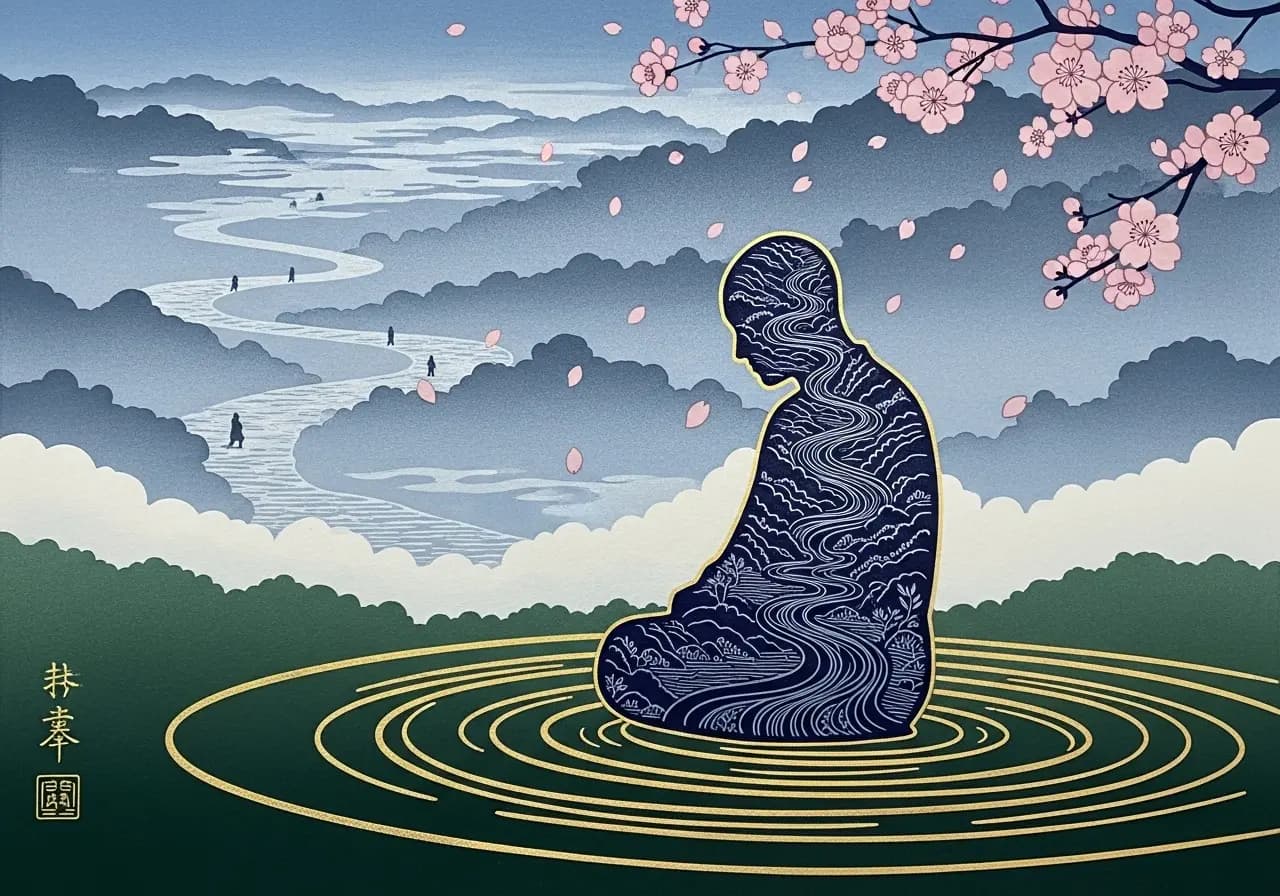
Stopping and Seeing
Episode 58 of the Secular Buddhism Podcast
Welcome to another episode of the Secular Buddhism Podcast. This is episode number 58. I'm your host, Noah Rasheta, and today I'm talking about the art of stopping and seeing.
The Three Doors of Liberation
In episode 52, "The Sound of Silence," I talked about a teaching called the three doors of liberation, and these three doors are emptiness, or non-self; signlessness, or no form; and the third one is aimlessness, sometimes referred to as no goal. Today, I'd like to elaborate a bit more on this third door—the idea or concept of aimlessness.
When I talked about this in episode 52, I shared the story of Angulimala. He was a murderer who was intent on causing chaos and mayhem, and when he confronts the Buddha, the Buddha goes on as if no big deal was happening here. He confronts Angulimala, who wants to chase him, but the Buddha just keeps walking as if nothing unusual is occurring. Angulimala can't believe what he sees, because he's used to most people being terrified and running from him or screaming. I presume he's taken aback by the fact that there's no fear coming from the Buddha, so he yells at him and says, "Stop!"
And this is my favorite part of the story, because the Buddha—I imagine in a calm and serene tone—just replies, "I stopped long ago, Angulimala. It's you who hasn't stopped." That's shocking to Angulimala. He doesn't know how to respond to that. This is the story as it's recounted in Old Path White Clouds, the book by Thich Nhat Hanh, but this powerful phrase—"I stopped long ago"—has really stuck with me. It's motivated me to share this podcast episode about the art of stopping and seeing, and applying this thought. I imagine the Buddha standing there, serenely saying, "I stopped long ago. It's you that hasn't stopped." I imagine him saying that to me. What is it that I haven't stopped? What was it that Angulimala hadn't stopped? That's what I want to talk about today.
A Question About Sitting With It
Part of this is inspired by a question I received from a good friend of mine, who asked: "I'm not sure what you mean by 'sit with it' with regards to specific feelings. Can you expand on that for me?" He also said, "I'd love to better understand the concept of suchness or oneness. I'd love to hear a podcast on that in greater depth."
I hope this episode accomplishes that—exploring the idea of suchness, the idea of oneness, and the idea of sitting with things, all in the context of the art of stopping and seeing.
Connecting to the Four Noble Truths
I also want to correlate what I'm going to talk about with what I discussed in episode 51 in my conversation with Stephen Batchelor. He talked about the Four Noble Truths not as truths to believe in, but as four tasks. As a quick reminder, we have the acronym E.L.S.A. to help us remember these:
E is embrace the suffering or discomfort. In other words, we embrace the situation at hand. What is the situation? On a large scale, it's that in life, difficulties arise. We embrace that. On a smaller scale, it's something like: "I'm stuck at this red light, and I don't want to be stuck at this red light." I can embrace the suffering and discomfort that I'm feeling in that moment. That's the first one.
L is for let go—let go of your instinctive reactivity to it. This includes letting go of the feeling that I shouldn't feel what I'm feeling. I'm just allowing things to be. Another way to think of this is: let it be. You know, let things be. I embrace the suffering and discomfort, and I allow it to be what it is.
S is see—see the stopping of the reactivity. As Stephen Batchelor said, this is what I call "sit with it." To me, sitting with something, stopping and seeing the reactivity of it, doesn't mean I'm stopping my emotions. It doesn't mean, "Okay, I'm not going to get mad." To me, this means when I am mad, I can stop and just see that I'm mad, and stop right there. I don't have to take it a layer deeper and realize, "Oh, now I'm mad that I'm mad." That, to me, is not stopping.
The stopping is being with whatever arises. If anger or sadness or a difficult, uncomfortable emotion arises, I can just be with it. I can watch it, I can sit with it.
And to me, this goes hand in hand with the concept of suchness. I can see things as they are. I can see my emotions and my feelings as they are, not as I think they should be. Because it's in that realm of how I think things should be that I run into trouble. In other words, the feeling of the feeling. So I'm sitting with the feeling, whatever that feeling is—pleasant or unpleasant—and that's suchness. To experience suchness is to experience life as it is, not as I think it should be, but just to see it as it is.
Suchness with other people is allowing someone to just be who they are. For a moment, I pause and don't have "who I think you should be" competing with "who you are." And I can do this with myself as well. A sense of suchness would be: "I'm allowing me to just be me, and not competing in that game of who I am and who I think I should be."
So oneness is being with the present moment, just as it is, becoming one with it, accepting it—not dwelling in the way I think it should be, but accepting the present just as it is.
A is the final step: act skillfully. The idea is that when I can embrace the suffering or discomfort, when I can let go of the instinctive reactivity I have to it—in other words, the desire for the pleasant and aversion for the unpleasant—when I can see the stopping of that reactivity, when I learn to sit with whatever I'm experiencing, even if it's uncomfortable, then I can act skillfully. Whatever I'm going to say or do or even think will be more skillful now because of these tasks and the way that I work with them.
The Three Correlations
I want to correlate all of this to that third door of liberation, aimlessness, which I talked about in episode 52, "The Sound of Silence." The third door of liberation is aimlessness, and it's correlated to the third noble truth: stopping and seeing. It's also correlated to the story of Angulimala, when the Buddha says, "I stopped long ago." I want to bring all three of these ideas together in what I'm going to talk about next.
There's something really powerful here, something very insightful: the ability to stop and see.
The Hidden Agendas Behind Everything We Do
The idea here is that everything we do and say is motivated by intent. You could say there's an agenda behind it. Think about this: there's an agenda to everything you say and do. There's a reason why you're saying it and doing it. Now, these aren't normal, transparent agendas. Unfortunately, they're typically hidden agendas. There are ulterior motives to what we say and what we do.
We're usually saying and doing things for a reason. There's something we're trying to get out of it, and most of the time, I would say we don't even know why. We don't understand the motive behind a lot of what we say and think and do. I think there's a deeper form of introspection here, because it's not just what I say and what I do—it's also what I think. The very thoughts that arise and seem so random or just natural, this thought just arose—there's generally an ulterior motive to where these thoughts are coming from.
From an evolutionary standpoint, we're driven by motives. I'll address this more towards the end, but aimlessness means that you don't put anything in front of you as the object of your pursuit. In other words, what you are looking for is not outside of you. It's already here inside. For example, you already are what you want to become.
Concentrating on aimlessness releases your longing and craving for something in the future or something that's somewhere else. One powerful way of working with the idea of aimlessness is to ask yourself: "What is my aim?" Or "What is my goal?" There's a lot of insight to be had with this introspective process, asking: "Why am I doing what I'm doing? Why am I saying what I'm saying?"
And like I mentioned, at a deeper level, you can actually explore this with your thoughts too: "Why am I thinking what I'm thinking?" Somebody does or says something, and you immediately create a thought around that. "Why am I thinking that? Where is this coming from? Why do I think this person is doing or saying that?" There's a lot to work with here.
Also with feelings: "Why am I feeling what I'm feeling?" And you'll discover that under everything we say, everything we do, everything we think, there's an agenda—often a hidden one, an ulterior motive.
For example, you can see this in nature. What it looks like on the surface is: "Oh, that bird is showing its feathers and doing this strange-looking dance for that other bird." What's the agenda behind it? "Oh, well, this bird is trying to attract a mate." Okay, so that's what I mean by this. There's always an agenda to the things that we do.
The Art of Stopping and Seeing
The art of learning to stop is about having the ability to pause, even if just for a moment, and shine some light on the things that we're doing, the things that we're saying, the things that we're thinking. It's about sitting with an emotion and just observing it.
Anger, for example, is one of those emotions that's very difficult to sit with, because we feel the need to do whatever we can to push it away, to distract ourselves, say something, do something, think something—to alleviate the discomfort we're feeling due to the emotion we're experiencing. Same with sadness.
But the point of stopping and seeing isn't to stop what we're experiencing. It's to understand in greater depth what it is that we're experiencing. It's to be able to catch ourselves and say, "Aha! You rascal you, I know what you're doing. I know why you're doing this. I know why you're saying this, or I know why you're thinking this." And to understand, "Ah, this is why I'm doing this. Here's the hidden agenda." And see through it. It's no longer hidden. We shine light on it.
There's real power in knowing what the agenda is behind a lot of what we say, think, and do.
Running Instead of Living
Here's the overall idea with this: What if we've been running our whole lives instead of living it, because of what we're chasing? We've been chasing after things like happiness, love, success. In Buddhism, even enlightenment falls into this category. And there we are, chasing after it. In this process of running, we're not living.
What if, by understanding the object of our pursuit, we can remove it? Then we're left with just living. That's the idea behind suchness.
The Tricky Part: Hidden Even From Ourselves
Here's the tricky part of these hidden agendas: they're often hidden not only to others—they don't know why we're saying or thinking or doing what we're doing—but a lot of the time, they're hidden from us. We don't even understand it.
And if we're completely honest with ourselves, we'll find that we really don't know why we say or think or do some of the things we say, think, and do. It's a lot like that rider and horse analogy that I often use. You're riding on this horse, and it's running at full speed, and if someone were to ask you, "Where are you going?" the honest reply would be: "I don't know. Ask the horse."
That's what's happening here. If we're completely honest with ourselves, a lot of times we don't know why we say or think or do the things we're doing, because the honest answer would be: "Ask the horse. Ask the emotion that's driving it. Ask the agenda. Ask the ulterior motive that I'm not even aware of."
This insight we're trying to gain is meant to help us stop, to stop running. When the Buddha told Angulimala, "I stopped long ago," I like to believe he was referring to his moment of enlightenment—the moment he looked inward, the moment he became perfectly aware of his own hidden agendas. He saw the proverbial rascal within and said, "Aha! I see you. I see you there." He gained insight into the nature of causality.
Understanding Karma and Dependent Origination
In Buddhism, this is often referred to as karma—cause and effect, the law of dependent origination. In other words, this is because that is. I'm saying this because of that, or I'm doing this because of that, or I'm thinking this because of that.
Our quest is: What is the "that"? What is the "that" that's behind this? This is a big question, because that's what I think he stopped and saw when he says, "I stopped long ago." This is what Angulimala was not able to see in himself in that moment. Why are you doing this? Why are you running around killing people? And once he understood the causes behind his thoughts and actions, he became enlightened, just like the Buddha. That's what the story goes on to say. Angulimala did eventually realize this, he stopped being a murderer, he became a monk, and that's a whole story. But I think that's what's being taught there.
Shedding Light on Our Motives
To me, like I've said many times before, this is not a mystical or supernatural process. This is literally shedding light on our motives and intents, understanding what's going on behind the thoughts, actions, and words. This is the moment we stop chasing after the object of our pursuit because we start to understand that it's not going to get us what we think we really want.
Even enlightenment—it's like, "Okay, well then, you're enlightened. Now what? So what?"
This idea is like understanding that a wave doesn't have to stress about discovering what water is or where the water is, because it is the water. In the here and now, it's already it. This is like a rose not having to stress about the fact that it's trying to be more like the lotus. It's already what it is. It's a rose, and it's beautiful. It's a beautiful manifestation of the cosmos just as it is. It doesn't need to be any different.
There Are No Shoulds
And like I talked about in last week's podcast episode, there are no shoulds. There's no "this is how it should be." Life is just what it is, and it's perfectly fine the way it is. And sure, there are a lot of "coulds"—how things could be. There's a lot of opportunity and hope in the way that we can interact with life as it's unfolding, to move it towards how things could be. That's all legitimate, and I'm not saying that we just become content and, "Oh well, now I'm not changing life, because there are no shoulds."
What I'm saying is: life could be this way, it could be that way. But that, to me, doesn't feel anywhere near the same as it feels when I'm thinking, "Here's how life should be," because there is no should.
And you, as you're listening to this, you are the manifestation of the cosmos in the same way that a rose is. You're wonderful just as you are. And if you think about it, it's taken every single thing that's ever been for you to be here and now, just the way that you are.
Sure, you could be another way. But you shouldn't. There's no should there. It's not that you should be another way.
How Buddhism Helps: Shedding Light, Not Fixing
This, I think, correlates with another common question I receive from people: "How does Buddhism or mindfulness help with X, Y, Z situation?" For example, PTSD or traumatic experiences or past events that now cause deep pain or fear—like abuse in the past or something like that.
In this context, what it's saying is: it's not that "Oh, Buddhism fixes this or that" or "Here's how it solves it." It's saying there's nothing to solve. Buddhism is a light that shines on things to give us more clarity into the nature of that thing.
In that sense, it's not that there's something to fix. It's saying: "Here's what is, and you can gain insight by seeing this more clearly, understanding the nature of impermanence, the nature of interdependence, and starting to see these things in life for what they really are."
But it's not saying, "Oh, here's why you do this. Because this will fix that, and then..." That's implying you shouldn't have PTSD. Again, going back to this, there is no should. You do have it. It's what you're experiencing. So let's understand it with more clarity. "Oh, okay. Well, this is why I'm experiencing this. Well, why is that traumatic? Oh, well, it's because of this." So you're constantly shedding more and more light on the understanding. But never with the intent of saying, "Okay, because I did all that, now it should go away." There is no should there. It's just: "Well, this is what is. If you're experiencing it, look at it closely."
The same is true with emotions. People will say: "Well, I thought the point of Buddhism or practicing mindfulness was so that I could get over my anxiety." Well, no, that's a should. We're going back to: if you're experiencing it, let's look at why.
Now, life can change it, because the nature of life is that it's impermanent. Things are always changing. So one day I may be experiencing it. The next day, I'm not. But the point wasn't to get from point A to point B—from experiencing anxiety to not experiencing anxiety. It may arise again.
Mindfulness practice in my own life helped me with anxiety at a stage when I was experiencing it a lot. I don't know if it'll ever come back. I don't know that it will. I see life quite differently than I did when I was experiencing it. But I don't sit here thinking, "The point of this is to ensure I'll never feel that again," because that's just not true.
The Fear of Aimlessness
I think we have this fear that if we approach life with an attitude of aimlessness, we're not going to get anywhere. Because the point is you're supposed to be somewhere. But if you think about this closely, that's actually impossible. You can't not be somewhere. You are somewhere. You will always be somewhere. You are always going to be wherever you are. Where you are is somewhere.
And again, think of this in the context of "could" or "should."
The thought that "I should be over there—I'm here but I should be there" is very different from "I'm here and I could be over there." To me, those two approaches feel very different, because one implies possibility. The other one implies almost this sense of "I deserve to be there. I'm not supposed to be here." This sense of entitlement, I think, is the right word. And the truth is, I am where I am. That's where I'll always be. It doesn't matter where I am physically; I will always be where I am.
So for me, it's one thing to start asking myself: "Where am I going in life?" But it's a whole other thing to be able to stop and understand: "Why do I think I need to be going where I think I'm going? Why do I think I need to be over there?" It doesn't mean that I should or shouldn't be over there. I'm just saying, why do I feel the need to be over there? I could be there, sure. But why do I feel like there's this sense of "I should be there"?
Understanding the Conditioned Mind
That's what I want to start looking into. The art of stopping and seeing is about analyzing the shoulds in our life, because that's the conditioned mind speaking. There's a conditioning behind that thought, and it's the conditioning that makes me think in what I would call "should mode."
I think Angulimala was operating in this mode. He was on a path of destruction. His conditioned mind had him operating in that should mode: "I should be killing," and that's probably because he was very angry or hurt. "Because I'm so hurt and so angry, I should take it out on someone and kill them." I don't know his exact motives, but I'm thinking of something along those lines.
He hadn't stopped to understand the agenda that was driving his actions. He might have been able to stop at some point and thought: "Oh, I'm very angry. Okay, well, that's what's motivating me. That's the agenda. Well, why am I angry?" The agenda has an agenda, right? So this is the clarity that he was finally able to gain through the Buddha's wisdom, which came about in that abrupt presentation: "Hey, I stopped long ago. It's you that hasn't stopped."
I imagine Angulimala was confused and thought: "What are you talking about? What do you mean, I haven't stopped?" And that moment of introspection and insight led to an entirely new path. He quit his path of murder, not because he felt that he should, but because he was able to see that he could. He could go through life not being a murderer. That was a possibility.
He didn't have to be compelled to stop like, "Hey, this is morally wrong." I'm not saying it is or isn't. What I'm saying is, it wasn't the compelling that made him stop—like, "You need to stop murdering! Okay, fine." That wasn't it. People had been trying that all along.
What he was able to gain was insight into the nature of things. And the skillful thing for him to do at that point, with that awareness, was to not do what he was doing. So he pivoted in life. He headed in a new direction.
Walking Through the Doors of Liberation
And this is what starts to happen with us when we walk through the doors of liberation, when we extinguish notions, when we stop and just see things as they are—behind the stories, behind the meanings, behind the labels that we add to them. We see our habitual reactivity in connection to our hidden agendas, our ulterior motives.
And we start to see there's no longer this need or this fear of not becoming who I think I'm supposed to be. You're just left with peace—this peace and calmness in resting in the fact that I am just fine just the way that I am, where I am. And then I see possibility opening up. "This is how I am, but this is how I could be. Maybe I'll try that."
It's like when the wave knows how to rest in the fact that it is already the water, the wave enjoys going up and enjoys going down. The ups and downs, right? The wave's no longer afraid of being or non-being, life or death, what's happening now, what happens later. There's no fear in any of that anymore, because the fear of coming and going—the wave has seen that the wave is the ocean.
And this, to me, is the art of stopping and seeing.
Not a Resignation From Life
When the Buddha said, "I stopped long ago," he didn't mean he had given up on life or that he had resigned to life as it is. In fact, from that moment on in the story—his enlightenment—he worked really hard for many, many years. From his thirties to his eighties, he worked pretty hard on building up a community, building a way of life that was beneficial to his society, teaching, traveling. There was a lot.
There was no resignation at that point. But there was the ability to stop and see and understand: "Why am I doing what I'm doing?" I think that's what he was able to answer about himself.
The goal of that process isn't for us to say: "Well, I want to know what he saw so that I can..." No, what he's trying to say is: "Point that to you. You do the same, like Angulimala did. Stop and see." It doesn't mean we're going to no longer have goals. It means we can have a much more clear understanding of why we say the things we say, do the things we do, think the things we think, feel the feelings we feel.
That's personal insight. That's on you.
Your Stopping and Seeing
Your stopping and seeing will reveal something incredibly profound about you that only you can see. I cannot give that to you. I can't say, "Hey, stop and see. Here, let me tell you this is what you're missing." I can't do that. You can only do that with yourself.
This is one thing I love about the Buddhist path—it's a very personal path. It's your path. And when you stop and see, you're going to see something that only you can see.
The Motives Behind the Motives
From the Buddhist perspective, we often talk about interdependence—the fact that all natural phenomena have causes and conditions. And this implies that the causes and conditions also have causes and conditions.
To me, this understanding of causality implies that even my hidden agendas—the ones I'm not aware of, the motives behind the things that I say and I do—also have motives. So the motives have motives. The agendas have agendas.
From an evolutionary standpoint, one of our core motives that I think is really helpful to understand is the motive to affiliate and bond with each other—the motive to belong. Our desire to belong seems to be a primitive survival mechanism. We do things in order to belong, and we avoid doing things that we think will jeopardize our sense of belonging.
For me, it's been interesting to explore my own agendas and to find that, often, the agenda behind the agenda is this need to belong. It's this core need to not jeopardize my belonging and to strengthen my belonging.
And again, I think the idea of understanding all of this isn't just to try to reconfigure myself and suddenly no longer be how I am. The idea here is that, through understanding the nature of my own mind, I can become more skillful in how I navigate this experience of being alive. I can work towards eliminating the unnecessary suffering—the self-inflicted suffering that I cause for myself and others when I'm unskillful in the things I say, think, or do.
The Call to Stop and See
So that's the goal of this podcast episode. By engaging in the art of stopping and seeing, I hope you'll have the opportunity to see something in yourself—to see the agenda, to see the agenda behind the agenda, and to become more skillful in how you navigate life.
I hope that in the stopping and seeing, there's the ability to realize: "Maybe I've been running after something, and in the process of running, I'm not living. This is about stopping and seeing that I can just live now. The way that I am now is fine. Sure, I could change and be a harder worker or drink less or..."
Those are all coulds, but they're not shoulds. And when I can explore this in the context of could versus should, like I talked about in the last episode, then I start to gain more insight. I start to experience this ability to sit with things, to just be with life as it is, to be with you as you are, to be with me as I am.
And in that process, overall, I'm eliminating or at least minimizing the unnecessary suffering for myself and others. And I hope that's what you can accomplish and what you can see and what you strive towards—not because that's how it should be, but because that's how it can be.
Closing Thoughts
I appreciate you taking the time to listen. I hope some of this information can be useful to you on your own journey of learning to stop and see, learning to just live instead of chasing the feeling of living.
Just stop and live.
I hope the story of Angulimala resonates with you the way it did with me. Like I've mentioned, it's been a scene that's prevalent in my mind. I see that moment—the shock and awe that Angulimala must have felt when the Buddha wasn't scared of him and just said, "Hey, I stopped long ago. It's you who hasn't stopped."
I hope you can stop and ask yourself: "In what way can I stop? Or why have I not stopped? What is the object of my pursuit, and why am I chasing it? If I finally get what I think I'm going to get, then what? If I'm here and I want to be there and I finally get there, then what?"
This is where that quote I really like comes in: Sometimes you get there and you realize there's no there there, because wherever you are, there's another there.
So stopping and seeing is about the present moment. It's about here and now. This is where you are, this is how I am. What can I do with that? What insight can I gain from seeing that, if I can stop?
Connect With the Community
If you've enjoyed this podcast episode, please share it with others, write a review, or give it a rating on iTunes. But also let me know what you think. We have an online podcast community—the Secular Buddhism Podcast community is a Facebook group where we can discuss things. You are also welcome to join our Weekly Sangha, where we discuss topics from the podcast and practice mindful living as a group.
You can join that online community by visiting secularbuddhism.com/community.
If you would like to make a donation to support the work I'm doing with this podcast, feel free to visit secularbuddhism.com and click the donate button there.
That's all I have for now. I look forward to recording another podcast episode soon. Thanks again for listening.
Until next time.
For more about the Secular Buddhism Podcast and Noah Rasheta's work, visit SecularBuddhism.com