

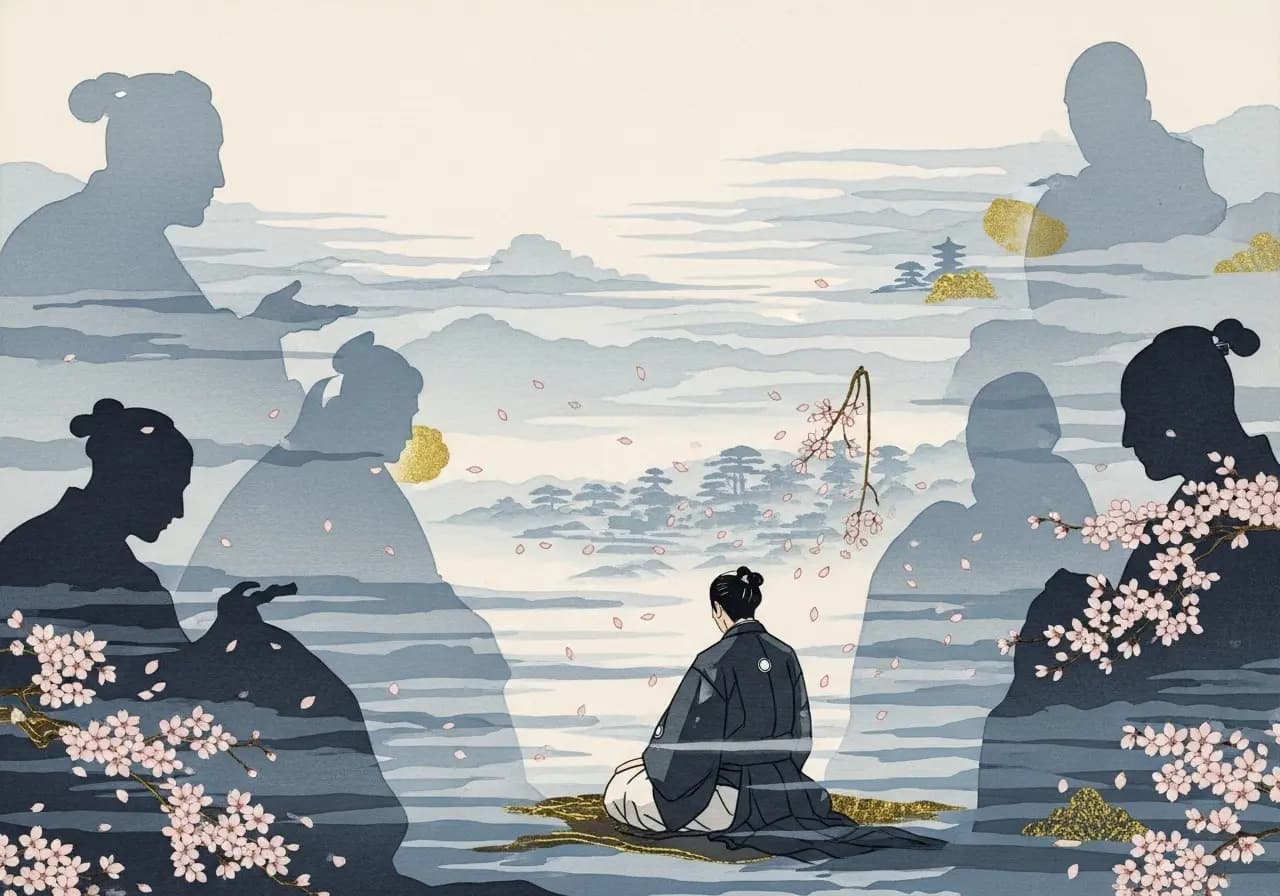
All-Pervasive Suffering
Episode 57 of the Secular Buddhism Podcast
Welcome to another episode of the Secular Buddhism podcast. This is episode number 57. I'm your host, Noah Rasheta, and today I'm talking about all-pervasive suffering—what it is, and more importantly, how we identify it when we're experiencing it.
There's a good reason why we talk about suffering so often in Buddhism. Suffering is the central problem that Buddhism addresses. Recognizing our suffering is the first step to its solution. We've talked about how suffering is a universal truth, along with impermanence and interdependence. It's one of the three basic qualities of existence, also known as the three marks of existence. But suffering itself comes in many forms.
We often talk about it in the context of three overall categories—three different patterns of suffering that we experience in our lives.
The Three Patterns of Suffering
The first pattern is the suffering of suffering. I talked about this early on in the podcast, probably in episode two. The suffering of suffering is what we're all familiar with. This is the pain of birth, old age, sickness, and death. It's easy to understand. We all get it.
The second pattern is the suffering of change, or the suffering of loss. This is how we feel when we don't get what we want, or when we do get what we want but can't hold on to it—like youth, aging, losing a job. Change itself fits nicely into this second category.
The third pattern is something different altogether, and it's the one I'm most interested in exploring in myself and in others.
Introducing All-Pervasive Suffering
This third category is called all-pervasive suffering. Unlike the first two patterns, this is the type of suffering we're generally not likely to recognize. You could say it's the most destructive when we do experience it because it underlies so much of what we say and do. This type of suffering is the hardest to identify, but it's based on conditioning—on the conditioned mind.
I've been thinking about this a lot lately because I've been receiving emails from podcast listeners, friends, and family, and reading through Facebook posts recently that have triggered this thought. I've noticed a sense of suffering that some people are experiencing in life because of certain circumstances or situations. What I want to highlight is that this type of suffering generally has nothing to do with the actual circumstances. It has everything to do with the concepts or beliefs behind the circumstances.
Let me give you an example. If we're looking at all-pervasive suffering as applied to a view you might have of yourself, consider this: I may experience a form of discontent or suffering because of the way I look—maybe it's my weight, or maybe it's the shape of my nose. I start to experience discomfort with reality as it is. This is how my nose looks, and I don't like it.
But here's the thing: the discomfort I'm feeling, which I think is associated with the circumstance of how my nose looks, if you look deeper, what you'll discover is that it's actually associated with an idea or concept—the conditioning in my mind that makes me think, "This isn't the right nose to have. My nose should look like that. Mine looks like this."
So I'm not suffering because of my nose. I'm suffering because of the belief I have about how my nose should be.
Where All-Pervasive Suffering Manifests
This manifests in three major areas in life.
First, with life in general. Here's how life is. Here's how I think life should be. The moment I hold that concept, that belief, that idea in my head of how it should be, I encounter all-pervasive suffering. It's a lingering feeling that's always there—the sense that things aren't the way they're supposed to be, that things aren't the way they should be.
Second, with other people. There's you as you are, and you as I think you should be. This is very evident in couples and relationships. Anybody in a marriage or partnership, or in relationships with family members, siblings, children, or parents experiences this. We conceptualize who this person should be, and we're constantly assessing and comparing who they are to who we think they should be. The suffering that arises from this is that nagging feeling that they're not who they should be. "You should be nicer. You should believe this. You shouldn't believe that. You shouldn't do this. You should do that."
But here's the key: the suffering doesn't have to do with the circumstance itself. It has to do with the belief behind the circumstance.
Third, relating to ourselves. There's who I am, and who I think I should be. The moment I do that, I can experience all-pervasive suffering.
A Concrete Example
I've noticed this a lot lately with people who have reached out to me. One example was someone experiencing feelings of anxiety and depression, and the entire explanation of their situation was focused on how "I shouldn't be feeling this."
This person was qualifying the experience of reality, saying, "This is how things are. This is how I feel, but I don't think I should feel this. I don't deserve to feel this way. After all, my situation in life is actually very good. Someone who has it way worse than me might be more entitled to feeling depressed than I am. I shouldn't feel this."
Do you see what's happening here? There's an additional layer of complexity because there's how you're feeling, and then there's how you're feeling about how you're feeling—and in this case, both are unpleasant emotions. Feeling depressed is already difficult, but to feel depressed and then feel, on top of that, that "I shouldn't feel depressed," means you're feeling bad about feeling bad. That's what all-pervasive suffering is. It's this lingering feeling that arises because there's a picture in our heads of how things should be, and reality isn't matching that picture.
Working with All-Pervasive Suffering
To work with all-pervasive suffering, what we do is spend time looking at how we're seeing things. What is the belief behind the feeling, the thought, or the emotion we're experiencing?
One way I like to do this is ask myself, "Is there a 'should' in here?" Whatever I'm experiencing, especially if I'm experiencing suffering, I ask myself, "What is the should?" "Oh, I'm suffering because this is happening at work and this isn't how it should be. Oh. Okay. Well, there it is."
I think I have a picture of how it should be, reality isn't matching that, and boom—I'm experiencing suffering. That's the all-pervasive suffering. This is why we say it's always based on the conditioned mind. There's some form of conditioning, a belief, a concept, or an idea that we hold. If you dig deep enough, that is the root source of the suffering you're experiencing when it comes to all-pervasive suffering.
You can start looking at this in your own life. I've done this many times. I've noticed instances of suffering in my relationships where I'm thinking, "This is how my relationship should be working. This is how the dynamic should be." Well, the moment I do that, any time it doesn't match that picture, I catch myself with this lingering feeling that something is not right. But it's not that it's not right. It's that I have an idea, a lingering belief that I know how it should be, and because it's not matching that, I'm experiencing discomfort.
A Caution Worth Considering
Now I want to caution you about something here. One of the first things we'll do once we realize we have the tendency to have "shoulds" is think, "Oh, I shouldn't have shoulds." Right? Now we're caught right back in the very same problem we're talking about.
So rather than trying to combat this tendency to have shoulds by saying "I shouldn't have shoulds," don't do that. It'll just complicate things. What we want to do is just look at the scenario and recognize, "Oh, that's why I'm suffering. Okay. I'm not going to do anything about that right now. I'm just trying to understand it."
We're just trying to have a clearer picture of what's taking place in our minds when we're experiencing discomfort or suffering.
From "Should" to "Could"
What helps me is to replace "should" with "could." Instead of thinking, "My relationship dynamic should be this way," I'll pause and say, "Well, what if I replaced 'should' with 'could'? Here's how my relationship could be."
Oh. That's a whole different scenario, because now it's more along the lines of possibility. Here's how it is. Here's how it could be. "Should" implies right and wrong. The idea of right and wrong creates problems from a Buddhist perspective. This is why we talk about the Parable of the Horse—the one about who knows what is good and what is bad.
There are several concepts in Buddhism that make it difficult for us to have the mindset of right and wrong as an inherent thing. How things are, how things should be—one is right, one is wrong. But if I replace that with how things could be, now it's on a spectrum of possibility. I'm dealing with reality. This is how it is, and I absolutely accept that this is how it is. But I'm also holding the thought that this is how it could be.
How things could be might be more beneficial for me or others. It could minimize the suffering I'm experiencing or the suffering others are experiencing. That may be the catalyst for what I say and do to move toward what could be. But that's a different mindset than being in reality and fighting reality because it's not how it should be.
There is no way that it should be. There are no shoulds. There's just how it is. There's how it was, and there's how it is, and then there's how it will be. But never how it should be.
I like to replace "should" with "could," and for me, it changes things. It minimizes that sense of rightness and wrongness. Reality doesn't feel like it's wrong the way it is right now, because it's just how it is right now. That minimizes a lot of this all-pervasive suffering—this lingering emotion that feels like something is not right.
I'm left instead with the understanding that everything is right as it is, because it's not about right or wrong. It's about how things are and how things could be. Things are how they are. That's reality, and that's what I have to work with.
The Source of All-Pervasive Suffering
I see this in all the examples I receive from emails and people who reach out. Generally, there's a "should" in there. There's an idea, and they're bumping up against the comparison of their reality with the story—the narrative of how reality should be. The dichotomy between these two—reality as it is and reality as I think it should be—is what causes this additional form of suffering. It's really self-inflicted, all-pervasive suffering.
That's the type of suffering we're really concerned with in Buddhist practice, because that's something you can work with. It stems from your ideas and your concepts. That's what you can look at. "What ideas do I hold? What beliefs do I hold that cause this form of suffering?"
So the invitation is to look deeply at your own ideas. Where do my ideas come from? Do my ideas cause me to experience discomfort or suffering?
The Western Myth of Original Sin
I wanted to share something from Tara Brach's book, Radical Acceptance. She talks about a concept that I think is worth exploring, especially for those of us with a Western mindset.
She mentions that our culture's guiding myth is the story of Adam and Eve's exile from the Garden of Eden. We may forget its power because it seems so worn and familiar, but this story shapes and reflects the deep psyche of the West. It's the message of original sin, and it says:
"Because of our basically flawed nature, we do not deserve to be happy, loved by others, or at ease with life. We are outcasts, and if we are to reenter the Garden, we must redeem our sinful selves. We must overcome our flaws by controlling our bodies, controlling our emotions, controlling our natural surroundings, controlling other people. And we must strive tirelessly—working, acquiring, consuming, achieving, emailing, over-committing, and rushing in a never-ending quest to prove ourselves once and for all."
I think this hits on something really powerful. I've experienced this in my own life, and I continue to see it in the lives of my close family and friends—this idea that we can't be at ease, that we can't accept things as they are, because we're constantly trying to prove ourselves to some standard of worthiness. Until I reach that standard, I don't deserve to be happy. I don't deserve to be loved. I don't deserve for life to be easy.
I see this all the time. I see people thinking, "My life is not hard enough. Therefore, I should not be feeling bad about it." So the moment they're feeling bad about it, they're caught in this way of thinking that says, "I feel bad about something I shouldn't feel bad about. Therefore, something is wrong with me. I'm weak. I'm a failure."
The problem gets placed back on them because they're not supposed to be feeling this way. But if you look at that closely, what you'll really find is that there's nothing wrong with feeling bad. There's nothing wrong with feeling depressed or feeling anxiety. These are just feelings. They're emotions.
It becomes complicated when we think we shouldn't be feeling what we're feeling.
Thinking About Thinking
We do this with thoughts too, right? "I shouldn't be thinking this." This happens all the time in meditation. People learning to meditate run into this idea: "I'm not doing it right because I'm sitting here thinking about this, and I should be thinking about that."
But that's missing the point entirely. Meditation is about learning to see what's there. It doesn't matter if you're thinking about this or that. It doesn't matter what the content is. You're learning to see it, to embrace it, to experience it, to get familiar with it.
We want to do the same with our emotions. When we're experiencing a negative emotion like anxiety or depression, we want to fight it. We want to get rid of it because of the conditioned mind that says, "Hey, you're not supposed to be feeling this."
But who said we're not supposed to be feeling it? Where did that idea come from? What if we understood that there is no "supposed to"? There's no way that you're supposed to feel. There's only ever just how you feel. If that's how you're feeling, sit with it. Look at it. Become intimately familiar with the emotions you're experiencing, with the thoughts you're having. Stop trying to fight them.
My Personal Journey with Anger
This was a really powerful shift for me—allowing myself to feel what I was feeling. I've mentioned in the past that I had a phase of tremendous anger in my life. A significant part of that anger was aggravated by the belief that I wasn't supposed to be angry.
So there I was, angry, and I was angry that I was angry. I had been conditioned to believe that "You're a nice person. You're supposed to turn the other cheek. You're not supposed to feel these things." So I would feel anger and push it aside. I dealt with this for a couple of years.
It wasn't until, through mindfulness practice and studying psychology, that it finally clicked: "Who said I wasn't supposed to feel anger?" I allowed myself to be angry. I was very, very angry, and it was okay because it's just what I was experiencing.
When I allowed myself to be with the emotion and just sit with it—I don't remember exactly how long it took, but it felt like what had been taking me years to overcome. By allowing myself to just feel it, within days or weeks it was gone. Because I allowed it to finally sit with me long enough to run its course.
I don't say that to suggest "you're supposed to let it sit there so it's supposed to go away." There are no supposed-tos here. You sit with it. The nature of reality is that it's changing. Things change over time. So if we look at it that way, I'm probably not going to feel the way I feel right now forever.
This is how I feel now, and if anger is what I feel now, then sit with it. In my case, it went away. Sure, it's resurfaced at other times for different circumstances, but that specific anger ran its course. And I haven't felt the way I felt back then ever since I allowed it to really run its course.
The Real Work
That's what we're trying to focus on with all-pervasive suffering—not the circumstances, but what are the beliefs or the concepts behind the circumstances that are making this more complicated than it needs to be?
It's like asking: "Whatever the feeling is, what is the feeling about the feeling? Where does that come from?" You may find it comes from an idea, a belief, an opinion. And that gives you something to work with. That's something you can look at.
Instead of pushing away the feeling or the emotion, explore the mental process happening behind it. What is the feeling beneath the feeling? What is the thought beneath the thought?
The thought itself isn't the problem. The feeling itself isn't the problem, whether that's a positive or negative emotion, thought, or experience. It's just what is. So that's what all-pervasive suffering is. It's the type of suffering we're most likely not going to recognize because we're caught up in the experience of the feeling. We don't even realize there's something deeper there.
That general background of anxiety, insecurity that can often taint even our happiest moments—deep down, that comes from somewhere mental. It comes from somewhere where there's an idea, a thought, an opinion, a belief that colors how we feel about how we feel. That's what we want to look at.
Understanding vs. Changing
From the Buddhist point of view, these ideas and concepts are fine. The problem isn't having them or changing them. The purpose is to just explore them. Exploring, knowing, understanding, and gaining knowledge about ourselves—that's what offers us glimpses of wisdom. That's where insight comes from.
So again, this isn't about changing things or sitting here and thinking, "I need to change how things are." That's part of the problem. Instead, it's sitting here and thinking, "I need to understand why I feel the way I feel. I need to look at it deeply. I don't need to change how I feel. It's just how I feel. So I want to look at it."
It's when I look at it that insight arises. I think, "Oh, that's why I feel the way I feel. Okay. Well, that makes more sense." We process it in that perspective, but not by pushing these things aside.
A Practice for Yourself
That's what I wanted to share about all-pervasive suffering. I see it everywhere, and I'm sure you do too. We all have friends, family, and loved ones who are dealing with all-pervasive suffering all the time. And I'm sure you are too, and I am too.
I'm trying to understand, at any given moment, if I experience suffering. The first thing I want to do is analyze it and ask, "Is this self-inflicted or is this natural?" Because if it's natural, I don't even need to worry about it. But if it's self-inflicted, I can actually do something about that. I can discover the source of it—the thought, the underlying thoughts, ideas, and beliefs that are making this more uncomfortable than it needs to be.
Then I have something to work with. That's what we're trying to do with all-pervasive suffering: trying to understand at a deeper level what's going on, not trying to change it.
It will change, trust me. It will change because the nature of reality is that it's impermanent. Things are always changing. But we can't gain the insight without increasing our awareness of what's going on. So rather than fighting the emotion or resisting the discomfort of suffering, what if we could sit with it, analyze it, study it, embrace it, become intimately familiar with it? Then it's not such a problem, right?
We become more comfortable with discomfort, and we understand it. Then it doesn't have such a grip on us. It arises, it lingers, and then it moves on in the same way that clouds in the sky do.
I hope that's relevant and makes some sense. Sometimes I wonder if the concepts I try to explain sound too esoteric. I try to explain these ideas in the way they've clicked and made sense to me. I hope this message about all-pervasive suffering resonates with at least some of you and gives you the ability to sit with instances of all-pervasive suffering you may be experiencing in your life.
Hopefully it gives you insight into what's going on at a deeper level—what the ideas, thoughts, concepts, and beliefs are that may be underlying the suffering you're experiencing.
Thank You
If you've enjoyed this podcast episode, please feel free to share it with others. You can write a review or give it a rating on iTunes. You can join our online community by visiting secularbuddhism.com/community for more information about that.
If you'd like to make a donation to support the work I'm doing with the podcast, you can visit secularbuddhism.com and click on the Donate button.
That's all I have for now, but I look forward to recording another podcast episode soon. Thank you for your time. Until next time.
For more about the Secular Buddhism podcast and Noah Rasheta's work, visit SecularBuddhism.com