

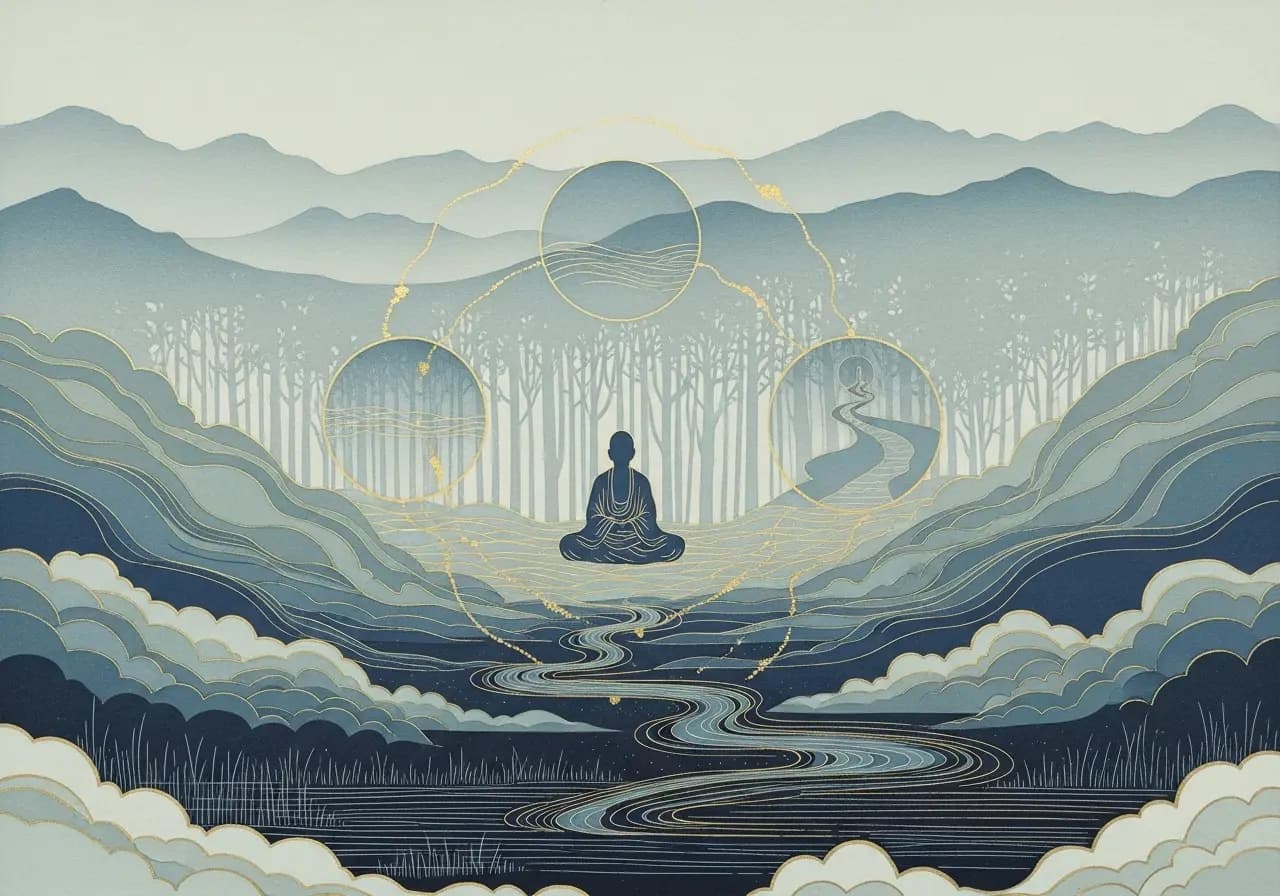
The Sound of Silence
Episode 52 of the Secular Buddhism Podcast
Welcome to another episode of the Secular Buddhism Podcast. This is episode number 52. I'm your host, Noah Rasheta, and today I'm talking about the sound of silence. I left a long, awkward pause here at the beginning, hoping to trick you into thinking this whole episode would be silent. After all, it's about the sound of silence. The truth is, even if it were, you can still gain a lot of insight and wisdom just by listening to the sound of silence.
Where This Came From
This topic came about because I've been reading through some stories in Thích Nhất Hạnh's book, Is Nothing Something? Kids' Questions and Zen Answers About Life, Death, Family, Friendship, and Everything In Between. One of the first questions addressed in the book is, "Is nothing something?" Thích Nhất Hạnh's answer is yes—nothing is something. You have an idea in your head of nothing, and you have an idea in your head of something. Both are things that can either create suffering or happiness.
This made me think of another quote or teaching by Thích Nhất Hạnh where he says, "The secret of Buddhism is to remove all ideas, all concepts, in order for the truth to have a chance to penetrate and reveal itself." When I correlate these two ideas—nothing becoming something, or nothing being something conceptual—with the idea of removing ideas in order to see what is, it made me think: what would really be there if I was able to remove ideas, concepts, and beliefs? What would I actually see? What would I hear?
Noble Silence
In the Plum Village tradition of Zen Buddhism, there is a practice called Noble Silence. This is a term attributed to the Buddha for his responses to certain questions about reality. When he was asked unanswerable questions, he is said to have responded with no response—silence. This silence seems to have been the appropriate answer to what he considered an inappropriate question.
To me, an inappropriate question is one that evokes an answer that doesn't lead to a proper understanding of reality. If the secret of Buddhism is to remove all ideas and concepts, then we want to avoid questions that only add ideas or concepts. Metaphysical questions would only add ideas and concepts. Therefore, these questions are irrelevant, and the silent answer by the Buddha makes sense.
Metaphysical assumptions regarding existence or nonexistence, what happens after we die, questions about deities—these all fall under the category of ideas and concepts. The very ideas and concepts we're trying to remove in order to see reality as it is.
I've mentioned before my story about seeing Chris and not seeing Chris. What blinded me from reality in that moment was an idea. It was a concept. It was a belief that Chris was a man when, in reality, Chris was a woman. I couldn't see Chris because of the concept I held. What happens if we remove those concepts? Will we become more likely to see reality as it is?
Perhaps the sound of silence is what it sounds like when we become free of ideas and concepts.
The Three Doors of Liberation
Buddhism is commonly referred to as the path of liberation. What would life be like if we were liberated from our own ideas and concepts—the beliefs that color our reality?
There's a teaching in Buddhism about the three doors of liberation. These three doors are emptiness, signlessness, and aimlessness. I want to talk about those.
First Door: Emptiness
Emptiness essentially means no independent existence. Emptiness is always relative to something. A cup that is empty of water is empty in relationship to water, but it may be full of air. Emptiness is not the same thing as nonexistence. Emptiness is not a philosophy—it's just a description of reality. It's a direct understanding that all things are empty of separate, independent existence. In other words, this is because that is. There is no this without that.
If you look at this in the context of time, it makes perfect sense. There is no present without the past. If you look at it in terms of space, you can look at a flower. The flower does not exist without all of the non-flower elements. You cannot have a flower without having bees, clouds, rain, and sun—all the non-flower elements. It's the same with us. You are interdependent with all the non-you elements, whether they be physical elements like your genetics, your DNA, the very food you eat, or non-physical elements like your memories, your cultural ideas and beliefs. Literally everything about you depends on everything that's not you. That's the idea of emptiness here.
Second Door: Signlessness
The second door is signlessness. This means no form. Like clouds in the sky, if you attach to the form of, say, a cloud, the moment the cloud is gone, you'd have the tendency to think, "Well, the cloud no longer exists. It's gone." But the attachment to the form is what blinds you from seeing the cloud in its new form—perhaps as rain, or mist, or even the water that you drink.
There's this understanding that the cloud is always there. It never ceased to exist, because it never started to exist. This is the first law of thermodynamics: matter doesn't cease to exist. It only changes. It changes form.
We look beyond the form, beyond the sign of a thing, and we start to see impermanence—the nature of constant change in all things, in all forms. Forms just become like containers of what is in the present moment. We start to see that the object of our perception may not be what it seems. Instead of seeing forms or signs of things, we start to see things as continuations of complex processes of causes and conditions. We see constant change. We see things in a continual state of becoming, always in flux. That's signlessness.
Third Door: Aimlessness
The third door is aimlessness. Essentially, it means no goal. This is the understanding that life itself is the goal. The path is the goal. As long as we think there is an ultimate destination, it makes it difficult for us to really enjoy where we are, because we see separation between where we are and where we think we should be. In a way, we're always trying to get there, but then when we do, there's no there there.
Everything we need to experience contentment and joy is found here in the present moment—the here and now. There's no need to look outside of ourselves. The problem with the opposite of aimlessness is that we run the risk of running our whole lives and never actually living it. What are we running after? Enlightenment? Happiness?
The insight of aimlessness is to help us stop running and instead start living. You could ask yourself, "What am I chasing after? What is the thing that I think I need to finally have?" You see this everywhere—money, fame, power. We're always chasing after something.
Now, there's a misconception with aimlessness. In our Western way of thinking, we might think aimlessness has a negative connotation. It's like, "There you go, without a rudder, where are you going?" From the Buddhist perspective, it's saying, "I'm going to have a very clear understanding of what I'm after, because I know why I'm after it."
The real danger of negative aimlessness would be that I'm headed somewhere and I don't know why. It's kind of like the parable I share often—about the man running on the horse, and the person standing there asking, "Hey, where are you going?" He says, "I don't know. Ask the horse." That's a form of aimlessness. To me, that would be the negative way of thinking about it. You're on this horse and you don't even know where it's going. The horse is running after money, or fame, or power.
But the Buddhist perspective of aimlessness is that this is actually a good thing. I don't have to chase after anything. I'm enjoying the journey. The path itself is my goal. That's the type of aimlessness we're talking about here in this third door.
What Is Silence, Really?
I think silence can be a powerful reminder of the lesson of liberation. If nothing is something because it's a concept, then what does that mean about silence? What is the implication of silence? Because silence is also a concept. In fact, the dictionary defines silence as the complete absence of sound.
This understanding puts us in the same dilemma of emptiness. In other words, silence, like emptiness, is always relative to something. The empty cup is empty, and yet it's not actually empty. It can be empty of water, but it's full of air.
The old question is, "Is the cup half empty or half full?" The answer tells you if you're an optimist or a pessimist, because the optimist says it's half full, and the pessimist says it's half empty. Here's a new one we can throw into this equation: the mindful individual will say, "Well, it's neither half full nor half empty, because it's both full and empty." When you understand that that's a relative concept, half full of water is half full of air. It's completely full and it's completely empty—empty of milk or whatever the relative term is. It's both full and empty.
What is the sound of silence?
Think about somebody in the city trying to escape the sound of honking, the sound of ongoing movement of people and cars. They leave the city and go to the country. There they are, sitting either in the forest or in a field, trying to enjoy silence. This is the silence of no city sounds. But now they're listening to the chirping of birds, the sound of the river flowing, the cows mooing. So silence is relative. You end one sound, but you hear another.
Maybe imagine someone in the country who doesn't want to hear any sound. They escape the sound of the river or the birds chirping. They put noise-canceling headphones on and discover, "Well, now I just hear white noise." Silence is always relative to something.
But what about when there is no sound? What then? You're just listening to your thoughts? How quiet are your thoughts? If you catch the gap between the thoughts—if you practice this—then what do you hear in that gap? Maybe even there, there's still the subtle ringing or humming of silence.
Have you ever heard that? This is interesting. Did you know that the earth has a constant hum? You can Google this. It's a fascinating thing. Researchers claim that microseismic activity from long ocean waves impacting the seabed is what makes our planet vibrate and produce a humming sound.
So here we have this scenario where there is this sound that's always there. We're trying to escape sound. We're trying to hear silence, but what if silence isn't real? It's a concept. It's not something you can hear. It's like those hidden images inside dotted pictures that, if you look at them and focus in the right way, you realize these aren't just random dots. There's a hidden image in there. Once you see it, you can't not see it.
I think it's similar with silence. Once you've heard the sound of silence, you can't not hear it. Once you've glimpsed reality without attachment to your ideas and concepts, everything changes, and yet nothing changed.
Non-Attachment vs. Detachment
Notice I mentioned that it's the attachment to ideas and concepts that's so problematic. It's not the ideas and concepts themselves. How do we eliminate our ideas and our concepts? Well, the idea of not having ideas and concepts—that's also an idea. Now what? What do I do with that?
The school of Buddhism that I studied with, the Bright Dawn Way of Oneness Buddhism, has this concept called suchness or oneness. I really enjoy this idea. The concept is that when we let go of the dualistic approach to life—good and bad, true and false, Samsara and Nirvana, enlightenment or delusion—we find suchness. We find oneness. We discover reality just as it is.
For example, I know that I have ideas. I know that I have my own beliefs and non-beliefs, and I have conceptualized understandings of reality. But I know that my ideas are just ideas. I know that they arise out of a complex web of interdependencies based on both space and time. In other words, if I were in a different time or in a different space, or had I been configured differently, I would have different ideas, different concepts, different beliefs.
What I let go of is my attachment to these things. I don't necessarily let go of the ideas themselves. I let go of the attachment that I have to them. Sure, over time, I have let go of a lot of ideas and beliefs, but I don't know that it's possible to let go of all of them. Ideas and concepts are what make us human. It's how we understand the world, and we inherit them from our society, our culture, and thousands of years of evolution. To believe that I can or should let go of all my ideas or beliefs—well, that's just another belief.
Oneness with reality is oneness with all things, including our ideas. But it's in a non-attached manner.
Noah Levine and I were talking about this a little bit. If you watched our interview about addiction and recovery—"The Mindfulness Based Approach to Addiction and Recovery"—you can visualize your palms together like you're about to pray, or you're doing the namaste-type gesture with palms together. That's a visualization of non-attachment. You have attachments where your hands are locked together, like you're holding hands with your fingers interlocked. That would be attachment—one is gripping the other.
Detachment is the separation of the two entirely. They're nowhere near each other. Then there's non-attachment. They can be there together, but they're not gripped. They're not attached, and they're not detached.
This idea of suchness or oneness is a non-attached way of living with everything, including our ideas and our concepts. I like this. It helps me visualize that this idea of letting go, or removing our ideas and concepts, means removing them in the sense that they are no longer obstacles. It's not removing in the sense of destroy. I'm not going to destroy my ideas and my concepts. I don't necessarily need to do that. I just don't let them get in the way anymore. They're just there. It's just an idea.
Same with my opinions. I have opinions about things, but they're just opinions. I don't even believe some of my own beliefs. I don't believe some of my own opinions.
The Onion Has No Pit
Alan Watts talks about searching for meaning—the meaning of life, for example—and he compares this process to peeling the layers of an onion, hoping to discover the pit. In the process, you find that all you've done is peel back the layers and discarded an edible and useful part of the onion. There is no pit. It's just layer after layer after layer.
I think about that with regards to silence. With regards to this understanding of emptiness. When you understand that nothing is still something and you hear the sound of silence, perhaps in that moment we start understanding what it really means to remove ideas, to remove concepts, to get those things out of the way and let them be there but in a non-attached manner. That's the understanding for me of what it means to hear the sound of silence.
An Invitation to Explore
I would wrap this up by raising the question once again: what is the sound of silence? I would invite you to explore this question yourself. Listen for yourself. See what's there. What happens when you hear something other than what you were expecting to hear? Because what is silence? What is it for you?
Listen for the silence from sound. But then listen for the silence that's found in the gap between your thoughts. What does that look like? Maybe by just sitting there silently, maybe you'll hear the same hum—this almost buzzing sound or ringing sound that's always there. It's always been there. I don't think I had ever noticed it until I started to sit there in silence asking myself, "What is the sound of silence?"
I found that for me, the idea of silence is just that—it's a concept. There is no silence. There's always something there, and I hear that now. I hear that when I don't hear sound. I just hear there's this low, almost like white noise humming.
I don't think this is the same as the ringing in ears that people experience. To me, this is different. This is the sound of what's there. In an inaudible way, it's saying: when you see what's there and you remove what you thought was there, what are you left with? Reality. Suchness. Oneness.
I've experienced this with sound. When I listen for the absence of sound, what's there? Well, there's a lot there. There are thoughts there. There are memories. There's the monkey mind. There's all kinds of stuff going on there, but my idea of what silence was—that's just a concept.
You can notice and you can increase the awareness that you have of this silence. What you might hear could be a profound discovery for you. I'd love to hear all about it.
Join Our Community
You're welcome to join our online community. We have a Facebook group called the Secular Buddhism Podcast Community. It's a group on Facebook where you can discuss the podcast episodes and the topics that are discussed in them. You can join that on Facebook by just doing a search for Secular Buddhism Podcast Community, and then you just click join.
Another option is you can join our online weekly Sangha. This is a relatively new online community. We get together every Sunday at 8 AM Mountain Standard Time, which is 7 AM Pacific, 10 AM Eastern, and 9 AM Central. We meet every week for a one-hour online meeting that's like a video call with many people. We use a platform called Zoom, and I'll post the Zoom meeting ID on our community page.
You can download Zoom for free on your smartphone or computer by visiting zoom.us. All this information gets posted on the Facebook community or on secularbuddhism.com/community. I'd recommend you go there: secularbuddhism.com/community.
Support the Work
If you enjoyed this podcast, please feel free to share it with others, write a review, and give it a rating on iTunes. If you want to join our online community, please visit secularbuddhism.com/community. If you would like to make a donation to support the work I'm doing with this podcast, that would be really helpful. You can do that by visiting secularbuddhism.com and clicking the "donate" button.
That's all I have for now, but I look forward to recording another podcast episode soon. Until next time.
For more about the Secular Buddhism Podcast and Noah Rasheta's work, visit SecularBuddhism.com