

Secular Buddhism Podcast
Episode 5: Death, Karma, and Mindful Living
Hello. You are listening to the Secular Buddhism podcast. This is episode number five. I'm your host, Noah Rasheta, and today I'm talking about death, mindful living, and karma. So let's get started.
Hey, guys. Welcome to the Secular Buddhism podcast. If this is your first time listening, thank you for joining. Secularbuddhism.com is my website and blog, and this is the podcast that goes along with it. The Secular Buddhism podcast is produced every week and covers philosophical topics within Buddhism. I also plan on interviewing other guests—authors, teachers, and really anyone who's interested in philosophy, secularism, humanism, and of course, Buddhism.
I'd like to start this podcast with a piece of advice from Tenzin Gyatso, the 14th Dalai Lama. He says: "Do not try to use what you learn from Buddhism to be a Buddhist. Use it to be a better whatever you already are." Please keep this in mind as you listen and learn about the topics and concepts discussed on this podcast episode.
The first five episodes of this podcast are intended to be a summary of the overall Buddhist philosophical concepts. The idea is that after listening to the first five episodes, you'll have a basic understanding of the Buddhist worldview, the secular Buddhist worldview, and specifically, the philosophical understanding of various topics. We've talked about several of these already, and today we're talking about life and death, what it means to live mindfully, what karma is, and these are really the final pieces to help you have a rounded understanding of Buddhist philosophy.
Death and the Preparation for Life
I want to start by talking about life and death, specifically death. According to the Buddha, we can actually use our lives to prepare for death. We don't have to wait for the death of someone close to us or the shock of a terminal diagnosis to force us into looking at our lives. We can actually begin here and now to find meaning in our lives. We can make of every moment an opportunity to prepare for death.
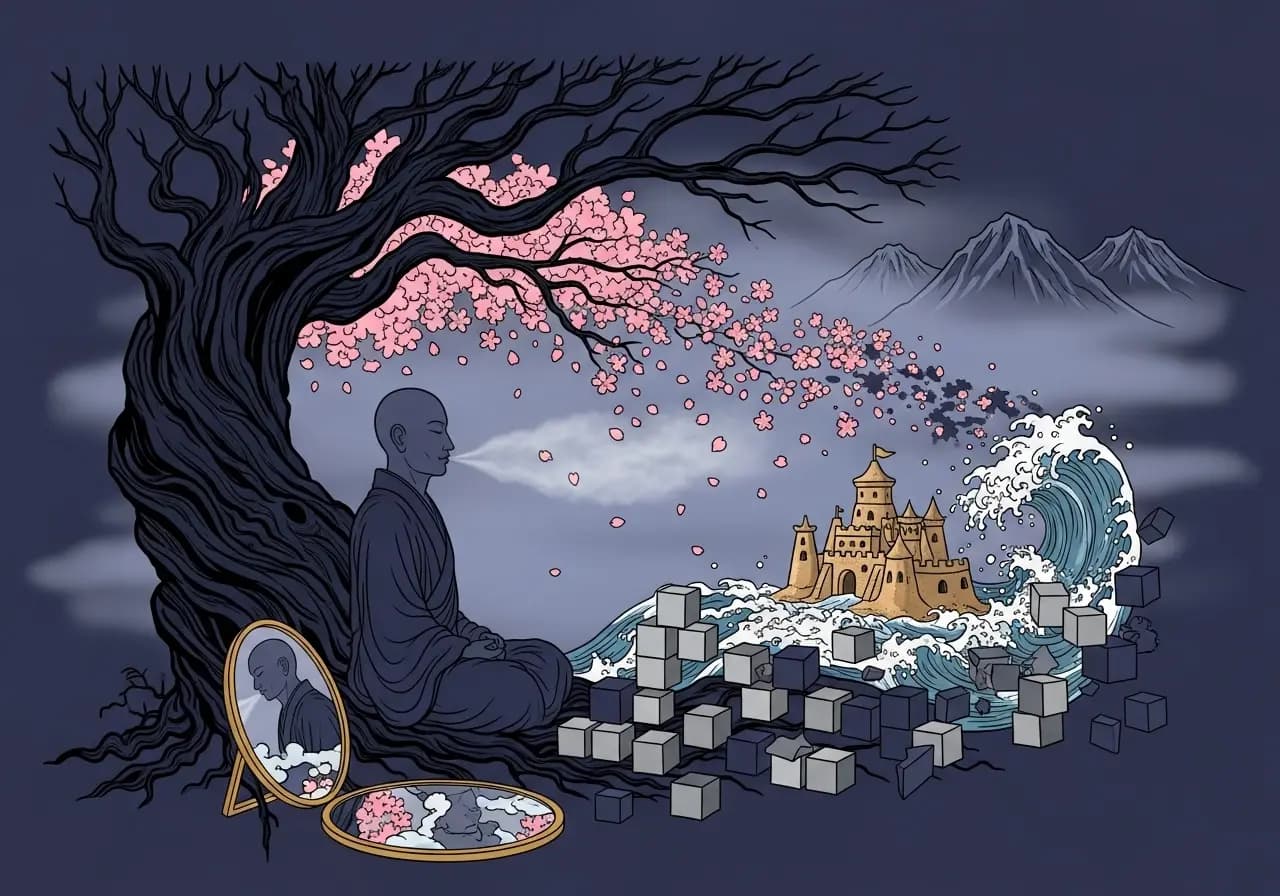
In the Buddhist approach, life and death are seen as one whole, where death is simply the end of one chapter and the beginning of another. Death is a mirror in which the entire meaning of life is reflected. If we refuse to accept death now while we're still alive, we're going to pay for it dearly at the moment of death.
By ignoring the reality of impermanence—which we've talked about—and particularly the greatest understanding of impermanence, which is the realization that we are impermanent, that we will die—we won't be able to live our lives fully. The goal in Buddhism isn't to achieve happiness. It's to achieve liberation or freedom. Once you understand that life is impermanent, you can transcend this pursuit of happiness and the constant running away from fear that is so common in our lives. You can learn to live by letting go. Letting go is the path to real freedom. And letting go of the idea that we are permanent, understanding that we are impermanent—death is a fantastic way to do this.
This idea is beautifully expressed by Michel de Montaigne in the following quote:
"There's no place on earth where death cannot find us. Even if we constantly twist our heads about in all directions as in a dubious and suspect land, if there were any way of sheltering from death's blows, I am not the man to recoil from it, but it is madness to think that you can succeed. Men come and they go and they trot and they dance, and never a word about death. All well and good. Yet when death does come to them, to their wives, their children, their friends, catching them unawares and unprepared, then what storms of passion overwhelm them, what cries, what fury and what despair. To begin depriving death of its greatest advantage over us, let us adopt a way clean contrary to that common one. Let us have nothing more often in mind than death. We do not know where death awaits us, so let us wait for it everywhere. To practice death is to practice freedom. A man who has learned how to die has unlearned how to be a slave."
In my personal studies of Buddhism, I've come to understand that the ultimate goal in Buddhism is not at all about happiness. It's completely about freedom. To practice death is to practice freedom. Yet the only requirement to be happy is to be free. Happiness is the result, but happiness isn't the goal.
There are two things we can confidently say about death: It is an absolute certainty that we will die, and it is uncertain when or how we will die. Keeping those two things in mind, you might wonder: "Why do we fear death?" Well, because our instinctive desire to live and go on living, and death is an end to everything that we hold familiar. Perhaps the deepest reason why we're afraid of death is because we don't know who we are.
We believe in a permanent, personal, unique, and separate identity, but if we dare to examine it, we find that this identity depends entirely on an endless collection of things to prop it up. Things like our name, our memories, our partners, our family, our job, our friends, our possessions. It's on their fragile and impermanent support that we rely on for our security. When these things are all taken away, will we have any idea of who we really are? Without these things, we're faced with just ourselves—a person that we don't know, a stranger with whom we've been living this whole time, but we never really wanted to meet.
We smother our secret fears of impermanence by surrounding ourselves with more and more goods, more and more things, more and more comforts, only to find ourselves as their slaves.
A Close Encounter with Impermanence
A close encounter with death can bring a real awakening, a transformation in our whole approach to life. About three years ago, my good friend and business partner, Jordan, was diagnosed with stage four melanoma. We had already been meeting regularly every Tuesday for lunch to discuss business, but over the next several months after his diagnosis, our topics of discussion increasingly focused on life and death, and our business matters kind of became secondary.
Many months later, it became more and more clear that the end was getting closer. I remember asking Jordan one time, "So Jordan, what does it feel like to know that you're dying?" I was genuinely curious about what that would be like to know.
His response was so powerful and it caused a change in my perspective. He said, "I don't know. You tell me." He pointed out that I'm dying too. I just don't know when. There's a chance that I could be in a car crash on my way home and end up dying before him. He said, "Most likely I'll die before you, but there's no guarantee. So what does it feel like to know that you might die before me?"
He flipped the question on me. You see, we're all dying. Some people just die sooner than others. Those who understand just how fragile life is know how precious it is. We don't need to go into a cave and meditate for the rest of our lives. We just need to start living in the present moment.
The past is past, and the future is not yet here. Even the present as we experience it becomes that past. Really, the only thing we really have is now. It is only when we believe things to be permanent that we shut off the possibility of learning from change.
Sogyal Rinpoche says, "Life is nothing but a continuing dance of birth and death. It's a dance of change." Understanding change and impermanence can bring about a new way of living—mindful living. That's what I want to talk about next, but first, I really want to convey this understanding, this idea that the only thing we really have is now, and that everything we need to be happy can be found in the present moment.
Mindful Living in the Present Moment
This is what I mean by that. You might be thinking, "Well, we talked about this earlier"—the concept of the three poisons in Buddhism, which suggests that there are things that if we can have them, we'll be happier. If there are things we can avoid, we'll be happy. And the third one is ignorance—the ignorance of thinking that way.
For example, you might be thinking, "Well, I would be a lot happier right now if..." and then plug in whatever it is that comes to your mind. There's no doubt there's something there. But mindful living is the realization that everything I need to be happy is already here. It's to be found in the present moment.
Here's a little mental exercise you can do that helps you become aware of this. I want you to imagine that at some point during the day, you get the dreaded phone call that a family member or a loved one—someone you deeply care about—has cancer and it's terminal. I want you to imagine what that would be like. Maybe some of you are experiencing this. If so, this exercise will make the experience even more powerful.
Whatever the situation is that you're in now, imagine a simple phone call away that makes it significantly worse. Someone was in a car accident, something that changes everything. I want you to imagine what that would be like—whatever that scenario is.
Now you're in this new scenario. Look back at what you are right now. What you are right now is the past because you're in this future scenario that is really difficult to cope with. Wouldn't you give anything to go back to how life was in this specific moment, with everything that you currently have on your plate?
That's the understanding of mindful living. It's realizing: I'm mindful of the fact that everything I need to be happy is contained in the present moment, right here, right now. All it takes is a phone call to change that, to put things in perspective. In a new scenario, you would give anything to go back to how things were now. And if you could go back, you'd think, "Oh man. Now life is good. Now I have everything. I couldn't ask for anything more. I just want to go back to how it was."
Yet that's exactly where you are now. That's the scenario we're in right now. The present moment contains everything that is perfect about it. What would change if the future made things worse? You don't have to just think of something drastic like the death of a loved one. Imagine that tomorrow you're put in jail for something you didn't do, or you're stranded on a deserted island. So many scenarios. In that new scenario, you'd be thinking, "I'd give anything to go back to how life was yesterday, with all the problems I had. Maybe work wasn't the best, but I'd give anything to be back at work with my mean boss and my low paycheck, because now I'm sitting in prison for something I didn't do."
That's how fast the scenario can change and make you look back and reflect on what is the present. It'll look so much better than whatever new scenario you're in. Yet that's exactly the scenario we're in now.
This concept—this ordinary mindfulness, ordinary bliss—a friend of mine once called this "radical okayness." I plan on doing a whole podcast episode on this concept, but I like the term "radical okayness." We're living in a moment of radical okayness. Everything is okay the way it is because this is just the way that it is.
The Nature of Mind and Looking In
With that, I want to talk a little bit about mindful living. Milarepa, a famous Tibetan poet, says, "My religion is to live and die without regret."
Our minds have two positions. We're either looking out or we're looking in. All the teachings and training in Buddhism are aimed at this one single point: to learn to look into the nature of the mind, to learn to look in, and to free us from the fear of death and help us realize the truth of life.
Looking in is not easy. It's very difficult. We're so addicted to looking outside ourselves, whether that's seeking peace, happiness, or joy. We don't even realize that we've made our lives so hectic and distracted that it's virtually impossible to look in. In a world full of distraction, silence and stillness terrifies us.
But when we learn to look in, we can become awakened and enlightened to the central truth of the Buddha's teaching: we are already essentially perfect. Life is already essentially perfect. It's this concept of radical okayness.
When you awaken to this reality, it's like having tinted glasses removed, and suddenly life looks different. Then it's not that life changed. It's that the way we see life changed. And yet that changes everything. Our true nature and the nature of all beings is not something extraordinary. It is unexpectedly ordinary. And yet it's that ordinariness that makes us so extraordinary. It's ordinarily perfect.
Living Mindfully: The Sandcastle Analogy
Living a mindful, awakened life is a lot like playing at the beach with kids. I recently got back from a trip where we were playing on the beach with my kids, building a sandcastle. What's fun about this is that even if the kids start fighting over whose turn it is to use the shovel, or complaining that their wall was knocked down, or the tower was stepped on—whatever form of drama can arise for them—you as the parent or adult don't feel the same level of anxiety or drama over the sandcastle. Because you know that at the end, a wave will come and wash it all away. It's completely impermanent.
In a similar way, life becomes a lot like the experience of building a sandcastle when you know life is impermanent. It's not as necessary to get caught up in the drama. Another way to view this is like going to a movie. You can watch a movie and still feel the emotions. You can cry. You can feel joy, sadness, fear. You jump when you're scared. You can feel compassion for the characters, and the whole time you completely understand that it's just a story. None of it is real.
This is how we start to learn to see life. We start to thoroughly enjoy the experience of living authentically because we can start to glimpse just how fragile and perfect life already is. We can enjoy every aspect of our impermanent nature—the times that we feel good and the times that we feel bad. They're both just part of the beautiful experience of being alive.
On this topic of happiness, Wayne Dyer has a quote I really like. He says: "There's no way to happiness. Happiness is the way. There is no way to peace. Peace is the way. And there is no way to enlightenment. Enlightenment is the way."
Buddha Nature: What Is It to Be Awake?
I want to talk about the nature of being awake in Buddhism. It's called Buddha nature. What is the nature of being awake? Well, it's the state in which we can truly grasp the nature of impermanence. This allows us to learn, grow, and change.
What is our nature? Our innate way of being? Wisdom, capability, loving-kindness, compassion—these are things that we're born with. Frustration, jealousy, guilt, shame, anxiety, greed, competitiveness—these are all experiences that we learn. Often they come through the influences of our culture, our families, our friends, and they're reinforced by personal experience.
But many of us don't recognize our Buddha nature until it's pointed out to us. It's kind of like a man who received a watch as a gift from a friend and he just thought it was a bracelet. So he's wearing it, and every day he's asking people, "What time is it?" He doesn't know that he has a watch or the ability to tell time until someone points it out to him and says, "Hey, you're asking me all the time. Did you know that right there on your wrist, you can tell what time it is?"
That's similar to the experience of awakening. It's like realizing, "Oh, all this time I knew." We've all experienced that—"Where is my phone?" or "Where are my sunglasses?" You're looking everywhere, searching and searching, and then you realize, "Oh, it was on my head the whole time."
That's like understanding or experiencing the nature of being awake. It's realizing: everything I have to be happy was already here, to be found in the present moment. That's the nature of being awake.
Remember the essential lesson of the Third Noble Truth that we talked about—I believe in the second episode? The lesson is that it's not the limiting ideas that we hold about ourselves and others, or virtually any experience, that defines us. These can be unlearned. In that moment, suffering ends. There's nothing to fear, nothing to resist—not even death can trouble you.
From the moment we're born, we begin to acquire labels, concepts, ideas, and beliefs. Like tinted glasses, these blind us to the reality of what life is. Being awakened is to become aware of how things really are, without concepts, without labels, without stories. It's like removing the tinted glasses and finally seeing life as it really is.
The Buddha taught that there were 84,000 ways to achieve enlightenment. That's to say there are many paths. There's not a single absolute path to achieving it, and the Buddhist approach is just one path. It's not the path. The Buddha was essentially saying, "This is just what I did and this is what I recognized, so don't believe anything I say just because I say so. Try the stuff out for yourselves."
Eleven Tools for Mindfulness
These things that you can try out for yourselves—what are the things that we can do to experience mindfulness? Because remember, this isn't a concept that can just be conveyed intellectually. I can't just explain to you, "Hey, this is the experience of enlightenment," and boom—you get it. But I'm going to give you eleven tools to experience this awakened nature, this mindful living.
Mindful living is being able to live in a way in which you experience awakening or enlightenment. Let's talk about this. I'm going to share eleven tools for mindfulness.
Tool One: Meditation
The first one is meditation. This is where mindful living really starts, and it doesn't have to be complicated. You just sit for five to ten minutes and you learn to just be in the present moment. You learn to just be with things. You can focus your attention on your breath. You can notice when your thoughts wander from your breath and you gently return to the breath.
We've all at some point probably sat out under the sky and just watched the clouds go by. Meditation is a similar experience, but you're doing this with the mind. You're observing the thoughts. Really, the exercise of meditation is just the same thing over and over. You focus your attention on one thing. You observe it. And the moment you realize you're distracted, you bring your attention back to that one thing—for example, breathing.
Just like you're sitting outside, you're an observer watching the clouds go by. Meditation is a powerful way of learning to experience mindfulness because it's the exercise of learning to be present, learning to be in the moment, observing things as they are, and learning to just see life as it is without assigning meaning, without making meaning of the things that present themselves in life.
Tool Two: Be Present
The second tool is to be present. Meditation is the practice for being present. You know that feeling when someone has been talking to you and then suddenly you realize you actually haven't been paying attention? So you kind of have to pause and say, "Wait, say that again." Yeah, this is the opposite of that. Being present is something that you do throughout the day all the time, and you have to remember—and remembering is the trick.
We're so easily and naturally distracted that it's hard to just be present and to focus. This is kind of an exercise, and meditation can help us learn to be present. People will really appreciate it when you can be really present with someone.
Tool Three: Watch for Distractions
The third tool is to watch for distractions. We constantly have the urge to check email, check social media. This behavior of distraction can be found everywhere—it's a distraction from how life is. We lose ourselves in other things. People who distract themselves from the reality of life by consuming drugs or alcohol do so as a distraction because they can't bear how life is.
We want to watch for the distractions that are trying to take us away from the reality of accepting life as it is. These urges come and they go. You don't have to act on them. Anything that distracts you from being present is a distraction that ultimately distracts you from living life. So look for your distractions. What are they? Then maybe ask yourself when distractions arise: What is it that I'm trying to be distracted from? What is it about life that I don't enjoy? Why am I being distracted?
Tool Four: Let Go of Expectations
The fourth tool is to let go of all expectations. Here's the thing: we all have expectations all the time. We have the expectation that our day is going to go a certain way, that people will be kind and respectful to us. We have the expectation that everything is going to go according to plan. When things don't, we feel that we failed.
When water encounters a new obstacle, it immediately adapts and goes around. That's kind of how we have to approach life. I recently read an article that was circulating on Facebook that I really liked. It said: "Life is like a Tetris game, and we need to quit playing it like it's a chess game."
I thought, how appropriate! That really is a healthy way of viewing life. It's like Tetris. You're playing and then objects present themselves, and you never know in what configuration. The whole purpose of the game is learning to take what presents itself and arranging it or twisting it in a way that works best. It's never in the ideal configuration because you have to position it wherever it's going to fit. Even if that's not ideal, it might be the most ideal you can work with in the time that you have.
Let go of the expectations of what life should be. Quit playing the chess game and learn to see life like Tetris.
Tool Five: Accept People and Life As They Are
The fifth tool is accepting people as they are, accepting life as it is. When I stopped trying to change a loved one and started to accept this person for who they were, I was able to just be with this person and enjoy time with her. This acceptance has the same effect with everything you do—whether it's a coworker, a family member, a child, a spouse, a loved one, or even a situation.
Learning to accept a bad situation: remember early on I mentioned the analogy of the horse and who knows what is good and what is bad? When an unpleasant feeling or an annoying sound or an annoying situation in life springs up, much like the Tetris game, we need to stop trying to fight the way things are and just accept: "Okay. This is what is. Here is the piece that's presented itself." The moment you can accept, you can work with it.
This kind of goes hand-in-hand with letting go of expectations. If I'm expecting life to be a certain way and it continually presents itself in a different way, think of the Tetris game. You're playing Tetris. What if every time a new piece comes up, instead of immediately working with it, you're frustrated, saying, "No. I needed a square, not this rectangle or not this bar"? Then we're not playing the game well.
The key to playing is that you have to accept the moment that presents itself, that new shape. You accept it. "Okay, this is what is." Now you have more time to work with it and figure out where it's going to fit and how it's going to benefit you most. Sitting there and resisting it, continually thinking, "This is not fair. I was not supposed to get a square. I was supposed to get a bar"—whatever the shape is—it's a waste of time.
We need to accept people and life as it is, just like you would in a Tetris game when a new shape presents itself. We just stop trying to fight the way we think things should be and just accept what is. We're going to be much more at peace when we learn to do this.
Tool Six: Be Okay with Discomfort
This leads to the sixth tool: to learn to be okay with discomfort. See, the fear of discomfort is huge. It causes people to be stuck in their old habits, to not start the business that they want to start, or "I'm stuck in the job I don't really like." Because we tend to stick to what we know and what we're comfortable with rather than trying something new and unknown—something uncomfortable—that's why a lot of people don't try vegetables, or they don't exercise, or why they eat junk. That's why you don't start something new, because you know that the moment you expose yourself to something new, you don't know what's coming.
It's like saying, "I don't want to play Tetris because I don't like panicking when a new shape comes in." Yet that's the very nature of life.
We can be okay with discomfort, and we do that by practicing. You can start with little things that are a little uncomfortable, just expand your comfort zone and get used to being okay with discomfort. I think a really good way to do this is meditation. It can be uncomfortable to just sit there in silence with your own thoughts, and yet the more you do it, the more comfortable you become with whatever arises.
The exercise of learning to sit and observe the thoughts and the mind like you would clouds in the sky is an excellent way to practice being okay with discomfort.
Tool Seven: Watch Your Resistance
The seventh tool is to watch your resistance. When you try to do something uncomfortable or you try to give up something, you're going to find resistance. But you can just watch the resistance and be curious about it. Watch your resistance to things that annoy you—whether it's a loud sound that interrupts your concentration. Notice that it's not really the sound that's the problem. It's your resistance to the sound. The same can be true of resistance to anything. Anything that you don't like or that you're resistant to—the problem isn't the sensation of being uncomfortable. It's that we're resisting it.
Watch that resistance and just feel it melt.
Again, going back to the Tetris analogy here. Watching your resistance would be like observing what happens when the shape comes in that was not the shape that I want. Watch how I resist that. How long do I hold on to the thought and the anger that "this is not the shape I wanted," versus how quickly can I learn to just adapt and accept how it is? You just say, "Okay. This is what is, and now I'm going to work with it."
Tool Eight: Be Curious
The eighth tool for mindful living is to be curious. See, too often we're just stuck in our ways and we think that we know how things should be. We know how people are, how people should be. Instead of being curious and finding out, we need to allow ourselves to experiment and let go of what you think you know. Let go of how you think things should be.
When you start a new project or a new venture, if you feel the fear of failure, instead of thinking, "Oh no. I'm going to fail" or "Oh no. I don't know how this is going to turn out," just try thinking, "Let's see. Let's see what's going to happen here. Let's find out."
Then there isn't the fear of failure, but the joy of just being curious and finding out. Learning to be okay with not knowing what Tetris piece is coming up next. You can find yourself in this position where you learn to be curious. While you're positioning whatever piece you've got in the game, you're thinking, "I wonder what's going to show up next."
The mental approach here is pretty different: playing Tetris and thinking, "I wonder what's going to show up next," versus "It better be a square. It better be a square. It better be a square." Just be curious: "I wonder what's going to show up next." The moment it does, you accept it and now: "How am I going to work with it?"
Tool Nine: Learn to Be Grateful
That leads us to the ninth step: learn to be grateful. We tend to complain about everything, and yet life is a miracle. Finding something to be grateful about in everything that you do is an exercise. The more aware that we become, the more mindfully we learn to live, the more we become grateful.
It's gratitude that makes us happy. It's not happiness that brings us gratitude. It's gratitude that brings us happiness. Learning to be grateful about everything is a powerful way of learning to be mindful. You can be grateful when you're with someone and you'll be happier when you're with them. You can learn to be grateful for the experience of being alive. Life is really amazing, and you'll learn to appreciate it when you can be grateful for it.
Tool Ten: Let Go of Control
The tenth one is to let go of control. This is a really tough one. We often think we control things, and that's only an illusion. Our obsession with organization, goals, and productivity, for example—they're rooted in the illusion that we actually control life. But life is uncontrollable, and just when we think we have things under control, something unexpected comes up to disrupt everything. Then we're frustrated because things didn't turn out the way we wanted.
We can learn to practice letting go of control. This doesn't mean that we have zero control on life. That's what makes it so tricky. There are aspects of life that we have control over, and then that feeds the illusion that, "Oh, well, we must control all of it." The reality is, we don't.
There are circumstances that we're somewhat in control of, but overall, we're playing a Tetris game, remember, and whatever comes up is just what comes up. We don't control that. But we do control what we do with each shape as it shows up. How we use it. Learn to just go with the flow like playing Tetris. Go with whatever life is presenting, and as it presents it, you live moment to moment to moment.
You can't play Tetris thinking: "While I'm trying to figure out what I'm doing with this bar that just showed up, I can't be thinking about ten shapes from now, what am I going to be doing with whatever that shape is?" Because you don't know. We don't know. We can only deal with these moment by moment by moment.
Tool Eleven: Learn to Be Compassionate
Now I want to talk about the eleventh step. This is the most important one to me. It's to learn to be compassionate. It may sound trite, but compassion for others can literally change the way you feel about the world on a day-to-day basis. Compassion for yourself is life-changing.
You need to remember these two things: Mindful living is about remembering to be compassionate after you forget. It's remembering to be mindful.
I mentioned before that the purpose of Buddhist teachings isn't to obtain happiness. It's to obtain freedom. When someone who's been held captive is released and they regain their freedom—freedom from their captors, freedom from whatever torture or suffering they were made to endure, freedom from a cell block or a room that they were in—with this freedom, new opportunities exist that were not available before.
It may be as simple as the freedom to go outside for a walk, but it's important to understand that freedom is always relative to something else: freedom to, freedom from.
The Buddhist Concept of Freedom
As sentient beings, we're held captive. We're constrained by worldviews of our time, our language, our societal views, our finances, our geographical limitations, our beliefs, our physical bodies, and even the laws of nature.
The freedom of awakening to the Buddhist concept of Nirvana is grounded in the cessation of craving. Craving for a fixed sense of identity, craving for permanence, craving from suffering, or craving for an answer, or craving for the next shape in the Tetris game to be whatever that shape is.
The twist here is that we're actually our own captors. We keep ourselves captive by clinging—out of delusion and fear—to a self that is independent of all other causes and conditions. Ironically, it's the sense of independence that's confused with a sense of freedom.
The aim of Buddhist teachings is to free ourselves from this illusion. We can achieve freedom by understanding the nature of impermanence, interdependence, and emptiness. Meditation and skillful living allow us to cultivate awareness of the freedom present in every moment we experience.
Applying this again to the Tetris game: it's the freedom to enjoy the game as it unfolds moment to moment, with whatever the game throws our way. Whatever life throws at you is contained in the present moment, and it's everything that you need to enjoy and be happy with the experience of living.
The Freedom of the Breath
Consider how your breathing carries on independently of whether you're mindful to it or not. But as soon as you start paying attention to it, you tend to try to control or constrain it. Now it's under your control. You're breathing under the pattern that you are controlling. It's difficult to try to just observe it because the very act of observing makes it controlled.
But next time you're meditating, try to wait for the in-breath to happen on its own. When your body determines that it's ready, it just breathes. By holding or waiting for a second, you know that the in-breath is coming, but you're not exactly certain when. You're just paying full attention, and you're free from any intention to control or your expectation of when it's going to happen. But suddenly it will. It just happens. And then you'll understand: it's not the I, the self that's breathing. It's more like it is breathing, and you realize you are a part of the experience of being alive.
It can be unnerving to experience the breath this way because, again, we're constantly in control. As you focus on mindfulness, the breath is one of the bodily functions that is both automatic and controlled. While the breath may initially serve as the object of concentration, it's by letting go of any urge to control it that we can witness in its rhythmic motions the intrinsic freedom of reality itself.
Breathing is the movement of life. It's the vital process that connects our body with the environment. The more we open and deepen our awareness of the breath and body, the more we understand the dynamics of our entire experience of living.
See, nothing stands still or remains permanent—whether it's our breath, our heartbeat, our body, our feelings, our thoughts. What part of any of this can we really claim as me or mine?
As we sit there aware of the breath, it is on the one hand ordinary and obvious, and yet on the other, it's a mystery that we breathe at all. Reality is a dynamic play of relationships. Awakening to this reveals our own intrinsic freedom because we too are, by nature, a dynamic play of relationships.
When we're locked into the assumption that the self and things are unchanging, that they're absolute and permanent, we'll continue to remain confined and unfree. Not only are we our own captors, but we're really good at convincing ourselves that we're not captive in the first place.
You could say that Buddhist teachings and practice have two main objectives. The first is to let go of self-centered craving so that our lives can become gradually more awake. And the second is to be receptive to the sudden eruption of awakening into our lives that can happen at any moment.
Awakening is both a linear process of freedom that's cultivated over time and, at the same time, it's an ever-present possibility that can arise at any given moment.
Awakening doesn't provide us with answers or with a set of ideas. It doesn't provide us with a philosophical or religious doctrine. By its very nature, it's free from the constraints of any preconceived idea, belief, or doctrine. It offers no answers. It only offers the possibility of new beginnings.
This would be like playing the Tetris game again. Awakening is the realization that at any given moment, whatever presents itself is now part of my game. I get to decide what to do with it.
Nirvana is like simply breathing. You breathe in and you breathe out. You breathe in and you breathe out. You breathe in, and you live. But you must also let go and breathe out. We don't breathe in a way that we hold on to oxygen. We must also exhale. If you don't let go, you suffocate. The key to awakening is to let go. Letting go of expectations. It's really that simple.
We have the tendency to want to make the idea of awakening this big, grandiose thing, but the reality is that awakening or enlightenment is just simply letting go. Letting go of the concept of awakening, letting go of the concept of enlightenment. It's letting go of everything and accepting that we're playing a game of Tetris and that the most we can do is play with each part, moment by moment by moment, as it presents itself.
I want to finish this section on mindful living with a quote from Robert Ingersoll. It says: "May we realize that happiness is the only good. The time to be happy is now. The place to be happy is here, and the way to be happy is to make others so."
Understanding Karma
Now I want to talk about the concept of karma. This is one of the most well-known words from the Buddhist vocabulary. It's probably also the most misunderstood. Typically, when you hear the word "karma," you probably think of something like "what goes around, comes around," or some form of cosmic justice. But that's not quite right.
I'm sure you've noticed that what we deem as good things happen to bad people, and bad things happen to good people. Where is the justice in that?
Well, the understanding of karma is that there is no justice system. Simply stated, karma is nothing more than the law of cause and effect within a system of interdependence. We talked about interdependence: everything depends on other things, right? Cake exists because of flour, eggs, sugar, and so on. Remember that analogy.
Karma is the law of interdependence. Rather than thinking of karma as "if I do something good, I'll get something good, or if I do something bad, something bad will happen to me," it's really a lot more simple than that. The proper understanding of karma is as simple as knowing: if I do something, something will happen. That's it.
We don't have to assign meaning to that—good or bad. It's as simple as understanding that karma means action. The lesson here that we need to really pay close attention to is that what we do affects not only ourselves but others. It affects everything.
With the proper understanding of karma comes this incredible sense of responsibility, knowing that the things that I say, do, and think are constantly changing everything. It's like we're in this intricate web of causes and conditions that all of us are a part of—every sentient being. And the things that I say, do, and think are affecting that, not only for myself, but for others around me. Sometimes, for others in ways that I could never even begin to conceive.
That's the understanding of karma. It just means action. The mistake that we make is giving meaning to that action, thinking there are good things and there are bad things, and what goes around comes around. That's all based on—remember the three poisons—the things that we want and things that we don't want. Don't allow those things to crowd into the understanding that all this really means is: if I do something, something will happen.
When something is done, something happens. Cause and effect. Causes and conditions. Everything has causes and conditions. That's the law of karma, the law of action.
Bringing It All Together
With that, that essentially covers all of the main topics that we could say would be a brief introduction to Buddhist philosophy, Buddhist thinking. These first five episodes of the podcast were intended to be an overview of secular Buddhism in general—what is the philosophical understanding of concepts that come from Buddhist philosophy.
I want to finish with a quote from Dogen. He says: "The way of the Buddha is to know yourself. To know yourself is to forget yourself. To be awakened by all things."
I hope as we've discussed these topics, you can really come to understand emptiness, impermanence, and interdependence. And specifically, how understanding these concepts reveals the implications for the self, for other, for myself and other. You realize it's an illusion. All we are is all we are.
The moment that we add stories, meanings, ideas, and beliefs to things, it makes it very difficult to just see things as they really are. I think perhaps the best way to view life—just like I mentioned before in that article—is to view life as a game of Tetris. We're playing the game, making the best use of whatever shows up when it shows up. Accepting it for what it is the moment it's there, and working with it rather than resisting it or wishing it was something other than it is. Because that's exactly how life is.
Things present themselves, and our only option is to accept it and work with it. You play this game on and on and on until the game is over. Rather than sitting there unhappy about the game that I have versus the game that you have, and why I got this piece and you got that piece, I can learn to accept what I have and be grateful that I'm actually here playing.
That's the beauty of gratitude: we learn to be grateful for the fact that we're alive. What could we possibly want more than just being alive?
I hope you've enjoyed these first five episodes, and I'm excited for the next several episodes. I still intend on doing various more in-depth studies on these topics, but these first five were designed to just kind of lay out the entire landscape of Buddhist thinking, of Buddhist philosophical concepts.
If you have any questions on the things we've discussed so far, please reach out to me. My email is [email protected]. Just feel free to reach out to me if you have any questions, comments, or concerns, or if you need further clarification on any of these topics. I'm really excited to continue doing this podcast, and I look forward to the next episode.
Thank you for being a part of this and for listening.