

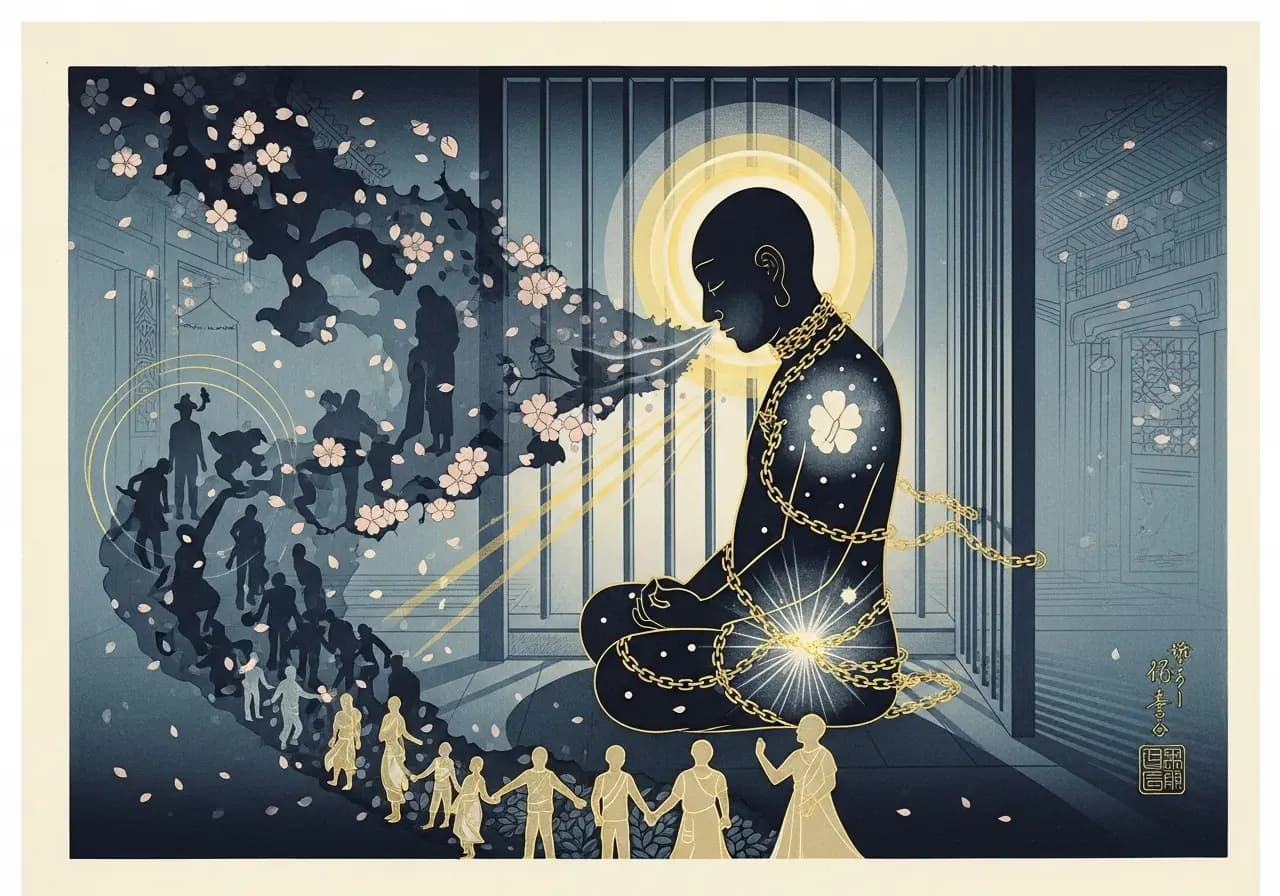
Talking About Addiction and Recovery
Episode 49 of the Secular Buddhism Podcast
Guest: Noah Levine, founder of Refuge Recovery
Hello. You are listening to the Secular Buddhism podcast, and this is episode number 49. I'm your host, Noah Rasheta, and in this episode, I'm excited to share an interview I had with Noah Levine of Refuge Recovery.
Earlier this week, I had the opportunity to interview Noah Levine, founder of Refuge Recovery—a mindfulness-based addiction recovery community that practices and utilizes Buddhist philosophy as the foundation of the recovery process.
We all know someone who is, has been, or will be affected by addiction. It may even be you. The information presented in this discussion could change your life or the life of someone you love. The original interview was broadcast live to the Secular Buddhism Facebook page and uploaded to our YouTube channel. You can watch it at facebook.com/secularbuddhism.
Welcome to the Secular Buddhism Podcast
Welcome to the Secular Buddhism podcast. If this is your first time listening, thank you for joining. SecularBuddhism.com is my website and blog, and this podcast goes along with it. The Secular Buddhism podcast is produced every week and covers philosophical topics within Buddhism and secular humanism.
I like to start each podcast with a piece of advice from Tenzin Gyatso, the 14th Dalai Lama. He says: "Do not try to use what you learn from Buddhism to be a Buddhist. Use it to be a better whatever you already are." Please keep this in mind as you listen and learn about the topics and concepts discussed in this episode.
And remember, if you enjoy the podcast, please feel free to share it, write a review, or give it a rating.
Noah Rasheta: Welcome to the Secular Buddhism podcast, and to the Secular Buddhism podcast live on Facebook. Let me just get this set up here.
Noah Levine: Can you share it live on my page at the same time?
Noah Rasheta: Let's see. I think it only allows me to share to the pages I manage, but I have you tagged.
Noah Levine: That would be cool.
Noah Rasheta: I have you tagged so hopefully that will show up on your page.
Noah Levine: There's probably a way for me to share it live from your page or something.
Noah Rasheta: There should be. Here's what I'll do. I'll share the stream on the Refuge Recovery page. Do you want me to share it on the Refuge Recovery page?
Noah Levine: Sure. You could do it on Refuge, but I was thinking on the Noah Levine 108 page. That's where most of my followers are.
Noah Rasheta: I'll look for that real quick. I see that. I'll share the link there. I posted that on your page.
Noah Levine: Cool.
Noah Rasheta: Great. This whole idea to interview you started because I picked up a copy of your book, Refuge Recovery, after a friend of mine was going through addiction and recovery and dealing with the aftermath of it—really spending time in prison. It got me interested in wanting to discuss the topic of addiction and recovery with someone, but from a mindfulness-based approach, a Buddhist-based approach. I picked up your book and started reading it. The very first thing that happened was something that reminded me of an experience I had a while back. My wife and I went to marriage counseling many years ago.
I remember going through that thinking, "This content is incredible. Why do couples wait until they need to hear this? It should be mandatory. If you're going to get married, you've got to go to marriage counseling, pass this course, and then you're going to have all these incredible tools for how to deal with the inevitable ups and downs of marriage." I had this similar experience reading your book where I was thinking, "Wait a second. This isn't necessarily for someone who's already struggling with addiction. This should be for anyone because it helps you understand the underlying causes of addiction—which are very similar to, if not the same as, the underlying causes of suffering."
I decided I want to talk to you and maybe feature this book and your work on the podcast to my listeners who are just interested in living more mindfully because this is exactly what that does. It helps you preempt ever reaching that stage where you may encounter addiction. Certainly, there will be people listening to this who know someone in the past, in the present, or in the future who may struggle with addiction and recovery. I thought it was good timing to have a conversation about it. So thank you for your time and for joining me to have this conversation.
What I was hoping we could talk about first is maybe just a brief introduction about you, your story, what led you to create Refuge Recovery, and your story with what led you to mindfulness and Buddhism. Are you there?
Noah Levine: I am, but I'm missing you a little bit. Let me disappear for one moment and make sure I'm on the right Wi-Fi. Just one moment.
Noah Rasheta: Sounds good.
(Brief pause)
Noah Levine: I'm still here. You still have my audio. I just want to make sure I'm on the right Wi-Fi. It might help. Let me get a better connection here. Can you still hear me?
Noah Rasheta: Yeah, and I see you now.
Noah Levine: Sorry to disappear. Let's see. That should hopefully solve our connection problem.
Noah Rasheta: Cool. Thank you.
Noah Levine: Tell me the question again, and I'm happy to be on the show with you. Thanks for inviting me.
Noah Rasheta: Great. The question was I was hoping you'd share just a brief summary of your story, your background, what led you to Refuge Recovery, and what led you down the path of studying Buddhism and mindfulness in general.
Noah Levine: I was one of the—I think somewhat—rare cases where I was born into a western family, an American family of European descent who were already practicing Buddhism when I was born. My father had found what I call the dharma, mindfulness Buddhism in the 1950s and 1960s, and had really committed his life to meditation practice.
Now, my dad, Stephen Levine—I'm sure you know, and many people know—wrote all these wonderful books about mindfulness, about death and dying, about bringing a mindful and spiritual perspective to grief, healing, and grieving. I grew up with it. I was basically introduced to Buddhism from my early childhood, but I dutifully rebelled against it and had my own trauma.
My parents were divorced when I was very young, and there was addiction in my family. Both my mother and my father had addiction in their lives. My mother was still struggling with addiction, and my father—my father wasn't somebody who would consider himself in recovery, but he had gone from being a heroin addict to being a meditator. He didn't call it recovery because he still used pot or alcohol or something like that, but he was able to get off the core addiction he had earlier in his life, really through meditation practice.
By the time I was five years old, I was feeling suicidal. I was just like, "I want out." I knew about death and I knew about reincarnation, and I was in that pain and suffering that felt like, "Oh, I could just kill myself and start over," at such a young age. Then I found drugs and alcohol. I started drinking my parents' booze, smoking their weed, eating their acid and mushrooms. Drugs saved my life. Drugs were the thing that allowed me to self-medicate and get out of some of the pain, existential angst, and suffering that I was experiencing in early childhood—so much so that I was suicidal.
Drugs and alcohol were a good time. I found punk rock in 1979, and I found this radical, rebellious drug culture that made a lot more sense to me than mindfulness or meditation. I had pain and I was meeting my pain with trying to avoid it. That worked for some time, and then it stopped working—which happens for all addicts. Not only addicts, I think that our coping mechanisms only work for so long.
By the time I was a teenager, I wasn't experimenting with drugs; I was addicted. I was smoking crack cocaine and injecting heroin, and I was drinking alcoholically on a daily basis. I was in and out of institutions. I started getting locked up. I started getting sent to recovery stuff at about thirteen because I got arrested a lot, so they'd send me to AA and say, "Get your card signed."
I had some awareness that there were recovering addicts and alcoholics. Of course, I had awareness of Buddhists and these spiritual folks that my dad was hanging out with—Ram Dass was around, and Jack Kornfield, and Joseph Goldstein and all these wonderful meditation teachers—but I didn't feel like any of that applied to me.
Noah Rasheta: From what I was reading, something happens at some point. You were in prison at the time. Tell me about that pivotal moment where you shift and realize you're ready to be done with this.
Noah Levine: Sure. In 1988, I was seventeen years old. I had three felonies. I was looking at doing multiple years in prison, in a youth prison. There was a shift. I had a suicide attempt. I woke up in a padded cell. For the first time in my life, I took some responsibility. I realized that I was in that situation based on my own karma, my own actions. With that realization came both a ton of shame, guilt, and remorse—a little bit of hopelessness, but also a little bit of hope—came from taking responsibility.
If I got myself into this situation, maybe I can get myself out. Up to that time, I blamed everyone else, so taking responsibility gave me some agency in creating some change. My father took the opportunity when I was talking to him on the telephone from my cell, from the phone in the institution, to say, "Try meditating. Try mindfulness. Go back to your room. Try to ignore your mind and pay attention to your breath. Just do simple breath awareness practice."
He said, "It will give you some relief from all of this fear of the future and regret from the past." He said, "It will give you some relief. It's worth trying." I was desperate enough that I said, "Okay." I went and sat in my cell and started meditating. I started a meditation practice that became the only thing that really made sense to me.
I saw in meditation right from the beginning that this was an action I could take. I wasn't very good at it; it wasn't a quick fix. It didn't solve all my problems, but it gave me a tiny bit of relief. And it theoretically made sense to me that I was training my own attention, mindfulness of the breath and body, and getting some relief from the confusion in my mind, the addiction in my mind.
At the same time, I started going to recovery. I started going to the twelve-step meetings that were in the institutions, and there, what they were saying was the solution was a Judeo-Christian philosophy—that God was going to remove from me that a higher power was going to restore me to sanity and remove my alcoholic craving. That didn't make sense to me. I was an atheist. What they were saying didn't make sense, but the meditation made sense.
What I found in recovery was I found community. I found all these wonderful people who were suffering just like me, addicts who were there to help and were just volunteering to show up and saying, "You can recover." The twelve-step community has been so integral, so important, so key to my recovery because when I started going to Buddhist meditation retreats, the Buddhists weren't really my people.
The Buddhists were my dad's friends. The recovering addicts—those were my people. The alcoholics—those were my homies. For a long time, I had this Buddhist-based practice and view, but my community was the twelve-step recovery community.
Noah Rasheta: That's where you started to develop the Refuge Recovery program. Is that right?
Noah Levine: For the first fifteen years, I practiced Buddhism. I participated in twelve steps. My teachers—Jack Kornfield, Venerable Ajahn Amaro, my father Stephen Levine—started encouraging me to teach. I started going back into the juvenile halls and prisons, working with community groups, teaching mindfulness, loving-kindness, and forgiveness, and teaching meditation. I didn't do recovery-based meditation. I said, "This is for everyone."
Everyone has some suffering, not just us addicts. Everyone has it. I want to make this available to everyone. I don't want to exclude someone like you that doesn't identify as a recovering addict from my meditation community. I don't want to say, "This is only if you've become a junkie or an alcoholic." For the first fifteen years of teaching—I've been teaching for over twenty years now—I didn't do recovery stuff really.
I did Buddhism for everyone, but because my first book, Dharma Punks, was about my addiction, recovery, and Buddhist practice, half of the people that showed up to sit with me were in recovery and half weren't. Eventually, about ten years ago, it seemed like, "I should create something."
There's been a bunch of cool stuff done around Buddhism and the twelve steps. Kevin Griffin and Darren Littlejohn, a handful of other people who've done this kind of cool work around finding a Buddhist way to look at the twelve steps, which I thought was a great resource. But it always left me feeling a little like, "Why do we have to keep trying to understand a Judeo-Christian worldview through a non-theistic Buddhist worldview? Why do we have to keep trying to make these things that don't really fit, fit?"
They fit in some ways and they don't fit in other ways—believe in God or don't believe. It doesn't totally fit. Then that's when I said, "Nobody else seems to be doing it. My community is asking for it," which had become thousands of people at centers in San Francisco, New York, Los Angeles, Nashville, Boston, and just all these communities that were hungry for it. That's when I created Refuge Recovery, which, three years ago when the Refuge Recovery book came out, there was about ten Buddhist recovery meetings in our lineage. Now there's over three hundred.
Noah Rasheta: Wow.
Noah Levine: As soon as the book was out there, people were just like, "Yes. This is what I was looking for. This makes more sense to me," or it just helps them understand the twelve steps. There's a lot of people who were like, "Well, I love the twelve steps, but I never really learned how to meditate, so now Refuge Recovery is an opportunity to really learn some deep meditation practices."
Noah Rasheta: One thing I love about the way you formatted the book is it not only introduces these concepts and helps you understand why they work, but it gives you the outline of, "If you don't have a group close by, this is how you can format these meetings yourself. You do this and you do that." It teaches the meditation. I think it's really useful for someone who may not have a group that they can attend.
Noah Levine: Yeah.
Noah Rasheta: Refuge Recovery is pretty big now. Tell us a little bit about how this works because you have an actual center where people could go to get clean, but there are also communities like local groups that get together. What's the difference between the two?
Noah Levine: There's the professional treatment center. It's called Refuge Recovery Treatment Centers—detox, residential, sober living for people that want to come to professional treatment with psychotherapy and trauma resolution, physicians and medicine management, all of that. That's available. It's insurance reimbursed. We just have one center so far in Los Angeles.
I felt like it was my responsibility—if I was going to say, "Here's a recovery path," I knew so many people who were going to want to use it for treatment, to actually provide a really good professional treatment model with it. We're doing that, and people can find that information on refugerecoverytreatmentcenters.com or refugerecovery.com.
But the other side of it, the thing I really wanted to create, I think the twelve-step model of peer-led addicts helping each other, alcoholics helping each other, is brilliant. We created a format for peer-led meetings with a guided meditation in each meeting—not led by a meditation teacher, but by a script. Here's the mindfulness instructions, here's the forgiveness instructions, the loving-kindness, and it's just read by somebody, read slowly by somebody in the meeting, so that every meeting has a meditation practice with instructions.
Noah Rasheta: I like that because it allows anybody to lead that. Let's talk really quickly about some of the key differences or similarities between a program like Refuge Recovery versus, let's say, AA, the twelve-step program, or any other program like that.
Noah Levine: There's so much in common and there are some key differences. Let's point to the common first—like community is key. Peer support, accountability, compassion, and service. Helping each other. Tolerating each other. Key. Showing up and having commitments to say, "I'm going to be here. I'm going to do this. I'm going to do my inventories. I'm going to look at myself, my resentments, and the suffering and the cause of suffering." There are all these commonalities.
The core difference between a Buddhist perspective and a theistic perspective is that the twelve steps are ascribing to a monotheistic worldview that human beings are powerless, that there's a grace, a blessing, or a cursing from God that is affecting us, that there's a higher power that is actually in control of human beings.
Buddhism has a non-theistic worldview that understands karma, that believes in responsibility, that believes in the human ability to free themselves from the suffering of addiction through their own actions and their own efforts. Some of the twelve-step view is that human beings can't do that—only God can do that. Only God can restore you to sanity, only a higher power can remove the craving for alcohol or drugs or whatever it is. There are some differences there.
Do you assign that recovery to an external power greater than yourself, or do you assign that meaning to one's own actions and the human ability to heal, to recover, to awaken? Buddhism takes much more of a humanist psychology view than a Judeo-Christian theistic view.
Noah Rasheta: Which obviously is very suitable for someone with that worldview. I want to discuss now a couple of the things that really stood out to me in your book. I love the book. I feel like it does a great job of presenting basic Buddhist philosophy. Just summarizing this again for listeners: from the Buddhist perspective, there's this idea that there's life as it is—reality—and then there's life as we think it should be, which is the story or the narrative. Sometimes they don't match up.
When we encounter this mismatch, we have this sense of discomfort—something is wrong, I need this to match that. That's not the problem. Up until this point, that's all okay. The problem becomes that with the discomfort, I'm not comfortable with the discomfort, so I'm going to start doing something about it. That's where we often get into trouble—the discomfort of being with the expectation of reality not meeting reality.
I start to do things like self-medicate. In the extreme case, we're talking about addictive behavior—drugs, alcohol. But in a less extreme case, similar patterns: I'm on Facebook all day. It could be anything on that spectrum. But ultimately, it's rooted in the fact that I'm simply not comfortable with the discomfort that my expected reality isn't matching reality. Would that be a fair assessment?
Noah Levine: I like it. I mean, I feel like that is exactly what you're saying. Yes, I think it's fair. As you know, what the Buddha talks about as tanha—craving. Craving for reality to be more pleasant, less painful. But I like the way you're talking about just expectations. I like that.
Noah Rasheta: From the Buddhist perspective, we talk about how the moment we want life to be other than it is, we're going to experience suffering. And that's natural. You talked about this in your book—how there's a difference between desire and craving. You say that craving is the thought and feeling that says, "I have to have it. I cannot be happy without it." Desire is simply recognizing, "I want it, but I'll be fine with or without it."
This is what I was alluding to with the underlying cause of suffering—that we want things to be other than they are. That's not the problem. It's taking it a step further: our inability to allow ourselves to just be in that space of discomfort sometimes, so we start to do something about it, and often that's what gets us into trouble.
You talked about how our relationship to craving—it's not craving itself that's the problem because that's natural—and I like how you worded this. The problem lies in our addiction to satisfying our craving. That's different than just having craving. There's craving, and then there's the addiction to satisfying the craving. Talk to me a little bit about that thought process.
Noah Levine: I mean, I think this is so key because without mindfulness, without some introspection and self-awareness, we believe that we have to satisfy our cravings, and we take it all so personal. But when you do a bit of mindfulness, when you start observing your mind, your emotions, and your sensations, you start to see how impersonal this human craving machine that we live in is.
Then you start to say like, "Oh, no. Of course there's craving. That's just what this biological imperative is—craving." When you step back from it and you actually get an understanding of it, then you say, "Craving again. No big deal. I don't have to satisfy it. I'm no longer addicted to it or so identified with thinking that I have to obey my mind."
The mindfulness really does that. It really shifts our relationship to our minds, and you realize a lot of my thoughts are untrustworthy. A lot of my cravings are based in confusion, based in ignorance, and are lying to me, saying if you do this, you'll be happy. Then you do it over and over and you realize, "Yeah, it doesn't work. I tried satisfying all of my cravings. It made my life worse, not better."
There's that shift from taking it personal and obeying it to starting to have some renunciation in that, but also not judging the fact that we are craving beings.
Noah Rasheta: Sure. I like to say, when I'm teaching mindfulness, that we're not trying to change our feelings. We're not trying to change our thoughts. We're trying to understand the relationship we have with our feelings because our problem isn't the feeling itself. It's the clinging to a certain feeling or the aversion to this other feeling. I want more happiness. I want less sadness. That's ultimately what's getting us in trouble, not necessarily the feeling itself.
You addressed that, I think very well in your book. One aspect of this that your book reminded me of is the Stanford marshmallow experiment on delayed gratification. This is the experiment where children were offered the choice between a small reward immediately or two small rewards if they waited for a short period of approximately fifteen minutes.
In all the follow-up studies—and this is where it gets interesting—the researchers found that the children who were able to wait longer for the preferred reward had better life outcomes like SAT scores, educational attainment, and just other life measures. What that indicates to me is what mindfulness has helped me understand: our ability to be with something patiently for a moment, especially discomfort.
What I see over and over when I'm teaching mindfulness workshops is people who are experiencing some form of suffering who are unable to be with the suffering and complicate it. Pema Chödrön says—and I'm paraphrasing—often the worst of our situations are the ones we give ourselves. A lot of the suffering that we experience is self-inflicted. I think that's where mindfulness really kicks in.
Then something you talked about in your book that I wanted to address here: you said that awakening or enlightenment looks like. How would you describe it?
Noah Levine: To be awake seems to mean to see reality clearly. When you're seeing reality clearly, you're understanding that everything is impermanent. Everything is constantly changing—every thought, every feeling, every sensation, every person. This law of impermanence: when we're awake, we're understanding it and living in harmony with it. Understanding that we're seeing reality clearly, that everything is perceived as pleasant, unpleasant, or neutral—that there's just a feeling tone to every sight, sound, smell, taste, sensation, and environment.
Noah Rasheta: Thought.
Noah Levine: And thought. Yeah, what happens in the mind. And our relationship to that pleasant or unpleasant perception is the cause of our ease or our suffering. When we're awake, we know, as you were pointing to before, it's not what's happening. It's how we relate to what's happening. When we're awake, we understand that everything is impermanent, and our response is going to be how we're relating to it. It's going to be the cause of our happiness or our suffering.
Maybe the third thing I will say is we're also awake to how impersonal so much of what we're experiencing is. There's not a solid, separate entity that we can say, "This is I. This is me. This is mine." What we have taken birth into is a human condition with a craving mind and body—and it's not our fault, and it's not who we are. It's not personal.
Really, to be awake in the simple way is to see clearly and respond appropriately. The appropriate response in suffering. That would be my working definition of what it means to be enlightened or awake. And then there's the question of what does it mean to recover? What are we recovering to? We're recovering to this ability to see clearly and to be at ease in the midst of joy or sorrow. To not satisfy our addictive cravings and to see that they're impermanent, that they arise and pass. That they're calling for compassion, calling for forgiveness.
Noah Rasheta: True.
Noah Levine: Then there's the question: is this awakening permanent, or are there little moments of awakening throughout our meditative life? Now, of course, the Buddhist say eventually you can come to Nirvana, a permanent state of not suffering, where you will end the cycle of rebirth and be free from suffering forever. That's the highest level. Then I think there's the practical level that we're working with, which is like, in this moment, could I see more clearly? Could I respond more wisely? Am I clinging to something that I could let go of? Am I resisting something that I could accept that is impermanent, even if it's painful—even if it's a painful emotion? If I accept this, be with it, let it come through, let it pass through rather than damming it up.
Noah Rasheta: Sure. I think that's where this concept comes in: suffering is natural, but we start to suffer because we're suffering, and we're compounding it. This is where it becomes unnecessary suffering. I think this is what I like about the mindfulness approach in general, but especially the Refuge Recovery approach to addiction. I see in people who are struggling with addiction a sense of—you described it earlier—there's a period of guilt, of feeling unworthy. This approach helps you realize, or I guess helps you to know, as Alan Watts says, "You're under no obligation to be who you were five minutes ago."
This idea of impermanence frees you. It gives you this sense of liberation to say, "Hey, at any given moment, I get to start over. This moment is the moment that matters. Everything in the past is done now—it's over. I don't have to hang on to that guilt, to that shame because I do have the ability to say, 'Don't judge me for who I was yesterday. I get to start over now with this new information and knowledge.'"
I wrote down a quote from your book that I really like, going back to this awakening and enlightenment. You said, "Awakening within each of us is the experience of non-suffering. Not suffering can be considered blissful when compared to suffering, but that does not mean it is pleasurable all the time. We need to let go of our fantasy of unending pleasure and craving for the pain-free existence. That's not the type of spiritual awakening that the Buddhist path offers."
I like this because we're back to this form of radical okayness. My friend Christopher Lebow-Ross, who runs the Salt Lake Buddhist Fellowship here, talks about this concept of radical okayness. The first time I heard it, I just loved it because life can be radically okay, and that's what you're insinuating in this definition of enlightenment. It's that realization that it can be okay, and it can be okay that it's not okay. I can be with whatever the emotion is that I'm experiencing, and that to me from a secular Buddhist standpoint really resonates with this idea of enlightenment. It's that you become okay with reality as it is, even if that means being okay that it's not okay.
Noah Levine: I like it. Our definition of okay and not okay is: is it painful? It's that maybe in more traditional language, talking about that okayness as equanimity. That equanimity—if it's painful, I can still be at ease in the midst of pain. I don't have to add anger, hatred, and fear on top of it. It's just pain. And also with joy, I don't have to ruin joy by getting attached to it. I can let it arise and pass.
Noah Rasheta: I like that. You see this all the time. At least I see this all the time, and I used to see this all the time in myself, particularly with negative emotions like being angry, but then being angry that I was angry, or being sad and now I'm sad that I'm sad. At the time, not realizing that a significant part of that discomfort or that suffering was the second layer.
Noah Levine: Absolutely.
Noah Rasheta: I have a couple of questions that people sent in and wanted me to ask you. I want to go through a couple of these real quick. One of them has to do with a TED Talk—"Everything You Know About Addiction Is Wrong." Are you familiar with that video?
Noah Levine: I'm not.
Noah Rasheta: I watched it. One of the things I liked about it is, kind of what he's trying to get at is that the way we've looked at and tried to understand addiction may be completely wrong. What he gets at by the end is that the opposite of addiction is not sobriety, but it's connection. It's our inability to have connection that leads us down the path of addiction. I wanted to get your thoughts on that idea.
Noah Levine: It's not a new concept that much of addiction is an attachment disorder and that addicts become pretty isolated—even if they're in a drug community, it's still a fairly self-centered experience of being an addict and a lack of connection. I feel like this is addressed very well, so I don't know what his argument is against, because I feel like it's addressed very well in the twelve steps and also in Refuge Recovery—that a huge part of the healing from addiction is the community, is being connected to fellowship, to Sangha, the accountability. I feel like that is pretty well understood—that part of the recovery is connection.
Noah Rasheta: I think that's the argument he's making—that with that strong connection, you're less likely to have problems with addiction.
Noah Levine: And how to become an addict in the first place.
Noah Rasheta: Right.
Noah Levine: Of course, that's true. But that also feels self-evident to me. I mean, this is part of the inventory process in Refuge, which is that everyone has craving, but not everyone becomes addicts. There's a thirty-one question inventory process in Refuge Recovery that says, "Let's try to identify what sets us apart from normal craving and pushed us over into addictive behavior and addictive craving." That attachment stuff, the lack of connection—obviously yes. That's for a lot of us. We felt isolated. We felt alone. We had low self-esteem. We felt separate and different from others, so we started listening to punk rock and shooting heroin, and then we felt like we were part of something and connected to something.
I'd have to watch it, but I think it makes sense. Of course, it's disconnection that's part of the cause of addiction, and it's reconnection that's a huge part of recovery.
Noah Rasheta: Sure. I thought that one was interesting to bring up because the idea of connection and relationship to non-attachment from the Buddhist perspective—we're saying that's also the problem. That way that we connect to our emotions or to our feelings is that the problem.
Noah Levine: I think that the difference is the way that I think about it. This is connection with my hands, and whether that's with another person connected or that's being connected with yourself, with your feelings, with your mind, where you're present and you're embracing and you're touching, but you also understand that it's impermanent. There's no grip on it. You're connected to it. This is attachment—this is when we're clinging and you're not letting this be impermanent. You're clinging to it. It becomes co-dependency and it becomes sex addiction or however it manifests.
Then sometimes people hear the mindfulness of Buddhist stuff and they say, "Detachment. Let me just avoid that shit because that shit hurts." Mindfulness is not about detachment. It's about connected, non-attached connection to impermanent process. I think that is very key—it's not attachment. It's connection that we're looking for, and not clinging.
Noah Rasheta: I love that. I think visualizing that with the hands makes so much sense. It's not this (gripping hand), and it's not this (open hand).
Noah Levine: That's right. For the people who are not going to see this but are going to listen to the podcast, it's not going to make as much sense. (Laughter)
Noah Rasheta: True. They won't know what we're doing with our hands. The next question is from Lucas in Canada. He says, "I'd like to ask about cannabis. I would like to know if Noah thinks it's possible to consume in a responsible manner while following the path. Cannabis has been a part of my life for a long time. Now that I'm older, I've learned to consume without excess, and I understand the relationship I have with the drug. I reflect on the non-attachment aspect of the practice and I know my habit doesn't own me. I don't define my happiness by it, nor do I need it to be happy.
Most Buddhists I've talked to about this don't agree with me. They see it as attachment and always conclude that it's bad for my practice. I understand where they come from and I'm a bit conflicted on it, so having the opinion of someone like Noah, who knows a lot about addiction and follows the path, would be very helpful." What would you say to Lucas?
Noah Levine: I would say several different things. Partially, to Lucas, it depends on the level of motivation and attainment that you're looking for in your Buddhist path. If you're somewhat interested in using meditation as something to suffer a little bit less, and have a little bit less stress, and know yourself a little bit better, then I think that there's probably a place to define a balanced relationship to intoxicants.
Also, Lucas, a lot of those people who are saying, "Oh, no. Cannabis, there's no place for it"—the Buddha would put pot and alcohol absolutely in the same category. Whether it's a glass of wine or a bong hit, the Buddha would have the same attitude about any kind of recreational drug use—whether it's pot, booze, or whatever it is.
Noah Rasheta: Just to clarify, which is what view?
Noah Levine: Which is abstinence. In the precepts, in the early Buddhist teachings, the Buddha said, "If you want to come to awakening, you're going to have to try to be mindful all of the time. Don't put anything into your system that makes being mindful more difficult. Marijuana makes being mindful more difficult. Alcohol makes being mindful more difficult, and if you have too much weed or alcohol or even too much sugar or caffeine—if you overdo it, you're going to become heedless to the point where you can't pay attention at all.
In moderation, maybe there's a little bit of mindfulness, but it's distorted mindfulness. The alcohol distorts your view. The marijuana distorts your view, even if it makes you feel like, "Wait, no, I'm more present, not less." Sometimes it feels like it's increasing, but still it's distorting it. It's not clear. I want to say all of that.
The traditional view of course is abstinence. That having been said, you mentioned Alan Watts earlier. I could name twenty well-accomplished Buddhists who've written books, who smoke weed, who drink alcohol, who do not follow the fifth precept of the Buddha. For forty or fifty years they've been meditating and have clearly decreased the amount of suffering in their lives and have dedicated their lives to helping others.
Then in some traditions, like in the Tibetan traditions or the Japanese traditions, they don't even practice the fifth precept as abstinence. They say moderation is okay. I'm very clear that the Buddha said abstinence, but people have now reinterpreted that to say moderation is okay.
Lucas, there is a place. If you're not an addict, if you're really honest with yourself and it's not addiction and it's a recreational use of a pleasure-inducing substance—whether that's alcohol, pot, or whatever it is—and you still are very serious about getting on the cushion and going on retreat, you will absolutely still make some progress. My sense is that if you get really serious about it, you might want to consider letting it go and saying, "I don't need that. I'm just going to be in the place of trying to just deal with life, and see life, and enjoy life free from any kind of recreational use," but that's a personal choice.
I had another friend who came to me and asked this question a long time ago—twelve, maybe fifteen years ago—and I said, "Just do this. You're serious about meditation. Make your relationship to marijuana your meditation. Be really mindful when you're crumbling up the buds and you're rolling the joint or whatever you're doing. Bring mindfulness to it, and then when you smoke, really meditate with that experience. Watch how your mind changes. Watch how your attitude changes. See what happens with the whole thing as a meditation practice."
He did that, and after doing that for a month or so, he said, "I didn't want to smoke pot anymore. I didn't enjoy it when I was mindful of it." He said, "I didn't want to do it anymore." Then he stopped smoking pot and he hasn't smoked pot in fifteen years because when he really brought mindfulness to it, he saw, "Oh, no. I don't like actually what this is doing to my mind. I want to stay awake."
Noah Rasheta: I have a friend who likes to say, "The only thing I like to be high on is mindfulness." We've got this question from Debbie in Texas. She says, "I would like to know how family members and friends can apply the teachings of the dharma to cope with another person's addiction. Also, I've studied Buddhism and I recently became a member of Alcoholics Anonymous. I see a lot of similarities in the two except for the strong reliance on the higher power for recovery, which we already addressed. I'd love to hear Noah's thoughts on this."
Noah Levine: The way that Buddhism approaches this, and it sounds like you already have some familiarity with it—in Refuge, everyone comes together. We're all looking at our craving, our clinging, our aversion. We're all looking at the relational and the Eightfold Path: How am I communicating? How am I showing up in my actions? What are my intentions, my understanding? How much mindfulness and concentration? We're looking at the Eightfold Path as the treatment for addiction, as the treatment for relating to our loved ones who are addicts, as the path for all of life.
This is what the Buddha said for everyone: "Be mindful, learn to concentrate, put the effort into being careful with what we say and what we do, how we relate to money and sexuality and intoxicants, and take that full responsibility."
One of the core things that I think has been most helpful for me in relationships with my loved ones who struggle with addiction is the equanimity practice. So maybe that's where I'll land this question, which is: loving-kindness is the practice of saying, "May you be at ease. May you be happy. May you be free." Compassion is saying, "I care about your pain. I care about your suffering." Appreciation is saying, "I appreciate your happiness, your joy. I wish you well. I celebrate your happiness." Equanimity is saying, "Even though I care about you and I love you and I appreciate you, I know you have your own karma." Your happiness or your unhappiness depends on your actions, not on how much I love you.
Equanimity is that bigger step back in practice and understands that I can't control you, no matter how much I love you. I can't control your actions, your karma—only you can do that for yourself. I feel like in family, in relationship to our loved ones, that's really the key: Can I have compassion and equanimity? Can I have love and kindness, forgiveness, and a sense of peace, being at ease, even when they are in the midst of addictive suffering?
Noah Rasheta: I like that. Thank you. Then this is a question from Glen in Australia. He says, "I'm living in Melbourne. I recently moved from New Zealand. I've been attending a twelve-step meeting for twelve years. I have found the only Refuge Recovery meeting in Australia is here in Melbourne. I would like to start another meeting up here, but I've never done a guided meditation where I am the guide. Would it be okay to use an audio of someone else doing the guided meditation—for example a recorded meditation of Noah Levine or Dave Smith?"
Noah Levine: My sense is that of course people are free to be creative and they could do that. I don't think there's any rules against it. My sense is that one of the ways that it works with the format of having it peer-led—Glen, if you start a meeting, you don't have to lead the meditation. You just hand the script for the meditation instruction to someone else in the meeting. It's actually better if the meetings don't start to be like one person is leading the meditation all of the time because they take on an authority role that they're not really supposed to have.
This is peer-led, so everyone should be taking turns leading the meditation by reading the script, and in that way, you're actually part of and your co-guiding each other. It's really my hope that Refuge maintains that peer-led energy and that we guide each other. I also like this, not only for the connection that it brings to the group, but I also like that it's breaking the hierarchy of Buddhism where we've had these thousands of years of its patriarchal, hierarchical—only the meditation master is allowed to give the instructions. It's just more religious hierarchy. I personally don't like it so much.
I like the fact that we're doing something very radical—I don't think it's ever been done in history—which is saying that Buddhism is peer-led rather than Buddhism with a meditation master. Now it's like, "Are you certified in mindfulness, man?" It became this whole industry rather than, "Here's the teachings. Apply them. Apply them."
Noah Rasheta: Cool. I like that. Just to start wrapping things up, what message do you have for someone who's maybe listening to this or watching this and they're struggling with addiction—any kind of addiction, whether it be pornography or a substance? Where do they go? What's their first step for this entire process towards recovery?
Noah Levine: Maybe the first step is admitting it. Admitting it, acknowledging it, accepting it, telling some people. So much of addiction is the secrecy is the same as the isolation, so becoming transparent, telling the therapist, telling your wife, your husband, your friends, your partner—getting it out so that we can say that this is real. First, the truth of accepting the suffering that addiction is spreading in our lives.
Then maybe the second thing is: Can I find a meeting? Am I ready to go to treatment? Do I want to go to a detox or a residential treatment center? Am I ready to just go to meetings and get some peer support? Gathering some support and telling the truth, taking the responsibility, and the intention to establish abstinence. I'm saying, "Okay, I'm going to admit this and I'm going to stop." Maybe relapse will be part of it. It often is. But I'm going to try to stop. I'm going to turn towards it rather than letting it keep pushing me downstream.
Noah Rasheta: Where do they go to learn more about Refuge Recovery?
Noah Levine: For the treatment center, it's refugerecoverytreatmentcenters.com or just refugerecovery.com. For the meetings, it's refugerecovery.org, and that will take you to the meeting listings. There are meetings all over. If there's not a meeting in your area, start one. Get the book. The book is available. Read the book. There's a meeting format in the book, on the website—everything you need. Start a meeting. Invite your friends. And may the revolution be with us.
Noah Rasheta: The book looks like this. It's also available in audio format on Audible. I would recommend that as a great place to start to become familiar with how mindfulness can help you in this addiction recovery process.
I do want to emphasize to anyone listening who doesn't have, isn't struggling with addiction: recognize that to some degree we all have a core addiction—the addiction to craving the pleasant and avoiding the unpleasant—which is the overall Buddhist view of what it is to understand the nature of reality. This can end up being the cause of a lot of our suffering for ourselves and others.
Anyone who's listening or watching who just wants to understand mindfulness a little better—replace the idea of addiction with just the idea of suffering. If you're experiencing suffering, this book is also instrumental and helpful to understand how do we break out of that cycle. It's learning to become more aware of the relationship that we have with our life circumstances, with our thoughts, with our feelings and emotions, and becoming more comfortable with the discomfort.
Noah Levine: Probably my other books, for people who aren't addicts and are just interested in mindfulness and Buddhism, Against the Stream or Heart of the Revolution are probably more appropriate for people that are just looking at, "How do I apply this to my life?" Those books will also have the guided meditations and a more overall Buddhist perspective, not the specific addiction like Refuge has.
Noah Rasheta: Perfect. I wasn't familiar with the other one. Against the Stream is one of them.
Noah Levine: Against the Stream and Heart of the Revolution.
Noah Rasheta: Heart of the Revolution.
Noah Levine: Against the Stream is an overview of the Buddhist teachings, mindfulness, and the Eightfold Path. Heart of the Revolution is a deeper look into loving-kindness and compassion and forgiveness—the Brahma-viharas, the heart practices of the Buddha. Then my first book, Dharma Punks, is my memoir of how I was an addict, came to Buddhism, and eventually became a teacher. That's also an interesting book.
I feel like Dharma Punks is a good book to give your friend who maybe is struggling with addiction but isn't ready to admit it because then they can read it and they'd be like, "Oh wait. I'm just like this guy. He recovered and maybe I can recover too."
Noah Rasheta: I enjoyed reading all of the stories of the various people and their specific journey in and out of addiction. I want to just wrap this up by echoing something that you emphasized and that I think is in a lot of what you do—maybe in everything that you do—which is the idea that these teachings, the teachings of the Buddha, are revolutionary in the sense that it's a revolutionary act to go against the way that we currently exist, the way that we currently fuse with our thoughts and emotions and our labels. It's a revolutionary act to become mindful of the nature of our own mind, the nature of reality, and the benefits are incredible.
Anybody who practices mindfulness will know that. Especially anyone who's dealing with any kind of addiction will have this radical change in their life because of these ideas and these concepts.
Noah, I want to thank you for coming on the show and for spending time sharing your insight and wisdom about addiction and recovery. Hopefully anyone listening who would like to learn more can visit your website at refugerecovery.org, check out one of your books, and get on the path to liberation—liberation from that habitual reactivity that is causing you so much suffering for yourself and for others. Do you have any final thought or anything before we go?
Noah Levine: Maybe the only plug—I mean, we talked about Refuge. againstthestream.org will give information about my meditation retreats and classes. We have centers in Los Angeles, New York, San Francisco, Nashville. There are groups all over the country, Seattle—so people that are interested, not for recovery stuff but just to do a meditation retreat. I have a seven-day retreat in October at Joshua Tree, which is such a great thing to just say, "I'm going to take a week. I'm going to do a long retreat." That information will be at againstthestream.org.
Noah Rasheta: Awesome. Really quick, I also want to plug your podcast because a lot of people that listen to my podcast ask about what other podcasts are out there to listen to. A lot of people who listen to mine recommend yours and they say, "I love the approach of Against the Stream and the way that they present a lot of psychology with Buddhist philosophy." Does your podcast have its own website?
Noah Levine: The podcast is on iTunes. "Against the Stream" on iTunes is where the podcast lives.
Noah Rasheta: Just search "Against the Stream" on iTunes and I assume on any other podcast software you'll find that. That's another great podcast. Once again, Noah, thank you very much. I'm going to turn off the live portion of this now, so thank you everyone for listening. You guys have a great day.
If you enjoyed this podcast episode, please share it with others, write a review, or give it a rating in iTunes. If you would like to make a donation to support the work I'm doing with the podcast, please visit secularbuddhism.com and click the donate button. That's all I have for now, but I look forward to recording another podcast episode soon. Until next time.
For more about the Secular Buddhism podcast and Noah Rasheta's work, visit SecularBuddhism.com
For more about Noah Levine's work and Refuge Recovery, visit:
- refugerecovery.org (for peer-led meeting listings)
- refugerecoverytreatmentcenters.com (for professional treatment)
- againstthestream.org (for meditation retreats and classes)
- Search "Against the Stream" on iTunes for Noah Levine's podcast