

Humanitarian Work in Uganda
Episode 48 of the Secular Buddhism Podcast
Host: Noah Rasheta Guest: Suzy Gillies, Africa Promise Expeditions
Hello, you are listening to the Secular Buddhism Podcast, and this is episode number 48. I'm your host, Noah Rasheta. Today I'm talking about doing humanitarian work in Uganda.
Last week I did a live video with Suzy Gillies of Africa Promise Expeditions on the Secular Buddhism Facebook page. This podcast is the audio of that interview.
The reason I'm doing this is because I've had a lot of people ask me questions about the trip that I went on earlier this year to Uganda. Sixteen of us got together—all podcast listeners—and we went to Uganda and spent nine days doing a mindfulness retreat combined with humanitarian work. We ended the trip with a safari and saw all the incredible things you'd hope to see in Africa. It was a truly amazing trip, and it's something we're planning to do again.
The purpose of the Facebook video was a live Q&A session with Suzy and me answering questions about what this trip is all about, what you can expect, and what it would take to join us. I thought I'd upload the audio so that if you're interested in hearing more about this Africa humanitarian trip to Uganda, you can get all the details. If you have any questions after listening to this episode, feel free to reach out to me directly by email at [email protected].
Okay, we're live streaming on the Secular Buddhism Facebook page, and I have Suzy Gillies visiting with me from Africa Promise Foundation and Africa Promise Expeditions. The purpose of this call is to get Suzy on so we can answer any questions you might have if you're interested in joining us for this upcoming mindfulness humanitarian trip.
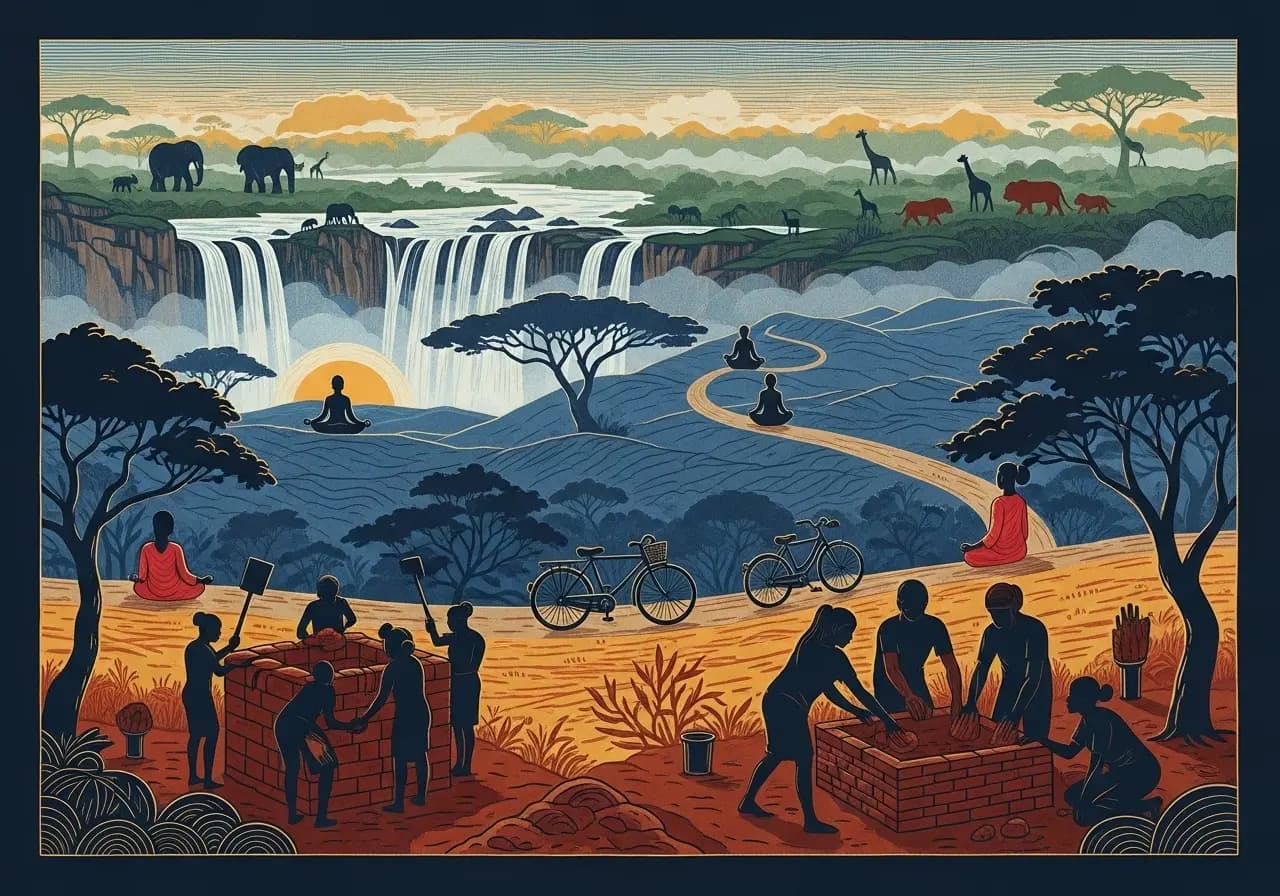
Some of you may recall from videos and pictures posted earlier in the year that I had the opportunity to go to Uganda with sixteen others to do a humanitarian trip. What made it unique was that it wasn't just a humanitarian trip. It was a blend of a mindfulness retreat, humanitarian work, and a safari adventure, all rolled into one.
This trip was organized through Africa Promise Expeditions, and Suzy is the founder and runs the company. We're doing it again, and I'm excited to say that because it means I get to go back to Uganda. It was such an incredible experience that we decided to do it again. So we're going to talk a bit about that, and then we'll answer any questions you might have if you're interested in humanitarian work, a mindfulness retreat, a safari—all in one experience. So welcome, Suzy.
Suzy: Thanks, Noah.
Noah: It's great to have you on the Secular Buddhism page. Let's talk a bit about what we're working on and what we're planning. First, people might be wondering: what is a mindfulness humanitarian trip? How would you define it?
Suzy: It's a mixture of several elements that I would call learning, service, and adventure. Now that we've done this together, we both understand it, but if somebody doesn't know what our trip is about, I would define it as a little bit of service, a little bit of cultural learning, educational workshops on mindfulness, and adventure. With the service component, I want to drive home something important: a lot of people believe they're going to serve and help in Uganda. My approach—and you've seen it firsthand—is that we're going as learners and as partners with Africans. We're not coming into Uganda saying, "This is what you need to do and this is how we can make you better." We're coming with resources, manpower, and womanpower, really as partners with the Ugandans.
A lot of people think they're going to help, and as you know and witnessed, the people who are really helped the most are the participants. So we'll mix it up—we'll definitely do mud building, which is a lot of fun. We stomp in the mud up to our knees. I can see a smile coming on your face because I know the memory is fresh. We work in conjunction with a school or community to build a structure through this mud process.
We'll learn how to make chapati, a local Ugandan food, with the students at the school where we'll be staying. That's always a question that comes up: where will we be staying? We stay at African Hospitality Institute. Noah, you can tell our friends what that's like if you want.
Noah: Yeah, I would say it's like an African resort in the middle of Africa. But it's a really unique place because it's not a hotel. It doesn't have all the amenities you'd expect at a big resort, but it's incredibly well kept and clean. It's self-sustained—they collect their own water and do all these really cool things. It feels like what you'd expect at a nice place. Everything's nice and new, and I loved it.
Suzy: Right. So we work with the staff at African Hospitality Institute and their students who are learning the hospitality industry. They take some time to teach us how to make local foods. Our transportation while we're there are bicycles—1950s Indian-style bicycles. As Noah knows, there are many days where we're riding our bicycles on dirt roads, singing "The Sound of Music" like crazy. Half the bikes are falling apart with missing pedals, and it's just part of the experience. We're having a great time on the bikes.
Noah: A couple of things stand out to me that I wanted to address real quick. When I first talked to you about this, I met you at a workshop in Park City, close to where I live. This all started as an idea: what if we incorporated mindfulness into the humanitarian work you do in Africa? Right away I thought that sounded exciting because I think most people have this dream of going to Africa and doing humanitarian work.
But as the months went by and we planned and prepared, I did feel reluctant at times, thinking: humanitarian work in Africa—who am I to go there and do anything? What if they don't even need our help? That was one of the biggest surprises and the most satisfying aspect of the humanitarian part of this trip. The sense I got from the Ugandans was: this is our culture, this is what we're doing. We would do this whether you're here or not, but since you're here, help us. Help us mud this building. Help us build this principal's office that we were adding to the school as a mud hut.
It wasn't about "Oh, we need you. We need you guys to come do this." It was more like "You get to come spend time with us. Let's have this cultural experience." We get to feel good that we were part of the experience and helped. But really, it's no different than if I went to visit you, Suzy, and you were like, "Hey, while you're staying with me, I'm remodeling the house. Why don't you help me with this and that?" It's not that you can't do it without me, but we're going to do it a lot faster if we both work on it. That's what the humanitarian part of it felt like for me.
I think it's really important to highlight that, like you said earlier, it's not that we're there to save anyone or do anything they can't already do. We just get to be there and experience that. Does that seem like a fair description?
Suzy: Absolutely. I think that's the biggest epiphany that people have when they go, and we drive that home throughout the experience. We are here in partnership. We're here as friends with these people. The one thing we do bring is we fund the building. So maybe they wouldn't have that classroom or principal's office without us coming, but we work together with the community and we ask them what they need.
Noah: And all the school supplies, the kits that we put together—all of that felt like this is what we were bringing with us. That was neat.
Suzy: Yeah, so that part's really cool. The adventure part at the end—let's talk about that for just a minute.
Noah: Sure.
Suzy: So we do a Nile River boat cruise and boat up to Murchison Falls, which is a really powerful waterfall on the Nile River. Noah brings this incredible camera and takes amazing footage. He may or may not have brought a drone and had it confiscated by the government.
Noah: We have no drone footage.
Suzy: No drone footage. But what was that safari like for you?
Noah: The safari was incredible. We saw elephants, giraffes, zebras, lions, water buffalo—all these amazing animals. We took a game drive at sunrise and at sunset when the animals are most active. We also did the boat cruise on the Nile, which was phenomenal. We saw hippos and crocodiles and all kinds of birds. The landscape is just breathtaking. Africa is unlike anything I've ever experienced. The vastness of it, the wilderness, the raw beauty—it's hard to describe. You really have to experience it yourself.
Suzy: It truly is. And the combination of the service work and the mindfulness components mixed with the adventure creates this really unique and transformative experience.
Noah: Completely transformative. I mean, we're working with our hands, mudding buildings. We're sitting in meditation at sunrise and sunset overlooking the African landscape. We're on safari seeing the cradle of humanity. It's this perfect blend of service, spiritual practice, and adventure.
Suzy: Yeah, no problem. Sorry I had to change locations and get closer to my router. You could see this beautiful painting I picked up when Noah and I were there. Cost me about $50 in the market. So don't forget—we do shopping too.
Noah: Yeah, the last day we went to the market, and that was really cool. I bought some African drums and a bunch of little fun things to bring home. That's a fun part of it.
Suzy: It is definitely. So the trip costs $3,500, and that does not include your airfare. We picked a really great time of year to go. Airfares are generally about half the price because it's not summer, and because we're catering this trip to adults, we expect that adults can travel during the winter months, which saves a lot of money.
Just in comparison to other companies or organizations that do similar things, we're on the low end of the pricing. The reason I do that is because I want to make this accessible to everybody. I received some information yesterday from a company that does something similar, and their price is $7,100 with airfares in addition. So I feel like the value you're getting with us is really high.
Noah: I mean, we have to remember this is a safari—it's a lot of stuff. If you Google "safari in Africa trip," you're going to find that the pricing alone is way higher than what we're offering.
Suzy: This price is nothing compared to that. Yeah, and everything is included. Everything's included except for your visa, which is $50 at the airport. You have to get travel insurance, which is a minimum of about $35 for a basic medical evacuation policy. Some people choose to do more—like a $100 policy that includes cancellation reimbursement.
Your $300 deposit is not refundable because that shows me you're in and that Suzy's going to put some work into this. But the rest of your trip is refundable—I believe it's up to 45 days. And we'll work with you if our trip gets affected or if you need to drop out for some reason. We'll work with you because we want you on this trip, but we also want to make it comfortable for you. I'll help you work out a payment plan.
So the next steps, Noah, would be to go to the website—mindfulhumanitarian.com. It'll link to Africa Promise Expeditions where you fill out an application. I'll pick up the phone and call you. The three of us can chat, and then you put down your deposit when you feel ready to go. From there, I'll guide you on getting your plane ticket and setting up your payment plan. Final payment is due probably around February 1st, so you've got quite a while to make your payments.
But like Noah said, I'll hold your hand. My job is to make this easy for you. This will be my fifteenth expedition or trip to Uganda by the time we go. So I feel confident, and Noah and I partner really well together. Eventually, we're going to do some other things, hopefully in Nepal or India. So for those of you who've been with us before, just keep your eyes and ears open for future expeditions.
Noah: Yep. But if Africa's on your bucket list, this is a great way to do it. If attending a mindfulness retreat is on your bucket list, this is the way to do it. If going on a safari is on your bucket list, this is the way to do it. It's all three of those things rolled into one.
I can honestly say it's a life-changing experience to go to Africa—the cradle of humanity—and experience something like this trip. It's once in a lifetime. If you're interested at all, reach out to us. We'd love to answer any questions you have. I don't see any questions posted right now on the Facebook stream, but I'll monitor in case anyone comments after we're done streaming.
Suzy: Awesome. Yeah, I love Facebook, and it looks like something. Let me find that.
Noah: I'm not seeing the live stuff. I might be delayed.
Suzy: Okay, let me check in the app. I can see it. Oh, I can still see us.
Noah: Yeah, we're still online.
Suzy: Wait, but we're not live. Are we live?
Noah: Yeah, we're live.
Suzy: I thought you said we were done being live.
Noah: Oh no, sorry. So is there any last-minute stuff we want to mention while we're live?
Suzy: No, but I do see somebody who went with me on a trip in June—Laura Del Rio—and she said it's worth every penny. Laura found out about Africa Promise Expeditions and had written down "What is my heart hungry for?" and placed that in her house. She came across my work in Africa, reached out, and she and her son both went on the trip in June. I think her heart was fed. So that's kind of what I would say my closing remarks are: your soul will be fed.
Noah: Awesome. Yep, I agree. That's how I felt. Well, thank you, Suzy. Hopefully we'll hear from anyone who might be interested, and we look forward to seeing you guys in Uganda in February and March of 2018. So thanks everyone. We'll talk to you later.
For more information about Africa Promise Expeditions and upcoming trips, visit mindfulhumanitarian.com. For questions about the Secular Buddhism Podcast, visit SecularBuddhism.com or email [email protected]