

Why Buddhism is True: An Interview with Robert Wright
Episode 46 of the Secular Buddhism Podcast
Hello. You are listening to the Secular Buddhism Podcast. This is episode number 46. I'm your host, Noah Rasheta, and in this episode, I'm excited to share the audio of an interview I had with New York Times bestselling author Robert Wright about his newest book Why Buddhism is True: The Science and Philosophy of Meditation and Enlightenment.
Introduction to Robert Wright
Last week, I had the opportunity to speak with and interview Robert Wright. He's a New York Times bestselling author of The Evolution of God, a finalist for the Pulitzer Prize; Nonzero: The Moral Animal; and Three Scientists and Their Gods, a finalist for the National Book Critics Circle Award.
He has taught at the University of Pennsylvania and Princeton, where he also created the popular online course Buddhism and Modern Psychology. In 2009, Foreign Policy named him one of its top 100 global thinkers alongside Barack Obama, Bill Gates, and Anne-Marie Slaughter. He has written for a variety of publications, including The New York Times, The New Yorker, The Atlantic, Time, Slate, and The New Republic.
This interview with Robert was the first interview I've done for the podcast, and I'm honored to have started this new format of interviews with someone like him. I plan on doing roughly one interview episode per month while I continue to maintain the original format of the podcast, as well as adding the occasional question-and-answer format like last week's episode.
Book Description
Before we go right into the audio of the interview itself, I want to quickly share the description of his book from the Amazon listing:
"From one of America's greatest minds, a journey through psychology, philosophy, and lots of meditation to show how Buddhism holds the key to moral clarity and enduring happiness. Robert Wright famously explained in The Moral Animal how evolution shaped the human brain. The mind is designed to often delude us—about ourselves and about the world—and it's designed to make happiness hard to sustain.
If we know our minds are rigged for anxiety, depression, anger, and greed, what do we do? Wright locates the answer in Buddhism, which figured out thousands of years ago what scientists are only now discovering. Buddhism holds that human suffering is a result of not seeing the world clearly and proposes that seeing the world more clearly through meditation will make us better, happier people.
In Why Buddhism is True, Wright leads readers on a journey through psychology, philosophy, and a great many silent retreats to show how and why meditation can serve as the foundation for a spiritual life in a secular age. At once excitingly ambitious and wittily accessible, this is the first book to combine evolutionary psychology with cutting-edge neuroscience to defend the radical claims at the heart of Buddhist philosophy. With bracing honesty and fierce wisdom, it will persuade you not just that Buddhism is true—which is to say a way out of our delusion—but that it can ultimately save us from ourselves, as individuals and as a species."
I really enjoyed this new book, and I hope you enjoy it as much as I did.
The Interview
Noah Rasheta: Great. Well, first of all, I do want to mention how excited I was to get to interview you after reading your book. I had heard about your course and some of your other books before, but I hadn't read any of them yet. I'm always looking for a book that works as a foundational piece for people trying to learn a secular form of Buddhism, since that's really the area I'm most interested in. When I read your book, I thought, "Oh, this is it. This is the book that I think would do a really good job of helping people have a foundational understanding of some of these concepts in a way that speaks to the audience that listens to this podcast—secular-minded people." I was really excited about that.
Robert Wright: That's great to hear, especially coming from you, because you really know the territory. I did try to make the book accessible to people who don't have specialized knowledge in this area.
Noah Rasheta: Great. Yeah, I think you did a great job with that. I'm curious about a few things. First of all, just a bit of your history—how you got into your field, how you got into writing in general, and why this field?
Robert Wright: Well, as for writing, somebody put it in my mind that I might try being a writer. I think my mother was the first person to suggest journalism, actually. My first real journalism job was at a small newspaper. Then I came to do more magazine work and a certain amount of academic or quasi-academic publications. For a while I took academic writing and edited it heavily to make it accessible to a lay audience at a magazine called The Sciences, which no longer exists. I got a lot of practice at trying to communicate with a lay audience and communicating expert knowledge to a lay audience. I don't know if you want me to turn this into the story of Bob, but I'll say I worked at a number of magazines, started writing books. My first book was in 1988. I haven't been very prolific on the book front because this one is my fifth, and it's been a long time since 1988. I've usually had a job as well in the writing field or occasionally teaching at the college level.
Noah Rasheta: Cool. Then what interested you in Buddhism, at least in approaching this book?
Robert Wright: Well, in college you were supposed to be conversant with any philosophy that was considered cool. You'd hear about Buddhism. I had been brought up as a Christian but was no longer a Christian. I'm sure I was, in substance, looking for something like a spiritual practice or grounding, but my attempts to meditate never really amounted to much. I'm not a natural meditator. I have a very poor attention span, and I think various other parts of me make me not well suited to the practice.
What it took was a week-long meditation retreat in 2003 at the Insight Meditation Society to convince me that I could do this. That did more than just convince me—I had some pretty powerful experiences there. I ended the retreat in such proximity to bliss that I thought there's definitely something here.
Noah Rasheta: There's something to this, huh?
Robert Wright: Yeah. I wouldn't say I've been entirely consistent in my practice since then, but since about 2009—that was my second retreat—I've gone on quite a few since then. Close to one a year since 2009, and my daily practice has been pretty steady.
Noah Rasheta: Cool. Yeah, you talked about that in the book a bit. The retreats you do once a year or so—are they all similar? Do you keep going to the same place?
Robert Wright: I have tended to go to IMS (Insight Meditation Society). This last spring, for the first time, I went to a different place. I went to The Garrison Institute in New York and did a retreat in the Shambhala tradition. It was an official Shambhala center retreat, but it was with teachers who had studied under Chögyam Trungpa Rinpoche, who started the Shambhala movement, I gather. That was a really interesting exposure. I mean, I had never meditated with my eyes open, which they do. It had some elements of vipassana meditation and kind of mindfulness, more or less. It was pretty different from what I was used to. It was very interesting.
Noah Rasheta: Cool. Okay. When did you create your course Buddhism and Modern Psychology? How long has that been out?
Robert Wright: I guess it's been out now about three years. It was based on a seminar I taught at Princeton a couple of times. It was actually called Science and Buddhism, but it was basically psychology and Buddhism with particular emphasis on evolutionary psychology. Turning a seminar into an online course was kind of challenging because I didn't have a prepared set of lectures. I'd never taught it as a lecture course, so it really took some work. But the people at Princeton were great in helping me, providing me with all the resources, video, professional videography. That was a lot of work, but very rewarding because even though I'm not personally on a very regular basis engaged with it, it's now just kind of a course that's out there online for people to take. I still get feedback from people who are taking it, and that's always very gratifying, assuming it's good feedback, which it usually is. I guess the people who have bad feedback are polite enough not to share it with me.
Noah Rasheta: Yeah. Well, I've heard a lot of good feedback about it from circles that I run in. People who have taken your course had a lot of good things to say. I'm going to have to check out that course as well for myself.
Robert Wright: It's short. It's only really six lectures, and most are no more than an hour.
Noah Rasheta: Cool.
Robert Wright: It's on the Coursera platform.
Noah Rasheta: Okay. Anyone interested in that—you guys have to check out Buddhism and Modern Psychology on Coursera. What I am interested in talking about today specifically is Robert's new book, Why Buddhism is True. This is a book that I had the opportunity to read over the last couple of weeks, and I'm really excited about it. I was telling Robert a little earlier that a lot of the people who listen to my podcast are people who are disaffected from religion. They're secular-minded. They're not really interested in any kind of an ism, yet there's an interest in learning about the psychology and philosophy of Buddhist concepts like meditation. They know that there's something to it.
This book fits in really well for that audience—someone who just wants to understand the science and philosophy of meditation and enlightenment, which is the tagline on this book. I'm curious about the title, Why Buddhism is True. How did that come about?
Robert Wright: Well, I'm a little abashed about the title. The good news is it will get people's attention. The bad news is some people will hate it. It just popped into my head after writing the book. I didn't set out to write a book with that as the title, but I realized that I had tried in the course of the book to mount a defense of the fundamentals of Buddhist philosophy. I was arguing that it basically makes sense.
Of course, there are lots of different Buddhist traditions. In terms of skepticism about the title, you could say, "Well, wait. There is no one Buddhism," which is kind of true. There are certainly a lot of different traditions, and they differ in significant ways. At the same time, there are some concepts pretty common to the major traditions—like the idea that the reason we suffer and the reason we make other people suffer is because we don't see the world clearly.
This lack of clarity can in some ways be divided into two parts. We don't see ourselves clearly. We have major misconceptions about what's inside our head. Then we have major misconceptions about what's out there. You might say those track roughly under the Buddhist concepts of not-self and the Buddhist concept of emptiness, respectively. It's a little more complicated than that because sometimes the concept of emptiness is taken to encompass the concept of not-self.
In general, the concept of emptiness gets more emphasis in the Mahayana tradition, but I find that it's kind of there. If you talk to Theravada meditators of tremendous accomplishment and adeptness, they have an apprehension of emptiness just the way someone meditating in the Mahayana tradition might. Anyway, I can understand being prepared to accept a certain amount of blowback about the title. I try to make clear both upfront and in a note to readers what I do and don't mean by it, and in an appendix to the book I elaborate on what I hope I've accomplished. It's a title I'm willing to stand by.
Noah Rasheta: Well, I like the title. It piqued my interest when I first saw the book because I feel like the old me—coming from a more fundamental Christian view—would have been like, "Why Buddhism is True" would immediately send off flags saying, "Everything else must be false." Having studied Buddhism for so many years now and approaching the title from the Buddhist perspective, it didn't bother me at all. In fact, I was like, "Why Buddhism is True—I wonder what he means by true." As I read the book, it became very clear to me that the intent was more along the lines of why Buddhism works, why meditation works, why these concepts ring true to people.
I think the title's great because it does get that discussion going about what is truth, at least from the Buddhist perspective. It's not necessarily the same as from other traditions.
Robert Wright: Well, I'm glad you approve. Along those lines, I actually added something in the note to readers between the galleys and the actual final book. It's that quote by the Dalai Lama: "You don't have to use Buddhism to become Buddhist. You can use it to become a better whatever you are." That's to emphasize that this is not incompatible by and large—or it's certainly not inherently incompatible—with other spiritual or philosophical traditions. It can supplement whatever your governing philosophy or spirituality is.
Noah Rasheta: That's awesome. I'm happy to hear that because I don't know if you knew this, but that's the tagline I use in every podcast episode.
Robert Wright: I have heard it. Yes, I have heard it from you.
Noah Rasheta: I think it's a powerful sentiment. I'm glad that's expressed in the book because it is true that this stuff makes you a better whatever you already are. That's definitely the vibe I got reading your book. It's almost like a manual explaining some of these concepts, and I don't see how it would be off-putting to anyone from any other faith tradition. If you're listening to this podcast or watching this video and that is a concern—if you feel like, "Well, wait a second, I've got this other truth"—this doesn't conflict with that in any way.
There's a concept in your book that I wanted to talk about a bit. The way you talk about no-self or not-self, and the research you highlight in your book about the mental modules, really resonated with me. I find that in the workshops I teach, the concept of no-self or not-self can be difficult to convey because we run up against this idea: there's either a self or there's a no-self. Those are the two options, right?
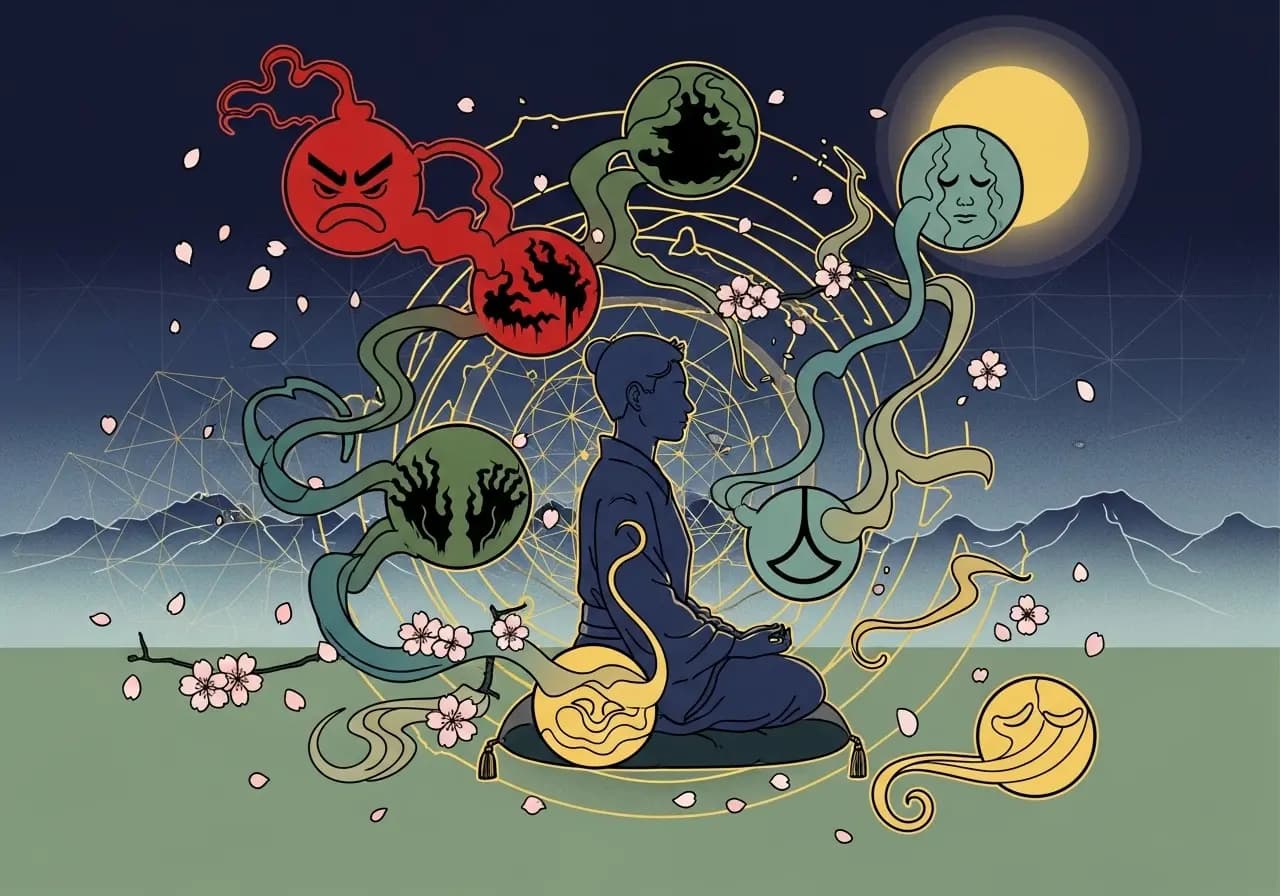
The way it was presented in your book, with the mental modules, expanded this view for me. I realized that what we're saying with this teaching—and you highlight in this book—is there's a lot of yous. There's the you that's you when you're hungry. There's the you that's you when you're mad. It's like asking, "Which you are you? Because you're not any of those permanently." I really like that. I wanted to talk about that a bit.
How was it for you first learning about the concept of not-self or no-self, and then walk me through that transition into the way you presented it in this book? I think you did a fantastic job of explaining that.
Robert Wright: Okay. I encountered the doctrine of not-self long after encountering the modular model of the mind, which I'm now viewing the doctrine in terms of. The modular model I encountered while researching my book on evolutionary psychology, The Moral Animal, which came out in 1994. The doctrine of not-self I didn't explore seriously until I was actually preparing to teach the seminar at Princeton, which was no more than five or six years ago.
I guess I had heard a talk or two about it at a meditation retreat at that point, but I hadn't tried to really look into it. I hadn't read the Buddhist discourses on not-self, which is fascinating to me for a number of reasons. One is that the way the Buddha goes through explaining it—he says, "Well, look at the various parts of your mind. Does it make sense to think of them as you?" He goes through different categories. The so-called five aggregates in Buddhist psychology, which include feelings, perceptions, and so on. The point is just that it's kind of an incremental approach to explaining the doctrine.
It's like he's asking: is there any one part of your experience that it really makes sense to think of as you? What I like about that is it makes it easier to connect an everyday meditation practice—even in its early stages—to the doctrine of not-self. Because if you're even doing stress reduction or working on anxiety, then one thing you're kind of doing is looking at that feeling and experiencing it and asking yourself if you really have to identify with it. Do you really have to consider it part of you?
You could see that as the first step toward potentially deeper meditative apprehensions that get you closer to the experience of not-self. In fact, in talking to people like Joseph Goldstein, a co-founder of the Insight Meditation Society, who have definitely gone a lot further meditatively than I have, you find out that yeah, they think of it that way. You start viewing your feelings in a different way, your thoughts in a different way. You kind of slowly move toward not-self. It's not like you have to meditate for 10 years and hope that finally, suddenly, you'll have this epiphany. You can kind of move toward an experiential apprehension of not-self in an incremental way, which isn't to say there won't be dramatic thresholds along the way, but still I think it's good that we can connect a part of the practice that some people call therapeutic—and some people call it that derisively because it's not spiritual—to the spiritual depths of Buddhist philosophy.
Noah Rasheta: I like that. Something I thought about when I was reading the book—I thought, "I wonder if anyone's ever had that moment of enlightenment watching the Snickers commercial where it says, 'You're not you when you're hungry.'"
Because part of what you talk about in the book is how our feelings determine who we are in that moment. Going back to Snickers, if you're not you when you're hungry, then it's fair to say you're not you when you're not hungry either. Because it just depends which you you are at the time. Are you the hungry you or the not-hungry you? Then we take that and expand it into all the other feelings we have throughout the day. It's the same line of thought. You're not you when you're mad. You're not you when you're happy because you're not permanently either one of those.
That was an aha moment I had reading your book. It's so simple: you're not any of those because you're not any of those permanently.
Robert Wright: Which is an explicit part of the early Buddhist defense of the not-self doctrine. There just is not the persistence through time of any one you.
Noah Rasheta: Exactly. I love the way you laid that out. Then you go on and give a specific example of one of the feelings. You have a section where you talk about jealousy. I want to make sure I quote this the right way. Do you know if the page numbers will switch from the galleys to the final book?
Robert Wright: They will switch. I can look. Do I have the physical... They won't be the same. You have an index copy and the galleys?
Noah Rasheta: I'm not sure which one this is, but it looks like chapter seven is called... I assume the chapter numbers won't change. It's called "The Mental Modules That Run Your Life."
Robert Wright: I think that's where the jealousy thing is. Yes.
Noah Rasheta: Inside of that you've got a section that says "Jealousy: Tyrant of the Mind."
Robert Wright: Right. Right.
Noah Rasheta: Now this section really spoke to me because I've experienced this. I've gone through this, and I've alluded to this story before in my podcast when I talk about my story. But going through and experiencing jealousy firsthand, having experienced emotional jealousy on the heels of a betrayal, a lot of what you described was like to a T what I felt. It was fascinating to read through this and think, "That wasn't me."
Robert Wright: You have transformed into a completely different person.
Noah Rasheta: Exactly. Exactly. Let's just talk about that section for a bit if you don't mind.
Robert Wright: Sure.
Noah Rasheta: The point that you're making in here—similar to what we've just been discussing—is that the jealous you is ... There's a module of the mind that can kick in and it overrides everything. You hear about this in courts, right? Crimes of passion, and the argument being made is that well, that wasn't me. I was going through an emotional state, and that's when I did this or did that. What you're saying here, and it totally makes sense, is that even if I don't go out and murder someone while I'm experiencing this, I may be making small, subtle choices that I wouldn't make if I weren't feeling what I was feeling, right?
Robert Wright: Right.
Noah Rasheta: If that's relevant to jealousy, which is a very easy one to identify with—I think most people have experienced that to some degree—then that's the case with every emotion and every feeling, right?
Robert Wright: Right. I mean a couple of things there. One is that, as you suggested, what the modular model of the mind says is that when you say, as you did, "Well, it's a different you when you're in this. It's a different you when you're hungry than when you're full. It's a different you when you're jealous"—the modular model says that's more literally true than you might think. In other words, there are specialized parts of the mind that take turns running the show. According to evolutionary psychology, they were designed by natural selection for different purposes. In some cases, at very different times. Some are older than others.
Certainly, jealousy is thought by evolutionary psychologists to be like a very carefully engineered module with a function. That's one thing—this model says, "Yeah, there's really a lot of different yous in there. They're often operating at a subconscious level." Sometimes you can sense the struggle between them, but sometimes maybe you're oblivious to it if there is any competition between them for which one's going to govern in consciousness. In any event, it's usually a case that one or another of them is kind of running the show.
The other thing I'd say is like the feelings thing I think is key because jealousy is a very dramatic example of a feeling ushering in a new you. I think much subtler feelings do it in a subtler way all the time. You'll see somebody you're kind of a rival with. That will give you a little feeling that will shape your perception of them and shape the essence you project onto them. That will govern how you interact with them, and you may notice that. Then there's maybe somebody that's kind of a frenemy, and that'll be a subtler kind of feeling.
But in general, it's like these feelings are ushering in different versions of us. One interesting thing about mindfulness meditation is it makes you more aware of feelings. It gives you more leverage over them in the sense of being able, if you're aware of them, to sometimes choose not to blindly follow them. If feelings are the things that usher in the different versions of you and mindfulness meditation gives you some leverage over feelings, well, then mindfulness meditation is a very powerful thing.
Noah Rasheta: Yeah. Absolutely. I love that you mentioned in this very section that resistance isn't the mindful way of dealing with jealousy anyway. That would be applicable to any feeling. It's not that we're trying to resist it or force a certain feeling away. No. In Buddhist practice, we're very aware of what we are clinging to—what we're trying to feel right—and what we're averse to, what we're trying to push away. That's something you highlight in this book: that awareness is so key when it comes to these feelings. Even small, subtle feelings at any given moment are influencing who you are in that moment.
Rather than doing anything about it in terms of resisting or pushing away, we just want to be aware and recognize: this is what I'm feeling. Why am I feeling this? I think that ties in so closely with mindfulness as a whole. That's why we do that.
Robert Wright: Right. An interesting example of that is treating actual addictions. I mentioned in the book that Judson Brewer, whom you maybe aware of, has done a lot of work in this area. He's a very serious meditator himself. He's now at UMass Medical School—that's where Jon Kabat-Zinn's research center is—in Massachusetts. He did a study where he looked at smokers, and he had them rather than fight the urge, just sit there and observe the urge. Not smoke a cigarette, but not try to distract themselves or do something else either. Just sit there and observe the urge.
He did an actual study involving 88 subjects and found it to be more effective than some standard treatments for nicotine addiction. As they observed the urge to smoke, it lost its power.
Noah Rasheta: Isn't that fascinating?
Robert Wright: Mm-hmm.
Noah Rasheta: I love that. I love all of this. Something I wanted to talk about with this is that I think sometimes we have this impression that okay, I start to understand that it makes sense that there are different mes. I get that I have different feelings, and I'm not the same me when I'm hungry versus not hungry. All that—I get that. But I have this sense of feeling like there is a me that's capable of overriding all the others at any given time. You talk about this as the CEO. You specifically have a section where you say, "The CEO is MIA," and I love that. Let's talk about that for a minute. Talk to me a little bit about this idea of a CEO.
Robert Wright: Well, the Buddhist doctrine of not-self has been described various ways and interpreted various ways. One way it is sometimes put is that the doctrine denies that the conscious self is kind of running the show, that it's the doer of deeds and the thinker of thoughts. I mean, this is what you hear maybe on meditation retreats. The meditation teacher saying, "You know, thoughts think themselves if you really look carefully at them. You're not in charge of generating them. They're just passing by your consciousness."
One trend in psychology over recent decades is to support the skepticism as to the actual power of the conscious self. The kind of old idea that the conscious self is the CEO—you're calling the shots—has come under challenge from a variety of experimental findings. That goes back several decades. A model I like in preference to it is, of course, this modular model, which by the way can help explain why it might seem like thoughts think themselves. I mean, if modules are actually kind of injecting them into your field of consciousness, then the very careful observer of them, a very adept meditator who's watching thoughts, would kind of see them as if they're thinking themselves. They're just kind of assuming form and passing away.
The idea that you, the conscious you, are the CEO has really fallen into disrepute in psychology for a lot of reasons. That's one of various cases where I think modern science lends some corroboration to millennia-old Buddhist ideas.
Noah Rasheta: I love that section—"The CEO is MIA." You have a quote in here. You talk about observing—going back to the feelings real quick—observing feelings without attachment is the way you keep modules from seizing control of your consciousness. You talk about the paradox. I'd like to talk about this paradox a little bit about the control aspect: that you take control by not trying to take control. Walk us through that paradox a little bit.
Robert Wright: Yeah. I mean it's paradoxical on two levels. First of all, there's that paradox that surrendering control and becoming in some sense a mere observer of the process gives you more control. That seems ironic, but you can kind of see why it's the case. Because if these feelings are running the show and becoming so aware of them that you don't blindly follow their guidance, that you don't react to them in the way they're designed to make you react—it makes sense then. Just kind of sitting there watching them takes power away from the feelings and gives more power to you.
Now the second paradox is more profound, and I'm not sure I can help us out of it, which is just like what do we mean by you, right? If the self doesn't exist—and I don't want to get too deep into the weeds of Buddhist philosophy, but in that discourse on not-self, the five basic parts of kind of human experience that are covered—in all of which the Buddha says are not part of the self—that includes consciousness as one of those. Consciousness, it says in there, is not the self.
That raises the question: well, where do we find this you that, in substance, has more power by virtue of meditation? I don't know that I have a confident answer to that question. I think there are people who are much further down the meditative path than I am who don't find it so puzzling. On the other hand, they have trouble articulating sometimes why they don't find it puzzling.
It's one of many cases where as a practical matter, you don't have to get too caught up in paradoxes that lie at the very roots, at the very depths of Buddhist philosophy and might become more relevant to you if you got somewhere near actual nirvana and awakening. For most of us, that's not a problem, right? For most of us, just living our lives is challenging. For those purposes, just think of there as being you. In fact, it is a Buddhist idea that in a so-called conventional sense, the self exists; in an ultimate sense, it doesn't. It's fine to live a lot of your life at a conventional level and talk of the self as existing.
Noah Rasheta: Sure. Yeah, I like that. You mentioned nirvana. This is one of the questions I had written down that I was curious about. What is nirvana for you? How do you define it?
Robert Wright: It is said to be something that someone reaches at the point that they reach so-called awakening or enlightenment, which is an interesting feature of Buddhism—that the two terms are synonymous, or at least these things arrive at the same time. That when you see the ultimate truth, you achieve ultimate happiness—bliss, right? There's a third part, which is that if all goes according to plan, you should be a much better person. There are really three things that are asserted by traditional Buddhist philosophy that are said to coincide: truth about the world, happiness, and goodness. That's an amazing thing. That's an amazing claim.
I think there's a case to be made that indeed progress along those dimensions, at least, tends to be correlated. Now as for what nirvana is, I mean first of all, it is said to be blissful. I'm agnostic on the question of whether there are any people in the world right now who have truly attained enlightenment. That's a long debate, or whether there have ever been. I mean, I don't know. It depends on how you define it. I tend to have a pretty strict definition of it that would make it hard for people to accurately claim they've obtained enlightenment, but different people have different views.
Well, here's an interesting thing about it: in the Buddhist texts, it is sometimes characterized with this word "the unconditioned." The unconditioned in Buddhist terms kind of means, more or less, the uncaused—not subject to the kinds of causes that normally push and pull us. That's a really fascinating thing because it gets back to what we were saying. I mean, if indeed feelings are the buttons that get pushed on us, that manipulate us, right, and get us to do certain things unthinkingly, reactively, and mindfulness meditation—by making you aware of your feelings—gives you the option of kind of removing yourself from those levers. Then you are in a sense liberating yourself from the causes that normally impinge on you, right?
The way I think of the world, it's not possible to completely remove yourself from all causation, right? I can't imagine that, although I think the Buddhist claim is that nirvana involves that. That aside, it kind of makes sense to think of meditative progress as moving you toward the unconditioned because it is making you less kind of mindlessly enslaved by causality as it normally operates in a human being. Does that make sense?
Noah Rasheta: Yeah.
Robert Wright: That's one thing that's interesting to me about nirvana. The chapter on nirvana was helped a lot by my reading what Bhikkhu Bodhi has said about it and getting feedback from him by email on how I was interpreting it. He was really great. He's a really important American translator of Buddhist texts.
Noah Rasheta: Sure. One thing I love about Buddhism with its paradoxes is that the thing that you want is the very problem, right? I talked about this at a presentation on Sunday about spiritual journeys from the Buddhist perspective. On a typical journey, the journey is from point A to point B, wherever point A is and wherever point B is. There's a goal that you could say: the goal is to get from point A to point B. Now on the Buddhist path, you could say that it's similar in the sense that point A is suffering, point B is you reach this place where there is no suffering. Rather than thinking of these places as places, these are more like mental states.
Yet the paradox in this would be: if I am not at point B, wherever I am, and I see there's point B and I'm trying to get there, that's the very source of my suffering—that I'm here and I'm not there and I want to be there. That's where this paradox comes in: the moment I can accept "well, this is where I am and I don't want to be anywhere else, this is just where I am," ironically that's when you get to point B. Not because you wanted to get there, but because you've made where you are point B.
Now correlating that paradox with what you're talking about with the feelings and how we just observe them—to me that comes across as similar in the sense that I feel this. I don't want to feel this. I want to feel that. Now I'm caught in the very problem. That's why I love the title "Why Buddhism is True," correlating it to this whole line of thinking. Is it saying, "This is what's true—that when you are completely content with where you are, when nothing needs to be any different than how it is, ironically that's it. That's when you found the very thing that you were looking for—which is that nirvana or that radical acceptance."
Robert Wright: It is ironic that you start out by saying, "I'd like to be happier. I'd like to be enduringly happy. That's the way I'd like to feel." The answer is well then quit caring about the way you feel.
Noah Rasheta: Exactly.
Robert Wright: It seems paradoxical, but that's at the very core of Buddhist practice: to quit yearning for things to be different than they are. That's what it means to quit trying to kind of run away from unpleasant feelings and quit trying to cling to pleasant feelings. It's paradoxical, but that doesn't mean it doesn't work. It seems to work. I don't want to minimize the challenge, though.
Noah Rasheta: Absolutely.
Robert Wright: There are people who say that they've attained spontaneous awakening and never had to meditate, don't meditate. I envy them. I think for most of us it takes real commitment, which is hard to get on the cushion every day, but then it pays real dividends.
Noah Rasheta: It's funny. I have a friend who has told me before, "I want to learn to be more patient." There's almost a sense of frustration in the process because it's like, "I want to be patient now." That's the irony of it—that's the very reason you can't, right? You can't want that now. I think about that a lot with Buddhism in general, with enlightenment. The idea of enlightenment in Buddhism, the science of enlightenment, all of this that's talked about here—you mentioned this in the book. The huge irony in all this is when you can sit there and watch these modules, you don't have to control them. That's the only time you actually have a sense of some control over them.
That's still the irony because you don't have control over them, and I love that paradox.
Robert Wright: Yeah, but just to not have them controlling you is progress in itself, right?
Noah Rasheta: Yeah.
Robert Wright: Right. Now it's full of paradox. Life is full of paradox. Quantum physics is full of paradox. You know what I mean? Reality seems to involve paradox.
Noah Rasheta: I think that's an important distinction that you just made. The way our feelings and emotions control us—and what if our goal was just to not let them control us rather than thinking the duality? We're always in this dualistic mindset: I don't want them to control me, therefore I must control them. The truth is you can't get to that point, but you can get to the point where they don't control you. The reactivity goes away, and that's really what we're after, right? The freedom from our habitual reactivity.
Robert Wright: That's right. That's right.
Noah Rasheta: I love that. Let's talk a little bit about the book in general, on the whole. Why is this book important right now?
Robert Wright: That's a good question. First of all, as a practical matter, it does serve as a good introduction for people who are not that conversant in Buddhism and maybe haven't even meditated. I mean, one of the blurbs I'm proudest of is Sharon Salzberg, who was very nice and said something like, "The book is of value both to experienced meditators and to people who are wondering what the fuss is all about, who have never meditated." I like to think that it works at both of those levels. I don't know because I can't be a naïve reader of it, but I hope that's true.
Leaving that aside, I mean leaving aside what I hope it will be as a resource to people—what I was trying to do was argue that in fundamental ways, you hear that well, meditation is being validated by science. What people usually mean by that is well, they did a study showing that meditation relaxes people. That's good, but I think a deeper validation is possible. That's what I was trying to achieve. I argue that science actually corroborates not just the practical value of meditation, but the philosophical foundation of Buddhist meditation—in particular, mindfulness meditation—and kind of the Buddhist psychology implicit in all that.
That's what I hope to do. I did it by reference to not just psychology, although a lot of what I talk about are various things, brain-scan studies, and various experiments in psychology. But I also put particular emphasis on evolutionary psychology because I'm a long-standing fan of that. I've written about it. I think it is itself a very valid framing of psychology broadly. I mean, if you believe that natural selection created the mind, it kind of has to have some relevance to the way our minds are, right?
I hope that I brought something of value by bringing my prior conversance in evolutionary psychology to Buddhist philosophy and to meditative practice. I think here it's maybe a good thing that I'm not a better meditator than I am. What I mean by that is I started in middle age. I was already, I guess, thinking that I might write about this. I was kind of observing the process from the point of view of a beginner and thinking all along like how would you explain this to people? I make fairly considerable use of my own experiences, especially on retreat, where you tend to have the most dramatic experiences. I hope there's something distinctive there in that combination of things: evolutionary psychology, Buddhist philosophy and psychology, and my own experience meditatively.
Noah Rasheta: Great. Do you happen to have a favorite concept or topic that you discussed in this book?
Robert Wright: You mean favorite in the sense that I'm proudest of what I did with it, or I like the way it reads most?
Noah Rasheta: I guess a section that you feel really rings true through experiential knowledge. We talk about Buddhism as a whole: "Why Buddhism is True." Is there something specific that has stood out to you that you presented in this book where you're like, "This right here rings true to me."
Robert Wright: Well, a couple of things. I would say in terms of the distinctive light that an evolutionary perspective can shed, I think the argument I tried to make about so-called emptiness—the idea that the things you perceive out there actually don't have the essence that we tend to project on them. I'm proud of that, and I hope people will take the argument seriously, but that's not the most user-friendly part. It's the reason I kind of saved it for the later parts of the book.
I would say in a way one of the more user-friendly is something I already said: just appreciating that a fairly modest meditative practice—however halting and incremental your progress may seem and however therapeutic it may seem in its aims, just to make you a little less stressed out or whatever—is kind of continuously and naturally connected to more thorough-going meditative attainments and to the depths of Buddhist philosophy.
I hope people take seriously the claim that our everyday way of looking at the world is deeply misleading because I think that has moral consequences. It's what starts wars. It's what I think is responsible for the political polarization in the United States today. It's that everyone thinks their view of the world is the actual true view, but actually our minds were designed by natural selection to mislead us. Not always. I mean, there are a lot of things we see very clearly. You want to see the walls. You don't bump into it, and so on. But especially when it comes to our righteousness, our rectitude, and the contrasting rectitude of whatever tribe we identify as the enemy, there our minds are systematically misleading us.
I think both making progress on both the not-self and the emptiness front will help us make progress in fighting these problems—political polarization, sectarian strife, and so on. I mean, if you ask me what I hope will come out of the book, my hope is that it'll help things at that pragmatic level.
Noah Rasheta: That's awesome. I couldn't agree more with you on that assessment. That's the vibe I got reading this book. It felt like this is something everyone needs to read. I've always thought every couple when they get married should be required to go through mandatory relationship coaching or something to that effect. I feel like every person going out into the world as an adult should have some kind of mindfulness skills. I felt like this book gives you the foundation. I've heard of this mindfulness stuff. What is it? Why would I even want it? This is the kind of book that's like, "Ah, okay. It makes sense. It makes sense how it works, why it works, and now I want to practice it."
That's the feeling I got from it. I'm always recommending books. I have a list of probably 40 or 50 books on my website, SecularBuddhism.com/books. These are my recommended books. But I mean this when I say this: I feel like your book is now among the top of the list for me to make sure people read to understand, "Hey, this is why this stuff works. This is why we practice this stuff." I'm going to encourage everyone to read it. I'm very happy that you wrote it. I'm very happy with the way that you wrote it because I think it speaks to people who, like me, are secular-minded and who aren't interested in anything that feels dogmatic in any way. The way you've presented it, I think, is just fantastic. It speaks to that audience. Thank you for contributing and writing this at a time when the world could benefit greatly from this book.
Robert Wright: Well, thank you so much. That means a lot coming from you. As I told you before we started recording, I've been aware of your podcast for a long time. Very impressed by it and impressed by the way you kind of do it by yourself. I mean, it's just kind of you talking, and that's a hard thing to do. But for that reason, months ago when the book was coming out, I thought, "Well, I guess that's one place I won't see myself talking about the book because he doesn't have guests." I'm glad that what is from my point of view the perfect time—you're branching out a little. I really feel lucky. I'm really, really grateful for what you said about the book, and really gratified that you have that view.
Noah Rasheta: Well, thank you. Do you have a specific place where you want people to go look for this? Is Amazon the best place? Any links I'll put them on the website and in this specific episode.
Robert Wright: I guess if they want to kind of check it out a little before buying, there is WhyBuddhismIsTrue.net, which features kind of just the first few paragraphs of every chapter. You could kind of check it out a little there, although these days Amazon lets you kind of browse a book a little. You can do it there too. I don't particularly have a preference. Some people want to support independent bookstores. That's a great thing too because they're a great institution.
Noah Rasheta: Well, I'll be posting links to different places. If any of you listening or watching this are interested in the science and philosophy of meditation and enlightenment, written from a perspective that is very open to what I highlight in the podcast—with the Dalai Lama saying, "Do not try to use what you learned from Buddhism to be a Buddhist. Use it to be a better whatever you already are"—that journey starts with this book in my opinion. This is a great place to start. The concepts are very clear. I think my favorite part of your book, if I just want to share my take, was the whole topic of not-self. The way you present and correlate that with the mental modules made so much sense to me. I love your analogy of the red pill at the beginning of the book with The Matrix.
Robert Wright: From the movie The Matrix.
Noah Rasheta: That really is what this is like, right? Realizing you're living in the matrix.
Robert Wright: Realizing you're living in the matrix.
Noah Rasheta: Mm-hmm. You talked about this. What you see isn't what you think it is. If you want to see what it is, use the red pill. I love that. Thank you very much for your time and for being on the show. I'm excited and honored that you are the first guest that I've had in this new interview format.
Robert Wright: Well, I'm excited and honored by the exact same thing.
Noah Rasheta: Well, thanks. I'll be doing this more often—maybe once a month with a format like this. I'd love to maybe reconnect at some point in the future and see how the book is doing or what other projects you have in the works. For now, I think this is kind of the main focus, but I'd love to see what you come up with down the road and have you back on the podcast.
Robert Wright: Absolutely. I'll be here.
Noah Rasheta: Cool. Well, thank you for your time. Do you have anything else that you would want to add? Any closing thoughts or anything?
Robert Wright: I don't think so. I would just say try it. And if you've tried meditation and it's never worked, try a meditation retreat. Do research. Find out where you're going and have reason to think that the teachers are good and that it's what you want. Without a retreat, I don't think I ever would have gotten into this stuff.
Noah Rasheta: That's really good to hear because I get that a lot from people: "I like this, and I tried it. I meditated a few days, but this is really hard." I always say meditation is easy. Meditating is hard. Doing it is the hard part. I love the idea of a retreat. Remind us which one you went to.
Robert Wright: I've done most of mine at the Insight Meditation Society, which is in rural Massachusetts. It's one of the places where vipassana meditation—which is not exactly the same as mindfulness meditation, but involves it—is taught in the United States. This is an important institution co-founded by Sharon Salzberg, Joseph Goldstein, and Jack Kornfield, who himself went out and founded Spirit Rock in the west.
Noah Rasheta: Cool. Okay. I'll post links to some of these places that we're talking about in the podcast as well and on the website. Well, thank you very much. This has been a really fun experience. I've been a little reluctant since I started the podcast about when and how to do interviews, and I've had a few authors reach out to me already with books. Yours was the first one where I thought, "Oh, I'll give it a try," and I started reading it. As soon as I started reading it, I was like, "Okay, this is the type of author I want to interview because..."
Robert Wright: That's so great to hear. The title worked with you, at least. Got you to open the book.
Noah Rasheta: Well, if I had been browsing the halls of the bookstore and came across it, I would have looked at it and thought, "Huh," because I think from the Buddhist perspective, I would have seen just the interesting correlation of Buddhism and true in the same sentence, and I would have been like, "What do they mean?" and I would have read it. The way the book is designed now, I love the comments you have on the back. Martin Seligman, Sharon Salzberg, Jonathan Goldstein—I mean, those were great. I would have read the back and I would have said, "Okay, this is a book I'll pick up and give it a try."
The title would have caught my interest, and then looking at it a little more closely would have been enough to say, "Yeah, I'll read this." Then reading it makes it so I would tell anyone about it now. Good job on the book.
Robert Wright: That's so good to hear.
Noah Rasheta: All right. Well, thank you very much. It's been a pleasure having you on.
Robert Wright: Same here, Noah.
Noah Rasheta: All right. Take care.
Robert Wright: Bye bye.
Closing
If you enjoyed this podcast episode, please share it with others. Write a review or give it a rating on iTunes. Check out Robert's new book by visiting SecularBuddhism.com/true. If you would like to make a donation to support the work I'm doing with this podcast, please visit SecularBuddhism.com.
That's all I have for now, but I look forward to recording another podcast episode soon. Until next time.
For more about the Secular Buddhism Podcast and Noah Rasheta's work, visit SecularBuddhism.com