

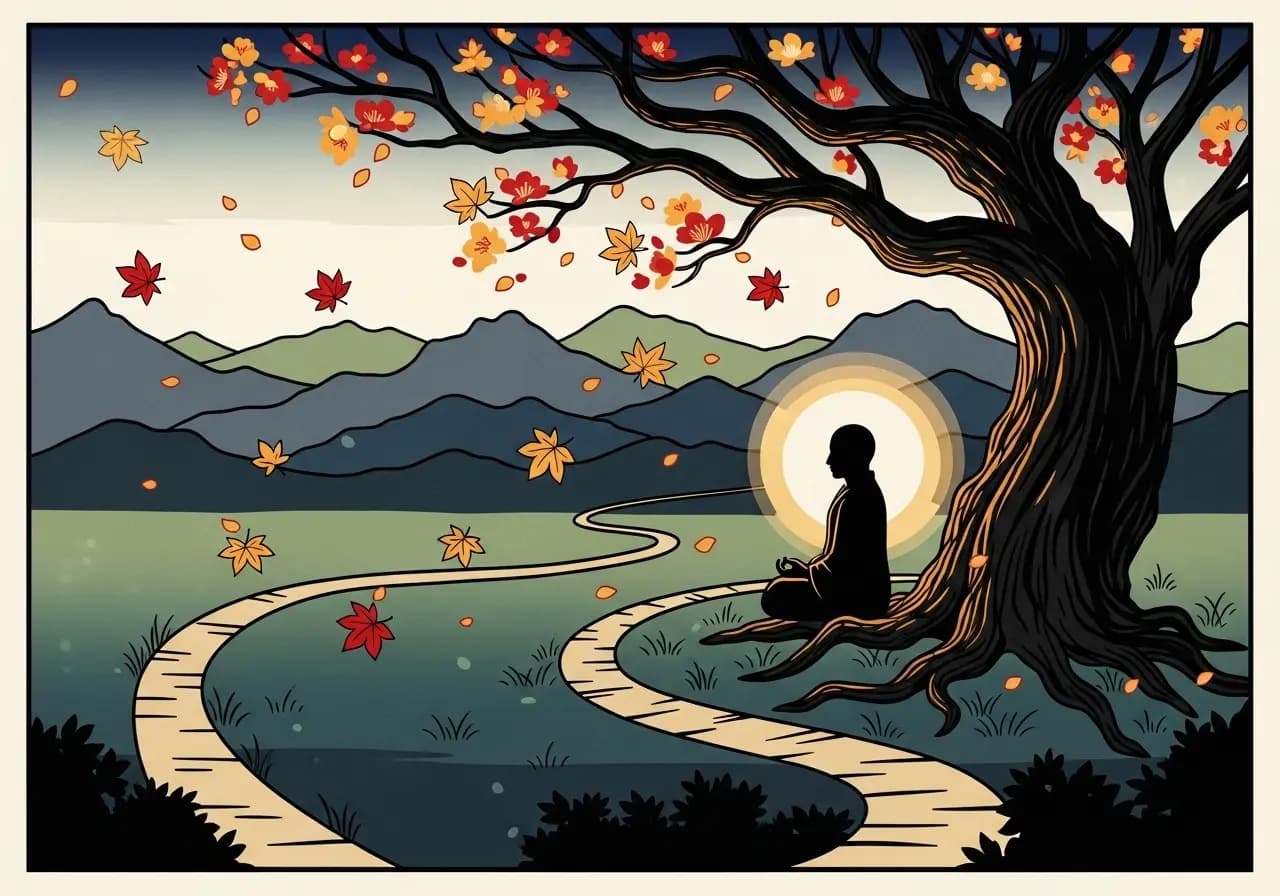
Finding the Teacher Within
Episode 44 of the Secular Buddhism Podcast
Hello. You are listening to the Secular Buddhism Podcast, and this is episode number 44. I'm your host, Noah Rasheta, and today I'm talking about finding the teacher within.
Welcome
Over the past several weeks, I've been watching a series on Netflix called "Buddha." It's a 55-part series about the historical Buddha, and it's inspired by Thích Nhất Hạnh's book Old Path, White Clouds, which happens to be one of my two favorite books on the topic of the historical Buddha, Siddhartha Gautama. The other book is Buddha by Karen Armstrong. If you're interested in learning about the historical account of the Buddha, I would certainly recommend both of those.
What's been great about watching the Netflix series is that it's really fun to finally add visual images to the stories I've read in several books and early Buddhist texts. It's not the best quality production. I like to think of it as a Spanish soap opera produced by a Bollywood production company—that's the style. There are several moments where I just laugh because it's quite entertaining in a comical way.
In general, despite the low production quality and subpar acting, I still enjoyed it quite a bit because it's fun to have a visual representation of stories I've listened to and really enjoyed in my own studies of Buddhism. But something that really stood out to me while watching the transformation of Prince Siddhartha Gautama into the ascetic Siddhartha, and ultimately into the Buddha—the Awakened One—was the role of his various teachers along the way.
The Buddha's Teachers
Historically, according to the Pali Canon, the Buddha had two main teachers once he became an ascetic in the forest. The first was an ascetic named Alara Kalama. He taught Siddhartha how to meditate, and after studying with him for some time, Kalama said, "Hey, I've taught you all that I know. There's really nothing else I can teach you. Why don't you stay here and take over the school?" He was getting old, and he wanted someone to carry on his work.
But Siddhartha said, "No, I'm not interested in that," because he didn't feel satisfied. He didn't yet have the answers to his questions.
From there, Siddhartha went on and found another teacher named Udaka. He worked with him, and ultimately the same thing happened. Udaka eventually said, "Well, I've taught you all that I can. You know everything I know. There's nothing left for me to teach you."
At this point, Siddhartha became frustrated. He thought, "Well, I guess I'll have to figure this out on my own," and he continued his journey. And that's exactly what happened. He attained enlightenment or awakening all on his own.
I covered this concept of the Buddha attaining enlightenment in a previous podcast—Episode 39: What is Enlightenment? If you're interested in exploring that topic a little more, go back and listen to that episode.
The Discovery Within
In the story of the Buddha, he ultimately discovers that the teacher he's been looking for was himself. It was him all along. This is finding the teacher within. That's the topic of this podcast.
The profound implication of this discovery is that it's similar for us. We, too, can learn as much as possible from all the teachers out there. But in the end, the greatest discovery is realizing that the teacher you're looking for is you—the teacher within.
Before I dive deeper into this topic, I do want to remind you of a couple of things. First, there's a commonly shared quote from the Dalai Lama: "Do not try to use what you learn from Buddhism to be a Buddhist. Use it to be a better whatever you already are." Regardless of which path you're on or how far along that path you may be, mindfulness can help you become a better whatever you already are.
Second, this podcast is made possible by the Foundation for Mindful Living, a 501(c)(3) nonprofit whose mission is to make the world a better place by teaching people to live more mindfully. If you get any value out of this episode and you're in a position to do so, please consider becoming a monthly contributor. Even $2 can make a big difference. Of course, one-time donations are appreciated as well. You can do that by visiting secularbuddhism.com and clicking on the "Donate" button at the top of the page.
Which Path Is Right?
The reason I wanted to discuss this topic is because people often ask me, especially those just starting to listen to the podcast or read books on Buddhism, "Well, which is the best Buddhist path? Which is the right path? Which one teaches more accurately?" These are natural questions for us to have.
What I like about the example from the historical account of the Buddha is that he had multiple teachers. There was the guru he worked with as a child to study the Vedas. Then he had other teachers throughout his life. The two more well-known teachers in his adulthood are the ones I mentioned earlier.
The point is that working with teachers is a common thing, but a teacher can only get you so far. This is what happened to the Buddha. His ultimate teacher ended up being himself.
Now, I think what happens with a lot of people who study Buddhism is they encounter this story and think, "Wow! Okay, so he became awakened. So the Buddha is the ultimate guru, the ultimate teacher I want to work with." And we make the same mistake we've been making all along—we're looking outside of ourselves for something that can only be found internally. It can only be found inside. That's the great realization that the Buddha had. His awakening was understanding that he was the ultimate teacher.
Teachers Can Only Go So Far
What that means for us is that we can learn from the Buddha, we can learn from these stories, and we can learn from a Buddhist teacher, a monk, or anyone else. But you can only learn so much. You're going to reach the point where it's going to be like what the Buddha encountered: "Hey, I've taught you everything that I know. There's nothing left for you to learn." Now it's back on you. The ball is back in your court.
I think we make a mistake when we think of the Buddha as the ultimate teacher in the sense of "That's who I need to learn from." Certainly, following his example is a good idea. Studying what he taught is a good idea. But if we're going to get anything out of what he taught, let's understand the main thing he taught.
The very last teaching in his final discourse was about becoming your own light—be your own light, be your own guide. He was essentially inviting people to do exactly what I'm trying to explain in this podcast: realize that you are the ultimate teacher. In other words, you are your ultimate teacher, and I am my ultimate teacher.
Taking Refuge in the Buddha
In Buddhism, it's common to take refuge. In fact, becoming a Buddhist means taking refuge in the Three Jewels: the Buddha, the Dharma, and the Sangha. I discussed this in detail in Episode 41: Life on the Buddhist Path. You can go back and listen to that if you want a better understanding of what it means to take refuge in each of these.
The first one, taking refuge in the Buddha, is about wisdom. It's about anchoring myself in the possibility of becoming awake in the same way the Buddha became awake. It's not necessarily about learning from the Buddha as if he were my teacher and trying to match his wisdom. Rather, I think the profound implication is this: to take refuge in the Buddha is to say, "I'm going to do what the Buddha did and discover that I'm my own greatest teacher. I'm not going to rely on someone else to be my guide or to be my spiritual authority. I'm going to be my own."
Like the Buddha said, "Be a light unto yourselves." This is about awakening the Buddha within—the Buddha nature. We talk about Buddha nature in Buddhism. This is the essential understanding that you have everything you need already inside you right now. It's just a matter of discovering it.
In his final discourse before he passed away, one of the Buddha's monks asked him, "What if we meet you on the path?" The Buddha replied, "Don't accept anyone that you meet on the path as your authority towards liberation, even if you meet me."
You may have heard the expression "Kill the Buddha if you see the Buddha on the road." I think that teaching comes from this sentiment.
The Buddha goes on: "Even if it's your father, it doesn't matter who it is, don't take someone as your authority because you are the only one who can awaken yourself." The power of awakening oneself—that's what the word "Buddha" means: Awakened One. Nobody can awaken you. Nobody can force you to wake up. People can help along the way, but just like in the Buddha's own story, they'll help you get so far, and then that's it. Then you have to go on your own. Someone else may help you get a little bit further, but at some point, you have to figure it out on your own. You have to awaken yourself.
The Buddha's Final Teaching
This is the Buddha's famous last teaching: "Be a light unto yourselves." In other words, be your own guide. While Buddhism offers us a natural understanding of reality—that things are interdependent, that things are interconnected, that all things are impermanent—you can observe this natural understanding on your own. You can figure this out through observation and through meditation. This is all part of the process of awakening yourself.
The Buddha said, "Don't look to anyone else for guidance." Now, that doesn't mean "Okay, I'm not going to learn from anyone anymore. I won't read books or listen to this podcast." What he's implying is don't rely on someone as if they hold the key to your awakening, because they don't. People can be part of the path in the same way that the Buddha had teachers, but ultimately, he was his own teacher.
The Foundation Matters
Think about this from a different perspective, completely outside of ideology, religion, or spirituality. Let's think about math. When you go to school and start learning math, you begin from the bottom up. You learn the basics—how to add two single-digit numbers, then double-digit numbers, then subtraction, multiplication, and division.
You don't reach fifth grade and suddenly think, "Oh, that first-grade teacher was pointless for me because they only taught me that two plus two is four. Now I know how to multiply three-digit numbers, so that was dumb." We don't do that because we recognize it was a foundation. What I learned then is what made it possible for me to learn this now.
This progression continues. The more proficient you become with math, the more beneficial it is for you to interact in the world of numbers. Now, as a mathematician, it's not vital for you to ask, "In what style did Pythagoras teach?" or "What did he say about this or that?" because the math speaks for itself.
I think Buddhism is the same. The teachings are much more important than the teacher. We don't want to get hung up on the guru part of all this. We want to understand the concepts and know how to apply these things in our lives. That's what matters most—not the teacher.
The Map Versus the Territory
When was the last time you had a discussion or debate about algebra, wondering "Who's the legitimate founder of algebra? Was it Diophantus or al-Khwarizmi?" Some people say it's one, and most people say it's the other, but it's irrelevant. Even though we live in a world where algebra plays a significant part in our day-to-day lives, we may not even know—go ahead and Google it. You'll find that much of modern society functions on principles that work through the discovery of algebra, and most of us don't know anything about the founder because it's not that important.
What if we could start to view spirituality, at least Buddhism, in the same way? I'm not saying that means we don't need to have any respect or appreciation for the Buddha. Many people do, and I think that's part of their practice. But especially in the secular approach, we recognize that what matters here is the algebra itself, not the founder of algebra. What matters is mindfulness as a tool, as an exercise.
These concepts all stand on their own two feet. Mindfulness doesn't have to work only if you can prove that the Buddha was who he said he was. Buddhism doesn't have that dependency like some other religions do, where the validity of the present-day message is contingent on the truthfulness of the founder's story.
Buddhism isn't like that. You can observe it, practice it, and realize on your own: "Hey, yeah, things are interdependent. Things are impermanent. What are the implications of that?" You can put all of this into practice without ever having been told that this comes from Buddhism, that there's a guy named Siddhartha who was later called the Buddha. None of that would matter, and all of this would still be relevant and beneficial to you in your own life. You could still achieve your own form of enlightenment or awakening without knowing any of that. That matters a lot to me, especially on the secular Buddhist path.
All Paths Are Right Paths
Ultimately, when someone asks that question—"Which is the right path? Who's the right teacher? Which is the right form of Buddhism?"—the answer is none of them, and the answer is all of them. It's whichever approach or message resonates with you that helps you understand and really apply these concepts. That's the one that matters.
For some people, it's going to be a very secular approach. They don't want to hear anything that hints at being supernatural or that is unknowable through science. That's fine—that's the path I like. But that doesn't mean this path is any better than another path. There may be forms of Buddhist schools of thought that include cosmologies, realms, and demons and angels and things like that. Does that really matter? Is it fair for us to say, "Oh no, that one's less accurate than this one"? How would we know? That's not the point.
In Buddhism, the point isn't to arrive at which truth is true or which one's more true. None of that is relevant. The whole point, as the Buddha always taught, is: "I teach one thing only: suffering and the end of suffering." That's the goal of all of this. How do we learn to minimize suffering by understanding the causes of suffering and then tackling those causes? That's one of the things that makes Buddhism so unique.
Now, it's unfortunate that there are internal struggles between various schools of Buddhism—between classical Buddhism versus secular Buddhism, between Tibetan Buddhism, Zen Buddhism, Shin Buddhism, and various other forms. There are schisms within each of these. That's fine. There's nothing inherently wrong with that. Ultimately, it gives us a whole bunch of different flavors that we get to choose from.
The Water and the Tea
The essence of all of this is like water—the understanding that things are impermanent, that things are interdependent. That's common to all of Buddhism. But the actual flavor that goes in the water, like tea, that's less important. You may have a preference. You like this flavor more than that flavor, so you're a Zen Buddhist. Or you like that other flavor more than this flavor, so you practice Theravada or Tibetan Buddhism or secular Buddhism or whatever.
I think it's important to respect each other's paths and recognize that there isn't one true path. There can certainly be a correct path. The path you're on always feels like it's the correct path. But just because you're on the right path doesn't mean it's the right path for everyone. And just because it feels like the true path doesn't mean it's the only true path.
I think that's important to understand with any spiritual practice because, going back to the story of the Buddha, you could say that at one point he was studying under a Vedic teacher, and that person is not at all like what we know Buddhism to be. Well, that's fine. It was still a stepping stone on the path that led to ultimate awakening or awareness.
You've Never Been on the Wrong Path
What that implies for me personally is this: I've never been on the wrong path. I've always been on the right path. When I was a Mormon missionary in Ecuador teaching, I was on the right path. That's where I was at that time. Being where I was then is an integral part of being where I am now. If I feel that where I am now is exactly where I want to be or where I should be, then everything that's led up to being right here would be correct. It would be right.
But we make the mistake of thinking, "Oh, back then I was in the wrong place. Now I'm in the right place." The thing is, we always think we're in the right place. But what did it take for you to get to the right place? It took everything else being in all the wrong places. That's because wrong and right are an illusion. It's a perspective.
I've addressed this quite a bit in other podcasts, so I won't get into the dichotomy of good and bad or right and wrong. But what I really want to emphasize with this episode is that we can find the teacher within. That's the ultimate realization that the Buddha had. That's the ultimate teaching of Buddhism: "You are your own teacher."
The Ultimate Knowledge
You can learn a lot from a teacher—someone like me who does a podcast, or you could go to a Buddhist temple and learn from a teacher or monk or nun there. There are many sources out there. You can read a book. You can learn it all on your own. But the ultimate knowledge you're going to gain when it comes to awakening is that aha moment you're going to have when you realize that all things are interdependent, that all things are impermanent, and you start to understand the implications of that realization. All of that happens on your own. Nobody can do that for you.
I think it's very important to highlight this and say that at the end of all of this, you're your greatest teacher. It's you. It's all about you. Be very careful about giving your authority to someone else. See, whoever you give authority to has power over you. Now, it doesn't mean they have power over you inherently—it means they have power over you because you gave them power over you.
Imagine being able to do that to yourself. Make yourself your greatest teacher. Because any teacher can show you any path, but ultimately you're the one that walks it. It's like the Chinese proverb: "A teacher can show you the door, but you're the one that has to walk through it." That is a profound form of wisdom.
Tools, Not Authorities
All of the things you'll learn—whether through this podcast, through books, or through listening to any Buddhist teacher—are all just tools. Some tools are really helpful. Some are more helpful than others. Some are more efficient than others. Some work better for certain people than others. That's all great. That makes it so that all of it's good.
Everything that's out there can be beneficial. But at the end of the day, this is about finding the teacher within. This is about you discovering that everything you've been looking for outside of yourself is not going to help. What you're looking for is to be found inside you internally. This is the concept of finding the teacher within.
I remember a point in my life where I was looking at my jobs, relationships, and family, and it wasn't until I finally learned to look into myself that, of course, I found the answers there all along. At that point, what do you long for? Everything that you want, you've already got it. It's there inside you.
The Awakened Life
That's the deep understanding that comes from studying Buddhism. That's the deep realization that the Buddha had. From that moment on, he was able to live with peace, joy, and contentment. Now, it doesn't mean you won't experience anger, frustration, or resentment. We're going to experience emotions—that's part of life. But we won't get caught up in those emotions. We won't be mad about being mad. We don't have to be anxious about being anxious. We can just be anxious. That's enlightenment. That's the awakened life, the way I like to think of it.
That's what I wanted to address, all based on that question: "Which is the right path?" Your path is the right path. You'll understand that when you realize your path is the right path because you are your teacher and you're also your student. That can be a really profound shift for you while you're on this spiritual path.
Closing
I hope that was a helpful topic. I have several topics I've been wanting to record this week, and I'm excited to hopefully knock out several more episodes. It's kind of one after another after another.
That's all I have for this episode on Finding the Teacher Within. As always, if you enjoyed this podcast episode, please share it with others, write a review, or give it a rating on iTunes. If you're new to Buddhism and interested in learning more, you can always listen to the first five episodes of this podcast in order. They serve as a summary of all the key concepts taught in Buddhism.
You can also check out my book, Secular Buddhism: Eastern Thought for Western Minds, available on Amazon, Kindle, iTunes, and Audible. For more information, you can visit secularbuddhism.com.
That's all I have for now. I look forward to recording another podcast episode soon. Until next time.
For more about the Secular Buddhism podcast and Noah Rasheta's work, visit SecularBuddhism.com