

No Cows, No Problems
Episode 43 of the Secular Buddhism Podcast
Hello. You are listening to the Secular Buddhism podcast, and this is episode number 43. I'm your host, Noah Rasheta, and today I'm talking about "No Cows, No Problems." In this short episode, I want to talk about a story that's often shared about a farmer who lost his cows. To me, this is a story about attachment to our possessions—it's about the suffering that arises from our attachment to the things we own. It's relevant because we all have cows. I want to talk about the story, discuss the moral, and explore what we can learn when we apply it to our daily lives.
But before I jump into that, I want to give you a quick update on the podcast format.
Podcast Format Updates
I've been thinking about incorporating an occasional Q&A episode into the rotation. As many of you know, several of you have reached out to me by email, and quite often I get questions about clarification on certain topics or how a particular concept might apply to your situation. I thought it would be cool to occasionally—maybe once a month or just every so often—dedicate an entire podcast episode to questions I've received from listeners.
There are two ways to send me your questions. You can email me as you have in the past at [email protected], and I'll read the question in my own voice and then give you an answer in the podcast episode. But what I think would be even cooler is if you're willing, you could call in with your question and leave me a voicemail.
That way, I can extract the question in your own voice and insert it into the podcast. I think that would sound a lot more fun and personal for those of you willing to call in and ask the question directly.
To do that, just call my Google Voice number: area code 435-200-4803. Leave me your question in a voicemail, and I'll extract it, put it in the podcast, and address your question in that specific Q&A episode. Those of you outside the US would just need to dial the country code +1 and then 435-200-4803.
I'm excited to try this format. I think it could be really valuable for everyone.
The other format I'm ready to do occasionally is to interview people. I have a couple of interviews lined up that I'm actually really excited about. I wouldn't want to do this in every episode because it takes considerable time and effort to arrange interviews, and I'm not quite ready to handle that all on my own yet. So these will be occasional.
So moving forward, the podcast will have three formats. The most common format—like this episode and all the past episodes—will be me explaining a specific topic, sharing a story, or discussing something. The second format will be the occasional question-and-answer episode where I address questions from listeners. The third format will be the occasional interview episode.
If any of you have questions you'd like featured on the podcast, I'd prefer you call in with your question, but you can also email me if you prefer to remain anonymous or not have your voice featured. Again, the phone number is 435-200-4803, and the email is [email protected].
A Reminder Before We Begin
Before I jump into the story about the cows, I want to remind you of the Dalai Lama's advice. I try to say this in every episode, and I do it for a reason: "Do not try to use what you learn from Buddhism to be a Buddhist; use it to be a better whatever-you-already-are."
I think that's so important to emphasize regularly.
Also, I want to remind you that this podcast is made possible by the Foundation for Mindful Living, a 501(c)(3) non-profit whose mission is to make the world a better place by teaching people to live more mindfully. This podcast and the topics I discuss and the stories I share are all part of that mission.
If you get any value out of this podcast and you're in a position to be able to contribute, consider becoming a monthly contributor. Even just two dollars a month can make a big difference. It allows me to do much more with this platform. One-time donations are also appreciated.
You can do this by visiting secularbuddhism.com and clicking the Donate button at the top of the page. I want to say thank you to everyone who's already done this because it's making a very real difference. It helps me plan what's possible as I think about how to grow both the non-profit and the podcast itself. So thank you, thank you, thank you to those of you who have been in a position to contribute.
The Story of the Farmer and the Cows
Okay, so let's jump into this week's topic. The story I want to share goes something like this:
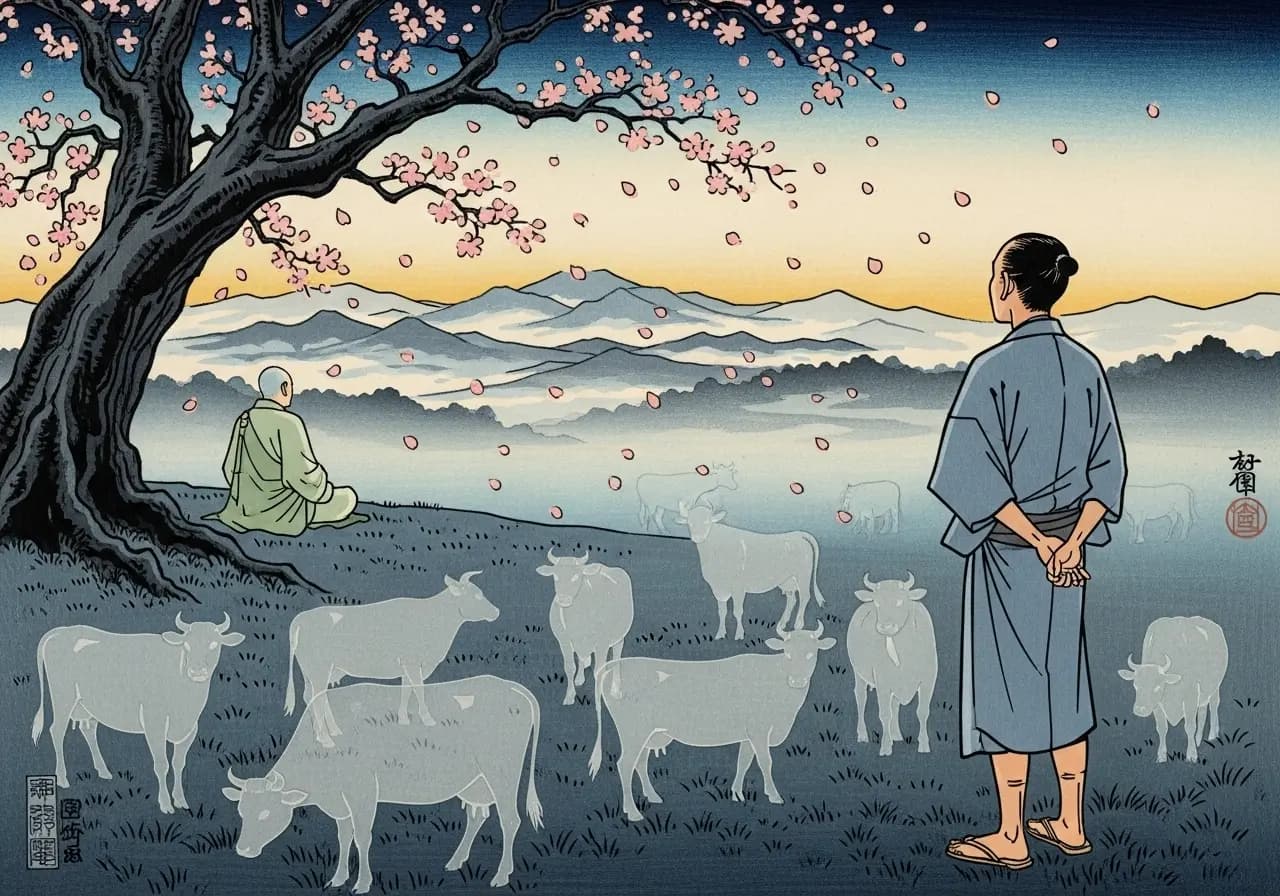
One day, after the Buddha and a group of monks finished eating lunch mindfully together, a farmer came by looking very agitated. He asked, "Monks, have you seen my cows? I don't think I can survive so much misfortune."
The Buddha asked, "What happened?"
The farmer said, "Well, monks, this morning all twelve of my cows ran away, and this year my whole crop of plants was eaten by insects."
The poor farmer was dismayed, and the Buddha said, "Well, I'm sorry, but we haven't seen your cows. Perhaps they've gone in that other direction."
The farmer ran off in that direction. Then the Buddha turned to his monks and said, "Dear friends, do you know how you are the happiest people on earth? You have no cows or plants to lose."
That's the story. That's the essence of it.
When I first heard this story, it really spoke to me on multiple levels. At the time, I was feeling very much like the farmer. Ironically, I first read this story in Old Path, White Clouds, and I felt like the farmer. My cows were missing, and I was in a frantic search to see if I could find them or recover them.
But for me, the story continued differently than the farmer's story. I felt like the farmer. I spent some time looking for the cows. I couldn't find them. Once I realized, "Okay, well, there's no recovering these lost cows," I felt like I was able to come back and sit down with a group of monks, and I found tremendous peace in the concept of letting go—of letting things be. I was able to sit with my feelings. I was able to distinguish clearly between the emotions I was experiencing.
The Loss of My Business
To give you context, most of you know about the plight I've been going through with my company and the difficult financial times I've experienced. After my company had placed several of my products in various big-box retail locations—specifically Walmart, AT&T Wireless, and Verizon Wireless—things took a turn.
Ultimately, what happened is my company was forced under, which forced me to go under personally. My personal credit and loans were all linked to the business, so when roughly six or seven thousand stores worldwide started returning product—inventory I had already paid manufacturers for and hadn't been able to resell—it became unmanageable.
Some of you may know that I was one of the very first to popularize the selfie stick, and what a global phenomenon that was. It was everywhere. As soon as we popularized them, companies from all over started copying my design and manufacturing cheap versions. Before we knew it, you could see these things on street corners being sold or in gas stations. They were just everywhere—not just here in the US, but worldwide. It was crazy how fast it climbed and how fast it fell.
In December of the previous year, I was being featured by The New York Times in an interview about the rise of the selfie stick. And then it seemed like in January, they started to be banned. Disneyland banned them. Museums banned them. The Louvre in France banned them. Just as fast as they climbed in popularity, it seemed like overnight they were frowned upon. Nobody liked them anymore. It wasn't cool to have a selfie stick.
The timing meant that I had thousands and thousands of these in stores all over the world. Suddenly they were all sent back to me, and I was in a position where I had to absorb the loss of the manufacturing cost, the shipping cost to get to all those stores, and then when they sent them all back, they didn't just say, "Hey, we don't need these anymore." They also asked for their money back.
When Walmart says, "We want our money back" on inventory you've already paid for, it's a big deal. It's a significant amount. Long story short, it left me in a position where I realized I wasn't going to be able to survive this financially. It was really difficult because during the uncertainty about whether this could maybe fail or maybe it could succeed, that was a tumultuous phase.
But the moment it crossed the line from uncertainty to certainty—when it was certain that I was going to have to go down the path of bankruptcy—it became a little easier. It's like being in a water fight with water guns. You don't want to get wet, but the moment you do get wet, you think, "Oh, well, I'm wet now," so it's not so stressful to have someone come spraying you with water. It was a similar feeling for me going through this.
The Gift of Mindfulness During Loss
It was during that tumultuous time, during the uncertainty of what was going to happen, that I encountered this story of the farmer and the cows. I remember laughing hearing it, thinking, "Oh my gosh, that's so true. So much of this suffering I'm experiencing from the loss of my cows—it's real and it feels very difficult to cope with."
Fortunately, this came during a time in my life when I'd been spending considerable time and effort being more mindful and having mindfulness as a regular, everyday part of my life.
While I felt like the farmer at first—running down the path, thinking, "Wait, I'm going to find them"—I also came to feel like I was in my version of the story. I looked and realized, "Hey, it's true. They're gone. I can't do anything about it." Instead of holding onto that for much longer, I went back and sat down. I was like, "Okay. Well, now I'm one of you guys. I don't have cows either, so I'm going to enjoy the same experience of peace and contentment that you have because you have nothing to lose. Now I have nothing to lose."
It was an interesting process to sit with that.
I've talked in the past about the parable of the two arrows, and I felt like I was experiencing that as well. There was the first arrow—the suffering that came from the loss of my business, the loss of my sense of identity.
I've mentioned before how my sense of identity was attached to a label—my career. I'm an entrepreneur, and that's been a very important part of how I identify myself in relationship to the world and to others. I realized a significant part of my suffering had to do with this perceived loss of identity. When I realized, "I'm linking who I am to what I do," I was able to at least mentally sever the two and realize: I'm not an entrepreneur. That's just something I do. But when that no longer felt like a core part of my identity, a significant amount of the pain I was feeling also went away.
It wasn't me personally being threatened. It was just a label that isn't going to be a label anymore. Maybe it will be again someday. Maybe I'll be an entrepreneur when I do something else, but for now I'm not. I'm just someone who doesn't have cows.
The Two Arrows
It was interesting to sit with this and realize I was experiencing both arrows. The first arrow was the loss itself—that's normal, natural pain and suffering.
For me, this came in the shape of looking at my warehouse, seeing my employees, thinking of the various memories I'd built with them, the trade shows we'd attended worldwide, the people I'd met along the way, and the hard work that had gone into designing the product and packaging. This had all been a very significant part of me for the last seven years.
There was nostalgia in that emotional grieving—this is something I'm going to lose. It's not going to be part of my life anymore. That was a difficult phase, and I was able to sit with it. It lasted about a week where I'd go to work and see everything I'd built. I would get emotional, and I would laugh and I would cry. It was an interesting phase.
But what I noticed is I was always experiencing the pain of the second arrow—I was feeling bad about feeling bad. Part of me was saying, "You're not supposed to feel bad. You're supposed to be mindful and get past this really quickly." And I realized that was creating a big part of my suffering. I was feeling bad about feeling bad.
That's when I was able to do something incredible. I allowed myself to feel bad. I allowed myself to just feel the emotions. I was able to reminisce on all the great memories. I was able to feel sorrow. I was able to let myself cry. At the end of that process, which took about a week, I found a tremendous sense of peace.
It was over. The cows were gone. I no longer have to worry about losing the cows because I don't have those cows anymore.
What This Story Teaches Us
It was fun to link what was happening in my personal life, in my career and business, with this story that touched me so deeply—the idea of the poor farmer losing the cows.
I felt like I could identify with the farmer, but I could also identify with the monks. I could identify with the pain and sorrow of losing the cows, the frantic search for them. But I could also identify with the serenity, the deep peace that comes from knowing I don't have any cows to lose.
I think when it comes to possessions, we're always trying to accumulate more and more, and we think that these cows are essential for our existence. I don't think there's anything wrong with having possessions. It's not the possessions themselves that cause the problems. It's the attachment that we have to the possessions that becomes the problem.
Often, our attachment to our possessions is the very obstacle that prevents us from having joy or contentment in the present moment. We're accumulating stuff, and the more we have, the more we have to fear. We depend on our attachment to possessions to feel joy or happiness, so the greater the risk of losing those things. The higher you climb, the scarier it is that you're going to fall. The higher you are, the harder the fall.
To me, this story is a valuable teaching that says we can let go of our attachment. But I want to be clear: the key to this story isn't to say, "Hey, let go of everything right now. If you give it all up, you'll never have to worry about anything." I think there's truth to that, absolutely, but I don't think that's necessary.
We don't need to give up everything we own. But I do think we need to give up the attachment we have to everything we own.
Impermanence and Attachment
It's all impermanent anyway—our possessions, the labels we have like my label of being an entrepreneur, the opinions we hold. We attach to those things too. All these things are impermanent. These are the cows.
Several weeks ago, I did a guided meditation on impermanence where I asked you to imagine what it would be like to see everything you own slowly disappear on a stage. If you haven't had a chance to listen to that, go back a few episodes and find it, because the point of that exercise is that this is the nature of reality. All things change. All beginnings have endings. So why should we feel so attached to the cows we own?
Again, I'm not saying we need to start letting go of our cows right now. But take a look at the cows in your life and imagine: "What would I be if I didn't have these cows?"
The cow could be the specific house you have, the specific job title you have, the car you drive, the type of work you do. Whatever it is—are you attached to it? Do you feel that your sense of identity derives from the thing you do, or is it separate?
There's me, and then there's who I am as a person. There's what I do. There's what I'm called—my name. These are all separate from the core essence of who I am. Who I am is just me, and that's constantly changing.
In one day, I wasn't an entrepreneur. The next day, I was. In one day, I didn't have a big business. The next day, I did, and I had products sold all over the world. The day after that, I didn't.
You can start to see the reality I talk about so often: life is like a game of Tetris. One piece shows up and it's all great, and the next piece shows up and you think, "Oh, that doesn't fit anywhere and it's ruining my game." Are we attached to these pieces as they unfold? That's the core essence of this teaching. It's not about the cow. It's about the attachment to the cow.
Exploring Your Own Attachments
This has been an opportunity for me to spend considerable time looking at my attachments. Recently, I am losing a lot of these attachments, and that's not the problem. That's not what's painful. What's been painful is realizing that some of the things I've had to give up are things I was attached to.
For example, my title—my identity as an entrepreneur. Weirdly enough, that was more painful than losing my house or losing the money or the income from my company. It was the perception that other people have of me, so my sense of identity felt like it was on the line.
That was more painful, and I'm glad I was able to explore that and see it and find it. I was able to disassociate with that label in terms of allowing it to own me.
Remember, that's my definition of non-attachment. It's not about not having things. It's about: do the things I have, the labels I have, the opinions I hold—do those things own me?
It's been really neat to spend time with this and realize right now nothing owns me and I own very little. It's been very refreshing. It's been very refreshing to hit this reset button, to be at a place where I get to decide—with my blank slate—where do we go from here?
Sitting with the Process
This week is a big week for me. On Thursday, I meet with the trustee over the bankruptcy to find out what they're doing with all of my stuff, all of my inventory, all of my personal assets, my home. I expect that it'll all be taken. It'll all be gone. That's the standard protocol.
It's been fascinating to be able to sit with that, to experience it, to see the attachment I have to these things, and to watch them go.
In that parable of the cows, it's one thing to wake up and realize, "Oh no, the cows are gone." But it's another thing to sit there and watch somebody come and say, "Hey, these are my cows now," and they're going to walk out with them. To have peace with that. To think, "Well, okay. I'm not going to have any regrets about this. I've thoroughly enjoyed the last seven years running my business, watching it grow, watching it reach the peaks that it did."
Now I want to enjoy watching it dissolve because it's a reminder to me—in the same way that I watch incense being burned. I see the smoke going up, and I think: this is the nature of my reality. I'm experiencing it. I'm seeing it firsthand. Things that are born die. Things that are created dissolve. This is reality in motion, and I'm grateful for that experience.
I'm grateful to be able to experience this right now the way I'm experiencing it—with the perspective and the mindset that I'm experiencing it with. Because I can see how difficult, how emotional, and how heart-wrenching it would be to go through all of this if there was significant attachment to the possessions. It would be very painful. So why make it more painful than it needs to be beyond that first arrow?
That's why I love that parable. The first arrow of pain—sure, that's fine. That's natural. I have no problem with that level of pain. But I don't want to allow the second arrow to make this any more painful than it has to be.
The Real Lesson
That to me is really the essence of what this story is about.
Again, maybe look in your own lives and look at your cows. Look at your possessions. Which of these possessions—and I mean not just physical possessions, but the possessions of your labels, your opinions, your beliefs—throw it all in there. Look at it and say, "Where do I see attachment?"
It's okay to have that attachment. Just know that that attachment will cause significant pain if and when—and I should just say when—it's time to let go.
That "when" may not be until the end of your life, when you're sitting on your deathbed realizing, "Oh, this is it. I'm about to die." Maybe that's when you sever the connection with everything you know. Does that have to be painful? Or will you be prepared because you've been letting go your whole life? Because you've been experiencing non-attachment with your possessions your whole life?
To me, that's the essence of non-attachment. It's not necessarily letting things go.
I talk about attachment and its opposite would be detachment, but non-attachment is not the same thing as detachment.
It's like holding on to something and saying, "I'm holding on to this because this makes sense right now, but I can let go if I need to." That to me is non-attachment.
On the flip side of that, it would be saying, "Oh, there's that thing. I will never hold on to that. I will never touch that." That to me is also a form of attachment. It's certainty.
Whereas non-attachment would say, "I'm not going to hold on to that, but if I need to, I will because I might need to one day." The difference is the maybe. Maybe it is, maybe it isn't. Maybe this is the best thing to hold on to right now. Maybe it's not.
Then there's a level of comfort that arises because you don't have to oppose something so firmly or hang on to it so tightly. It all becomes a loose grip on reality. You can't just let it all go.
That's why I think I like the expression "Let it be" better than "Let it go." Let it go works for the past, right? Let things go in the past, sure. In the present, I think it makes more sense to say we're letting things be.
Letting it be just as it is. Because remember, the moment we want life to be other than it is, we experience suffering. So here we are, letting things be and seeing: what would life be like if I would just let it be?
Well, then you discover pretty quickly that because of the nature of impermanence, things arise, they linger, and then they pass. And that's it. We move on. That's the nature of reality.
That's the topic I have for today: No Cows, No Problems.
Announcements and Invitations
Now, a quick item of news. I've talked about this a couple of times—upcoming workshops. I'm doing a workshop on Sunday, August 27th in LA. I'm doing one on Saturday, October 21st in Orlando. And one on Saturday, November 4th in Phoenix.
If you're interested in any of those, visit secularbuddhism.com and click on the link that says "Start Here." At the bottom of that page, you'll see "Attend a Workshop." If you click on that, you'll be able to learn more about those workshops and sign up. Right now, registration is only open for the LA one, but monitor that page because the Orlando and Phoenix ones will open up soon.
I've also mentioned that I did a recent Humanitarian Mindfulness Trip to Uganda earlier this year, and I'm doing that again next year. If any of you are interested in learning more about this African humanitarian trip—it's a life-changing experience. Everyone who went on the last trip (we had 16 people) loved it. Email me with questions about that at [email protected].
As always, if you enjoyed this podcast, please share it with others. Write a review. Give it a rating in iTunes. Or, if you're new to Buddhism and interested in learning more, go back to the first five episodes of the podcast. Listen to them in order. They're a summary of some of the key concepts taught in Buddhism.
You can always check out my book, Secular Buddhism: Eastern Thought for Western Minds. It serves as a basic introduction to Buddhist concepts and is available on Amazon, Kindle, iTunes, and Audible. For more information or links to those, visit secularbuddhism.com.
That's all I have for now, but I look forward to recording another podcast episode soon. So thank you for your time, thank you for joining me, and until next time.
For more about the Secular Buddhism podcast and Noah Rasheta's work, visit SecularBuddhism.com