

Life on the Buddhist Path
Episode 41 of the Secular Buddhism Podcast
Hello. You are listening to the Secular Buddhism podcast, and this is episode number 41. I'm your host, Noah Rasheta, and today I'm talking about life on the Buddhist path.
Welcome
Today, I want to talk a little bit about what it means to be a Buddhist, especially in the secular sense. What is life on the Buddhist path? As a listener, you might be someone who's interested in deepening your mindfulness practice. You might be wondering: Is there a process by which one becomes a Buddhist? What does that even mean? How does this apply to a secular Buddhist path?
If that's you—a listener who wants to take that next step—this podcast episode will discuss what life on the Buddhist path entails. In most Buddhist traditions, there is a process by which one becomes an adherent to this path or this way of life. I want to address that specifically because I've recently gone through this on my own.
I've been studying and teaching Buddhism for many years now, but I recently graduated this past weekend. I completed a ministry program with a Japanese school of Buddhism that was based out of Chicago and is now in California. They have an American secularized style of Buddhism that infuses several different traditions, and that's where I've been studying for years. This graduation ceremony officially allows me to be what you could call a Buddhist minister now, which permits me to officiate at weddings, funerals, and other ritualistic aspects of Buddhism.
I find this pretty fascinating at the intersection of approaching Buddhism from a secular lens, because Buddhism itself is already so secular in nature. It's a non-theistic tradition, and yet there are rituals and aspects of it that can feel quite religious. I wanted to address that a little bit with regards to this topic of what life is like on the secular Buddhist path.
Remember, as I've mentioned with every podcast: you don't need to use what you learn from Buddhism to be a Buddhist. Just use it to be a better whatever you already are. For some people, the spiritual path they're interested in is the Buddhist path—the secular Buddhist path. I want to talk about that today.
Taking Refuge: Anchoring Ourselves to Values
In typical Buddhist schools and traditions, the process by which one becomes "Buddhist"—and I'm using air quotes here—is that you take refuge. It's called taking refuge, and you take refuge in three things: the Buddha, the Dharma, and the Sangha.
I want to explain this, but first, let's look at the word "refuge" for a second. Refuge is like safety, comfort. Another word that I think does a good job of explaining this idea of refuge is anchoring. We're anchoring ourselves to values.
This is important because in the Buddhist tradition, it's values we're trying to anchor to, not necessarily beliefs. Buddhism is not a dogmatic religion or spiritual path—or at least it shouldn't be.
Refuge in the Buddha: Anchoring Ourselves in Wisdom
To take refuge in the Buddha—for example—what that means is this: I've mentioned in previous podcasts about enlightenment that the word "Buddha" means "awakened one." What we're taking refuge in is this idea of wisdom, this possibility of being awake, of being awakened myself.
For me, this means essentially that I value wisdom. Wisdom is one of my values. I anchor myself to the wisdom that others have taught—people like the Buddha and people who continue to teach even to this day. Wise individuals who have found freedom amidst suffering—that's what I value.
When I take refuge and say, "I take refuge in the Buddha," that's what that means: wisdom is a value that I want to anchor myself to. This anchor reminds me that waking up is a very real possibility. I can have freedom from my habitual reactivity, which can be the source of so much of my suffering.
Taking refuge is like anchoring ourselves in wisdom. That's the first step.
Refuge in the Dharma: Anchoring Ourselves in Perspective
Step two: you say, "I take refuge in the Dharma." The Dharma is the teachings. To me, this essentially means perspective. The teachings give us a perspective on life, on reality, that we didn't have before.
I anchor myself to the teachings that will help me understand the nature of suffering, the nature of impermanence—that things always change. The nature of interdependence—that everything depends on everything else. A flower isn't just a flower. A flower is interdependent with the sun and the clouds and everything else. I've talked about that before.
I strive to see reality through these lenses—these lenses of impermanence and interdependence. This anchor reminds me that I need to take a look at the way that I'm seeing things. In fact, it reminds me how important my perspective is, perhaps more so than what it is I'm seeing. The recognition of how I'm seeing things is what matters. It's like turning inward, looking at that mirror.
Taking refuge in the Dharma is anchoring myself in the teachings about impermanence and interdependence. It's a perspective shift.
Refuge in the Sangha: Anchoring Ourselves in Community
Then the third one: you take refuge in the Sangha. What that means is friendship and support. I anchor myself to the companionship and support that I need in order to be a better whatever I already am.
There's a phrase in the Dhammapada that says, "If you find a wise person who points out your faults and corrects you, you should follow that person as a sage, as you would a revealer of treasures."
I really like that sentiment. I think all of you listening can identify with this—to have a friend, someone you know (maybe you know them in person, maybe you don't) but someone you can rely on who just tells you how it is. Not in a mean way, but in a genuine way. They help you or inspire you to be a better version of who you are. We all have someone like that.
That's what this part of the refuge is about. I want to be with other like-minded individuals who are aspiring to be better versions of themselves. That's my community, and I'm going to take refuge in it. I'm going to anchor myself in this community of people who inspire me to be a better version of what I already am.
The Three Refuges as a Commitment
Those are the three refuges. In most Buddhist schools, essentially what it takes to become a Buddhist is you simply say these three things: "I take refuge in the Buddha. I take refuge in the Dharma. I take refuge in the Sangha."
But I want to emphasize something: more important than saying it is recognizing what does it mean. You don't have to say it out loud. It's something you recognize in your mind. I'm going to anchor myself, take refuge in wisdom. I'm going to take refuge in knowledge, learning, understanding, perspective. And I'm going to take refuge in friendship and support—not just for the support I need, but my willingness to be a support to others who are also on this path.
That's it. There's really nothing else to it.
The way it's typically explained, it almost doesn't even seem like it's a religious thing at all. It almost seems like common sense. Who wouldn't want to be on that path? That's how I view it. A lot of people are on this path without even realizing they're on it. They already value the knowledge and wisdom that comes from wise people—not just religiously or spiritually, but people who contribute wisdom to our world. People who spread those teachings.
I think you get the point. I anchor myself in wisdom, I anchor myself in perspective, and I anchor myself in friendship and support. To me, that's essentially what it means to be a Buddhist, especially a secular Buddhist.
The Eightfold Path: A Guide for Practical Living
Now, very common in Buddhism is the teaching of the Eightfold Path. What that means is these are eight areas in your life that, once you decide this is the path you want to be on—the path that leads to more wisdom and more compassion—these eight areas become important areas where you can focus and work.
These eight areas help you accomplish the goal of being a better whatever you already are. That's where the rest of this conversation will go.
The Eightfold Path is the traditional path that someone aspiring to wake up follows. These eight areas are important areas in your life where you would be able to focus on and work with to accomplish that goal.
Let me talk about these eight areas. The Eightfold Path consists of wise understanding, wise intention, wise speech, wise action, wise livelihood, wise effort, wise mindfulness, and wise concentration. These are referred to as the Eightfold Path.
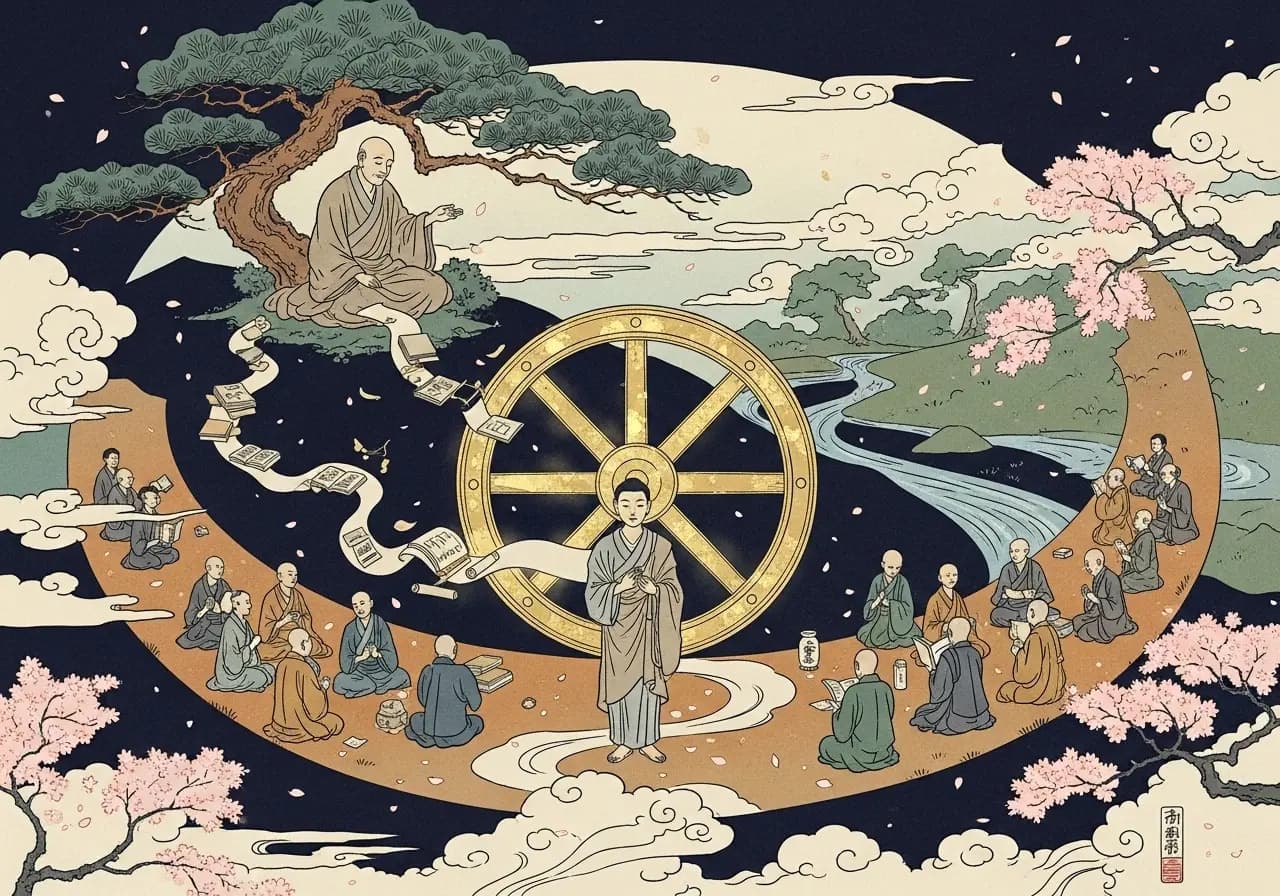
This is why the symbol of Buddhism is a wheel with eight spokes. But it's important to understand that this isn't a moral code to be followed. It's a guide. It's meant to guide specific areas in your life where you can experience and discover the nature of reality for yourself, from your own perspective.
Thich Nhat Hanh tells a story in his book Old Path White Clouds where the Buddha says, "I need to state very clearly that my teaching is a method to experience reality, but it's not reality itself. Just in the same way that a finger pointing at the moon is not the moon itself." The Eightfold Path is to be seen like that—it's a guide.
Consider that standpoint. Then it's common to take these eight areas and divide them further into three groups: the moral discipline group, the concentration group, and the wisdom group.
The moral discipline group includes wise speech, wise action, and wise livelihood. Some traditions translate these as "right speech," "right action," "right livelihood." I like to use "wise." Another word that also translates well from the original Pali is "skillful." You could say skillful speech, skillful action, skillful livelihood.
Group two is the concentration group, which includes wise effort, wise mindfulness, and wise concentration. These are trainings in a higher state of consciousness.
Then there's the wisdom group, which includes wise view and wise intention. These are trainings in higher wisdom, increased wisdom.
Another way to think of these three categories: three of them train me to have higher moral discipline. The other group are trainings in higher consciousness, a higher state of consciousness. Then the third group is a training in higher wisdom.
Let's go through these one at a time.
Wise Understanding: Seeing Reality as It Is
The first one, and in my opinion the most important one, is wise understanding, also called wise view. Sometimes these terms are used interchangeably.
Understanding or view is essentially the recognition that the way I see something may not be the way it actually is. It's recognizing that it's just the way I see it. I can't get past that. My reality is influenced by the way that I perceive things.
I can illustrate this with an example: imagine walking into a barn at night where there's a coiled hose. I think it's a snake. In that moment, it doesn't matter what it actually is—the only thing that matters is what I think it is. All of my actions, everything I'm going to do from that moment on, is governed entirely by my perspective.
This is why it's so important to have a wise view or a wise understanding of reality. Reality may not be what I think it is. If I were to act immediately as if it was a snake, I'd jump or do something reactive based on that perception. At that point, I'm acting not based on reality, but based on my perception of reality.
That's why it's so important to recognize that there are two realities: there's what is, and then there's my story around what is. Everything that I do in life is revolving around the story that I've created around reality, but that's not the same thing as reality itself.
This is why this first spoke is so important. We want to be wise about our understanding or our view of reality. Wisdom is about turning that light on in the barn, so to speak. Suddenly I realize, "Oh, that wasn't a snake—that was actually just a hose." My entire set of actions from that moment forward change based on a new understanding of reality that's different from what I thought a few minutes ago.
This whole first spoke of the wheel is essentially about continually seeking wisdom to help us learn to see the world the way it really is.
You could sum this up with two components: impermanence and interdependence. These are the two most common ways that we misinterpret reality. We think things are separate when they're actually interdependent. We think things are permanent when they're actually always changing.
Consider the flower: you can't separate the flower from the bees, from the sun, from the clouds and rain and soil. You start to realize, "Wow. Everything is interdependent." That fundamentally shifts one of my misperceptions about reality. Before that, I only saw things as things. There's this and there's that, and they're all separate.
Then there's the impermanence piece, where we tend to see things as permanent. With a change in perspective, we realize nothing is permanent. Everything is always changing. I can't isolate something and make it a permanent thing because there's no permanence there.
We do this with people. We believe someone is a certain way, or circumstances seem really negative. Later we discover they weren't what we thought they were. This is the whole parable of the horse and "who knows what is good and what is bad?"
Those two things—impermanence and interdependence—really start to shift the way we understand our understanding, our view of reality. That's that first spoke: wise understanding, wise view.
I think that's the most important one because once we understand that the nature of reality is impermanent and interdependent, it starts to change how we view reality. With this wise view, all of the other spokes become easier to understand and to practice.
Wise Intention: Understanding Why We Do What We Do
Now let's look at the second spoke of the wheel: wise intention.
Intent is everything on the Buddhist path. A lot of the things we do in life, we're not really aware of why we're doing them. When it comes to trying to reduce suffering, we need to be aware of the intention behind the things that we're saying or doing.
When our intentions stem from anger or hatred, they're more likely to cause harm than if they're stemming from a place of happiness or gratitude. Because we know that our tendency is to be reactive, it can be very difficult to be mindful of the intent behind our words and actions. Sometimes we're just reacting, and there's no thought to the intent. It takes practice to learn to become aware of our intentions.
In some traditions, you can model your behavior after someone as an ideal. I remember bracelets from childhood that asked, "What would Jesus do?" or "What would Buddha do?" The goal here is to become very familiar with the answer to this question: What would I do? That's really all that matters in the end, isn't it? Why do I say the things that I say? Why am I doing the things that I'm doing? Intention is how we understand that.
You practice by asking yourself why. As you're reacting to things, ask why. Why am I so angry right now? Why am I feeling this way? Why am I experiencing this emotion? You can do this with both positive and negative experiences.
If I'm being really kind to someone, I can ask why. Why am I being kind? You may discover, "Oh, I'm trying to be nice to them so that they'll lend me money." Now that I understand that intent, I realize that might not be a noble action. My intent may reveal to me that I'm actually increasing suffering rather than reducing it, even though on the surface it seems like a nice gesture.
Maybe if I genuinely care about someone, my intent would be different. You want to understand your intent. You want to be keenly aware of your intentions. The whole point is that we're trying to become liberated or free from our habitual reactivity. So it's vitally important to understand our intentions or at least be aware of them.
That's how you can decide if you need to create new intentions or let go of old ones. When you understand your intent, you can be more at peace with why you do the things you do, because you know it's not out of a reactive habit that you may not be aware of.
That's where intent comes in, and intent will play a role with everything else from here moving forward.
Wise Speech: Communication That Minimizes Harm
The next spoke is wise speech, and this is where we start to see how intent comes into play in the moral discipline group.
We're talking about communication—speech. But it's not just talking; it's the way we communicate with ourselves and with others. Communication is an essential part of creating a peaceful and harmonious life, both for ourselves and others, because we're social creatures and communication is perhaps the most important part of our human relations.
Wise speech is learning to communicate with others in a way that minimizes harm, or that doesn't cause harm. But this isn't just speech—this is writing, texting, emailing, social media, whatever form of communication you've got going on.
Lying, gossiping, insulting—those are obviously not wise speech. They don't minimize suffering. But on the flip side, it's also important to understand that neither are insincere compliments. That's also not wise speech. Promises you don't intend to keep? That's not wise speech either. Sucking up to someone because you're trying to impress them or get something out of them? That's also an example of unwise or unskillful speech.
This is where intent comes into play. I may do that without knowing it's what I'm doing, but once I have a thorough understanding of my intent, I can catch myself and think, "Oh, that's actually not very skillful speech." It may be causing more harm, even though I'm saying something nice, because I know the intent behind it.
Wise speech considers why you say something on equal grounds with what it is that you say. It's not just what you say; it's why you're saying it. Wise speech doesn't always have to be pleasant. It's not about just being nice or withholding ideas or opinions because you don't want someone to disagree with you or feel upset because you have a different view.
The important part is that it's always sincere and genuine. Think of the difference between constructive criticism and destructive criticism. We all know the difference. Receiving criticism from someone isn't a problem, but sometimes it's the intent behind it that bothers us. Are we trying to cause harm and pain, or are we trying to be genuine and authentic in expressing something? That's the difference with wise speech.
Wise Action: Doing What's Right in Context
The next spoke is wise action, which is another part of the moral discipline group. Wise action is essentially conduct that's proper and necessary for whatever situation you're in.
Here's a scenario that illustrates how wise action correlates to intent and to speech. Imagine during the Second World War when families were hiding Jewish people in their homes. If the Nazis come knocking and asking, "Do you know where the neighbors went?"—it would be wise speech to say, "No, I don't know where they are," even though that's a lie.
A wise action could be hiding those people in your house, even though you know that might be against the law. You get the idea of what I'm saying here. Wise action sometimes includes doing the right thing in a moral sense. It closely resembles the guideline for behaving appropriately according to the situation and the context.
Again, this is why it's going to be super important to understand what my intent is and what my view is. How do I view the world? Someone without wise or skillful view or understanding of reality may think they're living according to wise action when they're not. What they're doing actually isn't wise.
We don't want this to be a set moral code, because the problem with that is that morals change and evolve over time, based on time and place and society. If we just adhere to a moral code from some place in time, that may not be the wisest form of action for our specific time and place.
There's an expression that says: morality is doing what's right regardless of what you're told. Obedience is doing what you're told regardless of what's right. To me, that sums up this idea of wise action. We want to do what's right more than just do what we're told. Those are two different things.
Wise understanding, wise thinking, and wise speech—all the previous ones we've talked about—will give rise to wise action where your wisdom leads you to behave fittingly in any scenario you might be in.
Wise action is not a set of rules to be followed to the letter. That's why in Buddhism, there's nothing like the Ten Commandments. It's because those are just wise action. What is wise action? Well, you have to figure that out. It's not appropriate for me to say what wise action is for me because it might not be wise action for you. It depends on place and time as well.
From the story of the parable of the horse, we know that right and wrong are often subjective, especially in different societies and different time periods. What may be acceptable in one society or one time in history is often unacceptable in another time and place.
Imagine those times when people finally figure it out and realize slavery isn't okay. Maybe it seemed like it was for a long time, but then consciousness elevates, awareness elevates, and there's a perspective shift. That's why you're always working with this—it's not a static thing.
Suddenly, somebody somewhere realizes, "Hey, this isn't right. We shouldn't be doing this. This is not wise action." If it were stagnant, if it were a static set of rules like commandments, that gets really complicated, because life isn't stagnant. Life isn't fixed. Life is continually changing and evolving. Therefore, wise action should not be an absolute thing. It shouldn't be a set moral code.
You're going to want to live in a way where wise action arises naturally out of having wise understanding, wise view, wise speech, and wise intent. I hope that makes sense—how those start to correlate.
Wise Livelihood: Making Your Living Skillfully
The next one we'll look at is wise livelihood. This is the one that addresses what we do for a living, how we make a living, and how we interact with others while on the job.
We need to determine for ourselves if what we do for a living is causing more harm or more good for ourselves and others. Again, this is a very personal thing that arises naturally out of having a wise view and wise intent.
If I understand my intent and I understand the way that I perceive the world, it starts to give me the ability to decide: Is this the type of job or career I want to have where I feel like it's improving? Am I helping myself and others to be better, whatever we already are, or am I not?
Some things are obvious. Being a hired hit man would very obviously not be wise livelihood, because you're causing more harm than you are good for yourself and others.
But it does require balance—balance between what's good for you, what's good for others, and what's good for the environment. You can start to see how complex this can become. There's another aspect too: it also includes how we interact with the people we work with—customers, coworkers, and so on.
If I'm embezzling funds from my employer or stealing food from the fridge at work, those are examples of unwise livelihood. Even someone who's trying to do good—like a doctor—they may be doing good, but at the same time causing harm if they're taking bribes from a pharmaceutical company to prescribe a certain medicine over another one, knowing that this one wouldn't be as effective, but they get paid more if they prescribe it. That's another example of unwise livelihood.
This is where intent is really important. I need to understand: why am I doing this? Is it just for the money? What is the intent behind the action, behind the livelihood?
At the end of all this, ultimately it's just up to us to make the judgment call regarding the way that we make a living. You make your living and you know why you do it. It's a good idea to incorporate wise intent in this process. Ask yourself: why am I doing what I'm doing?
I've had to do this in my own life. I remember one specific job where I was really uncomfortable with the type of work I did. We sold supplements using a deceptive form of marketing. Some of you may be familiar with this tactic: you sign up for a free trial of these pills, and then you think it's free, but a month later they start billing you. And they make it really difficult for you to cancel that automated bill.
I worked for a company that did that, and I had to ask myself: Why am I doing what I'm doing? Am I comfortable with this? I was always uncomfortable knowing people were trying really hard to figure out how to cancel these ongoing bills. It was a widespread practice at the time, but at the end of the day, I decided that wasn't a career I wanted to be in. It wasn't a type of work I wanted to be involved with, because I felt that, for me personally, I was uncomfortable knowing the harm it was causing others, the inconvenience it was causing them.
I ended up leaving that job. I found another job where I didn't have conflicting feelings around my livelihood. That's the idea behind wise livelihood.
With those three—speech, action, and livelihood—we've covered the training in higher moral discipline. And again, you see how important it is that they're correlated with an understanding of what my intent is and my wise intent. This leads us to the last three spokes of the wheel.
Wise Effort: Putting Practice into Action
These are the training in higher consciousness, or higher awareness. You can start to see how they all feed on each other. The better I am at wise effort, that effort may be what helps me understand my intent, and that intent helps me to be introspective and understand that maybe what I'm doing for work isn't what I want to do for work. You can start to see how they rely on each other.
The next one is wise effort. This is essentially what it takes to put into practice all the other parts of the path. This is the effort on our part. If we want to experience any kind of positive change in our lives, it's going to require effort.
Whether it's learning a new skill—I want to learn music, for example—I've got to learn to read music. Or sports: it takes a lot of practicing. Business skills: I might have to go to school. Whatever it is I'm trying to do, there's effort required.
We can usually look at ourselves and recognize if we're going to give the proper amount of effort or not. We can decide that before we go into something. Without effort, there's usually very little or no progress. Our effort affects everything we do in the world.
You'll know this if you've ever tried to accomplish any kind of goal and failed. A common one for a lot of us is around New Year's when we decide we're going to start going to the gym and get in shape. The reason that a lot of us don't follow through—and I put myself in there, because this happens over and over—is a lack of effort.
What else could it be? Effort is what plays a part in that. For me, I've tried to learn to play guitar for almost ten years, and I've never really done a good job with it. It's the effort that needs to be put in. That's where I struggle.
The key to accomplishing a goal is directly connected to the effort that you put into accomplishing it. I know that when I've put time and effort into other things I wanted to do, that worked out really well for me. It took a lot of effort to start putting this podcast together, and that hasn't been a big problem.
You can start to see where and how much effort you're putting into the things that really matter in your life. This is especially important when you're looking at relationships, jobs, hobbies, and lots of other things—but relationships especially.
Do you put in the effort required to maintain the relationship with your loved one, spouse, significant other, parents, siblings? Wise effort is about prioritizing our effort in all of the things we do, because there are a lot of things we want to do in life. We need to prioritize and decide where does the effort go? Where am I going to dedicate time to make sure that I accomplish what I'm trying to accomplish?
Now, with Buddhism, we're trying to become a better whatever we already are. We're trying to improve and be better at how we live, to be less reactive. To be less reactive isn't going to happen just because I decide, "Okay, I don't want to be reactive anymore." It doesn't work that way.
In fact, I'm going to be reactive, and one of the first things I'll be reactive to is reacting to the fact that I cannot be reactive. Now I'm mad on two levels because I don't want to be reactive anymore, so when I am reactive, now I'm mad that I got reactive. Because I already know that I don't want to be reactive, I'm now mad on two layers.
You can see that without effort, there's no form of awakening, enlightenment, or liberation from habitual reactivity. It doesn't happen without effort. It's the effort that this specific spoke is relying on: Am I going to put time into meditating? Am I going to put time into reading more books to understand these concepts? Am I going to put the effort it requires to seek out podcast episodes that continually push me towards being a better whatever I already am? That's effort. That's where effort comes in.
Wise Mindfulness: Anchored in the Present
After effort, we've got mindfulness. Again, you see how all of these start layering on each other. Wise mindfulness is about being aware, being present. Now, being mindful helps us stay anchored in the present moment, because typically we're not in the present moment. We're either regretting something in the past or anxious about something in the future.
To be mindful, it requires practice. It does indeed require practice, which is going to require effort to be more mindful. We've all experienced the scenario of driving somewhere, only to realize you weren't really paying attention. You finally get there and you don't realize how you got there. Or you miss a turn. You're driving on the freeway, you're on the phone, and you realize, "Oh, crap. That was my exit."
This idea of being zoned out or distracted, we do this a lot in many areas of life. It's not just while we're driving. That's just an area where we notice it, but that's not the only time it happens.
When we're not mindful, we're not aware, and we're missing things that might be happening right in front of our eyes. I think of this a lot as a parent—mindless parenting. I don't want to look back and think, "Oh, man. I missed that phase with my kids when they were this age or that age or doing this or doing that." Not because of a lack of intent or lack of effort, but entirely because I wasn't mindful. I just wasn't aware.
I think this becomes really helpful when we think about it in the context of time. We're constantly stuck in the past or the future. That makes it really difficult to be mindful of what's happening in the present.
Wise mindfulness is about learning to anchor ourselves in the present moment. It connects very closely with meditation and effort. We want to be mindful, to be aware of the things that we're not even aware that we're not aware of. Again, that doesn't happen just because. It's like saying, "Okay, I want to be mindful. That's great sentiment, but what am I going to do about that?" That's how mindfulness correlates with all the others.
Wise Concentration: The Practice of Focus
Which leads us to the last spoke of this wheel: concentration. This is the practice of focusing the mind on one thing.
If I want to be mindful or aware, it's going to require the ability to at least concentrate, to concentrate on what it is I'm trying to do in that specific moment. This is where meditation comes in. This is the great tool that we use to practice concentration.
I know we typically think of meditation as someone sitting with their legs crossed on the floor with their eyes closed, but it can be so much more than that. It can be the concentration that we put into washing the dishes or when we're walking—just walking. We're doing anything. A really common one that I notice in my own life is when I'm eating.
A lot of times, I'm not really eating. I'm eating and looking at my phone. I'm checking what's on Facebook, reading the news, checking emails, and then I'm done eating. If someone were to ask me detailed questions about my meal, I wouldn't really know. This is a lack of my ability to concentrate.
So concentration is when we're doing something—we're just doing that thing. There's a Zen story about this with an enlightened person. When they eat, they eat. When they walk, they walk. Someone might say, "Yeah, anyone can do that." But the difference is when you're awake. Someone who's awakened, when they walk, they just walk. They just walk because that's what they're doing.
When they're eating, they're just eating. I think we can all correlate to our own eating habits. I don't know about you, but anytime I go somewhere to eat, if I look around, more than half the people—usually three-quarters of them—are just on their phone.
When was the last time that you actually ate and just ate? That was your whole goal: "I'm only eating." I'm concentrating when I'm eating. I'm paying attention to what this tastes like, what the experience of eating is like.
Alan Watts says you can make any human activity into meditation by simply being completely with it and doing it just to do it. I would challenge you to try next time you go eat somewhere: try eating meditation where you're just eating and that's all you're doing. You're not doing anything else. That's concentration.
The opposite of concentration would be distraction. I just think about distraction as the opposite because we all know what that's like. We live in a society and a culture that's constantly bombarded with opportunities for distraction—whether it's the chime on your phone or the billboard on the street or commercials on TV or text, email, whatever it is. We've got thousands of distractions that are all competing for our attention virtually anywhere you look at any given time of the day.
Distraction prevents us from seeing life as it really is, because we don't know what we're seeing. We're seeing all kinds of other things. Distraction prevents us from understanding the truth about ourselves and others.
This is what we're trying to accomplish with wise concentration: to have the skill and the ability to be with something for a moment, to concentrate. When an emotion arises for me and I'm sitting here upset, am I trying to distract myself out of it? "Don't be upset, turn on the TV." That's a distraction. Distractions can be fine, but here's what I'll never know if I constantly react to my emotions that way: I'll never be able to sit with an emotion and ask why. Why am I upset? I'm sitting here and I'm upset. Why?
Imagine being able to sit with your emotion, to concentrate on it. You may gain insight out of that. That's the whole purpose of this with concentration: what can I discover that I didn't know that I didn't know?
The Eight Spokes: A Living Practice
Those are the eight spokes of the wheel, the Eightfold Path. If you were to enter this path, if you think, "This is a way of life I want to live. I want to practice Buddhism as a philosophical way of living"—what does that entail?
It's essentially these eight areas. These eight areas that you're going to strive to be more aware of and to be skillful with in your life. They are understanding or view: How do I view the world? How do I understand reality? Am I skillful in the way that I understand what's unfolding right now in front of me, or am I not skillful with that?
Next is intention: Do I understand my intentions? Then it goes into speech, action, and livelihood. From there we've got effort, mindfulness, and concentration. Those are the eight areas that make up the Eightfold Path.
As I mention, this is a path that you're constantly working on. It's not like a linear thing where you think, "I've got to master this before that one makes sense." You're always working on all of them.
Sometimes you may be working a little more heavily on one spoke versus another. There's no particular order that you need to go with, although I do like to emphasize that the first spoke is the most important because with wise understanding and wise view, the rest start to arise naturally.
When I truly grasp and understand the nature of impermanence and interdependence, it changes the way that I talk to myself and others. It changes the way that I act. It increases the desire to have more effort, to be a better whatever I already am. You can see all these ramifications, all based on the first one—on wise view.
This is a path. It's an ongoing practice that can bring about a new sense of awareness and perspective into everything that you do. I want to emphasize again: this is why Buddhism is often referred to as a practice. It's not like you get it, and then you're done. You're always getting it. You're always trying, you're always practicing, you're always trying to be a better whatever you already are, but you never actually get it.
Just that concept itself—to be a better whatever you already are—how do you win that game? You never say, "Oh, I did it. Now I'm the best whatever I already was." It's not about that. It's about being better. Whatever you are now, be better. You'll never be better and arrive at the finish line. You're always practicing to be a better whatever you already are.
You accomplish that by keeping in mind these eight areas of your life that you want to focus on. Maybe you can write them down. I like to have a little visual representation of the Eightfold Path with the eight spokes on the wheel, and each spoke has the word written out. It reminds me that these are eight areas that I am committed to being better at in my life. Or maybe not even being better at, but if anything, understanding these.
I want to understand these eight areas in my life, because the simple act of understanding them already makes me better at them. View this as a guideline for the specific areas where you want to focus in your life to help you become a better you. That's it. It's that simple.
There's nothing to believe in. There's no set of commandments. It's not like you have to be—nobody says you have to have intent. It's not that. I just want to understand my intent. Why do I do the things that I do? It's not about saying, "Do this. Don't do that." It's just saying, "Whatever it is you're doing, know yourself. Why are you doing it? Why do you do that?"
At the end of the day, it empowers you to know: What would I do? What would I do? That's what we're striving for here. That's what combats this instinct to just be habitual, to just habitually react without knowing why I'm reacting.
Bringing It Together
I've got these eight areas in my life that I'm committed to and dedicated to trying to be a better whatever I already am. They all start with that first commitment that I make—to be on this path, to take refuge. The commitment I've made to understand what my values are.
I value wisdom. I value knowledge. I value friendship and support. I take refuge in those three aspects of my life. I have friends and family that form the backbone of that journey I'm on. I have books and sources that I go to learn the knowledge I need to anchor myself in these teachings that are going to help me be a better whatever I already am.
Of course, there's the first one: I anchor myself in all the great teachers that have come before me—whether it be the Buddha or Thich Nhat Hanh or the Dalai Lama or any other teacher. They don't have to be Buddhist, but those are the ones I mentioned because that's the path I'm on. But it's not restricted. Wisdom is not confined to a specific tradition. It's not like, "Well, wisdom is only found in Buddhism." Wisdom is found in every tradition, and it's our job to seek it out.
Whatever tradition you're in, find the wisdom, anchor yourself to it. That's taking refuge. You can be taking refuge in the Buddha, so to speak, without believing in Buddha at all or being Buddhist. You could do that the moment you anchor yourself to wisdom from whatever tradition.
A Personal Reflection
That, in a nutshell, is my explanation of life on the Buddhist path. This is the path I have chosen, and most recently—last weekend—I've made this official for myself as a Buddhist minister. I'm honored now to be in a position where I can officiate at friends' or people's weddings and do more with it.
People have asked me, "Now what? Now that you're a minister, what's going to happen? What does this mean?" It's like it doesn't mean anything different. This is the path that I've been on. What I just explained in this podcast is a summary of life on the Buddhist path for me. That's the path three years ago, four years ago, five years ago, and today, and tomorrow—but all in the context of impermanence. It's just what it is right now.
Hopefully you can get some information out of this podcast that will help you in your path to accomplish the goal of being more awake, being a better whatever you already are. That's really the only goal. There's nothing beyond that.
Closing Remarks
As always, if you've enjoyed this podcast, please share it with others, write a review, or give it a rating on iTunes. Remember, you can always learn more. If you're new to these concepts, listen to the first five episodes of this podcast in order, or you can find these concepts explained in my book Secular Buddhism: Eastern Thought for Western Minds, which is available on Amazon, Kindle, iTunes, and Audible. You can get more information on all of that on SecularBuddhism.com.
That's all I've got for now. I'm really looking forward to recording another podcast episode soon. Now I have the time to do this more often, and thanks to the support from a lot of you listeners—that's giving me the ability to dedicate more time and resources and effort to making this a podcast that is beneficial. Every time you listen to it, I want you to gain something out of it. I want this to be something that's valuable.
I'm also creating other resources that I'll be able to explain in future podcast episodes. That's all I've got for now. Thanks again for taking the time to listen, and I look forward to talking with you next time.
For more about the Secular Buddhism podcast and Noah Rasheta's work, visit SecularBuddhism.com