

Episode 4: The Illusion of the Ego
Noah Rasheta: Hello. You are listening to the Secular Buddhism podcast. This is episode number four. I'm your host, Noah Rasheta, and today I'm talking about the illusion of the ego. So let's get started.
Understanding the Ego
Today we're going to be talking about the ego—specifically the illusion of the ego. But to understand this a little better, we need to talk about what the ego is. The word "ego" gets a bad wrap. We often attach meanings like megalomania or vanity to it. When you talk about someone who has an ego, it's usually with a negative connotation. But strictly speaking, it's just a psychological term that was popularized by Freud, meaning consciousness as opposed to the unconscious mind. So it's the awareness of one's own identity and existence. Your ego is your conscious mind—it's the part of your identity that you consider yourself to be.
With that definition in mind, what we're going to be talking about today is essentially the sense of self. What is the sense of self? What am I? That's a question you can ask yourself throughout this entire podcast episode. What am I? What is the self? That's what we're going to be exploring today.
The Problem With Permanence
Our natural tendency is to view not just ourselves, but others as well, as permanent things. In the last podcast episode, we talked about the reality of impermanence and interdependence. And yet when we're thinking of the self, the sense of ego—generally we see ourselves as permanent, fixed things. So taking what we learned or talked about in the last episode, if everything is interdependent and everything is interconnected, then what are the implications for the sense of self that we feel?
In the last episode, I talked about interdependence and impermanence seen through the eyes of wisdom. Understanding that everything is interdependent and everything is impermanent is vital for having a proper understanding of the sense of self. Because when it comes to the self, the sense of the ego that we feel, the tendency is to think backwards. We think of ourselves as independent of everything else—self and other as separate—and we tend to think of ourselves as permanent rather than impermanent. We tend to think, "I am an entity that exists independent of anything else, and I will continue on and on." But the reality, as we saw in the last episode, is that everything is interdependent and everything is impermanent.
So what does that mean for the sense of self? What is the ego? Well, as the title of this podcast episode implies, there is the illusion of the ego. When we think of ourselves and others as independent and permanent things, we tend to view ourselves and others as finished products—continually viewing ourselves as finished products rather than works in progress.
The Buddhist Concept of No-Self
In Buddhism, we talk about the concept of no-self: the idea that things have no intrinsic existence of their own. Take a moment and look down at your hands right now. They're probably holding your phone, on a keyboard, on a mouse, or holding something. Look at them and ask yourself, "Are these hands really me?" What if you lost your hands in an accident? Would you still be you? Of course, right? Now look at your legs and ask the same question. If I didn't have these legs, would I still be me? Then ask yourself: what part of you is really you? What part of your body, if removed, would make it so that you are no longer you?
Take a minute to think about that. Is there any part of your body that if it was gone, you would know with certainty that you are no longer you? Maybe you're thinking, "Well, it's my brain. My brain is what makes me who I am." Well, what specifically in your brain makes you you? Is it your personality, your memories, your abilities and skills?
Look at those for a second. Look at your personality. Does personality change over time? Can a traumatic brain injury change your personality? It sure can. If your personality would change due to a traumatic brain injury, would you still be you? Well, the answer is absolutely. It might be you with a different personality than the you from before. It doesn't even have to be that drastic, though. Just think back to the you from ten to fifteen years ago and ask yourself if you're the same person. Compare the you from middle school versus the you from high school versus the you from college, the married you, the parent version of you. If you're like me, you're going to notice that all of those are different people and yet they're all me. Think of it like this: that's who I was back then, this is who I am now. So if your personality isn't you, then what is you?
Maybe memories. What about memories? What if you lost all your memories? Would you still be you?
My grandma suffered from dementia in her final years of life. When I'd go visit her, I had to remind her who I was, and often I had to remind her of who she was—her own name, where she was, and where she was from. But even without her memory, she was still my grandma. Your memories are a precious part of you, but they're not you.
See, we often believe that our abilities and skills are what make us who we are. I consider myself a techie or a computer nerd, yet if I was stranded on an island for the rest of my life without any technology, I would still be me. I wouldn't be a techie or a computer nerd because I wouldn't have those things. Or consider a singer who loses their voice, or an artist who loses the ability to paint because they've lost their limbs, or a dancer or an athlete who becomes paralyzed. You see where this is going?
The things that you think make you who you are end up only being parts of who you are, but none of these things alone is you. It's like we talked about in the last podcast episode with the car. You can take the car apart and separate all of its components. You can take out the engine and ask, "What is the car?" The answer is that you take several parts together and you start forming the idea of car, but none of these parts alone by itself can constitute the car. For it to be a car, all it needs is one or more of those parts. And the same applies to us, the individual self. There is no part of you that is you without all of the parts of you that make you you. So you are who you are because of everything that makes you who you are, and yet none of those things alone can be called you.
Applying No-Self to Your Life
So how does the Buddhist concept of no-self apply in your everyday life? Why is this concept even useful? Consider this next time you're offended by something that someone says or does. Ask yourself, "What part of me has really been offended?" Analyze it like we did in the previous podcast—take it apart and look at its parts, its causes and conditions—and you're soon going to discover that this concept of no-self can actually be an incredible tool for letting go of the ego. Because you'll discover that the ego is an illusion. The ego isn't you. The sense of self that makes you think you are who you are is only a part of you, but that's not you.
The Story of Patricia
I think this concept is illustrated beautifully in a letter I received from a friend of mine, and I want to read this letter to you because it's about dementia and memory and what remains when so much is stripped away.
My friend writes: "My mother-in-law works at a dementia unit at a rest home in Australia. Today we visited her at work and met some of the residents, each with varying degrees of this difficult, at times tragic condition. The visit gave me much to reflect on—between the challenges of getting old, the final phases of life, and mortality itself. But one tiny thing in particular stuck with me.
"At the dining room, each member has a seat at a table. They use the same one every day, a routine crucial to suffering memory. Still, they often forget which seat is theirs. To help them remember, each person's place at the table has a laminated page stuck to it. The page has their name and a set of pictures and photos that are meaningful to them.
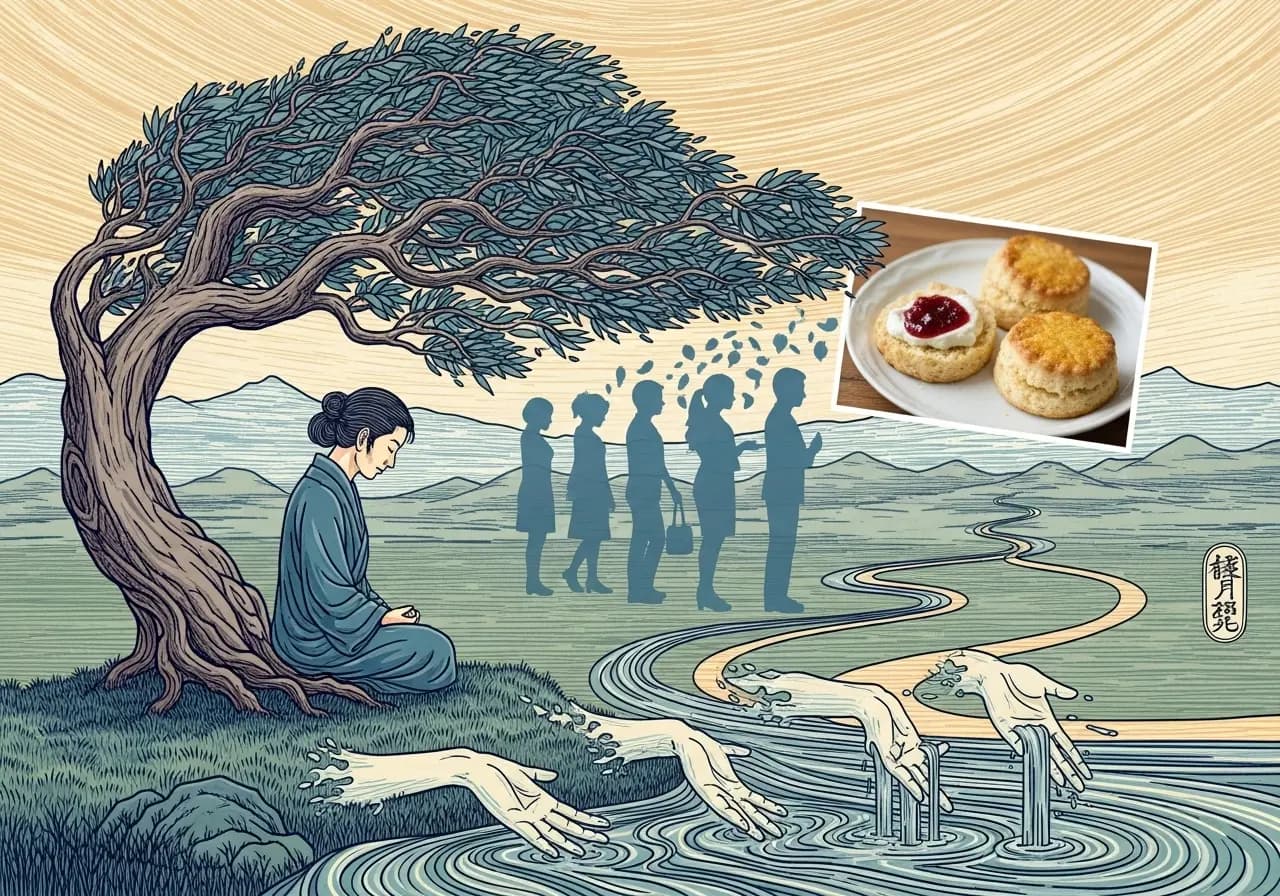
"For example, I met Patricia, who told me, guided by the pictures, that she'd been traveling around Australia. I could also see from the pictures that she loved scones with jam and cream and had some recent grandchildren. Each person's laminated placeholder was the same—ten to fifteen photos that reminded them of who they were. It was beautiful and somehow deeply sad. The thought that someday your life, however long and prosperous, might be distilled down to ten photos that will define you.
"I can't help but notice the kinds of things these pictures were, too. Patricia had ninety-something years to her name. Ninety years of stuff that might have been on that page—all the accomplishments and memories, the people and places, friends who came and went, highs and lows, joys and sorrows, love and hate, boredom and anticipation, anxiety and calm, fear and peace. And at the end of it all, there were scones with jam and cream. Ten percent of her photos were dedicated to that. Ten percent of who she is.
"It struck me that with the brevity of life, the constant coming and going of things, what remained in the end for these men and women was what they had loved. Sitting there past ninety years of age, suffering from dementia, most of what you ever thought was important is gone. The arguments and the hurts, the conversations, the judgments, the regrets—they're all faded or forgotten. Your friends might be gone. Your bank balance definitely isn't going to be on that page, and even the business you built doesn't photograph well and it probably isn't that interesting anyway.
"And there is a view of what you loved. You don't score more points if that thing is world peace when Patricia's thing is scones. If there are any points, you only score more by the intensity of your love, not by the object of it."
My friend was asking, "What do you love? What pictures will tell your story in the end?"
This letter was very moving and very touching. My own grandma suffered from dementia in her final years and months, and it continued to deteriorate to the point where she didn't recognize who I was when I would come to visit her. Sometimes she thought I was her son, my dad. Sometimes she would remember that I was one of her grandkids. And what's interesting is that you take this concept of mind and you think, "Well, my memories—that's who I am. The things that I remember and know, or my personality." And what you'll find, like this example with Patricia, even the things that we think are solid in terms of defining who we are—our memories—can be gone, and yet that doesn't change who you are. Now you're just you without the memories that you had.
So again, I ask you to ponder this question: What part of me is really me? What part of me is the essential self that I feel so connected to in my sense of ego? Because the conclusion should be that if you spend enough time pondering this, what you'll discover is that the ego is an illusion.
The Illusion of the Self
Much like the idea of a car, a car is real and it exists, and at the same time it's an illusion because it doesn't exist independent of all the parts that allow it to exist. Well, the self is the same. We exist and we're experiencing life the way we're experiencing it, but we are made up of everything that allows us to exist. I like the way Alan Watts talks about this concept. He says, "You are something that the universe is doing in the same way that the wave is something that the whole ocean is doing."
Now, the implications of understanding that the ego is an illusion, that the sense of self is an illusion, is actually really powerful. Because the conclusion of realizing "I am not independent of everything else" and "I am not a permanent thing" is that you realize you are interdependent with everything and impermanent just like everything else on earth. So what we essentially realize is that we are one with everything.
Labels and Identity
The sense of self can become really strong when we're talking about things like religion, politics, sports—anything where we identify really strongly with the things that we like or don't like, the things we believe or don't believe. This reminds me of an experience I had while traveling to the Middle East.
My wife and I were doing a Mediterranean cruise, and we had a tour guide in Israel showing us all the key attractions and sites in and outside of Jerusalem. We had spent hours with him. He was telling us the Jewish perspective of the various sites we were visiting. And something happened that I thought was interesting—it really stuck with me. When we crossed over to Bethlehem to see the sites there, we had to switch tour guides because this was territory now controlled by Palestine, and our Jewish tour guide couldn't go in there with us.
So we switched to a new bus and a new tour guide. As soon as we got in the bus and were driving through Bethlehem, the first thing we wanted to know—because everything we had just been experiencing was very clearly from the Jewish perspective—the assumption was, "Okay, you must be Muslim, maybe, or you're probably not Jewish." So we wanted to find that out quickly. We were asking our tour guide as soon as he introduced himself and we all introduced ourselves. I remember asking, "So, what are you?" And he kind of looked at us with a surprised look and said, "What do you mean, what am I?" And we said, "Yeah, our tour guide on the first part of the tour was Jewish, and it was interesting to get his perspective. So I was wondering what you are."
He kind of laughed and said, "Well, I am a human being. A human being who lives in Bethlehem."
That immediately struck me, and I realized, "Oh, okay. Well, that's a topic we're not going to go into then." At the same time, it seemed so wise. Well, of course, what else could you be?
And it made me realize in the months and years after that experience that we do tend to view each other through the labels that we use, as if those were nouns. It doesn't matter what he believes—what he believes isn't who he is. And what I was asking is "Who are you?" Yet I treat that question of "Who are you?" in terms of whatever you respond with—your beliefs, the ideas that you have, all of these things that describe you—I would tend to treat as you. And that was a powerful lesson to me: to realize, well, of course, all you are is a human being and nothing else. Anything that we add to that, we should add as an adjective. That's fine because that's a description. But not as a noun, because the noun has already been established—you're a human being.
The Courage to Be
That was a neat experience that stuck with me. And then, thinking more about that, I realized: well, what is the concept of courage with the understanding that the illusion of the ego? Courage ends up being the courage to be as we are, right here, right now. The courage to be free from attaching ourselves or chasing after others' acceptance and avoiding their rejection.
The things that we think make us who we are prevent us from having the courage to just be what we are—to be what we are right now. And recognizing that what we are right now, as I mentioned before, is that we are works in progress. We tend to take snapshots of ourselves or snapshots of others like a Polaroid that's been printed. And once I've interacted with you once, I've created this mental Polaroid, an image of who you are. And the problem is that's not who you are.
First of all, a snapshot, just like imagine a picture—it's a fixed thing. And as soon as I have it there, I've decided who you are without realizing that who you are is constantly changing. So an image certainly isn't going to allow me to see the you that's constantly moving. So if I was able to see you without putting that permanent image of who you are onto you, then I would recognize that who you are is constantly changing. And I would hope that you recognize that who I am is constantly changing.
And then this gets more complex because there's who you are and there's who I am. But what makes this even more complicated is that there is who you think that I am, and then there is who I think that you think that I am. Both of those layers of complexity in how we perceive each other are blinding us from what we really are.
Think about that. We do this all the time with the people that we interact with. We give ourselves labels and then as soon as we do that, as Kierkegaard says, "Once you label me, you negate me." You don't give me the opportunity to see who I really am because there is already who you think that I am.
Consider the way we use labels in our society. We use these labels all the time: "I'm a Republican. I'm a Democrat. I'm a Christian. I'm a Buddhist. I am dumb. I am smart." We use these labels as if these were permanent things that make us who we are. But we, like everything else, exist because of causes and conditions. We are who we are because of the countless things that make us who we are—like the cake, like the car. We inherit genetics from our parents, beliefs and ideas from our family and society. And these things are part of how we are, but they are not what we are.
The problem with our labels is how we use them. Because as I mentioned before, we tend to use these as nouns instead of adjectives.
So when I use a label like "I am a Buddhist" as a noun, then it separates me from everything that is not Buddhist. It divides and separates. But now consider the label "I am a Buddhist" as an adjective. It becomes a description of how I am—the noun "me," which is human. I am a human being. That's all I really am, and I tend to view things through the Buddhist lens. That's different than trying to separate myself by using that as a noun to describe who I am. Because the reality is, no matter how hard I try, I can't be a Buddhist or a Christian or anything. Because those things aren't things to be. We already are something. We're human.
So when we learn to view our own labels and, perhaps more importantly, the labels we assign to others as adjectives instead of nouns, it will be more like talking to someone and realizing, "Okay, I'm wearing a blue shirt and you're wearing a red shirt." But the color of the shirts we wear doesn't make up who we are. It's just part of how we are at this specific moment in time, at this specific moment of being human.
Try to start viewing labels—yours and others'—as adjectives rather than nouns, and see how that changes the way you view yourself and others.
Removing the Lens
And this doesn't just happen with people. It happens with everything. From the moment we're born, we acquire labels and concepts and stories and beliefs. And these things can tint the way that we view things. It's removing this tint that allows us to see things as they really are, to see ourselves for who we really are. In Buddhism, this is taught as Buddha nature—being able to understand that who you are in your true nature is beyond these constructs.
And we do this with reality as well. When you can see things as they really are beyond the stories, the meanings, the concepts, and the labels that we attach to things, then that is awakening. That is enlightenment. It's learning to see things as they really are.
In the last podcast episode, I talked about Plato's allegory of the cave, and this concept of seeing shadows and thinking that the shadow is the real thing, when the shadow of the thing isn't the same as the thing itself. But we wouldn't know that because we exist in a world where what we're seeing are the shadows.
So the important lesson here is that we need to start learning to see things as they really are and to see ourselves as we really are. And understanding that the sense of ego that we experience is an illusion—because what I am is constantly changing. Whether that be in the physical form—in the physical way my cells are constantly changing, growing and dying, and physically we're constantly changing—but every other aspect of me is changing as well throughout my experience of being alive. My beliefs change. My personality can change. My memories are changing. We're constantly adding new ones, we're forgetting old ones. We're constantly changing and evolving.
So that sense of self can really be examined. And what you'll realize is that just like the car, the self is the creation of everything that allows the self to exist. But none of those things are independent of the causes and conditions that allow it to be that way.
The Tree Metaphor
Several months ago, I was hiking in Park City, close to where I live, with some friends who were visiting from Mexico. And about halfway into the hike, I noticed this curious tree with an odd bend in it. I took a picture of it to remind me of how I felt when I saw this crooked tree.
When we look at trees, we see all sorts of trees. It doesn't matter if they're bent or straight, if they're oaks or pines, if they have bark or no bark. In most cases, what we see is just a tree being a tree. And we might even think, "How unique. I love that bend or that curve." We can start to imagine that maybe it wasn't getting enough light so it turned this way or that way. Perhaps a strong wind or the weight of too much snow may have caused it to bend. Either way, we don't get caught up in the emotions of judgment. We simply appreciate the tree.
Yet when we look at humans, we lose all that. It's easy to judge and say, "You're too this or you're too that." We judge the shape of the leaves and the color of the bark or whether it has bark. And everything else about it. But what if we looked at people the way we look at trees? What if we could appreciate people just the way they are without any judgment?
Understanding that this sense of self, this ego, is an illusion helps us remove the meanings that we attach to people—that people are supposed to be this or supposed to be that. Then we can start to appreciate ourselves and others simply for being, for being human beings being human. And when we can learn to see ourselves and others that way, it will be like when we look at trees. We simply appreciate the tree for just being a tree. There is no distinction of, "Well, this one is a bad tree because it's crooked and this one is a good tree because it's straight"—silly things like that.
Exploring With Curiosity
Beyond asking ourselves, "What part of me is really me?" you can start to ask yourself this in various situations or circumstances in life. You know, next time you're offended by somebody who cut you off on the road, ask yourself—because you're going to have that sense of anger—but then observe that for a minute and think, "What part of me is really mad? Why am I even mad about that?" Look for the causes and conditions of things.
Because what you'll find is there is no independent, permanent thing. Even if that thing is a sensation like anger, an emotion like anger—you can see it naturally arise, analyze it, and then it's gone, just like everything else in life. It's interdependent with the circumstances that allowed it to arise, and it's impermanent because it finally goes. And when you can view it that way, suddenly it doesn't grip you quite as tight as it used to.
Explore this with your various emotions. Explore this concept of interdependence and impermanence with all the things that you think are part of who you are—your memories, your emotions, your personality, your skills and abilities. Explore all these things and see where that takes you. See how that changes the way you perceive the sense of self. And as you realize that the illusion of the ego is simply that—an illusion—try to notice what aspects of your life change.
A simple change in perspective of the sense of self is enough to alter the way that you experience the various events that you go through in life. And perhaps one of the conclusions you can draw is this sense of interbeing—the sense of being connected with everything.
Thich Nhat Hanh's Teaching on Interbeing
Thich Nhat Hanh talks about this in the teaching he gives where he's discussing his left hand and his right hand. He says, "Imagine you have a hammer in your right hand and your left hand is holding a nail. You put the nail in a piece of wood and the hammer slips and hits your thumb. Your first reaction is to drop the hammer. The right hand is going to take the thumb of the left hand and hold it and comfort it because it's experiencing pain.
"And as it does this, the left hand is thinking, 'As soon as this stops hurting, I'm going to pick up that hammer and I'm going to hit the right hand back.' It doesn't think that way because it understands that it is one and the same. And it doesn't benefit the left hand to retaliate on the right hand and make it experience the same type of pain that the left hand is feeling."
And this seems so simple when you're thinking about your hands—these are two separate things. And yet because of the understanding that it's all part of being the same, you don't experience those types of thoughts.
Yet we do that with ourselves. The sense of self being separate from other allows me to want to retaliate on someone else if they do something that makes me hurt or upset. But you can study that and realize the nature of interdependence and the nature of impermanence allows me to get past those emotions. And I can realize it does mean no benefit to turn around and inflict harm on someone else who inflicted harm on me.
This is the very foundation for starting to understand compassion and love and kindness—which is going to be the topic of a future podcast episode.
Closing Thoughts
So I hope you enjoyed today's topic on the illusion of the ego. And I would love to hear what you think about this topic either on the podcast comments or on the secularbuddhism.com website. On the specific post for this podcast episode, I would love to get your feedback. But I hope that this has been a good podcast, and I look forward to the next one. Thank you.