

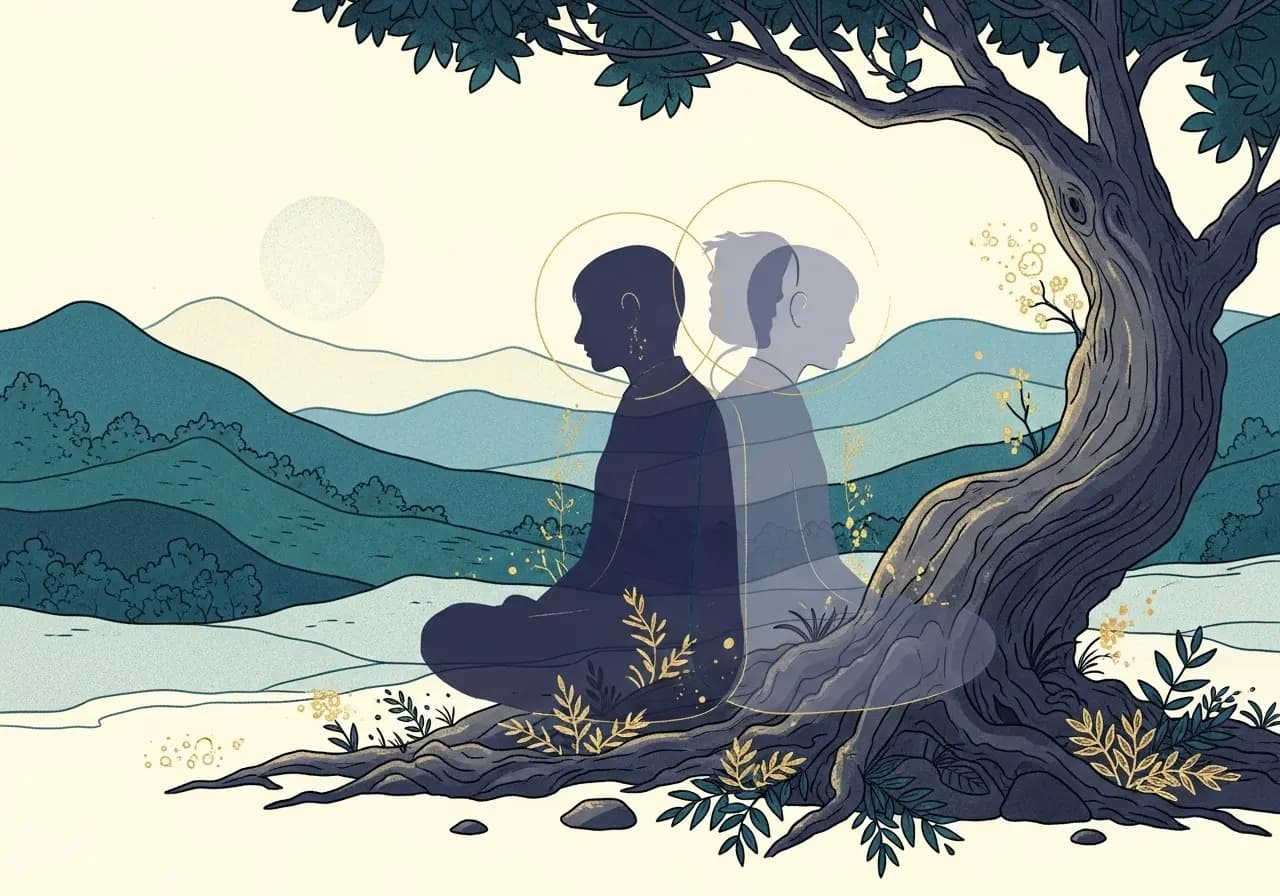
Life With and Without Beliefs
Episode 38 of the Secular Buddhism Podcast
Hello. You are listening to the Secular Buddhism podcast, and this is episode number 38. I'm your host Noah Rasheta, and today I'm talking about life with and without beliefs.
(Musical Introduction)
The Advertising Tactic
Have you ever noticed the TV or billboard ads for whiter teeth? They always show you a comparison. Here's what teeth look like with this treatment. Here's what they look like without this treatment. And this tactic seems to trigger in us the thought: "What would I look like with this treatment?" Or perhaps even worse: "Oh no, what do I look like without this treatment?"
This attitude of comparing plays a part in all forms of advertising and marketing. It pretty much says: here is what life would look like with this new car, or this energy drink, or this product or service. And then it's left up to us to imagine what it would be like without. We don't want to miss out, so that's what compels us to want to get something.
We're always being presented with this dualistic set of realities. There's what is, and then there's what could be. All you need is this one product or this one service. This tactic plays on our natural curiosity because we have a natural eagerness to want to compare and contrast things.
So what if we could use this natural curiosity to look more deeply into our own lives? What if we could examine the nature of our own minds, our thoughts, and our deeply held beliefs?
A Word About the Foundation and Podcast Support
Before I jump into that, though, I do want to remind you that this podcast is made possible by The Foundation For Mindful Living, a 501c3 non-profit with a mission to make the world a better place by teaching people to live more mindfully. The goal of the foundation is to make mindfulness teachings available to anyone, anywhere, and we can do that with the support of our listeners.
If every podcast listener donated just two dollars a month, the foundation could host mindfulness retreats and workshops all over the country—perhaps even the world—completely free to the attendees.
Now, I love recording the podcast. I love teaching workshops, hosting retreats. I never get tired of teaching about mindfulness or talking about Buddhism. The only part of all this that's difficult for me is asking for donations. Fortunately in the past I've been in a position to do this without relying on any kind of support. This has been my way of giving my time and resources, and it's allowed me to do everything on my own dime. I've been happy about that.
Unfortunately, though, as some of you may know from listening to recent podcast episodes, I'm going through a difficult phase with my business. Very soon I will no longer have the business, and I won't have the same financial freedom that I've had in the past to continue running this the way I have—using my own resources. During this time the podcast has grown quite a bit. It's become the number two podcast in the world for Buddhism, and it's consistently in the top 50 now for religion and spirituality in the world. I'm very thankful to each of you for listening and for supporting when you can, because it couldn't have grown without you.
But that also means I'm dealing with significantly more bandwidth and resources just to keep it all running. As of now, it's about 0.2 percent of monthly listeners that are donors—whether that's a one-time donation or a monthly donation. I would love to get that percentage up a bit. I don't know what a proper goal is, but between two and five percent of listeners making a donation would make a significant difference in the resources I would have. That would allow me to make this my full-time project.
So here's my pitch to you. If you're getting any value from these podcast episodes, and if you're in a position to do so, consider visiting SecularBuddhism.com and click on the donate button at the top of the page. Consider becoming a monthly contributor, or at least make a one-time donation that can go toward the cause of making mindfulness teachings available to everyone.
Normally you have to pay for something to see if you like it or if it was useful. We've all done this. You buy a product, you spend a couple of dollars, and then you get to see if you like it or if over time it remains useful to you. That's what's nice about this setup with a podcast. Podcasts are free, and I want that to always be that way. I don't want to start bringing in advertising as a way to supplement the income I would need to do this. I think that kind of muddies the waters, but with this format it's different. You get to listen to the podcast, and over time you get to decide if these teachings are making a difference in your life. If they are, if you're benefiting from this content, then you get to choose if you want to support it. That would ensure that I can continue recording new episodes and even more regularly than I do now because I would be doing it full time. And I can continue to provide you with content that continues to be beneficial to you and your day-to-day living.
I'm not asking anyone to donate unless you feel this podcast has been beneficial to you and you're in a position to do so. One of my main things has always been: I don't want any of this content to be restricted to people who can afford it. That's why the workshops I'm doing now are completely free. But every donation makes a difference with the mission of the foundation and the mission of the podcast—to take what can sometimes be complex teachings or complex topics and make them easy to understand and accessible to anyone who's interested in learning more about mindfulness, Buddhism, and meditation.
So that's it. That's my one-time pitch to you. I don't want to take up nearly as much time talking about this in the future. I just want to get into talking about the content of the specific topic for the day, and maybe I'll have an occasional reminder if it's still needed. But hopefully with your help we can get the percentage of listeners who donate from 0.2 percent up to a higher percentage, and that will make all the difference.
Beliefs and Reality
With that out of the way, let's jump into this week's topic.
We all have beliefs. In fact, it's one of the things that makes us function so well as a species—as a highly evolved species. The fact that we're capable of creating and collectively believing stories is what gives rise to our modern civilization. There's a whole book about this called Sapiens. You should check it out. But essentially our political, financial, and even religious systems all work because of our shared beliefs.
Think about that. If we didn't all believe that this little green piece of paper had any value, our financial systems would collapse. We wouldn't be able to trade or do commerce anywhere near as effectively as we can now because of our common-held belief that this piece of paper has value.
Today I want to talk about beliefs and the role they play in the narrative that we build about reality. I've talked about this in the past. There is reality, and then there is the story that we have about reality. In other words, there's you, and then there's the story you have about who you are. These are not the same thing. These are two different things.
The story we construct about reality is determined by the beliefs that we hold. So you could say it's our beliefs that build a fictional world. And this isn't necessarily a bad thing. The problem is that when reality doesn't fit with your beliefs, then you run the risk of causing suffering for yourself and for others, because you're trying to make reality fit the narrative of your own fiction.
And here's the thing about reality: reality is under no obligation to make any sense to you.
The Chris Story
If you're a regular podcast listener, you'll recall this story—this incident I had a while back about meeting with Chris in China, one of my suppliers. For months I had been communicating with Chris over email. When we finally went to meet in person, I just couldn't see Chris anywhere, because I kept thinking he's not here. After enough time went past and I finally sat down, the girl sitting next to me that whole time—who I didn't even realize—she looked up from her phone and said, "Oh, hi. Are you Noah? I'm Chris."
The story has stuck with me because it reminds me of how my belief blinded me. There was no problem with reality. Reality was what it was. I was there. Chris was there. But I couldn't see Chris because of the belief—because of the concept. The conceptual Chris blinded me from the real Chris.
This is what I'm talking about when I discuss the difference between what is and the story of what is—the narrative we've constructed around what is. That narrative is influenced by our beliefs. In my case, the story was that Chris was a man. That's why I couldn't see Chris, the female sitting there all along.
So there's this duality between what is and the story of what is—the narrative we've constructed around what is. And that narrative is influenced by our beliefs. In that specific event, there was absolutely no problem with reality. It was a problem with the narrative that was influenced by my belief that Chris was a man.
Remember, all of this happened during a time in my life when I was deliberately trying to be aware and mindful. So what does that say? If I wasn't even aware that I wasn't aware of reality, well then I'm in a dilemma. What do we do about that? How do we overcome that? If our beliefs are influencing our narrative and the story around reality, how can we work with that?
Working With Beliefs
I don't think we can just eliminate our beliefs. I'm not sure that we can, and I'm not sure that we need to or want to. But by understanding the connection between my beliefs and my perceived reality, I can become much more introspective about the role that I'm playing in my own self-inflicted suffering and the suffering that I may be causing to others.
I want to elaborate on this a bit more by introducing you to a popular Zen koan. If you'll recall, I've talked about this in the past. A koan is a riddle. It's a story, a question, or a saying—something that's meant to be difficult, if not impossible, to understand or solve. But it's ultimately meant to serve as a tool that knocks us away from our conceptual thinking for a moment.
Koans are used as tools to help us have a glimpse of reality without the bias of our beliefs and our stories. And remember, there's no problem with having beliefs or stories. It's only problematic when we confuse those things with reality. A koan can introduce us to the possibility of seeing or glimpsing what the world might look like if we could see it just as it is, without our beliefs, without our concepts. What does life look like if I'm suddenly not relying on the stories I tell myself about reality?
The Great Way Koan
The koan goes like this. It's an expression that says: "The great way is not difficult if you just don't pick and choose."
That's it. The great way is not difficult if you just don't pick and choose.
I've worked with this for a while, thinking about what it means. And I'm going to tell you what it means to me. But remember, at the end of the day, with this and all other things, the only real question that matters is: What does it mean to you?
For me, I think of it like this: Life is not difficult if you just don't pick and choose. But what is it that we don't have to pick and choose from? To me, it's reality versus the story I have about reality. That is the game I'm always playing. I'm trying to decipher what is reality versus what's the story I have around reality. And we are always choosing. We're picking and choosing between the two without even realizing that that's what we're doing.
We are always caught up in the fictional reality we've created because of our beliefs. And this koan is saying: What if you could learn to see reality as it is? Then you wouldn't have to pick and choose between what is and what you think is. What if events in life don't have to be anything other than what they are? No stories. No fiction.
I often talk about the analogy of a car cutting you off, and you can notice how quickly the story influences your view of reality. The real suffering in that event has nothing to do with being cut off. It has everything to do with thinking that a jerk just took advantage of you or something along those lines. But that's the story. That's the fiction.
This koan is alluding to the idea that life is not difficult if you don't have to pick and choose. You can be with reality as it is. What if we could approach events as they unfold in life without the stories that we've attached to those events?
Being Present in Nature
I often talk about what it feels like to be out in nature, because it's one of the few places where it seems very easy to drop all the stories, all the narratives, all the fiction. We aren't out there in nature looking at trees thinking, "Wait a second, you need to be more straight" or "Your leaves are not green enough" or "Sorry, there's too much bark growing on the trunk of this tree." We just don't play that game. It sounds absurd and silly to even imagine, but that's what we do in real life.
When we're out in nature, we simply allow nature to be just as it is, and in return, we don't feel that nature plays that game with us. You don't go out in nature and feel like the trees are judging what brand of backpack I'm wearing or the color of my shirt. It's in these moments where we're completely at one with reality. We are just with what is. And there's no tension, no inner conflict, nothing to add, nothing to subtract. You're just there with what is.
How refreshing does that feel? What if we could be like that in other aspects of our life? What if we could be like that with other people? Or even more, what if we could be like that with ourselves? That's the essence of what it means to be able to live with and without beliefs. It's looking at the role that beliefs play in how we are with ourselves.
Beliefs, Thoughts, and Feelings
Beliefs and thoughts and feelings—these things arise naturally in the same way that the wind or the rain does. When the causes and conditions are right, it rains. When the causes and conditions are not right, the rain is gone. Beliefs and thoughts and emotions—this whole sense of self—it's very similar. The key is to remember that we don't have to agree with them or fight against them. That puts us back at picking and choosing, and it's not difficult if you don't have to pick and choose.
We all know that Buddhism teaches the concept of non-attachment. Sometimes I think this is a concept that can be difficult to understand. In some ways I like presenting this on the flip side of that notion as the wisdom of adaptability.
The Wisdom of Adaptability
In the context of time, we say that all things are changing, all things are impermanent. Attachment is what seems to bring a sense of permanence to things that are not permanent. Thích Nhất Hạnh says: "It's not impermanence that makes us suffer. What makes us suffer is wanting things to be permanent when they are not."
I think in a similar way a lot of our suffering arises—not necessarily from having beliefs, but from wanting those beliefs to be permanent when they're not. Thinking this is this way and it always needs to be this way.
Sometimes I like to think about what it must have been like when science was making that transition from the geocentric view of the universe to the heliocentric view. I don't think the problem was that there was a geocentric view of the universe. They didn't know. If you were just observing the night sky without the proper knowledge, it would be easy to assume that everything is spinning around us.
The problematic part comes when a new model arises that makes more sense, and you can't let go of your current belief that the earth is the center of the universe. That's where it becomes problematic, because wanting our beliefs to be permanent can be problematic when they're not permanent. Nothing is permanent. All things are changing.
So this is where the wisdom of adaptability comes in.
Imagine how much more healthy it was for the scientists who were able to hold a view—that the earth is the center of the universe—to be presented with new information that makes sense and say: "Oh, well, okay. It looks like the sun is the center. We are revolving around the sun, not revolving around us." That's the wisdom of adaptability. To say, "That changes everything. From here I'll view it differently."
That's what it means to not have to pick and choose. At that moment you're not stuck with the cognitive dissonance of what you think is versus what reality seems to be saying. You can just say, "I'm not going to pick and choose. I'm going to go with reality every time, even when I don't know, even if it doesn't make sense."
It just allows you to loosen the death grip that you have on your view of reality. I think it's perfectly fine and healthy to hold a belief and to know that this is just how I view it now. This is how it is. Doesn't mean it will always be like this, because if new information comes along, I would be happy to change my view. That's the wisdom of adaptability.
Right Now It's Like This
There's an expression that is common in Buddhism that says: "Right now it's like this." It's an expression to remind us that we have the tendency to make things feel permanent. If you're going through a difficult time, it's easy to think, "Now life sucks"—as if it's a permanent thing. The expression "Right now it's like this" is the reminder that everything is in the context of time.
Sure, it's fine to say this sucks, what I'm going through sucks. But it won't always be that way, because the nature of things is that they're impermanent. Things are always changing.
This is where the Parable of the Horse comes in—the story I've shared so many times in so many podcast episodes. "Who knows what is good and what is bad?" It's trying to get us to understand that in the context of time, sure, right now I'm suffering because my son fell off the horse and he broke his leg. That seems like a bad thing. But the thing is, I don't know that it's permanent, because tomorrow I may be grateful that happened, because now he wasn't conscripted into the army.
That's the point: it's permanence that makes it problematic. Trying to hold on. As Thích Nhất Hạnh says: "It's not impermanence that causes suffering. It's wanting things to be permanent when they're not."
Wanting Others to Be Different
Now I want to deviate a little bit on another thought around all of this.
Have you ever noticed how it feels when you're around someone that you want them to be different than how they are? Have you ever noticed how that feels? I'm not saying that it's right or wrong to want someone to be other than they are. I'm not saying that. I'm just asking you right now to look into your own self for a minute. What does it feel like? How do you feel when you're around someone who you want to be different? You want them to be different than how they are. How does that feel?
Because it's the same way we feel in general toward life when we're wanting life to be other than it is. And that is the very definition of suffering in the Buddhist sense.
Suffering arises when we want life to be other than it is.
I remember feeling this way around a certain person in my own life—someone close to me that I felt was judgmental or harsh or difficult to be around. I always thought the solution was: when this person changes, then it will be good. Then life won't be difficult. Then I won't have to suffer around that.
But it wasn't until later, through contemplative practice, that I realized something different. When I didn't want this person to be any different than how they were, that's when there was true peace between us. I was completely content with them being who they were. It was fine if they wanted to be judgmental or harsh to me. I was at peace.
And the irony is that peace allowed them to change. Not because I wanted them to, but because they had the freedom to. But that's not the goal, right? They don't have to change. You're going to have peace when you can be content with life just as it is.
Acceptance and Self
And it's not just with life, and not just with others. I think what I really want to get at here is that you do this with yourself. There's who you are, and who you think you should be. And to make matters worse, there's who you think someone else thinks you should be. But we're playing that same game. We're wanting life to be other than it is, and it causes suffering.
When you're playing that game—there's who you are and who you think you should be—the moment that you can look at your life and you no longer want it to be any different than it is, you will experience peace. When you no longer have to pick and choose between who you are and who you think you should be, you will experience peace. Or when you look at someone else and you no longer have to choose between who they are and who you think they should be, think about that for a minute.
Just imagine. What would life be like if I didn't have to pick and choose? That's kind of the premise of this koan. What if I could be with reality just the way it is?
Now this is what "The great way is not difficult if you just don't pick and choose" means to me.
Hopefully you will be able to spend some time with this and ask yourself that question: What would I be like if I was completely accepting of me just the way that I am? What if I wasn't comparing or having to pick and choose between me and the me that I think I should be? Or between life and the life I think should be? Or between another person—who they are and who I think they should be?
What if you could be around someone and accept them just the way that they are? I promise you it would make a very big difference in what you feel. Notice how it feels when you're around someone that you want them to be other than how they are. Notice how it feels when you want to be other than how you are. That's a tumultuous thing to experience.
Closing
This podcast episode was inspired by a chapter in the book Bring Me the Rhinoceros and Other Zen Koans That Will Save Your Life by author John Tarrant. If you want to get a little more in depth with this specific koan—"The great way is not difficult if you just don't pick and choose"—I recommend picking up that book.
And as always, if you enjoy this podcast, please share it with others, write a review, and give it a rating on iTunes. Remember, if you're new to Buddhism or you're interested in learning more, you can listen to the first five episodes of this podcast in order. They serve as a summary of some of the key concepts taught in Buddhism. You can also check out my book Secular Buddhism: Eastern Thought for Western Minds, available on Amazon, Kindle, iTunes, and Audible.
For more information or links to those books, just visit SecularBuddhism.com.
That's all I have for now, but I look forward to recording another podcast episode soon. Until next time.
(Music)
For more about the Secular Buddhism podcast and Noah Rasheta's work, visit SecularBuddhism.com