

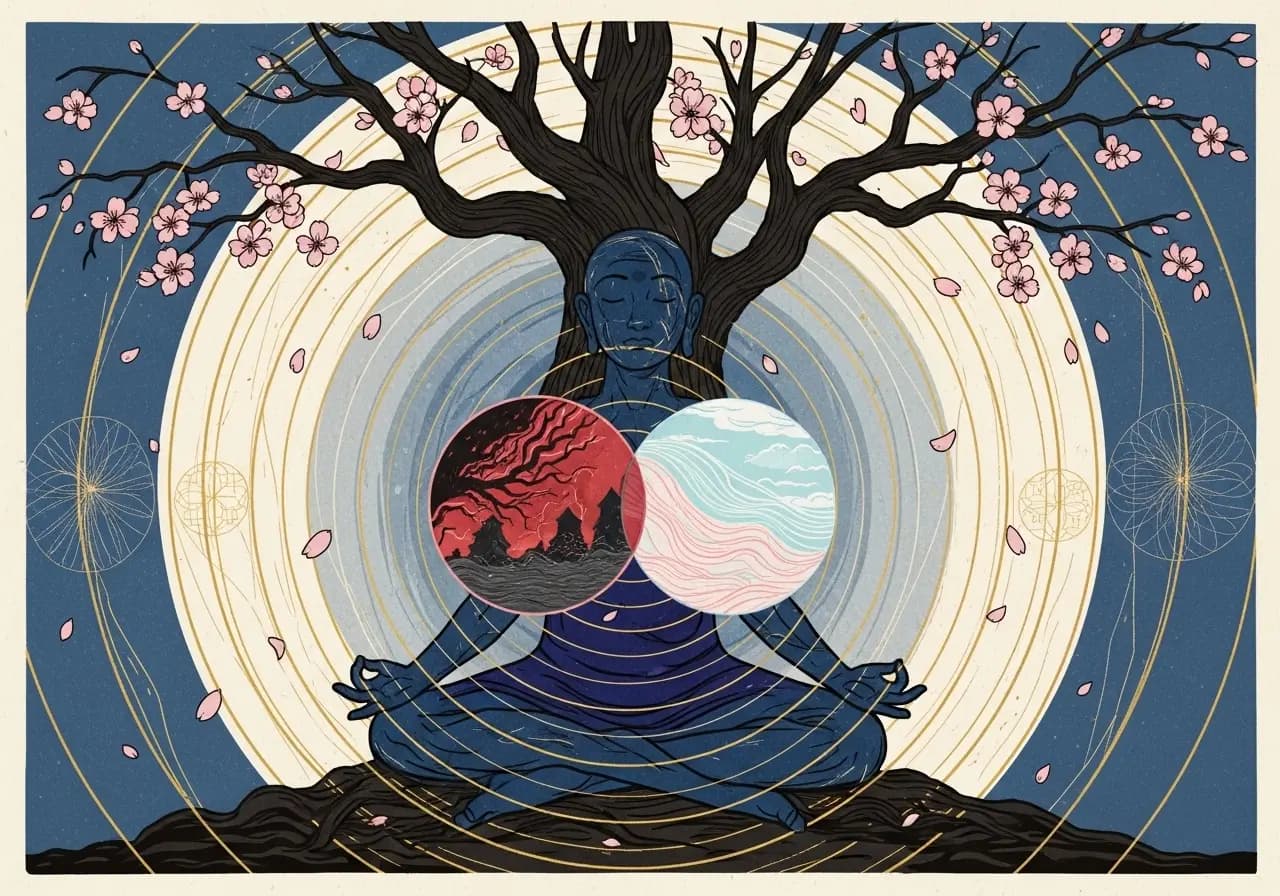
The Art of Self-Compassion
Episode 37 of the Secular Buddhism Podcast
Hello. You are listening to the Secular Buddhism podcast, and this is episode 37. I'm your host, Noah Rasheta. Today, I'm talking about the art of self-compassion.
Why Are We So Harsh on Ourselves?
Why are we so harsh on ourselves? Have you ever noticed how we tend to be nicer the further out we go from our inner circle? We're more harsh on a friend than we are on a stranger. We're more harsh on a family member than we are on a friend. And ultimately, we're just ruthless on ourselves.
When it comes to treating ourselves, the craziest part is that the person giving the beating is also the one taking the beating. Why are we so critical of ourselves?
In this episode, I want to explore the idea of self-pity versus self-compassion. What is self-compassion, and how do we practice it?
But before I jump into that, I want to remind you that this podcast is made possible by the Foundation for Mindful Living, a 501(c)(3) nonprofit whose mission is to make the world a better place by teaching people to live more mindfully.
If every podcast listener donated just two dollars a month, the foundation could host mindfulness retreats and workshops all over the country, and perhaps the world, for free. Imagine that—people being able to attend a workshop or a retreat to learn about mindfulness. That's possible. All you have to do is visit secularbuddhism.com and click on the Donate button at the top of the page.
And one more reminder: the Dalai Lama has said, "Do not try to use what you learn from Buddhism to be a Buddhist; use it to be a better whatever-you-already-are."
If you're new to Secular Buddhism or interested in learning more, you can listen to the first five episodes of this podcast in order. They are a summary of all of these concepts. You can also check out my book, Secular Buddhism: Eastern Thought for Western Minds, available as a paperback on Amazon, eBook on Kindle, iBook on iTunes, and audiobook on audible.com. For more information and links to those book versions, just visit secularbuddhism.com.
Okay. With all that out of the way, now let's jump into this week's topic.
Understanding Compassion
Self-compassion. So first, how do we define compassion? In general, everyone has some level of compassion, excluding conditions like psychopathy. But think of the images of suffering animals on TV. I remember those commercials with Sarah McLachlan playing in the background. Generally, we all feel a sense of compassion when we see stuff like that—compassion when a family member or a friend, or even a stranger, is experiencing an instance of suffering.
But why do we feel that?
I think we're hardwired from an evolutionary standpoint to feel this way, because we depend on the compassion of others for our very survival. No other creature on the planet requires the care and attention that a young human being requires to survive.
In Buddhism, this innate desire to lessen the suffering of others is often referred to as our Buddha Nature, or the awakened state. It's a natural state. Over time, it's our concepts, ideas, and beliefs that can desensitize us from this natural state. So part of the spiritual practice of someone studying Buddhism is to increase that state of compassion—to include all living beings, including, and perhaps especially, ourselves.
There's a phrase or expression that comes from a Tibetan Buddhist prayer that says, "May all beings have happiness and the cause of happiness. May they be free from suffering and the cause of suffering." That idea, or that prayer, is rooted in this practice of increasing compassion.
Another idea that comes from the Buddhist understanding of compassion is that everyone deserves it. It doesn't need to be quantified or qualified.
Think about a dog that gets hit by a car, and you see it. You don't tend to judge the circumstances before determining if the compassion is deserved. You just feel it. You feel sorry for it, and you try to minimize the suffering. You don't say, "Well, you shouldn't have tried to cross the road. See what you get?" We wouldn't do something like that.
But why is it that we do that when it comes to human beings? "I've been robbed." "Oh, well, you shouldn't have been in that part of town." Or the horrible story of someone being raped, and it's like, "Well, you shouldn't have been dressed that way." And so many other similar judgments.
These are horrible because compassion doesn't require any kind of judgment or qualification. Sure, there may be reason to analyze a situation and to use wisdom as a tool to avoid suffering. Like obeying the sign that says, "Warning: There are sharks in the water," so maybe you won't go into it. But once a person has gone into the water and they've been attacked by a shark and they're experiencing suffering, the compassion that we can feel to help ease or minimize that suffering shouldn't be entangled in the analysis of whether or not this person should have been in the water.
It's just not necessary. At this point, compassion is only concerned about one thing: to lessen the suffering that is being experienced. And there's no need for judgment in that process.
The Circle of Compassion
I mentioned this at the start. It's easier to feel natural compassion the further out we go from ourselves. So: stranger, then friend, then family, and ultimately, self.
As a practice, if we want to increase our compassion for others, we should start with ourselves. Because if I'm capable of deep compassion for myself, imagine that expanding out exponentially as you go out from there. Compassion for a friend might be harder than compassion for family, and compassion for a stranger might be even harder than compassion for a friend.
So I think we often think about working on compassion or developing compassion, but we start with thinking outside of that ring. What can I do for someone else first? And if this was a formula where you're imagining these rings, with the further the ring goes out from you, the easier it is to experience compassion, and let's say that multiplies by two, then imagine the amount of work and effort it would take if we were starting from the outside of that ring going inward.
Let's say the level of compassion I experience for another person is an eight out of ten. Then it diminishes—maybe six out of ten for a friend, four out of ten for family, and when it gets to me, it's like one or two out of ten.
So if I'm trying to increase the outer ring by working with others, and I get that to go up one notch, and then use that same formula going inward, I'm not making a big dent or a big increase in the compassion I have for myself.
But if I do this backwards—if I take the compassion I have for myself, and if it was on a two out of ten scale, and I was able to increase that to six out of ten, imagine what that does to the number going out from there to family, then friends, then strangers.
It's a lot like the turning of a wheel on a bicycle. You've got the pedals attached to one set of wheels, usually connected with a chain to gears, and the gears can shift and turn. Ultimately, the actual wheel is spinning. So if you think the key to get this wheel to spin faster is to work on the wheel itself—imagine the bicycle is kind of suspended in the air and you're spinning the wheel—you could spin it faster. Or you could start with the smallest of all those things: the little wheel of the gear where the pedals are. What if you made that bigger? Then what would that do to the ultimate speed of the tire? It would make it a lot faster.
The idea here is, instead of starting from the outside in, what if we started from the inside out in developing compassion? So this is self-compassion we're talking about now.
The Airplane Mask Principle
If you've ever flown on an airplane, you'll recall that during the safety procedure, usually at the beginning before you take off, they talk about how if there's an emergency, these masks come out of the top, and they always say, "Put yours on first, and then help someone else."
I was thinking about this on a recent flight with my son sitting next to me, and I was thinking, "Man, I would want him to be safe first, you know, first thing, because I care about him more than I care about myself." And then I realized, "Well, if I only have a matter of seconds and I were to pass out, then I can guarantee he will too, because he can't reach it and he won't know what to do."
And I thought, "Is it selfish of me to want to put the mask on first?"
It may seem so at first, but if our goal is to dramatically increase our compassion towards others by focusing on ourselves first, then it wouldn't be selfish. Like the airplane mask, I put mine on first because of how much I care for my son sitting next to me.
So on one hand we have this idea of self-pity, and this seems to be a default setting for a lot of us. On the other hand, we have self-compassion. One arises out of fear—perhaps the fear of not being liked or the fear of being disliked. Remember, we're hardwired to belong. And the other one arises out of love.
Self-pity arises out of fear. Self-compassion arises out of love.
And there's an element of wisdom that I want to point out here. In Buddhism, we're always teaching about interdependence, and we continually go back to this idea that all things have causes and conditions. Things inter-are. The flower exists because of the sun, the clouds, the rain, the soil, and so on.
And suffering fits this understanding. Suffering is also interdependent.
In the last podcast episode, I talked about this and how we can learn to look deeply at our suffering and understand the causes and conditions. The absence of compassion has causes and conditions too. So if compassion is the natural state that we experience, and you can see this at a very young age, then we can look into what are the causes and conditions that may be preventing us from experiencing compassion.
Again, aside from psychopathy, which is also a cause or condition that would prevent compassion from arising naturally, perhaps there are other causes and conditions. For example, prejudice. If I hold a racist idea or concept, could that be the cause or condition that prevents compassion from arising naturally towards a specific group? You bet.
If you spend time looking at how you see the world, then you start to notice things like this. Perhaps you can ask yourself, "What ideas or beliefs do I hold that may be preventing me from feeling natural compassion towards others? Maybe a specific group?"
Three Steps to Self-Compassion
Okay. So how do we actually practice self-compassion?
I want to mention three steps to assist with this process. Step one is you practice being kind to yourself by imagining you're someone else. Step two is looking deeply at suffering. And step three is developing mindfulness or awareness around suffering.
Step One: Imagine You're Someone Else
Starting with step one: practice being kind to yourself by imagining you are someone else. What does that mean?
Well, I've mentioned already that in our society, it's much easier to be kind to family and friends than it is to be kind to ourselves. Unfortunately, we don't seem to treat others half as badly as we treat ourselves.
I'm sure we've all done this. Have you ever said to yourself, "You idiot" or "You're such an idiot"? What are some of the things that we say to ourselves that we would never ever say to someone else? Think about that for a moment. Think about some of the things that you say to yourself.
Mother Teresa used to say, "It's easy to love the people far away. It's not always easy to love those close to us. It's easier to give a cup of rice to relieve hunger than to relieve the loneliness and pain of someone unloved in our home. Bring love into your home for this is where our love for each other must start."
I really like that. And I would go further and add that when we learn to love ourselves, that's when we can truly learn to love others. But it has to start with ourselves. And this is where self-compassion can kick in.
Let me give you a personal example. Just recently, my business has been experiencing some complications and difficulties for quite some time. A couple of years ago, I had a big contract with Walmart that fell through, and I've been struggling to recover from that ever since. And then it happened again about a year ago with AT&T Wireless. Similar deal. They ordered all these products, put us in all their stores, and then decided, "Nevermind. We don't want to sell these anymore." And they take it all back.
A lot of these big retailers are notorious for this. Doing business with big box retail can be really difficult for a small company. And I've paid the price for that twice. It's been such a significant price that I've had to pay—taking all that inventory back, scaling down manufacturing—that it's put my company on the precipice of failure.
And in the last few weeks, I've been dealing with a few other setbacks that have kicked in. It's like adding the straw on the camel's back. And I'm in a very serious predicament now where I'm in complete uncertainty about the future of my company. It's been stressful and difficult.
And I've caught myself on occasions with how I talk to myself about it, thinking, "Man, you failed. What have you done?" And so I'm experiencing firsthand in various occasions in the last few weeks and days this sense of self-pity. You know, "Oh, poor me," or self-criticism. You know, "You're such an idiot. Why did you ever do business with these guys? You knew this could have happened again after it happened once."
And then I started to remember this concept of self-compassion. I started to imagine somebody I really care about. In this case, my brother. I have a twin brother, and he's my best friend. I was imagining, "What if this was his company? He started this seven years ago, and this is his baby. He's built this, and he's telling me what's happening at work."
And imagining him telling me the same thing changed the entire dynamic.
At that point, I'm thinking, "Well, geez. I'd hug him and say, 'I'm so sorry to hear that this is happening. How can I help you? Don't be hard on yourself. You didn't know this was going to happen with these big retailers.'" And it was so fascinating to see how much easier it was for me to feel kindness and compassion by imagining myself to be someone else. And noticing how harsh I could be on myself when I was just in this experience all by myself.
So this is one of the techniques we can do. If you're going through something—whether it's getting out of a bad relationship, running a red light and then coming down so hard on yourself for what you've done—imagine in that moment someone you really care about, and now they're telling you what just happened to them. Notice how quickly that tone, how quickly that compassion can arise naturally.
And then flip it back to you and say, "Well, geez. Why can't I throw that in for myself?"
And what you should experience is the opportunity in that moment to actually feel compassion for yourself. I felt it myself in these past few weeks, in these past few days. This form of compassion: thinking, "You know, what I'm going through is a difficult thing, and I'm going to do my best to get through it. And at the same time, I'm going to adapt and move on."
And all these things come to mind, but the harshness was gone. The criticism was gone. And self-kindness counters the tendency we have to tear ourselves down.
I don't know why it's so easy to tear ourselves down, but we do. So this form of practice—being kind to yourself by imagining you're someone else—can make a difference. So give that a try.
Step Two: Look Deeply at Suffering
Step two in this process is to look deeply at suffering. This was the topic of last week's podcast episode. So in summary—and you can go back and listen to that episode to get a much more in-depth understanding—essentially, what we're doing is understanding that suffering is universal and that life difficulties will arise for everyone.
Early on in the podcast, I talked about this and I mentioned the story of the bear. You're hiking in the woods and someone warns you on the trail. Somebody's jumping out in a bear costume scaring people. And now that you know, you can continue your journey knowing that when that happens, you'll still be startled, but how much more quickly can you recover from it? Because you realize, "I knew this was going to happen, and it's happening to everyone else on this trail."
Everyone experiences hardships in life. And our tendency is to want to think, "Why is this happening to me?" As if I was the only person in the world experiencing the potential collapse of my company, or losing a job, or any other trial that you may go through in life.
As hard as it is to see this at the time, it's important to understand that you're not alone. Everybody experiences hardships.
Another part of this is understanding interdependence. And I think this is central to the understanding of self-compassion. Remember, if you learn to look deeply at an object—the flower, as an example—you'll see that the flower is made up of all non-flower elements. The sun, the earth, and everything else.
But we're no different. You are made up of all non-you elements. Starting with your parents, your culture, your society, your beliefs—this doesn't end. It goes on and on and on, but you are inter-being with everything that is not you. And so you are inter-being with everything and everyone else.
I know that may sound crazy at first, but if you really look deeply and you see, that's what you see. Interdependence. You can't see something without seeing everything. This is a concept I really love about Buddhism: you cannot see something without seeing everything. And if you're not seeing everything, you're not seeing something with the right eyes.
And I think we fall into this constant trap of thinking, "Things are supposed to go a certain way. Life is supposed to be a certain way." And then when they don't, we think something's wrong. And this causes us to not only suffer, but then we feel alone in our suffering. "Why is this happening to me?"
And remember, we're all part of this shared experience. When we look deeply, what we start to see is that everybody experiences suffering. Sure, the circumstances are different, the degree of pain can be different, but the basic experience of human suffering is the same. It's universal.
While self-pity may say, "Poor me," self-compassion is saying, "I'm not the only one going through something difficult." And it can even take it a step further. It can say, "Well, now that I know what this is like, I can help somebody else who's going through this."
Learning to look deeply is understanding that when you look at something, it's not just that one thing. There are always layers of complexity because all things have causes and conditions. So in the same way that looking at a flower and only seeing the flower is a narrow way of seeing, looking at the flower and seeing all of the elements that allow that flower to be what it is—that's looking deeply.
And we can do that when we look at ourselves and when we look at our own suffering.
Step Three: Develop Mindfulness Around Suffering
That leads us to step three: developing mindfulness or awareness around suffering. Remember, mindfulness is just awareness. It's the acute awareness of our moment-to-moment experience with complete equanimity and balance.
What does that mean? It means that we're completely aware of our thoughts, our emotions, and our sensations without this need to cling to them or to resist them.
Awareness of impermanence reminds me of the expression, "This too shall pass." And remembering that, it's easier to be kind to the non-permanent me.
There's the me that's constantly thinking, "Oh, this is going to be this way. What's going to happen?" Because we tend to want to experience our moment-to-moment experiences of life with a sense of permanence attached to it. Like, "Oh crap. This is always going to be this way," or "Oh man. I'll never do that again." We think in terms of permanence. And the reality is, there's no permanence to be found here.
So for instance, rather than thinking, "Well, geez. I've failed. If this company collapses, I'm a failure," I'm realizing, I'm not a failure. I'm simply experiencing failure at something right now. This too shall pass.
Can you see the difference in those two approaches? It's dangerous when we get caught up adding permanence to the way that we see things. And mindfulness prevents us from over-identifying with our thoughts and with our emotions.
This is understanding that "I'm not angry. I'm experiencing anger." You know, "I'm not a failure. I've just failed at something. At this, or at that."
Being a failure is a mere concept. If you think about it, what does it mean to fail? Failure is always relative to something. There's no such thing as failure without it referencing something, right? "I failed to practice my guitar. I failed to meditate. I've failed to continue holding a job." Or whatever it is, it's relative to something. Failure is always relative.
Because there is no absolute in there, you cannot be a failure. You can't. Sure, you can fail at something. I've failed at a lot of things. We all do. But we're certainly not failures because that's impossible.
And mindfulness can help us understand that through the understanding of impermanence, or the nature of change. Things are always changing. So if you're in a continual state of becoming, how do you fail? It's not over, you know? It's never over because change is the only thing that's always happening. So there is no permanence there.
The Transformative Power of Self-Compassion
When your perspective shifts to allow you to experience this self-compassion, what you'll find is that you not only transform your own life, but it starts to transform the lives of everyone you interact with. Because when you become a better whatever-you-already-are, it allows everyone else around you to become a better whatever-they-already-are too.
Do you see how that works?
So rather than starting with that outer ring—"What can I do for others? What can I do for friends? What can I do for family?"—bring it in. Bring it to the core of, "What can I do for me? How can I learn to develop compassion directed at me?"
And I want to make a note about this because self-compassion should not be about trying to make our pain go away. It's not like we're trying to minimize the experience that we're going through. We're not trying to manipulate this experience that we're having. That makes self-compassion a new form of resistance, and that inevitably makes things worse.
So I'm talking about self-compassion as the art of becoming more comfortable with discomfort.
Self-compassion doesn't take away the suffering I'm experiencing. It creates space for it. It allows it to come sit at the table and be like, "Yeah, I'm going through this and I'm experiencing that. Well, let's sit with it. You know, come join us at this table, anger or sadness. Let's have equanimity here." And that's what self-compassion can allow for.
It starts internally.
A Practice for This Week
So maybe what you can do is try this exercise for this week. When you hear that voice of self-criticism or self-pity, which you will—we all do—try to imagine for a moment someone that you really care about. A parent, a sibling, a spouse, a child—anyone.
Imagine that they are the ones going through whatever you're going through, whatever you just did. Notice how the tone of that voice, that internal voice, changes when you're directing it toward someone you already care for.
And then, when you feel that compassion arise naturally, turn it and channel it towards yourself.
And remember, if there's the you that you think you are and there's the you that can observe that you, then you can certainly create a space for the you that cares, to empathize with the you that's experiencing the suffering.
Now, if that's kind of hard to understand, then I'll leave you with this quote by Alan Watts that you can think about for the rest of the week. He says, "There was once a man who said, 'Though it seems that I know that I know. What I'd really like to see is the I, which knows me when I know that I know that I know.'"
So there you go. Think about that. Mull over that for a week.
A Final Thought
Before I wrap up this week's episode, I do want to share one last thing. Leo Tolstoy said, "Everyone thinks of changing the world, but no one thinks of changing himself."
My personal goal has been to teach mindfulness in a way that's universally accessible and easy to understand. That's why I've started this podcast. That's why the content on the podcast is free and open to anyone in the world. And I also have a book with more content available at a very affordable price.
But let's face it. While there are countless sources to learn about mindfulness or Buddhism, sometimes it's easier to just work one-on-one with an expert. Why? Well, for the same reason that people hire personal trainers to get in shape when they could just go work out alone in the gym. Because having an expert to guide you and to hold you accountable in your practice makes all the difference in the world.
An Announcement: One-on-One Mindfulness Coaching
So with that, in light of the recent changes that I am experiencing with my career, my business, and my potential source of income, I'm happy to announce that I am going to be offering one-on-one mindfulness coaching for anyone who's interested in deepening their mindfulness practice.
Some of you may already know that I've been training rigorously for the past several years in a Buddhist ministry program, and this is exactly what I've been training in: how to teach mindfulness. And now I'm ready to start teaching that to others in a one-on-one format.
I know that this isn't the right format for everyone, but here are some of the things you can expect from one-on-one coaching.
What I plan on doing is putting together a customized, six-week mindfulness coaching plan designed entirely around your schedule. So there would be six hours of one-on-one teaching and learning. It could be an hour a week. It could be 30 minutes twice a week. We could schedule that however works best.
We would go over specific topics that are generally barriers for mindful living and talk about the understanding of these topics, how to overcome the barriers, and just be able to look deeply at any specific instances of suffering that you may be experiencing at this time in your life.
And just keep in mind, I'm not a counselor. I'm not a therapist. I don't have the answers for you. I'm here to help you discover your own answers through mindfulness in the way of the Buddhist tradition.
Working with me, you would learn to make meditation a daily habit. I'll check in with you every day. And at the end of the six weeks, if you're not 100% satisfied with the coaching you've received and the knowledge you've acquired, you'd get a full refund. No questions asked.
A session like this—six weeks of coaching—would only cost $299. And that's to work one-on-one with me for a full six weeks. It's the same as the average cost of working with a personal trainer on your body at the gym.
I can only work with a limited number of people at a time because of the time constraints I have. So if this is something you're interested in, just visit my website, noahrasheta.com, and you can schedule a 30-minute initial consultation for free and see if this is the right fit. I can answer any questions you might have and give you an idea of what kind of expectations and how this is all going to work.
Or you could just contact me by email. If you go to my website, noahrasheta.com, you can click the Contact Me button and fill out that form, and that would email me.
This is something new I'm going to try and see how it goes. I've had a lot of requests from people in the past about, you know, "How could I spend time studying with someone like you? A teacher? A Buddhist teacher who could explain all of this stuff in a one-on-one setting?" And I feel like the time has come for me to be able to offer that.
So we'll see how that goes. If you're interested, let me know.
Supporting the Work
And once again, as always, if you enjoy the podcast, please share it with others, write a review, give it a rating on iTunes.
And if you're in a position to be able to, I would encourage you to consider making a one-time donation or becoming a monthly contributor to the podcast by visiting secularbuddhism.com. Just click the Donate button at the top of the webpage.
Remember, a simple two-dollar-a-month donation from every listener would easily allow me to take these workshops and this content to cities all around the country, to spread these teachings and make them completely available and free for anyone who wants to attend.
I'm trying this format for the first time, and I'm doing a workshop in Park City on mindfulness here in Utah. And I'm so happy to be able to make that available to the public for free. Anybody can come. It's in an auditorium with room for 300 to 400 people. And people can learn these concepts and teachings without any barriers.
If you can't afford it, you shouldn't have to. Learning wisdom should be available to anyone, and that's why I do the work that I do.
And then, of course, if somebody wants to and can do one-on-one coaching or learning, that's available now too.
Closing
But that's all I have for now. And I look forward to recording another podcast episode soon. Until then, have a great week. And until next time.
For more about the Secular Buddhism podcast and Noah Rasheta's work, visit SecularBuddhism.com