

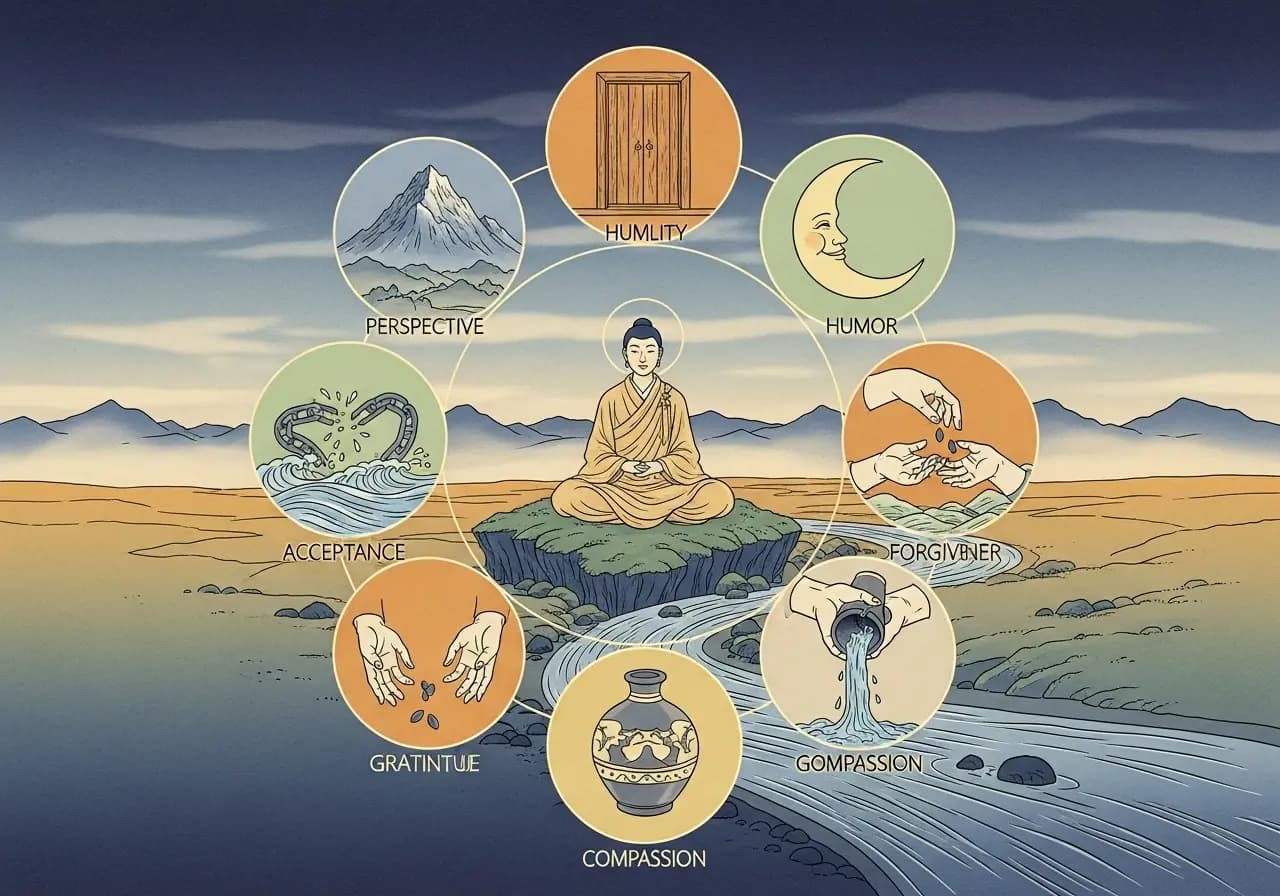
The Pillars of Joy
Episode 35 of the Secular Buddhism Podcast
Hello. You are listening to the Secular Buddhism Podcast, and this is episode number 35. I'm your host Noah Rasheta, and today I'm talking about the pillars of joy.
Welcome back to the Secular Buddhism Podcast. This is a weekly podcast that focuses on Buddhist concepts, topics, and teachings presented for a secular-minded audience. The Dalai Lama has said, "Do not try to use what you learn from Buddhism to be a Buddhist. Use it to be a better whatever you already are." If you're new to Secular Buddhism or you're interested in learning more, check out my book, Secular Buddhism: Eastern Thought for Western Minds. It's available as a paperback on Amazon, e-book on Kindle, iBook on iTunes, and audiobook on Audible.com. For more information and links to those book versions, visit SecularBuddhism.com. Now let's jump into this week's topic.
Getting Back on Track
It's great to be back. I've been gone for a couple of weeks doing a lot of traveling. I did a humanitarian trip in Uganda, Africa, and the planning for that trip, plus being on the trip itself, caused me to fall behind a little bit on the podcast episodes. It's been almost a month now since I've recorded a podcast episode, and it's great to be back, re-energized and excited to record several new podcasts.
Today I wanted to discuss the idea of joy, and this is inspired by the Dalai Lama and Desmond Tutu's book, The Book of Joy: Lasting Happiness in a Changing World. I read this a few months ago and took several notes, and I thought it would be fun to do a summary and talk about the pillars of joy. To get more in-depth with this entire topic, I highly recommend you read the book. It's really good, but the idea is this: there are certain pillars that, in the same way that you have pillars that hold up a building, these are the pillars that allow joy to exist, or happiness.
Happiness Versus Joy
One of the first things I noticed was the distinction between happiness and joy. When we talk about joy versus happiness in the Buddhist lens, we have something we teach called the four immeasurables: love, compassion, joy, and equanimity. The idea is that these things are immeasurable. There's no limit. You don't run out.
With something like willpower, for example, studies show that we have a certain amount at the beginning of the day, and certain things can influence that. If you're hungry or if you're tired, your ability to have willpower decreases throughout the day and you run out. Then rest kind of fills it back up, almost like a tank of gasoline. But love, compassion, joy, and equanimity—we call these immeasurable because they don't run out. There's no limit.
Anyone who has children, or friends or family—someone that you love—you'll understand that love isn't something that runs out. If I love you too much now, I won't be able to love this other friend of mine enough. It doesn't work that way. It just grows, and it's immeasurable.
I think about this often with my kids. When I had my first child, my son, it was like, "How could you ever love this much?" Then the second one comes along and it just multiplies. Just when you think, "Wow, it's not possible to love more than I love," the third one comes along and it's the same thing. The idea is that love, compassion, joy, and equanimity are immeasurable traits. They don't run out.
When we talk about happiness versus joy in this book, I think it's important to distinguish that happiness is an emotion. It's not something we develop. It's something that we experience. I've mentioned before that something always taught in Buddhism is the idea of dependent origination—the idea that all things have causes and conditions. Happiness as an emotion has causes, and when those causes are right or the conditions are right, happiness arises. When the conditions are gone, happiness is gone. All of our emotions work this way, so in that sense, when we're looking at emotions, happiness is no different than sadness or anger. These are just emotions that we experience when the conditions allow. When the conditions are right, these emotions arise, and when those conditions are gone, these things go away. That's the understanding of happiness.
Now, knowing this, you can conclude that happiness only affects you—the person experiencing it. It's a state of being. So you may be happy, but that doesn't necessarily spread to someone else just because as an experience, only you can experience it. You could be happy and I wouldn't know that you're happy. Or I could be happy and someone might not know that I'm experiencing happiness.
Joy, on the other hand, we view as an attitude. When we're talking about the immeasurables, joy is not an emotion that we experience in the same way that happiness is. We view joy as an attitude that we develop, and the idea is that joy affects me and it affects others. It promotes a state of well-being. It comes from within. It's not to be found externally.
The Buddhist teaching of joy comes from the Pali word mudita, which means being happy with someone's fortune or someone's happiness. This is what's reflected in biblical teachings as "rejoicing with those who rejoice." This is the opposite of the German word schadenfreude, which is pleasure derived from the misfortune of others—because sometimes we experience that too. The idea of joy as an attitude is that it's something that we can develop, and it's something that affects not only ourselves experiencing it but others as well.
Think about that distinction between happiness and joy—happiness as an emotion and joy as an attitude.
Finding Joy in Suffering
The big question is: how do we find joy in the face of life's inevitable suffering? You know, one of the core teachings in Buddhism is that in life there is suffering, that difficulties will arise. So how do we find joy in the face of this reality?
Well, the first thing I want to highlight here is that these pillars we're going to talk about that develop joy—these arise naturally. They need to be authentic. They're not to be faked. What that means is if you're not experiencing these emotions or these attitudes, you can look into it and see what's there. You don't need to pretend.
Remember, in Buddhism there's no compelling. There are no commandments that say you need to be happy, or you need to have joy, or you need to be humble. There's none of that. In fact, it's saying these things can arise naturally, and if you're not experiencing this naturally, then look into it. Look into the causes. Be with how you are, but there's no need to fake it till you make it with these things. So keep that in mind as I discuss each of these pillars.
The Eight Pillars of Joy
The eight pillars of joy discussed in this book are:
- Perspective
- Humility
- Humor
- Acceptance
- Forgiveness
- Gratitude
- Compassion
- Generosity
Let's start with the first one: perspective.
Pillar One: Perspective
In the Buddhist tradition, we talk about the Eightfold Path. We have the Four Noble Truths: that there is suffering, that suffering has its causes, that there's the cessation of suffering, and the path that leads to the cessation of suffering. That path has eight areas and it coincides in many ways with these eight pillars of joy. This first pillar, perspective, is essentially the same as the first in the Eightfold Path, which is wise view or perspective.
The idea here is that with the proper perspective, the way we see things changes. There's essentially a narrow view and a wide view. I've talked about this parable of the blind men and the elephant. You have blind men each describing what the elephant is like, and they're each touching different parts. One's touching the side. One's touching the trunk. One's touching the tail, and so on.
The idea is that by realizing and accepting that the way we perceive reality is a lot like the blind person describing an elephant, we can accept the validity of different perspectives. This turns the perspective of "I" or "me" into "we." Whatever I can perceive my reality to be—if I combine that perspective with your perspective or just another perspective—we understand more. The more perspectives we have, the more it all makes sense. That's kind of the wide view.
The narrow view is thinking, "No. Only my perspective is valid because only mine is right." We all have that tendency to want to think that our perspective is the only correct one. The reality is, just as in that parable, all of the perspectives are right because they're all incomplete.
In Buddhism, we teach viewing reality with the eyes of wisdom: the eye of interdependence and the eye of impermanence. Recognizing that all things are interdependent and recognizing that all things are impermanent—constant change and interdependence.
Just in a nutshell, to remind you: interdependence is the understanding that when you look at a flower, you can't just see the flower alone. You have to see all of its dependencies. So when you look at the flower, you see the sun. You see the clouds. You see the rain. You see the soil. All of the things that make the flower a flower include all of the non-flower elements like the sun and the rain.
That's interdependence. That perspective, when we see reality that way, starts to change the way we understand reality. The other one is impermanence, which is that all things are always changing. We've talked about that one multiple times in the podcast. With the right perspective, what we'll start to notice is a change in how we perceive reality. And I think that leads right into the next pillar, which is humility.
Pillar Two: Humility
When you understand that you exist interdependent with all the things that allow you to exist, that strong sense of independence starts to go away. You realize, "Well, I don't exist without all the things that allow me to exist." Just like the flower doesn't exist without sun, rain, clouds, temperature changes, soil, and so on—and all of those things don't exist on their own either. They exist with their causes and conditions. So you start to understand really quickly with this perspective that, "Wow. I depend on everything. I am because everything else is."
I think that starts to create this next pillar of humility. It arises naturally because remember, we don't want to fake this. You don't want to just pretend to be humble. The idea is that with the right perspective, humility arises naturally because you realize, "Wow. I'm just a part of all of this, and how lucky am I because without all of this, there is no me?" That starts to reduce that sense of independence—or that narcissistic view that I'm the center of everything. You start to realize how that's just not the case.
Humility, when we're talking about it in this sense, is recognizing that you are not greater than others. And the moment you think you are, that robs you of your happiness. The opposite of humility is pride. Pride is an exaggeration of the self, an exaggeration of the ego. Pride closes the door to all personal progress because in order to learn, you must first think that you don't know, right? The wise are humble not because they're going to pretend to be humble, but because they genuinely know that they don't know it all.
There's this quote that says, "I used to know a lot until I learned a little." I think the idea is that an open mind starts with humility. It's recognizing that of all there is to know out there, I know hardly anything. And there's me and then there's everything in the world in terms of interdependence and impermanence. The things that allow me to be me have their own causes and conditions both in time and space. Suddenly you realize how little you really are compared to everything that is. I think that induces this sense of humility.
In a paradoxical way, humility favors strength of character because the humble person makes decisions according to what they think is fair and holds to them without worrying about image or what other people will say about them. And that requires strength of character. I think sometimes we think of these things as separate—that strength of character is the opposite of humility. But I think, again, in a paradoxical way, these things are intertwined. It requires humility to have that strength of character, to know I can stand for the things that I think are fair without having to get caught up in worrying about my image or what other people think of me. And that comes from humility—from the shrinking of the self or the ego because of the proper perspective, the proper understanding of the nature of self.
There's humility in not knowing, in not assuming. Holding on to that mentality of "I don't know" requires humility because our tendency is to want to think that we know. I do this when I cast judgment on someone—"so and so is this, so and so is that"—as if I knew. That might be based on something that was done in the past. It may even be based on something that's happening in the present, but what I don't know is all the future, right? That person might change. That person may not always be a jerk, but if I make that permanent, I'm assuming that I know—that I know the reality of how that person will always be. Humility allows you to have that space of "I don't know," and you're always open to whatever might be.
Brené Brown, in her work with vulnerability, talks about just showing up and being seen as we are. I think that requires a lot of courage. It also requires a lot of humility. That's the kind of humility we're talking about as far as this pillar.
With the proper perspective of reality, humility arises naturally. And because we're humble, it's easier to be happy because we're open to things as they unfold and not fixating on anything that seems to be permanent. Because we understand that things are impermanent and things are interdependent.
Pillar Three: Humor
With that humility and perspective, let's talk about the next pillar that I think arises naturally. With perspective and humility, we have humor. When you no longer take yourself so seriously, everything becomes funny. Think about that. We take ourselves so seriously, and humor—and I want to be clear—humor that does not mock or belittle brings us closer together. It helps us diffuse tension or tense situations, and humor shows us, in a way, our shared ridiculousness. You know, we're all here in this life. We're taking it so seriously, thinking that there's somewhere to go, somewhere to be. And the truth is, we're just here in a hamster wheel, running, and if we could all see that, we would all start laughing at ourselves. There's no need to take this so seriously.
Studies on humor are beginning to show that laughter boosts your immune system. It relaxes your body. It protects your heart by lowering stress hormones, which can cause inflammation. And in general, it just feels good to laugh. Laughter is a respite from pain. It gives us the ability to find humor in any situation and helps us maintain the joy that so many of us are actually craving in life.
Humor is an important part of this pillar, and again, it's not faking it. It's not pretending that things are funny. It's realizing that in reality, things just aren't so serious, and then humor arises naturally. I love that this is talked about in this book because both the Dalai Lama and Desmond Tutu—you see them and they're always full of joy. They're always laughing. I don't think they take themselves that seriously. And if we didn't take ourselves so seriously, we would be able to experience this same humor that is a pillar of joy.
Pillar Four: Acceptance
Let's talk about the fourth pillar now: acceptance. Acceptance is the ability to accept our life in all its pain, imperfection, beauty—just as it is. But it is not resignation. This is something I clarify every time I talk about acceptance. It's not defeat. It's accepting that we need to pass through the storm. It's facing suffering and asking the question: how can we use this as something positive? It's not resignation.
Acceptance allows us to engage life on its own terms rather than wishing in vain that things were different. Because the moment we want things to be other than they are, we experience suffering, right? Acceptance is what enables us to change and adapt, rather than expecting everything else to conform or adapt to our expectations.
One of the central practices of Buddhism—one that I think we can all learn from—is aimed at seeing life accurately, at cutting through our webs of concepts, our expectations, and the distortions that we have of reality. When we accept reality, we're better able to see it accurately and respond to it in the appropriate way.
Acceptance is like sitting in a field looking up at the sky and watching the clouds go by. There's no resistance to the moment-to-moment experience because there's only observation and acceptance. You know, you don't look at the clouds and say, "Oh, there's a misshapen cloud," because there are no misshapen clouds. There's just reality. There's just what is. And clouds, like all things, they arise naturally. They linger, and then they disappear, replaced by new ones. Constant change.
I also like to think about this as playing the game of life like playing Tetris. When we're playing Tetris, a shape appears, and those of you who have played this can visualize it. The game works so that a shape shows up and you have limited movement with what you can do with the shape. You can move it from left to right on the screen or you can rotate it to try to get it to fit the best way possible. And before you know it, a new one shows up.
Acceptance is playing that game knowing, "I have limited control with what shows up, but I don't control what shape shows up next." Now in life, if you think about it, it's a lot like Tetris. Because we have some control with how life unfolds, it gives the illusion that we're in control. But the reality is we're not. Just when you think you have it all figured out, something jumps up and the whole game changes because now you're confronting a new shape you were not expecting. Acceptance is learning to play—learning to play life the way we play Tetris. I'm going to accept the pieces as they show up. I'll do the best that I can, knowing that before I know it, that piece is gone and a new one has shown up.
Acceptance is being open to the actual feelings we're having in the moment-to-moment experience of life and being willing to just feel that, whatever it is. You know, if it's anger, if it's happiness, if it's fear, if it's jealousy, anxiety, joy—whatever it is, we can learn to simply be with our experience.
We can try to control the experience, but controlling is the opposite of acceptance. So we like to say, "You know, if you're angry, be angry. If you're sad, be sad." I think a lot of the anxiety that comes from our emotional states is the resistance to the state itself—thinking that the point is you're supposed to be happy and not be sad. But as emotions, these are just things that arise naturally. What if you could be happy when you're happy and when you're sad, just be sad? You know, accept that you're sad. Sit with it. Become comfortable with it. Because like clouds, before you know it, emotions arise, they linger, and then they're replaced by other emotions when the causes and conditions are no longer there.
Acceptance is about observing the natural state that you're in and being with it. Think of the expression, "This too shall pass." I think when we understand the nature of impermanence—that all things are continually changing—we learn to accept things as they are and go with the flow instead of resisting reality.
Another analogy I like to use here with acceptance is to imagine if you've ever gone white-water rafting or any kind of activity in a river where the river's flowing. When you're on the river in a boat, it's useless to just try to resist the rapids and go up. You actually can't. So the idea is you go with the flow and you do your best to maneuver in and out of rocks or whatever you're maneuvering. But at no point are you not being pushed around by the overall flow of the river.
Life is a lot like that. Here we are in the river of life and it is taking us. Rather than resisting it, how can I work best going with the flow and steering my boat from left to right or doing whatever I need to do to navigate the best that I can? But turning around and trying to go against it is not ever going to work. Think about that as acceptance.
Pillar Five: Forgiveness
The next pillar is forgiveness. Once we attain acceptance of the present, then we release our desire to change the past. This is the concept of forgiveness.
I talk about this using the parable of the raft. You know, if you need to build a raft to cross from one side to the other on a river, at one point while crossing, that raft is everything to you. It's a matter of life and death. The moment you get to the other shore, it's no longer wise to continue your journey with the raft on your back because you don't need it anymore.
I think in life we do this. We have rafts—things that got us through specific things in life. Now, one of the mistakes that we make is we continue on our journey and we're still holding on to that raft. And sometimes we'll look back and resent it, thinking, "Ah, I wish I would have never been on that raft. That was—I didn't like that phase of my life," or whatever. And the reality is, at the time you were on it, it was very meaningful. It's what you needed.
Forgiveness is recognizing the raft was the raft and now I don't need it, so I can let it go. But I don't need to hold on to anger or resentment for what that was at a previous point in my journey.
Holding onto grievances is our way of wishing that the past could be different. And when we hang onto those negative emotions—the anger, the grief, and the desire for vengeance—we're only hurting ourselves. Now, if we use those emotions to strike back and cause harm, then we're only inviting that cycle of retribution, and then we become trapped in that.
Forgiveness, this pillar, doesn't mean that we forget. It means not reacting with negativity or giving in to negative emotions. This doesn't mean that you don't respond to the acts or that you'll allow yourself to be harmed again. What it means is that justice can still be sought. A perpetrator can still be punished. Justice can be served without hatred. And once it's served, we can let it go.
I like to distinguish it too. I think sometimes we think that we're not supposed to experience anger. That's not what Buddhism teaches. It's teaching the opposite. Like I mentioned before, the emotional experience that you're having is reality. So if you're angry, be angry. But the danger here is crossing over into hatred because hatred has never been useful. It's never accomplished anything positive. So the idea here is that we can still demand justice. We can still ensure that we're not going to be harmed, and we can process all of this without hatred.
Until we forgive a person that has wronged us, we allow that person to hold power over us. They effectively control our emotions. I've experienced this firsthand in my own life—holding on to anger and resentment for someone who wronged me. I held onto it for years. In a lot of ways, it's like that story of hanging onto a piece of coal with the intent of throwing it at someone, but meanwhile, I'm the only one being burned. That's a lot how hatred feels.
But the choice is always ours. So if you're going to be angry, be angry. That's completely fine. And when you're ready, let it go. Be done. From the Buddhist perspective, forgiveness is not commanded. It's encouraged because it's understood as a way to end suffering. So, taking this analogy of the coal, you can be standing there holding the hot coal. That's fine. It's not that you're commanded to let it go or to drop it. Hold onto it until you're ready to let go. When you are ready to stop experiencing the burning sensation and the pain of hanging on to anger, then you let go. But only when you're ready, and not because you have to.
All of these pillars, like I've talked about, they're not compelled. These were not commandments. These are things that we have the opportunity of experiencing on our own when we're ready. And when you let it go, it feels incredible to let go of that pain. Then that wound can heal, and before you know it, that's not even a point of pain anymore in your life.
Buddhagosa was a fifth-century Buddhist commentator, and he started this teaching of the hot coal. He said it like this: "By holding on to anger or holding on to hatred, by doing this you are like a man who wants to hit another and picks up a burning ember or excrement in his hand, and so first burns himself or makes himself stink." I like that because that's kind of the idea. If I pick up excrement thinking I'm going to go and ruin someone's day with this, well, guess what? I'm the one making myself stinky while doing that.
Remember: he who angers you controls you. And again, this doesn't mean you're not supposed to be angry. It's that you hold onto the anger as long as you need to till you're ready to let it go. But the letting go of the anger always starts with you. I think one of the mistakes that we make is thinking when circumstances change, then I'll let go of my hatred or my anger. What we're saying in this teaching is that you are the one with the freedom to choose. Whenever you're ready, let it go.
Pillar Six: Gratitude
That's going to lead us to the next pillar: gratitude. When we understand the nature of interdependence, we start to understand that everything is a gift. You know, like the flower I mentioned—the flower is receiving the gift of sunlight, receiving the gift of the rain from the clouds, the nutrients from the soil.
What I start to notice through this lens of interdependence is that I'm grateful—not because all of this is for me, but because I am the result of all of this. I'm the result of all that is. And with acceptance, we no longer fight against reality. With gratitude, we embrace reality.
Brother David Steindl-Rast says, "The root of joy is gratefulness. It is not joy that makes us grateful. It is gratitude that makes us joyful." You can see why this pillar of gratitude is so important for experiencing joy, for developing an attitude of joy. Gratitude, I think, arises naturally from awareness because you start to notice new things that you're grateful for every day.
You know, I've talked about this before, but when was the last time you paused and looked down and thanked your shoes for protecting your stinky feet throughout the day? When was the last time you paused and thanked your computer or your smartphone for allowing you to be connected, allowing you to listen to this podcast? Thanked your marker or your pen for allowing you to write your ideas? You start to see things in this new light—with gratitude for everything—because all that I am is the result of all that is. I get to be me because everything else is what it is. And then there's this connection with all of these things that allow me to be what I am.
I want to read a quote from Richard Dawkins from Unweaving the Rainbow, and I really like this because I think this embodies the attitude of gratitude when it comes to how lucky we are to be alive. He says:
"We are going to die, and that makes us the lucky ones. Most people are never going to die because they are never going to be born. The potential people who could have been here in my place, but who will in fact never see the light of day, outnumber the sand grains of Arabia. Certainly, those unborn ghosts include greater poets than Keats, scientists greater than Newton. We know this because the set of possible people allowed by our DNA so massively exceeds the set of actual people. In the teeth of these stupefying odds, it is you and I in our ordinariness that are here. We privileged few who won the lottery of birth against all odds. How dare we whine at our inevitable return to that prior state from which the vast majority have never stirred?"
I really like that. That is the attitude of gratitude for just being alive—not because there's something we're supposed to obtain or to accomplish, but just the sheer statistical improbability of it. Of all the possible combinations of this present moment being whatever it could be, it is what it is. And it is what it is because of all of the past events—whether we like them or not, whether we perceive them as good or bad. All make the present what it is.
To be grateful in the present moment for reality as it is allows us to have acceptance and gratitude for all past moments as well—the pleasant ones, the unpleasant ones, the painful ones, the happy ones, the sad ones. All of these moments start to share a level of equanimity because all of them contribute to the present being exactly what it is. To me, that's the understanding of gratitude.
Pillar Seven: Compassion
That takes us to the seventh pillar: compassion. There is a saying that is often attributed to the Buddha, and I think it explains compassion well. It says, "What is that one thing which when you possess, you have all other virtues?" If you think about that for a minute—that one thing that when you possess it, you have all other virtues—it's compassion.
Compassion is a sense of concern that arises when we see others suffer, and we wish to see that suffering relieved. That's it. That's all it is. It is the bridge between empathy and kindness.
Compassion is the wish for others to be free from suffering. And I think this is the key here: it does not need to be prequalified. "I will only have compassion for you if I feel that you deserve it." That's a qualification. Compassion, like I mentioned, is one of the four immeasurables. There's no measuring here. It's not concerned with the circumstances of the suffering—this idea of mourning with those who mourn. We can do that while having fundamentally opposing views and ideologies.
Compassion doesn't need to be justified. Compassion is the path to healing. It leads to kindness. Kindness leads to joy. As the Dalai Lama says, "Love and compassion are necessities, not luxuries. Without them, humanity cannot survive." Then he goes on to say, "If you want others to be happy, practice compassion. If you want to be happy, practice compassion." I hope that we will all strive to develop kindness and compassion towards each other.
And I think the Dalai Lama puts it well when he says, "When we think of alleviating other people's suffering, our own suffering is reduced." That is the true secret to happiness.
I do think it's important to bring up that compassion shouldn't just be extended to others. It should also be extended to yourself. Contemporary culture measures us constantly. It evaluates and judges us based on our achievements. We're always comparing ourselves, and self-loathing often results when we fail to live up to these expectations that we internalize. We think, "I'm not good enough. I'm not as smart as so and so. I'm not as wealthy as so and so. I don't look as good as so and so." But when we learn to be compassionate towards ourselves and we learn to recognize our own humanity, our own needs—to be kind to yourself is as important as being kind to others when we're talking about this pillar of joy and compassion.
Pillar Eight: Generosity
That leads us to the eighth and final pillar: generosity. This is the eighth pillar of joy. Giving to others does not subtract from ourselves. It adds to us. Researcher Elizabeth Dunn and her colleagues have found that money can buy happiness if we spend it on other people. People who give experience greater long-term satisfaction, whether that giving is large or small.
I think there's a reason why nearly every major religion embraces charity and why our bodies respond so positively to this virtue of generosity. We are complementary beings in a competitive world. We're not meant to be constantly set in opposition to one another. When we give to one another and we engage others in that spirit of generosity, it makes us thrive.
We can see this in how we regard others. Who are the figures whose names ring out across history and are still spoken today with love and admiration? If you think about that, mostly they're the names of people who were the most generous, the most caring, and the most compassionate. People look up to these figures—people like the authors of this book, Desmond Tutu and the Dalai Lama—and we look up to them for a reason: because they promote harmony.
To strive to attain a generous spirit can be made possible by acknowledging that you are merely a steward of your wealth. You're a steward of your possessions and your power, but these things aren't actually ours. In the same way that the flower doesn't claim the sunlight—like, "This is my sunlight"—it's receiving it. I talked about this in the last podcast episode: this is the idea of understanding the difference between receiving and taking.
Think about all the things that we receive in life—that we receive from the planet, that we receive from others, the efforts of farmers that allow us to have the food that we consume. This process doesn't end. It's an incredibly complex web of interdependencies that I receive. I receive the benefits of all that is so that I can be. I think generosity is the understanding that when I see that, then I can give of myself because I am a part of that process too. Everything that I am, everything that I do, that I say, and that I put out in the world is there for someone else to be able to receive benefit from. That is the understanding of generosity in this eighth pillar, and joy arises naturally out of that. It arises from that sense of community.
The Theme Emerges
I think we see a theme emerging from these pillars. It's that joy comes from our togetherness—from realizing that we are all part of this human community and that no one thing can exist in isolation. No one can be happy in isolation, much less develop an attitude of joy. No. Joy comes from participating in the human story in a positive way, becoming aware of reality just as it is, having compassion for others that arises naturally—not forced—and acting on that compassion through generosity.
When I talk about spirituality in my work in Secular Buddhism, I talk about spirituality as a sense of connection and meaning—having connection and meaning in life. I think joy—developing an attitude of joy—really helps to fulfill that sense of meaning. What greater meaning can we have than to seek to be joyful in this short amount of time that we each have to be alive? That we each have to be experiencing the incredible miracle that it is to be alive?
That includes all of it—what we perceive as good and bad, the happy, the sad. All of these moments can be cherished because they're all unique. And it's that togetherness that we experience with others—you know, to be able to see someone else and see in them their interdependence with all things, their impermanence, their constant state of changing—that allows us to realize that we're all the same. And that togetherness, I believe, is the true nature of joy.
A Natural Unfolding
These eight pillars, like I said, if you want to study this more in depth, definitely pick up the book. But these eight pillars of joy can help us develop an attitude of joy that arises naturally. None of these things need to be faked. None of them need to be forced. We're not compelled. There's no commandment that says you need to be joyful.
But what if—by having the proper perspective—all these things started to line up and the natural result was joy that arises naturally? An attitude of joy? Not the same as happiness because happiness can be fleeting. But joy can be an attitude that we develop and experience throughout all of the emotional states of existence. We can experience a sense of joy, a sense of gratitude, a sense of acceptance while we're going through emotional states like anger or sadness. We can still experience that sense of joy because that's the attitude that we develop.
Final Thoughts
That's what I wanted to share in this week's topic: the pillars of joy from the book The Book of Joy.
As always, if you enjoy this podcast, please feel free to share it with others. Write a review on iTunes or give it a rating. And if you're in a position to be able to, I would encourage you to consider making a one-time donation or becoming a monthly contributor to the podcast by visiting SecularBuddhism.com and clicking the donate button at the top of the page.
The donations allow me not only to keep this podcast going, but they allow me to travel and put on workshops in different cities. And I can put on these workshops without having to charge a lot of money. Generally, the only cost involved in a workshop is the food—lunch for the time—and I can do that with your support as a listener.
My goal with all of this is to make these teachings accessible, to share mindfulness, and to show the concepts of Secular Buddhism in a way that they can be accessible to anyone.
That's all I have for now, but I look forward to recording another podcast episode soon. So thank you for listening, and until next time.
For more about the Secular Buddhism podcast and Noah Rasheta's work, visit SecularBuddhism.com