

The Art of Giving and Receiving
Episode 34 of the Secular Buddhism Podcast
Hello. You are listening to the Secular Buddhism podcast, and this is episode number 34. I'm your host, Noah Rasheta. Today I'm talking about the art of giving and receiving.
Welcome
Welcome back to the Secular Buddhism podcast. This is a weekly podcast that focuses on Buddhist concepts, topics, and teachings presented for a secular-minded audience. The Dalai Lama has said, "Do not try to use what you learn from Buddhism to be a Buddhist. Use it to be a better whatever you already are."
If you're new to secular Buddhism or interested in learning more, check out my book Secular Buddhism: Eastern Thought for Western Minds. It's available as a paperback on Amazon, an eBook on Kindle, an iBook on iTunes, and as an audiobook on audible.com. For more information and links to those book versions, visit secularbuddhism.com.
Let's Jump In
For the past few weeks I've had this topic on my mind that I've been wanting to share. For one reason or another, I haven't had a chance to record a podcast for a couple of weeks. I was traveling for work, attending the Consumer Electronics Show in Las Vegas, and I also had a cold and my voice was essentially gone. I still sound a little sick, but I'm feeling much better now. Please forgive me if my voice sounds weird or my nose sounds plugged while recording this episode.
But I want to talk about the topic of giving and receiving. The Buddhist understanding of giving comes from the Sanskrit word Dana, which means to offer, share, or gladly give. Dana is a virtuous form of giving that does not expect anything in return—not even a thank you.
The Different Types of Giving
There are many ways to give. Sometimes we give out of obligation, like a child obeying a parent to share a toy with their brother or sister. Other times we give out of sympathy, like giving food or money to a person in need—maybe a homeless person. Another type of giving could be an exchange of reciprocity. For example, anything that resembles a transaction. Employment—I work for you, giving you my time and my talents, and in exchange you give me money.
These are all forms of giving. When we give in these ways, we typically expect something in return, even if it's just a simple thank you. Even when giving is driven by virtue such as empathy, we still tend to expect the recipient to at least be grateful for the gift. There's nothing wrong with these types of giving, but the type of giving I want to talk about is a little bit different.
The Richness of Unconditional Giving
The type of giving I want to discuss is the kind where the thankfulness of the giver is greater than that of the receiver. You can think about love as an example of this. To be able to love deeply is a richer experience than to be loved.
I think about that often when I consider the type of love a parent has towards their child. The love I have for my kids, for example, is a love where I feel more gratitude for the ability that I have to feel that love for them than I would feel back from them. To know that they love me feels less profound than knowing that I love them. That's the richness of that type of love.
I think this can also be felt towards pets. Anyone who has a pet knows that it's a richer experience to have love for the animal that you care for. It doesn't necessarily matter if you know whether or not that animal loves you back. I see this in my kids. We have fish, and when they feed their fish there's a love that they have towards their little pet. And it never comes up—the question like "Oh, the fish isn't grateful that I fed it" or "The fish doesn't love me back." That's irrelevant in this kind of giving. That's the kind of giving I want to talk about.
Giving as Art
I like to think of this concept as giving artfully because I think a true artist gives in this way. When a painter is painting from their heart, there's no expectation that someone's going to say, "Oh wow, that's a really nice painting." That's kind of beyond the point. That's the icing on the cake later, but that wasn't the reason for doing it. They're painting because it's what they do.
It's kind of like the sun just giving off its heat. In fact, Galileo said, "The sun with all those planets revolving around it and dependent on it, can still ripen a bunch of grapes as if it had nothing else in the universe to do." I like to think about that as the type of giving that's referred to as Dana in the Buddhist form of giving.
I think it comes natural for us to understand this idea of giving and how giving can be beneficial to both the recipient and the person giving. But Sunada Takagi says, "That life is as much about graciously receiving as it is about giving." While giving may seem natural for us and we all strive to be good at giving, I think most of us seem to be pretty bad at the receiving end of giving.
The Practice of Receiving
A good friend of mine, a fellow teacher, Christopher Ross-Leibow, shared a profound thought with me about the idea of receiving versus taking. I want to share with you what he wrote:
The practice of receiving, let alone even asking for help, is challenging for many of us. The first time I really openly asked and accepted help wasn't until I was in my late forties. In my delusional thinking, I believed that to need help was to be weak, and to be weak was to be unlovable. I think at this point it is important to realize that receiving is different than taking. We take food, love, money all the time. The difference between the two is that when we take, our small self is saying, "I earned this."
When we get love from our spouse or our children, when we get kudos at work, when we eat a lovely meal, we aren't receiving the love, the acknowledgment, or the food. We see ourselves as earning it. And we take it because it is ours. A similar strain of this construct is when we see ourselves as unworthy to receive anything. This can manifest as self-doubt and shame. In both strains, we're stuck in seeing giving and receiving as economic exchanges. But how could it be any other way?
I was never taught how to receive. Were you? Most of us have been taught that it is better to give than to receive, but how can that be since to give, you need to have someone who receives? Proportionately, it just doesn't add up. So truly receiving is something different from taking. There's an inherent humility. There's an openness of heart. An acknowledgement of our interdependence and an awareness of our dependence on a myriad of things. Receiving is a place of openness and courage in that it implies a vulnerability. We may ask for something in that open space and not get it. Yet in realizing our lack of control, our inability to fix love, joy, and peace in place by somehow earning them, those very things arise naturally. Everything I receive is a gift—a gift to me the receiver and a gift to the giver—an ever-expanding circle of giving where in the end there is no giver, no receiver, and no gift.
That was written by my friend Christopher Lebo. I thought it was a really profound expression of the difference between receiving and taking.
Examining Our Own Patterns
I've been thinking a lot about Christopher's explanation of this concept, and I've been enjoying the process of trying to understand in what areas of my own life I'm unaware that I'm taking versus simply receiving.
I've also tried to spend time analyzing the flip side of that—the aspects of my life where I'm the giver. As an employer, as a podcaster, as a meditation teacher, as the breadwinner for my family, and so on. When I'm giving, am I expecting a return or even a thank you? I like to ask myself, "What would it be like to just give without any expectation of a return or even a thank you?"
I realized that I think love is a wonderful example of this. When I first started dating and eventually married my wife, I have to admit—and I think most of us would—that I was unknowingly giving my love in a conditional, transactional way. An attached way, really. I loved her because I believed she loved me, and this is the reciprocal way of loving. You're capable of giving this love because you're expecting that that person loves you back.
In that case, my love for her was attached to her love for me. It never occurred to me until later in life, once we started having children. I mentioned before that I noticed how different that love felt. In that case, I was giving my love and my kindness to my children without the same expectation of that reciprocal love. In fact, it didn't even matter if my kids had to express it back because it was just unconditional.
I thought it was interesting to notice how much more natural it was to be able to love unconditionally towards my kids than it was even towards my own spouse. And when I think of my kids, it's easy to understand that concept—that to be able to love is richer than being loved, because that's how I naturally feel. I've since spent many years trying to foster that same kind of unattached or unconditional love towards my wife that I feel towards my kids. I can honestly say that I feel that now for her.
The Nature of Unconditional Love
I want to be clear when I'm talking about this type of love, this unconditional love. I'm not talking about the type of love that puts up with things that shouldn't be put up with—things like abuse or harm. These are causes for taking action to stop, to get away from a relationship that's toxic or harmful. But that's not what I'm talking about. Like I mentioned, it's love that's unconditional like what we feel towards our kids or what we feel towards pets. I'm sure you can think of other examples where you feel that type of love.
That's the type of love I want to feel towards all people, not just those close to me but everyone. And learning to give and receive in a way that is not attached to reward is easier when we understand the nature of reality as being interdependent and impermanent. I think that's why those of us who teach Buddhism talk about these topics constantly. In fact, I've mentioned before that we call this "seeing with the I's of wisdom"—the letter "I". Seeing with the I's of wisdom, of interdependence and impermanence.
Receiving Through Interdependence
Think of all the ways that we receive that we never pause to consider or think about. These are examples of interdependence where we continually receive the benefits of the efforts of so many other people. For example, the people who farm our food, the people who transport that food, the efforts of the people who make our clothing and who make our shoes.
In my case, tonight on my way home from work, it was snowing the whole way, and I was receiving directly the benefits of the people who were plowing the roads in front of me. Think about the garbage trucks that take out our trash, or the countless people and processes that give us electricity, technology. Even the ability right now for you to receive these words through a technological platform—we wouldn't have that if we weren't receiving those benefits from whoever created all of this.
That's an example of understanding interdependence in the sense of receiving. We're all receiving, at any given moment, the benefits of other people and their efforts. We're always receiving. And that's different from taking. Even though we may not be aware that we're receiving it.
What we're trying to do is awaken and have this awareness of the receiving that's already there. That's kind of the irony in our culture. There's this idea that we need to be independent and not have to rely on others, and that receiving is a form of weakness. The irony is that everything that we are is because of others and because of the efforts of others. We're always receiving.
The Interdependence of the Flower
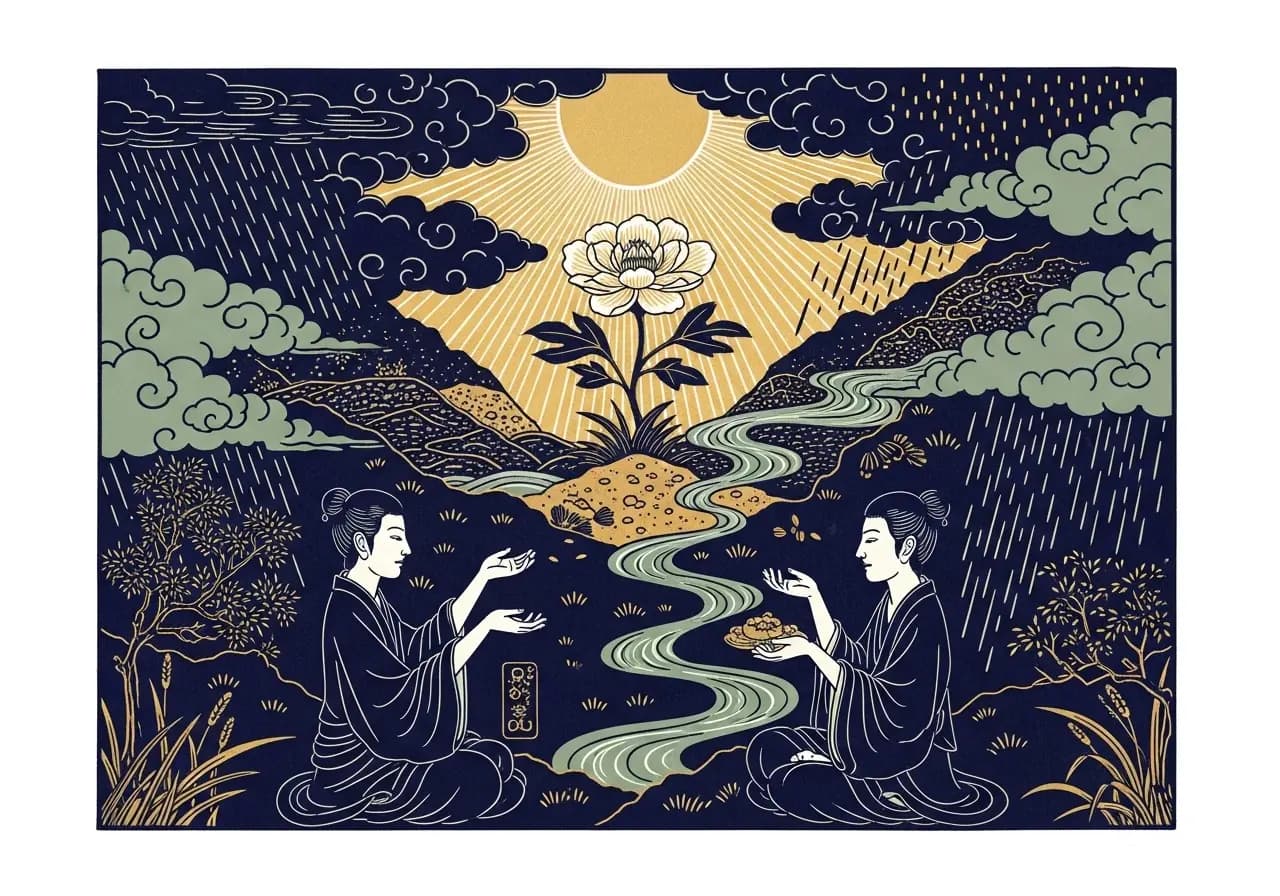
In speaking about this deep understanding of interdependence, or "inter-being," as Thích Nhất Hạnh calls it, he says, "We have never really seen the flower until we have seen all of the non-flower elements that make up the flower. To see the flower mindfully, we must also see the sun, the clouds, the rain, the soil, and the countless processes that allow that flower to be a flower."
I think of each of these interdependent processes—giving and receiving—in a very non-attached way. The sun gives its rays, it gives its heat, and the flower receives them. It doesn't take; it receives. And the sun doesn't need to get anything in return for giving off its heat.
This is what the Buddha taught. He said that "generosity should be measured by the level of attachment one has to what is being given and to the attachment one has to the self that is giving it." I think once you've realized that the self and all of its possessions are impermanent, then you have a deep understanding of non-attachment. And non-attachment is perfect generosity.
This is why the practice of generosity is so highly encouraged in the Buddhist tradition. I think from the Buddhist perspective, the art of giving is not so much about the gift that is being given. It's about seeing our natural clinging to the act of giving and renouncing our habitual clinging.
Bringing It All Together
So, think about that. How about you? What does giving and receiving mean to you? In what ways do you practice giving and receiving? Have you experienced that from the perspective of non-attachment? How would that look to you? How can we get better at allowing ourselves to receive from others? I know that's hard for us in our culture, in the Western mindset. But I would invite you to pause this weekend and think about that.
Not only how we can be better at receiving, but also pause and see in how many ways you're receiving already that you're not even aware of—ways you've never even stopped to think about. And when we notice that, what is the natural outcome that comes of it? It should be a form of gratitude and a form of humility when we understand just how much we are constantly receiving from others.
I'd love to hear your thoughts in the comments on our Facebook page or in the Facebook group about this topic—the art of giving and receiving.
Closing
That's all I have for this week. As a reminder, if you enjoy this podcast, please share it with others, write a review, and give it a rating in iTunes. If you're in a position to be able to, I would really appreciate it if you could consider making a one-time donation or becoming a monthly contributor to the podcast. You can do that by visiting secularbuddhism.com and clicking on the "Donate" button at the top of the webpage.
That's all I have for now, but I look forward to recording another podcast episode soon. Until next time.
For more about the Secular Buddhism podcast and Noah Rasheta's work, visit secularbuddhism.com