

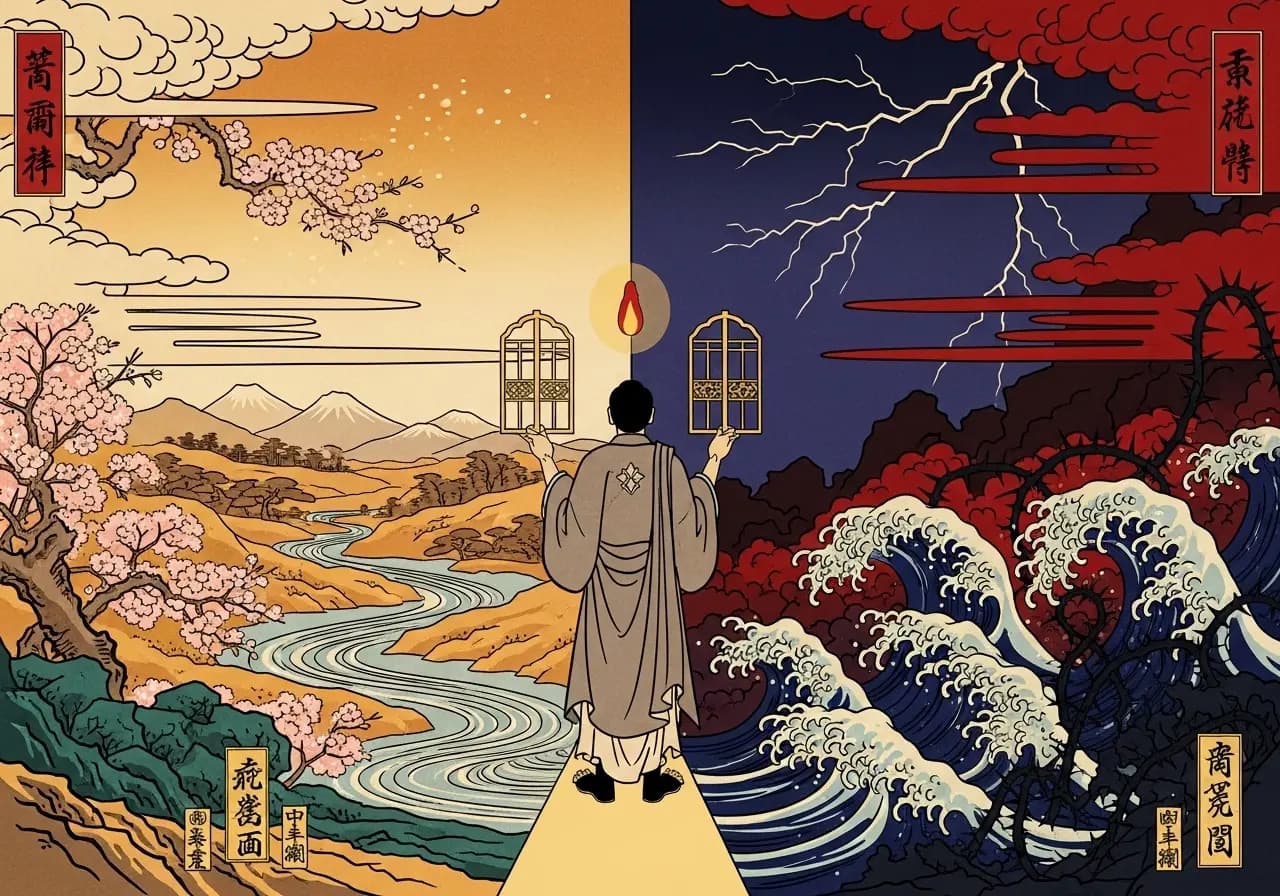
Heaven and Hell—Here and Now
Episode 33 of the Secular Buddhism Podcast
Hello. You are listening to the Secular Buddhism podcast, and this is episode number 33. I'm your host, Noah Rasheta, and today I'm talking about heaven and hell. Let's get started.
Welcome
Welcome back to the Secular Buddhism podcast. This is a weekly podcast that focuses on Buddhist concepts, topics, and teachings presented for a secular-minded audience. The Dalai Lama has said, "Do not try to use what you learn from Buddhism to be a Buddhist. Use it to be a better whatever you already are."
If you're new to secular Buddhism or you're interested in learning more, check out my book Secular Buddhism: Eastern Thought for Western Minds. It's available as a paperback on Amazon, as an eBook on Kindle and Apple Books, and as an audiobook on Audible. For more information and links to all the book versions, visit secularbuddhism.com.
Let's Jump In
All right, so let's jump into this week's topic. Over the last couple of weeks, I've been reading a book on Zen koans by Gyome Kubose. It's been a fascinating experience to become familiar with Zen koans. On the website Elephant Journal, it talks about koans and says, "The koan serves as a surgical tool used to cut into and then break through the mind of the practitioner. Koans aren't just puzzles that your mind figures out suddenly and proclaims, 'Aha, the answer is three.' They wait for you to open enough to allow the space necessary for them to enter into your depths—the inner regions beyond knowing."
Essentially, what that means is that a koan is meant to help us break out of the conceptual way of thinking and into more of an experiential understanding of a specific topic. The specific koan that I read this week really resonated with me, stuck with me, and I decided I wanted to share it in this podcast episode. It's called the Gate of Paradise.
The Gate of Paradise
A soldier comes to visit a famous Zen master named Hakuin. The soldier asks, "Is there really a heaven and a hell?" The Zen master replies, "Who are you?" The soldier says, "I am a samurai." "You? A samurai? What kind of lord would have you as his guard? You look like a beggar."
The soldier starts to get angry, becomes so enraged that he's about to draw his sword. The Zen master continues, "Oh, so you have a sword. It's probably too dull to even cut my head." At this point, the soldier is indignant and he brandishes his sword. The Zen master says, "Here. Open the gates of hell."
The soldier immediately recognizes the wisdom in those words and puts his sword away. The Zen master says, "Here, open the gates of heaven."
It's a short story that conveys the Buddhist understanding of heaven and hell. I love the way the Zen master does this because rather than answering the question, he shows the soldier these states. He induces them into the very mind of the questioner. Rather than having a theoretical discussion about what heaven or hell is, he's showing him the reality in that moment by allowing the soldier to experience his anger, turning it almost into hatred. When the soldier realizes what he's doing, he instantly sheathes his sword—he's able to control his anger. And that's the experiential understanding of what it is to be in heaven: to be able to control your emotions and respond rather than react.
Heaven and Hell as States
Gyomay Kubose, in his book, goes on to say about this koan that heaven and hell are the contents of our everyday life. Here we have this neat little story that does a really good job of helping us understand that heaven and hell are here and now. These are states that we experience in the present moment. Furthermore, we are the gatekeepers of the gate to heaven or the gate to hell.
I've thought about this many times when I felt just like that soldier. Every time I've felt that way, it was my ego that was being offended, hurt, criticized, or questioned. I love knowing that I myself am the gatekeeper of my own paradise and my own hell.
What's interesting is that when I think about instances in my life when I felt like that soldier, every single one without exception that I've been able to recall is an instance where my ego is on the line. It's the ego that is so sensitive to being criticized. When someone questions who we are—like the Zen master asking "Who are you?"—the ego responds with "Who are you to question me?" It's when the ego self is attacked that way that we instantly start to experience what in this koan is described as that sense of hell.
The Ego and Our Reactions
I often bring up the example of getting cut off by a car because it's something we've all experienced. If you think about it, in that moment, what makes it so frustrating usually has nothing to do with time. We might think it does, but honestly, when I evaluate myself in this example, I don't think we're thinking, "Hey, you just robbed me of five seconds." We know we can make up that time by increasing our speed for the next minute or something.
What's really happening is something more like, "How dare you do that to me? Don't you know that I'm an important person and you shouldn't just be cutting me off? Because I'm me. I'm right here. What are you doing?" It's an attack on me—the ego me—not just the me that's driving along.
When that ego is removed, you start to look at a scenario like that and ask, "What is there even to be offended at?" I got slowed down. It doesn't matter if it was a person, a tree that fell, or an animal that got in the road. The results in all those scenarios would be the same. I had to stomp on my brakes or swerve, and now I'm five seconds behind the schedule I was on.
But when it's a person, this is an attack on what I perceive as my ego, my self, my sense of self. That's what makes it so difficult to work with in these scenarios. I think that's probably what the soldier was experiencing—an attack on his ego. And I think that's what made it so quick to open the gates of hell.
I'd invite you to take a minute and think about instances in your life when you felt like this soldier. When you felt any form of anger that's at risk of turning into hatred, see if you can pinpoint in what way the ego is attached to that story. Is the ego the culprit of feeling so hurt, offended, or criticized? Like me, you might find that the ego is what's attached there—the common denominator in these instances.
We've all experienced anger. And you've probably also heard the expression often attributed to the Buddha—though it's not an actual quote from him: "Holding onto anger is like grasping a hot coal with the intent of throwing it at someone else. You are the only one that gets burned."
The Burning Ember
The expression actually comes from a monk named Buddhaghoṣa. He was discussing anger and said, "By doing this you are like a man who wants to hit another and picks up a burning ember or excrement in his hand and so first burns himself or makes himself stink."
I like Buddhaghoṣa's version because it's easy for us to imagine somebody right there next to us holding a hot coal, waiting to throw it at someone. The burning ember. But it's hard to see how that really affects me. If you're standing right next to me, holding this coal because you're angry at someone and you're waiting to throw it at them, I could be looking at that scenario and thinking, "Well, that's unfortunate. You're burning your hand. You know, if you would just let go of that, it would stop hurting."
But I like Buddhaghoṣa's version because he mentions not just the burning ember, but also excrement—and how he makes himself stink. That to me is a little more indicative of what it's like when someone is around me who's experiencing this type of anger they're holding onto. The stink that he talks about affects the people around you. I think we all know someone like this—someone who's holding onto anger, who's vengeful, or whose anger makes them difficult to be around. In the same way it would be uncomfortable being around someone who smells of excrement, you'd say, "That's affecting me now because I'm standing too close to you."
I think anger can cause a similar aversion. You find yourself thinking, "I don't want to be around this person because they're not pleasant to be around"—in the same way it wouldn't be pleasant to be around someone who's stinky. I kind of like that correlation. The ember burns me if I'm holding it, but I'm also the stinky one if I'm holding onto it. Others around me are going to start noticing that, and they may not want to be around me so much.
Don't pick up the burning ember. Don't pick up the excrement and make yourself stinky. Now, sure, this is a lot easier said than done. But how do we go about actually not doing it? That's the tricky part. I think this is where it becomes a matter of introspection for you. How do you drop that coal, that burning ember, that excrement? That's for you to decide. I think that's kind of the point of this koan.
Opening the Gates
The soldier was able to experience what it felt like to sheath the sword, to put it back and say, "Huh. I'm not going to allow myself to go that far." That's when the Zen master says, "Here, open the gates of heaven." Because the soldier was noticing, "Wow, I have the ability to calm myself down and not want to chop your head off. I'm putting the sword away and that's the start of it. That's the gate."
You are the gatekeeper of your own heaven or hell. That to me is the essence of what's being taught here. Now, that can only be experienced by you. You know when you're in one place or when you're in the other. It's not about someone telling you, "You should feel this way or you should feel that way," because then you could just pretend. But pretending doesn't get you there. I could pretend I'm no longer in this state of hell, that I'm putting myself in a state of heaven, and pretend all I want, but if I'm not actually there, I'm not actually there.
That's what this koan is trying to get us to experience in a very experiential way: we know when we're in one state or the other, but only we know.
The answer to how we actually get there? To me, that's the part of the koan that's for you to figure out. I think meditation plays a big part here. We talk about this often with the whole premise of mindfulness: creating that space between stimulus and reaction. That space is where we have the freedom to decide, "Here's the trigger, but I choose how to react. I'm not going to allow my habitual reactivity to put me in a state of anger that puts me at risk of experiencing hatred because that's entering my own hell."
You know, what mindfulness allows us to do is have a greater sense of understanding of what's happening and to remove the ego from that equation. At that point, like we say, "No self, no problem," right? If I can remove my ego from that equation, then what is there even to be offended by?
The Practice of Introspection
You could call me whatever you want to call me, and I'm not going to respond to it. Not because I'm pretending and saying, "Huh, that didn't bother me." If it's bothering you, it's bothering you. Rather than pretending it's not, that's where you want to get very introspective and say, "How interesting. This is really affecting me. Why? Why does it affect me if somebody calls me this? Or if somebody does that?" That's for you to analyze and become introspective with.
I think the threefold mindfulness meditation is a powerful technique to do that. My question for you—and a question for myself—is, "What gates are we opening today? What gates are open right now?"
Only you know where you stand, and only you have the keys to open and close the gates to heaven and hell.
I like a quote by Pema Chödrön who says, "The most difficult times for many of us are the ones we give ourselves." Isn't that the truth? I think about that a lot. When I look at the difficult times I've experienced, not all of them, but many of them I can look at and say, "Huh. In what way have I given myself these difficult times?" Now, this isn't always the case, but in many instances it is. I like to imagine now that, knowing I'm the gatekeeper and I hold the keys, the responsibility is on me. Rather than blaming circumstances or blaming specific people, I'm the one who decides when I'm going to open and walk through the gates of heaven or the gates of hell.
A Personal Reflection
That's my invitation to you with this koan. Like the Zen master who allows the questioner to experience in a very experiential way what heaven and hell actually are, I ask you: Is there really a heaven and hell? I'm sure you know the answer because you've been in both. You've experienced both at one time or another.
What caused you to feel in one versus the other? What I've found, again for me personally, is that when the ego is not attached, those are the moments I would equate to being in heaven. These are moments where you're kind of in a state of flow almost, or suddenly it's not about me. It's about something greater than me. Holding a newborn, doing humanitarian work, doing something that puts me beyond just me—these are moments where you experience joy, happiness, and contentment in a way that has to be because the ego has been so detached in those moments. It's not about me.
The moments where I feel the opposite—what I would equate to hellish moments—every single one that I've analyzed, I've concluded it's because the ego was very attached to that moment. The suffering coming from it was almost a direct attack on the ego itself. "How could this person have done this to me? Don't they know who I am? How dare you call me that or cut me off?" Me or mine always fits in nicely with these scenarios of hellish moments or hell.
Closing Thoughts
Those are the thoughts I wanted to share with you. I think this is kind of a shorter episode, but I wanted to make sure I shared something this week. Again, ask yourself, "In what way am I the gatekeeper to my own heaven, to my own hell?" When you're experiencing these moments in day-to-day living, see if you can create that pause between stimulus and reaction. Oftentimes, it's right after the reaction that you can pause and say, "Oh, that's what I just did." But that's still good, because noticing that you've noticed is a form of awareness.
Ask yourself these questions about the moments of heaven or hell that happen in the here and now, in the present moment: What are they for me? How do I experience one? Why do I experience the other? Be introspective with it. What are the causes of these moments? What am I feeling in this state or that state?
See what you can find. This koan is here for you to get introspective and to find the answer yourself.
Something I wanted to end with in this podcast episode that I really enjoyed is a statement of intent rendered by Sharon Salzberg. She's a Buddhist teacher and does a lot of writing for Lion's Roar. I can't remember exactly where I came across this, but it's a statement of intent—kind of a thought that you keep with you. Rather than having a form of prayer, Buddhist practice usually involves something like a statement of intent. It's kind of internal, a reminder of what I'm doing or why I'm doing it. This statement of intent, she says:
"May the actions that I take toward the good, toward understanding myself, toward being more peaceful be a benefit to all beings everywhere."
I really like that, so I wanted to share it with you.
As always, if you enjoy this podcast, please feel free to share it with others. Write a review or give it a rating on iTunes. And of course, if you're in a position to be able to, I would appreciate it if you could consider making a one-time donation or becoming a monthly contributor to the podcast by visiting secularbuddhism.com and clicking on the donate button at the top of the webpage.
That's all I have for this week. I look forward to recording another episode next week. Until next time.
For more about the Secular Buddhism podcast and Noah Rasheta's work, visit SecularBuddhism.com