

The Fear of Uncertainty
Episode 31 of the Secular Buddhism Podcast
Hello. You are listening to the Secular Buddhism podcast, and this is episode number 31. I'm your host, Noah Rasheta, and today I'm talking about dealing with the fear of uncertainty.
Welcome
Welcome back to the Secular Buddhism podcast, a weekly podcast that focuses on Buddhist concepts, topics, and teachings presented for a secular-minded audience. The Dalai Lama has said, "Do not try to use what you learn from Buddhism to be a Buddhist. Use it to be a better whatever you already are."
Before I jump into this week's topic, I'm excited to announce that a book I've been working on for the last year or so is finally available for purchase on Amazon, iTunes, and Audible.com in several different formats.
I've been working on this book specifically to serve as an introduction to Buddhist thought. I wanted to make it easy for people to go to one source—this book—and learn all the basic concepts pertaining to Buddhist philosophy. The idea is that you can take these concepts, read or listen to the book, and gain a much easier understanding of Buddhist thought. If you're interested in learning more about Buddhism, this would be a great place to start for an introduction and foundational understanding of Buddhist philosophy. And I think it'll make all the topics discussed in these podcasts a little bit more relevant and make more sense because you'll understand the background and the overall worldview behind these teachings.
If you're interested, check out SecularBuddhism.com, scroll down to where it says "Read the book," and click on "Learn more." You'll see various formats available: the e-book, paperback, audiobook, iTunes version, and even a PDF. I'd appreciate your support in getting one of these books, and it's a great place to start with all of this. If you have any questions, feel free to reach out to me. I'm excited to finally have this book available. A lot of you have been waiting for something that would serve as a foundational presentation on overall Buddhist thought, so here it is.
Let's Jump Into This Week's Topic
Now, let's jump into this week's topic: dealing with the fear of uncertainty. I've recently had several podcast listeners reach out to me asking me to talk about this topic—specifically about learning to cope with the fear that arises from uncertainty.
So, why do we fear uncertainty? Well, our brains are essentially hardwired to react with fear to uncertainty. In a recent neurological study, a Caltech researcher took images of people's brains as they were forced to make increasingly uncertain bets. The less information the subjects had to go on, the more irrational and erratic their decisions became. You might think the opposite would be true—that with less information, we'd be more careful and rational in evaluating what we know. But oddly enough, that's not what happens.
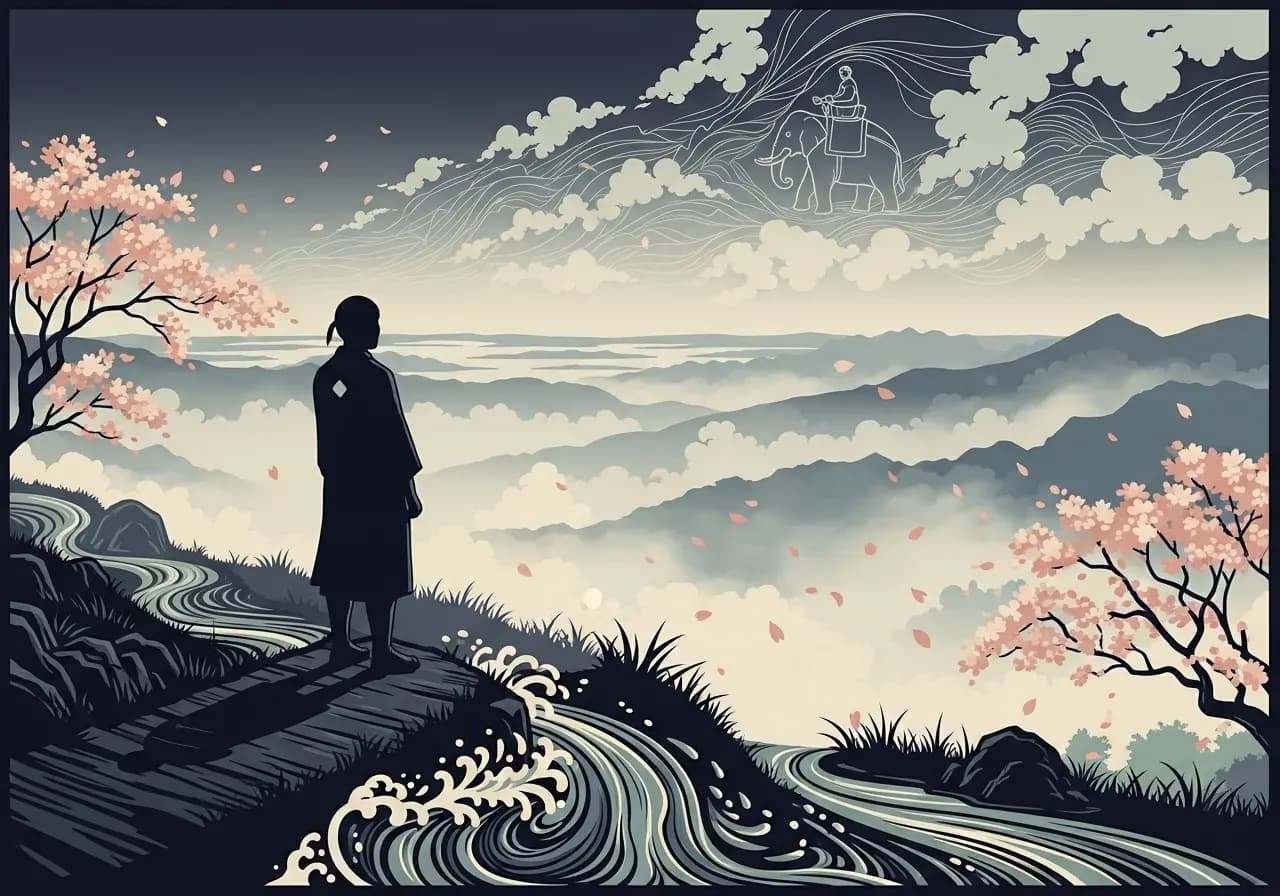
As the uncertainty of the scenarios increased, the subjects' brains shifted control over to the limbic system—the place where emotions such as anxiety and fear are generated. Uncertainty seems to trigger a battle of sorts between the rational brain and the emotional brain, the rider and the elephant, as we might say.
I can imagine how this was once an evolutionary survival tactic. Picture our early ancestors venturing into an unknown, dark cave and immediately feeling that sense of fear and caution, with their senses heightened because death might be just around the corner. The problem is that in our day and age, rarely does uncertainty mean our lives are on the line. Yet we're hardwired to feel this way because it's a survival mechanism.
So as we face uncertainty, our brains push us to overreact. That's normal. The question is: how do we work with that? And is it possible to move beyond fearing change? Can we learn to relish and even welcome uncertainty?
Understanding the Rider and the Elephant
I think the key lies in understanding the relationship between the rational brain and the emotional brain—the rider and the elephant. This is a behavioral psychology mental model originally presented by psychologist Jonathan Haidt in his book The Happiness Hypothesis. He argues that humans have two sides: an emotional side that's automatic and irrational—this is the elephant—and an analytical side that's controlled and rational—the rider.
According to this model, the rider is rational and tries to plan ahead, while the elephant is irrational and driven by emotion and instinct. Uncertainty causes the rider to panic, and then the elephant takes over essentially.
From the Buddhist perspective, the elephant could also represent our habitual reactivity—that knee-jerk reaction that comes with encountering uncertainty. Taming the elephant isn't about eliminating those reactions. It's more about how quickly the rider, or the rational mind, can regain and maintain control when the emotional mind is trying to take over.
The Wisdom of Adaptability
So let me talk about this from the perspective of the wisdom of adaptability. It seems that the more resistant we are to accepting change, the more we suffer. Change can be painful, and perhaps that's why we're so anxious about uncertainty.
In fact, Thich Nhat Hanh says, "People have a hard time letting go of their suffering out of fear of the unknown. They prefer suffering that is familiar." I think that's a fascinating thought. Our fear of the unknown—our fear of uncertainty—could cause us to prefer the suffering we're experiencing in an environment that's familiar. Because what's familiar is so much safer than the unknown, and even though we suffer more in that familiar space, we just stay there.
There's a video I shared quite a while back on Facebook—it's been shared by many people—of a little boy in the water, floating on his back while hanging onto a rope. He's crying and panicking as if he's about to drown. Then the mom (or somebody) walks into the frame, grabs his legs, and puts them down so he can realize how shallow the water is. He stands up, and the water is only to his waist or less. Of course, he immediately stops crying. The video circulated as a meme saying something like "When you overthink, this is what overthinking looks like."
I think that's a nice visual representation of this concept: we prefer to stay suffering in a state that's familiar. In this case, floating on your back thinking "I'm about to drown"—that's still familiar. It's full of suffering, but what's even scarier is the thought of lowering your feet and wondering, "What if I really can't stand there?" That fear of uncertainty could prevent you from lowering your feet when, in this specific case, the reality is simply shallow water.
Now, I don't think the point here is to highlight that life is always better than you're expecting, or that it's always shallow. That's not the point. The point is that the suffering was there whether or not it was shallow. There's only one way to know. You have to relax, put your feet down, and find out.
The Paradox of Worrying
There's an expression I really like around this thought that comes from the Tibetan poet Shantideva. He says, "If the problem can be solved, why worry? And if the problem can't be solved, then worrying will do you no good."
I really like that because, truly, what's the point of worrying? If you can solve it, then start doing—start focusing on how to solve it. But if it can't be solved, then again, why worry? Nothing can be done about it.
I have a good friend of mine—a foreign exchange student who was living with us last year. He was talking to me earlier today about an incident he had while filming video files for a YouTube video. When he moved the files over to his computer and started working with them, he accidentally deleted the files he needed. He wiped the hard drive trying to clean things up, and then tried to recover the files with software, but it didn't work. It was a really stressful situation—hours of footage lost, unable to recover it.
What was interesting is that when he told me the story later, he was surprised with how quickly he found contentment in that situation. He was getting really frustrated until he just accepted, "Well, I can't do anything about it." And it was in that moment that he started to feel contentment. I imagine that contentment was directly correlated with how quickly he was able to accept what was and adapt to that new reality he was facing.
The Illusion of Control
I think part of why we fear uncertainty is because we get caught up in this game of thinking we can actually control life as it unfolds. This illusion of control happens because sometimes we do control parts of what's happening. And I think that makes us forget that we actually don't control it at all. Sickness, old age, death, and so many other things come along to remind us that we are simply not in control.
Think about this: the problem isn't that there is uncertainty in life. The problem is that we're not okay with the uncertainty that there is in life. Those are two very different things. I think that's why we fear it—not because it's there, but because we don't like that it's there. And the crazy irony in all of this is that uncertainty is the only certainty. It's always going to be there. There's no getting rid of it.
So you could ask yourself: "What would my life be like if I was okay with the uncertainty of it all? What would that look like?"
A Practical Example: Choosing a School
I had another podcast listener reach out to me. In fact, it was earlier today that I was reading her email. She was concerned about upcoming decisions regarding schooling—having to pick the right school. This is another example of uncertainty. She wanted to get the right choice, and the fear of uncertainty was, "How can I ensure that I pick the right school?" Or perhaps even more deeply, "How can I ensure I don't pick the wrong school?"
To me, both of those scenarios are really about the same thing: "I don't know what's going to happen once I pick, and that uncertainty is scaring me." But what if it's not about right or wrong? What if there isn't a right or wrong pick? It's only going to be right or wrong based on perspective, right? Because I could pick a school and at some point in the future look back and say, "Well, my life worked out this way, therefore I must have picked the right school." Or I could look back and say, "I'm not happy with where my life is, I must have picked the wrong school."
Both of those interpretations could be inaccurate because it's all going to be based on perspective anyway.
Faith as Comfort with Uncertainty
Alan Watts talks about how faith is an attitude of being open to whatever might be. To me, this implies that rather than having faith in making the right decision, I'm placing my faith in my ability to wisely adapt to whichever choice I end up making. Because in this sense, faith isn't about trying to eliminate uncertainty. It's about being comfortable with uncertainty. You could almost say that faith is synonymous with uncertainty.
Applying this to the school scenario: the fear of uncertainty can be minimized by increasing the faith I have in myself to be able to adapt to whichever decision I end up making. I hope that makes sense.
Impermanence and the Uncertain Future
Buddhism teaches that all things are impermanent. This means that all things are continually changing, and this implies that all things are going to be uncertain because they're always changing. This impermanence is the permanence of an uncertain future. So fear of an uncertain future affects our quality of life in the present moment.
I experience this all the time as a business owner. Uncertainty is scary, but it's also unavoidable. And one of the things I've done in my own life is to try to focus on developing my ability to adapt. Because the quicker I can adapt, the better things go.
For example, I've had multiple deals I've been working on over the past several years with my business. I manufacture photography accessories, and I sell my products to various chains and stores throughout the world. AT&T Wireless was one of my customers, selling one of my products in their stores. Then one day, out of the blue, after I think six or seven months of working with them, they decided to recall one of the products we manufacture. When they do something like that, contractually, you just have to take everything back.
So out of the blue, I get a call that thousands and thousands of a certain tripod—a product we make—were going to be sent back to me. It was devastating because a lot of money had been invested into manufacturing those products, and they were all out there in the market. Having them pulled that way meant I had to take them all back, and I had nowhere to sell them because AT&T was the ones selling them.
Immediately, this produced a high level of uncertainty. What's going to happen with these products? What's going to happen with the purchase orders they had placed that they owe me? I'm not going to get that money now. How am I going to pay for all the manufacturing costs I had incurred? Right out of the gates, it was a lot of uncertainty, and it was really scary.
But what I found for myself in this experience was the ability to quickly adapt to the new set of circumstances. I think sometimes the suffering that can come with a scenario like that isn't accepting the new scenario. It's like you've just been dealt a new hand of cards and you don't want to accept it. You're like, "No, this isn't fair. This can't be happening." Sure, I could have experienced all that, but it doesn't help because the reality is there's a new reality now. Before the call, there was a whole different reality. Then that call comes in and everything changes in that instant. And this is where the wisdom of adaptability kicks in. It's about how quickly you can adapt to the new set of events as they unfold—the new reality that's constantly changing.
Life as a Game of Tetris
This is why I like to compare life to a game of Tetris. Because that's kind of the point—it's constantly changing. You're always getting a new shape, and you're always adapting your gameplay to the new reality that's constantly unfolding in front of you. I think one way to combat the fear of uncertainty is to increase your ability to adapt as the game unfolds.
I think there's always going to be fear of uncertainty. The point isn't to get rid of that fear. I think the point is to become comfortable with it and recognize, "Well, that's natural. The fear of uncertainty is natural, so I'm going to move past it quicker because I don't have to get frozen in that fear."
The Role of Meditation
I think meditation plays an important part here. In a way, meditation is the practice of becoming comfortable with this discomfort. Our quality of life in the present moment goes up as we become more comfortable with uncertainty. And I think that this is practiced directly when we're meditating.
If you think about it, the whole point of meditation is to practice being with what is. It's not to change reality. It's to become comfortable with reality. And if uncertainty is reality, then meditation is a great place to practice being comfortable with that uncertainty.
I'm going to address in a different podcast a whole method—a whole set of techniques built around the idea of using meditation as a tool. So I'll address that probably in next week's or the following week's podcast. There will be an episode specific to meditation and working with it in this way.
Final Thoughts on Uncertainty
I want to share a couple of final thoughts on this topic.
First, we need to stop trying to have certainty in life. Remember the game of Tetris? The point is that you don't know what's coming next. That's the whole point of the game. What you can practice is just observing. If you're playing Tetris, you're not trying to figure out how to anticipate what the next five pieces are. You could rack your brain trying to figure that out, but you'll never figure it out. Because that's the whole point of the game—you don't know.
So what if you could practice just getting into that mode of observing? When it comes to fear of uncertainty, don't judge the fear. Just observe it. Don't over-identify with the emotions you experience because, remember, you're not your emotions. Rather than seeing fear as "Uh-oh, I am afraid," think of it as "I am experiencing fear." Create that little bit of separation between you and your emotions because you're not your emotions.
Second, learn to just go with the flow. Be like water. Think of how water adapts immediately to anything and everything. To me, water is the ultimate expression of the wisdom of adaptability. Because it's in the fact that water can adapt to anything that water has the power to change anything. Water in the form of a river flows through a canyon and adapts to whatever the path needs to be for it to flow. And at the same time, water is what's carving that path. So the strength of water is found in its adaptability.
We can go through life in that same way. We can be like water. We can adapt to the circumstances around us, and at the same time, shape those circumstances. But we're shaping them because we are adapting to them.
That's the paradox, and I think it's the paradox that sums up this topic of the fear of uncertainty. There's no need to fear it because uncertainty is the only certainty out there. It's just what is. And the sooner we can accept that and be with that, we can go with the flow and use uncertainty as part of our strategy of playing the game—a lot like playing Tetris.
Realize that the whole point of the game is that you don't know what's coming next. That's the point of the game. So think about that and ask yourself: "What would life start to look like for me if I didn't have that fear of uncertainty? What if I was okay with uncertainty because now I understand that uncertainty is part of the game?"
Like my friend that I mentioned earlier, when circumstances unfold, the quicker you can adapt to those circumstances and accept them. Using Shantideva's wisdom: "If you can do something about it, then why worry? If you can't do something about it, then why worry?" In both scenarios, why worry? What would life look like?
Keep that in mind. And as I said, I will add to this discussion in a future podcast episode. But this is all I have for now.
Thank you for listening, and thank you for supporting the podcast and for being listeners. Thank you for supporting the book if you end up getting it, and for using it as a foundational understanding of Buddhist philosophy. And just in general, this is a week to be thankful—this is Thanksgiving week. I'm just thankful for all of you and for your support and for being a part of this journey with me.
So thank you, and until next time.
For more about the Secular Buddhism podcast and Noah Rasheta's work, visit SecularBuddhism.com