

Secular Buddhism Podcast
Episode 3: Seeing Through the I's of Wisdom
Host: Noah Rasheta
Hello, you are listening to the Secular Buddhism Podcast. This is episode three, and I'm your host Noah Rasheta. Today we're talking about "Seeing Through the I's of Wisdom," so let's get started.
Hey guys, welcome to the Secular Buddhism Podcast. If this is your first time listening, thank you for joining us. SecularBuddhism.com is my website and blog, and this is the podcast that goes along with it. The Secular Buddhism Podcast is produced every week and covers major philosophical topics within Buddhism. I also plan on interviewing other guests, authors, teachers, and really anyone who is interested in philosophy, secularism, humanism, and Buddhism.
I'd like to start this podcast with a piece of advice from Tenzin Gyatso, the 14th Dalai Lama, where he says, "Do not try to use what you learn from Buddhism to be a Buddhist. Use it to be a better whatever you already are." Please keep this in mind as you listen and learn about the topics and concepts discussed in this podcast episode.
Come back often, and feel free to add the podcast to your favorite RSS feed or iTunes. You can also follow me on Twitter or Facebook—the username is Noah Rasheta. Or visit my website at www.SecularBuddhism.com. Any links mentioned in the show will be available in the show notes.
Now let's dive into this week's topic. In the last podcast episode, we talked about the nature of suffering, specifically the Four Noble Truths that were taught by the Buddha at Deer Park. This was his first major sermon. In this sermon, he discussed what is commonly known as the Four Noble Truths. In essence: number one, the truth of suffering—that there is suffering in life. Number two, the truth of the cause of suffering. Number three, the truth of the end of suffering. And the fourth one is the truth of the path that frees us from suffering. That's what we're going to be talking about today.
I gave this episode the title of "Seeing Through the I's of Wisdom." This is the letter "I," not the two eyes we see, but that's a play on words.
The reason this episode is called "Seeing Through the I's of Wisdom" is because of the importance of interdependence and impermanence. We exist in the plane of space and time, right? So when it comes to space, we say that things are interdependent—everything is connected to everything. Everything that exists has causes and conditions that allow it to exist. And on the plane of time, we say things are impermanent because everything is constantly changing and nothing remains permanent or stays the same. So understanding these two concepts—interdependence and impermanence—is the key to the right perspective, or the wise perspective, of how we should be living.
Emptiness: The Central Teaching
I want to start talking about the topic of emptiness. This is a central teaching in Buddhism, and yet it's often misunderstood. Emptiness does not mean nothingness. The proper understanding of emptiness is so important that the great Buddhist philosopher and poet Nagarjuna wrote, "Emptiness wrongly grasped is like picking up a poisonous snake by the wrong end." And that's why I want to make sure this is very clearly understood.
According to Buddhist teachings, things—and that means all things—have no intrinsic existence of their own. Everything comes into being because of causes and conditions. In some Buddhist traditions, this is called dependent origination. So things have no existence of their own and are empty of a permanent self. When we're talking about emptiness here, we're talking about things being empty of an intrinsic identity or a meaning on their own. What I'm saying is things only exist because of their interdependence on other things.
The Table and the Cake
Let me give you a few examples. You can take a look at anything and break it down to its causes and conditions. For example, the table in your kitchen. It exists because of the materials and processes that make it a table—the causes and conditions. It wouldn't be a table without wood, nails, glue, the hands of a carpenter, a hammer, staples, the person who invented the hammer, and so on and on and on. And then you can break each of those down, and you'll realize the glue is a combination of ingredients, a person who invented glue, the people who made the person who invented glue, the smith that forged the shape of the head of the hammer or the staples. And then you can break each of those down, and what you'll find is that there is a virtually infinite combination of causes and conditions that allow your table to exist as a table. And yet your table cannot exist without the causes and conditions that allow it to exist.
Another example: imagine a cake. You know, when we think of a cake, it's just this thing. There's a cake, it's on the table, I'm going to eat it. The cake is a real thing, and yet the cake does not exist as an intrinsic thing. It only exists as the culmination of all things that make it a cake—eggs, flour, sugar, heat, an oven, a baker, etc. You can analyze anything and you can come to the same conclusion: things only come into being as the result of their causes and conditions, and those causes and conditions have their own causes and conditions, and that goes on and on and on.
Understanding Interdependence
Which leads us to the major concept that we know of as interdependence. Comprehending and understanding emptiness will not lead us to something beyond this reality. It's what takes us right to the heart of what this reality is. Interdependence—because of what we just discussed—is the idea that everything is interconnected. We can conclude that nothing that exists, including you, including me, exists in and of itself without dependencies—these are the causes and conditions. Everything about us is in constant change, from the trillions of cells that make up our body to the multitude of processes that create thought, emotions, reactions, opinions, and beliefs. We are not static objects. We are works in progress, and we have mind-boggling complex processes that all depend on each other. So remember this: change is the only constant.
Plato's Allegory of the Cave
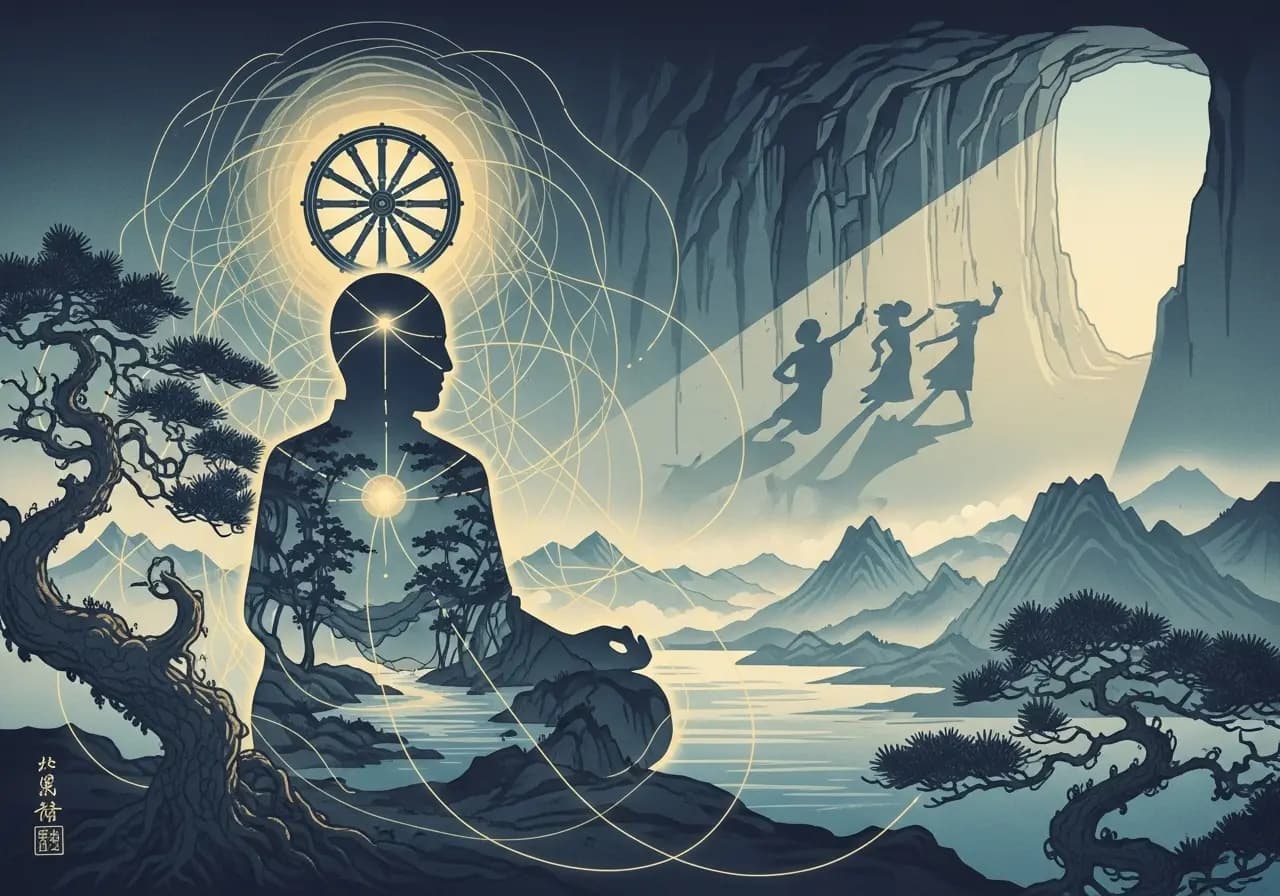
Another way of understanding interdependence or emptiness would be studying Plato's Allegory of the Cave. In Plato's Allegory of the Cave, we learn about some prisoners who have been trapped in a cave their whole lives. They've never seen the world outside of the cave. They are chained in such a way that they are facing the wall, and their backs are turned toward the entrance of the cave. Due to their positioning, they can occasionally see shadows on the cave wall—the shadows of things that are passing by the cave. They occasionally hear noises and they associate the sounds with the shadows they see. They only know the world through the shadows that they see on the cave wall.
One day, one of the prisoners escapes and leaves the cave. At first he can't see anything because it's too bright and he's blinded by the brightness. But over time his eyes adjust, and he can see things with much more clarity than before. For the first time, he's seeing things as they really are. From that moment on, he understands the shadow of a thing is not the same as the thing itself.
Elated with his new understanding of the world, he returns to the cave to tell his friends all about what he's seen. But to his surprise, they don't believe him. It's not that they don't want to believe, but they literally can't believe him. You see, they only know the world through the shadows, and they've never experienced life in any other way. Enlightenment is seeing the world the way it really is. It can't be fully grasped by explanation. It has to be experienced, and only then can it truly be understood.
The Car: Breaking Down the Illusion
Another example to help us understand interdependence and its logical conclusion of emptiness would be to think of something like a car. If you were to take your car outside right now and disassemble it into every piece that you can fully disassemble it to, and it's there in the driveway and you're looking at it, and if I were to ask you, "Well, what is the car?"—which of those pieces would you pick out and say, "This right here, this is the car"?
You'll notice there's an engine, a hood, a steering wheel, a wheel, all of the individual parts. You wouldn't be able to pick a single one and say, "This here is the car," because the car is a concept. It's a thing that only exists because of all the things that make the car a car. And what's interesting is you can't take a car and remove one item—you know, remove the engine—and say, "Now it's not a car." It's still a car. It's a car without an engine. You can't point at the engine and say, "The engine is the car." No, that's the engine.
So then, what is the car? This becomes very interesting because you can do this with anything. And what you'll realize is anything that exists only exists as a culmination of all the causes and conditions that make that thing exist. This includes us. This includes anything.
So back to the car. Furthermore, you can take the engine and you can say, "Well, then what is the engine?" Well, here it is—this block. But now take the engine apart. You'll see that you have a cylinder block, you have cables, you have a belt, you have all these things that went into making the engine, but none of them is the engine. So then you realize the engine is also empty. It's not a thing that exists in and of itself. It exists because of all the parts that make it exist.
Continue to break things down. Every single part of the car you can break down again and again and again, and you'll realize everything is made up of causes and conditions that allow that thing to be. But nothing exists in and of itself—everything is completely interdependent of everything that makes it exist.
Emptying Your Cup
Another way to explain the concept of emptiness comes from a Zen story commonly told in martial arts. It's called "Empty Your Cup." The story goes that there was a master trying to explain something to a student. The student wasn't brand new—he was a senior student who probably already knew many things. He had knowledge and experience to draw upon as he listened to this teaching of the master. But every time the master tried to explain something new to the student, the student would hold it up against his own notions and knowledge—the way he believed things ought to be—so he wasn't able to see the lessons the master was trying to teach him.
So finally, the master poured a full serving of tea into his cup and a full serving into the student's cup. He told the student that he wanted to give him some of the tea from his cup to the student's. So he starts pouring it from his cup into the student's cup, which was already full, and the tea from the master's cup just starts spilling and spilling all over the surface, all over the table. The student finally says, "Master, you can't pour anything into my cup because it's full. I need to empty it to make room for what you're trying to give me."
And the master says, "Yes, I know. And I can't give you any new thoughts, ideas, perspectives, or knowledge of any of life's lessons until you clear out the thoughts that are already full in your cup."
The master pauses for a brief moment and meets the eyes of the student with his own, and calmly says, "If you truly seek understanding, then first empty your cup."
The student ponders this for a moment, and then all of a sudden, he gets it. With that look of enlightenment, he smiles and says, "Okay, I'm ready to start learning."
The idea with this story is that we do the same thing. In life, we have our understanding of concepts, of the meanings of things, and we're like this teacup that's already full. Grasping the understanding of emptiness is realizing: okay, there's how life is, and then there's the story we've created of how life is. And as long as the story is there, there's no room to see how life is because it's already being taken up by the concept I have of what life is.
So seeing life through the eyes of wisdom could be compared to this concept of emptiness, or emptying your cup. It would be like saying, "Okay, I want to see everything from the fresh perspective of a beginner, assuming there's no preconceived concept or knowledge there that's going to prevent me from seeing life as it really is." So that's emptiness: learning to see with a beginner's mind, or learning to empty ourselves of the concepts that are already impeding us from seeing how it really is. Or, as in the example of Plato's Allegory of the Cave, you could say understanding emptiness is learning the shadow of the thing is not the same as the thing itself.
You know what I'm looking at in life are mere shadows. How do I go from seeing the shadow of the thing to seeing what it really is? You might not know because you've only ever seen life through the shadows. So the aim and goal of Buddhist philosophy again is to help us understand that we are seeing life as shadows, and if you can just have that radical shift in perspective, you can come to start seeing things as they really are. That is the essential goal of Buddhist philosophy, and that is this concept of seeing the world through the eyes of wisdom—the eye of impermanence and the eye of interdependence. That is how we start to see things as they really are.
Interbeing and Impermanence
So to note: any individual thing or person has no permanent fixed identity. Everything taken together is what Thích Nhất Hạnh calls inter-being. This term embraces the positive aspect of emptiness as it is lived and acted by a person of wisdom, with a sense of connection, compassion, and love.
Because all things are interdependent and in a constant state of change, all things must also be impermanent. So this is the second of the two "I's" of wisdom: impermanence. Everything is impermanent—jobs, relationships, the good times, the hard times, our loved ones, our own life. The lives of everyone we know. Everything.
The problem is that we know this, and yet we tend to cling to things as if they were permanent because we want things to last. When we truly understand impermanence, the less we cling to outcomes and expectations. Now that doesn't mean it's suddenly easy when we lose a job or a loved one. It just means that the recovery from suffering will go more smoothly when we learn to see things as they really are: impermanent.
Gross and Subtle Impermanence
The Buddhists define impermanence in two main categories: gross impermanence and subtle impermanence. Gross impermanence is our understanding that things die, we die, countries change, political ideas change. You know, this kind of impermanence we see all around us in the big things. Things arise, they endure for a while, and then things pass away.
The Buddha emphasized that gross impermanence is understood by what he called subtle impermanence. This is recognizing that things are changing constantly. For example, as I say this and as you listen, we are both physically undergoing change. The cells in our bodies are regenerating. That means the you that listened to what I said five seconds ago, in a physical way, is different than the you that is listening in this specific moment, five seconds later.
Think of the water in a river. It's continually flowing, and yet it's always just a river. Think of a fire from a candle. It's continually flickering, and therefore it's constantly a new fire, and yet we just see it and think, "Fire." From the time that we light it till the time that it's extinguished, we see it as this constant thing. It's just fire. But in reality, fire exists because it's continually changing. It's a new and ever-changing thing.
This concept of the river also applies when you're standing in the river. You're never standing in the same river twice because the water as it flows past you, you're continually in a new river.
The Buddha taught that we should think of ourselves and everything around us as sequences of momentary events, not as solid things. From the Buddhist lens, there are no things—there are only continuations of constantly changing phenomena.
So what is the goal or the benefit of seeing the world through the eyes of wisdom?
Freedom Through Perspective
Steven Bachelor mentions in his book "Buddhism Without Beliefs" that "as we become aware of all this, we can begin to assume greater responsibility for the course of our lives. Instead of clinging to habitual behavior and routines as a means to secure the sense of self, we realize the freedom to create who we are. Instead of being bewitched by impressions, we start to create them. Instead of taking ourselves so seriously, we discover the playful irony of a story that has never been told in quite this way before."
The Eightfold Path
The Eightfold Path is at the heart of Buddhist practice. The path is intended to be a guide for everyday life, and following in the path, we learn to see life as it really is. This path is depicted as a wheel with eight spokes because the path isn't linear and there's not a specific part of it that's more important than another. It's equal. So just as a wheel with eight spokes, all eight spokes would be equally important. In a lot of Buddhist traditions, you've probably seen the symbology of a wheel with spokes to represent Buddhism, and what that's showing is the symbology of the Eightfold Path.
Wise View
The eight points of the path are, first, wise view. Wise view means seeing the world as it is. What are your views of the world? Do you cling to your views? Wise view is probably the most important of all the aspects of the path because with the proper view, or with a wise view of the world, everything else will come naturally. All of the other aspects of the path come naturally.
I like to sum up the definition of wise view with an old parable called the Parable of the Horse. It goes like this:
"An old Chinese farmer lost his best stallion one day. His neighbor came around to express his regrets. But the farmer just said, 'Who knows what is good and what is bad?' The next day, the stallion returned, bringing with him three wild mares. The neighbor rushed back to celebrate with the farmer. But the old farmer simply said, 'Who knows what is good and what is bad?' The following day, the farmer's son fell from one of the wild mares while trying to break her in. The next day the army came to the farm to conscript the farmer's son for the war. But they found him injured and left him with his father. The neighbor thought to himself, 'Who knows what is good and what is bad?'"
What I love about this parable or this analogy is that we have two ways of viewing the world. One allows us to have a very open mind and accept things as they happen and work with them as they happen. The other scenario is that the moment things happen, we give them meaning. We assign meaning to things, and the moment we do that and decide what is good or what is bad, then we start to experience suffering around these events because as we deal with them, we have to make them fit into the understanding of whether or not it's a good thing or a bad thing.
Wise Intention
Wise intention means understanding what the true intentions are behind our actions. Our thoughts, words, and actions are all driven by intentions. For example, when our intentions stem from anger, fear, resentment, or greed, we are more likely to do harm with our thoughts, words, and actions. A great way to practice is to start asking ourselves questions about intent. For example: why am I thinking this? Or what is it that made me angry enough to pick up the remote and throw it? Once we're aware of our intentions, it's a lot easier to set new ones and replace old intentions.
Wise Action
The next one is wise action. Wise action means acting or behaving in a way that is not harmful to ourselves or to others. Because we understand the nature of interdependence, wholesome intentions help lead to wholesome actions.
Wise Speech
Wise speech or communication means communicating with others in a way that does not cause harm. Lying, gossiping, and hurting other people's feelings is not wise speech. This covers all forms of communication—not just speaking, but in our day and age, this would include texting, emailing, and writing. It doesn't mean withholding opinions or ideas. It just means we're mindful of the intention behind the communication to decide if what we're going to say will do more good or more harm.
Wise Livelihood
Wise livelihood addresses how we earn a living. We need to determine for ourselves if what we are doing for a living is causing harm to others and ourselves, or if it is neutral, or if it is helping. Wise livelihood also includes how we interact with others while doing our jobs.
Wise Effort
Wise effort is what it will take to be able to put into practice all of the other parts of the path. Without effort, there is no practice. So we must be determined to put into practice all the other points of the path if we want to experience any kind of positive change. Wise effort affects all of our interactions in the world.
Wise Mindfulness
Wise mindfulness means paying attention to everything that we think, say, and do. It's important that mindfulness should be anchored in the present. With proper intention, effort, and mindfulness, we can train ourselves to be present in everything that we do. Wise mindfulness goes hand in hand with all the other points of the path. For example, wise speech will determine what I'm saying to someone when I'm talking to them. Wise mindfulness will prevent me from checking my phone and texting while trying to talk to someone in person.
Meditation is the tool that we use to develop mindfulness. And as we develop mindfulness in the quiet, still environment of meditation, it will then extend to include mindfulness in everything in our daily lives.
Wise Concentration
And the final one: wise concentration, or sometimes it's referred to as wise meditation. Wise concentration is the practice of focusing the mind solely on one thing. Like mindfulness, concentration is a tool to anchor us in the present. Concentration improves through meditation and it requires the use of wise effort, wise intention, and wise mindfulness. Once mindfulness and concentration are established, then you can develop greater insight overall because your mind is no longer cluttered with thoughts that inhibit wisdom.
Living the Path
The Eightfold Path is something we need to practice continually. You'll notice how various segments of the path overlap and rely on each other. Walking the path, so to speak, is an ongoing lifetime effort that will bring many rewards and improve your overall quality of life.
The Goal of Buddhist Philosophy
So you'll see that the goal of Buddhist philosophy isn't to take us to a set of revealed truths or facts. What it's trying to do is cause a radical shift in perspective. It's a radical shift of how we view the world—from viewing outward to turning inward and viewing in, and realizing that everything that we're looking for is to be found within.
Steven Bachelor in his book "Buddhism Without Beliefs" says, "To experience emptiness is to experience the shocking absence of what normally determines the sense of who you are and the kind of reality you inhabit. It may last only a moment, before the habits of a lifetime reassert themselves and close in once again. But for that moment, we witness ourselves and the world as open, vulnerable."
Autobiography in Five Chapters
I want to share with you "Autobiography in Five Chapters" by Portia Nelson:
"Chapter One: I walked down the street. There's a deep hole in the sidewalk. I fall in. I am lost. I am hopeless. It isn't my fault. It takes forever to find a way out.
Chapter Two: I walk down the same street. There is a deep hole in the sidewalk. I pretend I don't see it. I fall in again. I can't believe I'm in the same place, but it isn't my fault. It still takes a long time to get out.
Chapter Three: I walk down the same street. There's a deep hole in the sidewalk. I see it there. I still fall in. It's a habit. My eyes are open. I know where I am. It is my fault. I get out immediately.
Chapter Four: I walk down the same street. There's a deep hole in the sidewalk. I walk around it.
Chapter Five: I walk down another street."
Like the "Autobiography in Five Chapters," you too must be willing to walk down another street when that specific chapter of your life arrives.
As we go through life, we gain insight from every experience we have. It's not about just trying to have good experiences or avoid having bad experiences. It's about the experience of experiencing. Enjoy the journey, because the journey is the goal.
End of Episode 3